They were the most emotionally intelligent person you had ever met. They listened deeply, remembered everything, said all the right things at exactly the right moments, and made you feel — perhaps for the first time in your life — truly seen. The relationship felt like finally coming home. And then, slowly, almost imperceptibly, something began to shift. You started feeling confused more than comforted. Small and grateful instead of loved and equal. Apologetic for needs you never used to question.
If that progression sounds familiar, you may be recognizing something important: covert narcissists hide their red flags with extraordinary skill — and they do it precisely long enough to make sure you are emotionally invested before the mask begins to slip. Research in personality psychology suggests that covert narcissism is one of the most difficult relational patterns to identify early, not because it is rare, but because it is specifically designed — through a combination of psychological defense mechanisms and interpersonal manipulation — to appear as its opposite.
This article will give you what most people do not receive until years into the damage: a clear, psychology-grounded map of exactly how covert narcissists conceal who they are, the specific tactics they use, and what to watch for before you are too far in to see clearly.
What Makes Covert Narcissism Different From Overt Narcissism
To understand how covert narcissists hide their red flags, you first need to understand what makes them structurally different from the more familiar, recognizable version of narcissism.
Overt narcissism — the kind most people picture when they hear the word — presents as grandiosity. Bragging, arrogance, domination of conversations, obvious entitlement, contempt that is difficult to miss. The overt narcissist is loud about their superiority. They are often identified relatively quickly because their behavior is socially conspicuous.
Covert narcissism shares the same core psychological architecture — a profound deficit in genuine empathy, an insatiable need for admiration and validation, a fragile sense of self that requires constant external reinforcement, and a deep sense of entitlement that exists regardless of whether it is expressed openly. But the presentation is almost the mirror opposite of what most people expect.
The covert narcissist presents as humble, sensitive, even self-deprecating. They often seem wounded rather than grandiose. They appear to be the deeply feeling, misunderstood person who has simply not been appreciated enough — and that presentation is devastatingly effective at attracting empathetic, caring partners who are drawn to people they believe they can understand and support.
Psychologists sometimes refer to covert narcissism as vulnerable narcissism — because the outward expression is one of fragility and sensitivity rather than dominance. This vulnerability is not entirely performed. The covert narcissist genuinely experiences significant emotional pain, particularly around perceived slights, rejection, or insufficient recognition. But the difference between this pain and genuine emotional depth is what happens in response to it: the covert narcissist’s suffering is always oriented inward toward their own ego, and outward in ways that place others in service of managing it.
The camouflage of apparent sensitivity is precisely what makes covert narcissists hide their red flags so effectively — and for so long.

Stage One — The Love Bomb That Does Not Feel Like One
The first way covert narcissists hide their red flags is by opening with something that feels like the answer to everything you have been looking for.
Love bombing — the practice of overwhelming a new partner with attention, affection, validation, and intensity — is well-documented in narcissistic relationship research. But when most people hear the term, they imagine something obviously excessive: constant calls, lavish gifts, declarations of love within days. Overt narcissists often love bomb in this dramatic way.
Covert narcissists are far more calibrated. Their version of love bombing is subtler, more personalized, and therefore far more convincing. They do not overwhelm you with generality. They overwhelm you with specificity — the precise, curated version of exactly what you needed to hear, said in exactly the way that lands for you.
They remember the small thing you mentioned in passing and bring it up three weeks later. They articulate your emotional experience more clearly than you articulated it yourself. They say “I have never felt this connected to someone this quickly” in a tone that feels earned rather than scripted. They mirror your values, your interests, your communication style — seamlessly, as though they were made to complement you.
This mirroring is not accidental. Covert narcissists are often acutely perceptive — not out of genuine empathy, but out of a finely tuned radar for what others need, because knowing what others need is how they secure the admiration and attachment they require. They use emotional intelligence as a tool of acquisition, not as an expression of genuine care.
The result is that the early stage of a relationship with a covert narcissist feels extraordinary. Soul-mate-level recognition. Rare connection. The sense that something cosmically right is happening. That feeling is real — it is just not produced by what you think it is.
“The covert narcissist does not just make you feel loved. They make you feel found — and that is a far more powerful and far more dangerous thing.”
Stage Two — The Slow Architecture of Self-Doubt
Once the emotional investment is established — once you are attached, once you have begun weaving this person into your sense of self and your vision of the future — the dynamic begins to shift. Not suddenly. Not dramatically. Gradually, in ways that are easy to explain away individually but devastating in aggregate.
This is the stage where covert narcissists hide their red flags most skillfully — because the shift is engineered to be undetectable. Each incident, taken alone, seems minor. It is only when you step back and look at the full pattern that the architecture of what has been built becomes visible.
The compliments begin to carry a small sting. “You look beautiful — I just wish you dressed like that more often.” The support becomes conditional. They are warm and available when things are going well, but subtly cold or withdrawn when you need emotional support, as though your need is an imposition they are generously tolerating.
They begin expressing their opinions about your choices — your friends, your career decisions, how you spend your time — not as directives, but as gentle concerns. “I just worry about you when you spend so much time with her.” “I’m not sure that job is really worthy of what you’re capable of.” These statements come wrapped in the language of care, but their cumulative effect is to position your existing life as insufficient and to make their perspective the new standard against which you measure your decisions.
Your confidence, slowly and almost invisibly, begins to erode. You second-guess yourself more than you used to. You find yourself seeking their approval before making decisions that once felt straightforward. You notice a vague anxiety that did not exist before — a sense that you are always slightly falling short, always almost but not quite enough.
And the most insidious part: they have been so warm, so sensitive, so apparently devoted that when you feel this way, your first instinct is to blame yourself — not them.

The Seven Hidden Tactics Covert Narcissists Use
Understanding how covert narcissists hide their red flags requires examining the specific behavioral tactics that operate beneath the surface of the relationship. These are not random behaviors. They are consistent, patterned strategies — often unconscious — that serve the narcissist’s need for control, admiration, and emotional dominance.
Tactic 1 — Passive Aggression Disguised as Sensitivity
The covert narcissist rarely expresses anger directly. Instead, they express it through withdrawal, sulking, subtle coldness, and a particular brand of silence that is designed to produce anxiety in their partner without giving them anything concrete to address.
When you ask what is wrong, the answer is “nothing” — delivered in a tone that makes clear something is very wrong. When you press further, you are told you are “reading into things” or “always looking for problems.” The conversation ends with you apologizing for trying to understand what happened, while they maintain the position of the wounded party.
This tactic keeps the other person in a permanent state of low-grade vigilance — always monitoring the narcissist’s emotional temperature, always trying to prevent a withdrawal they cannot predict or fully understand. Over time, this vigilance becomes exhausting and identity-eroding.
Tactic 2 — Victimhood as a Control Mechanism
Covert narcissists are extraordinarily skilled at occupying the victim position — and they do it in ways that make it nearly impossible to challenge without appearing cruel or dismissive.
When confronted about something hurtful they have done, the conversation rapidly shifts to how much they are suffering. Their difficult childhood, their past traumas, the way they have always been misunderstood, how hard they have always tried. These are often real experiences — but the timing of their deployment is strategic. They surface precisely when accountability is required, redirecting the emotional energy of the conversation from their behavior to their pain.
The result: you came into the conversation needing to address something they did to you, and you end it comforting them. And the original issue has never been resolved.
Tactic 3 — Intellectual Superiority Wrapped in Humility
Many covert narcissists express their grandiosity not through overt boasting but through a subtler form of superiority — a quiet but consistent communication that they see things more clearly, understand things more deeply, and think about things more carefully than others.
This can manifest as gentle corrections of your perceptions, a tendency to reframe your emotional experiences in their own terms, or an ongoing implication that your reactions are the result of limited understanding. They rarely say “you are wrong.” They say “I think you might be interpreting this differently than how it was meant” — and they say it with such apparent calm and clarity that it is easy to doubt yourself.
Over time, this establishes them as the authority on reality within the relationship — and you as the less reliable narrator of your own experience.
Tactic 4 — Gaslighting Through Emotional Reframing
Gaslighting in its overt form is relatively recognizable — direct denial of events, aggressive dismissal of your perceptions. Covert narcissists gaslight in a far more sophisticated way: through emotional reframing.
They do not tell you that what you remember did not happen. They tell you that you are misinterpreting it — that your emotional response to what happened is disproportionate, irrational, or a symptom of your own unresolved issues. “I think your reaction here says more about your anxiety than about what I actually did.” “You always catastrophize — I’m not sure you can trust your own read on this situation.”
This form of gaslighting is particularly damaging because it does not attack your memory. It attacks your emotional competence — your ability to trust your own feelings as legitimate information about your experience.
“When someone consistently tells you that your feelings are the problem rather than their behavior, they are not helping you understand yourself. They are dismantling your ability to trust yourself.”
Tactic 5 — Triangulation and Manufactured Insecurity
Covert narcissists frequently introduce third parties — real or implied — to create a low-level insecurity that keeps their partner seeking reassurance and approval.
This might look like frequent, approving references to an ex. Mentioning that someone at work finds them attractive in a tone that is casual but lands somewhere uncomfortable. Making comparisons — usually subtle, occasionally overt — between you and other people. None of these references are accidental. They are calibrated to produce just enough insecurity that you work harder for their approval — without being so obvious that you can call them out without seeming paranoid or jealous.
Tactic 6 — Selective Generosity
Covert narcissists can be extraordinarily generous — but their generosity is rarely unconditional. It tends to appear at specific moments: when they need to re-establish your emotional attachment after a period of withdrawal, when they have done something that requires repair, or when there is an audience.
The gift, the gesture, the grand moment of affection — these arrive with a precision that serves a function. And because the generosity is real, it is easy to hold onto it as evidence of the person you fell in love with, even as the broader pattern tells a different story.
Tactic 7 — Emotional Withholding as Punishment
One of the most painful and least visible tactics in the covert narcissist’s arsenal is the strategic withdrawal of warmth, attention, and emotional presence as a punishment for perceived infractions.
You do not always know what the infraction was. Sometimes it is that you were too happy about something that did not center them. Sometimes it is that you expressed a need that felt like criticism. Sometimes it is that you spent time with someone they feel threatened by. The withdrawal itself is the message — and the message is: your emotional safety with me is conditional on your behavior.
This tactic is extraordinarily effective at producing compliance, because the warmth that gets withdrawn is the warmth you fell in love with. The threat of losing it — of returning to that cold, distant version of them — is enough to make many people reshape their behavior dramatically, without anyone ever having to say a word about what is expected.

Why Empathetic People Are Specifically Targeted
It is not random that covert narcissists so often end up in relationships with people who are highly empathetic, emotionally perceptive, and naturally oriented toward care and understanding. The selection is, in a meaningful sense, strategic.
Empathetic people make ideal partners for covert narcissists for several interconnected reasons. They are more likely to give the benefit of the doubt when something feels off. They are more likely to absorb blame — to turn the lens on themselves and ask what they are doing wrong — rather than directing it outward. They are more likely to stay when things become difficult, because they can see the pain behind the behavior and feel a genuine pull toward helping.
Empathetic people are also more likely to accept the framing that the narcissist’s struggles explain and therefore partially excuse their behavior. The narrative of the wounded, misunderstood person — which covert narcissists present so convincingly — resonates deeply with someone whose natural orientation is to understand and extend compassion.
This is not a flaw in the empathetic person. Their capacity for care is genuine and valuable. But it becomes a vulnerability in the specific context of a relationship with someone who uses that capacity instrumentally — who understands, at some level, that empathy can be leveraged.
Clinical psychologist Dr. Ramani Durvasula, one of the most prominent researchers on narcissistic relationships, notes consistently in her work that the people who struggle most to leave narcissistic relationships are not weak or naive — they are often extraordinarily emotionally intelligent individuals whose greatest strength has been systematically weaponized against them.
The Moment the Mask Slips — And What You See
Every covert narcissist eventually reveals themselves — but the timing and circumstances of that revelation vary significantly. Most commonly, the mask begins to slip when the narcissist perceives that the supply of admiration, compliance, and emotional labor from their partner is becoming insufficient.
This can be triggered by the partner setting a clear boundary. By the partner achieving something significant that shifts the relational dynamic. By the partner beginning to pull back emotionally. By an external stressor that depletes the narcissist’s psychological resources and makes the mask harder to maintain.
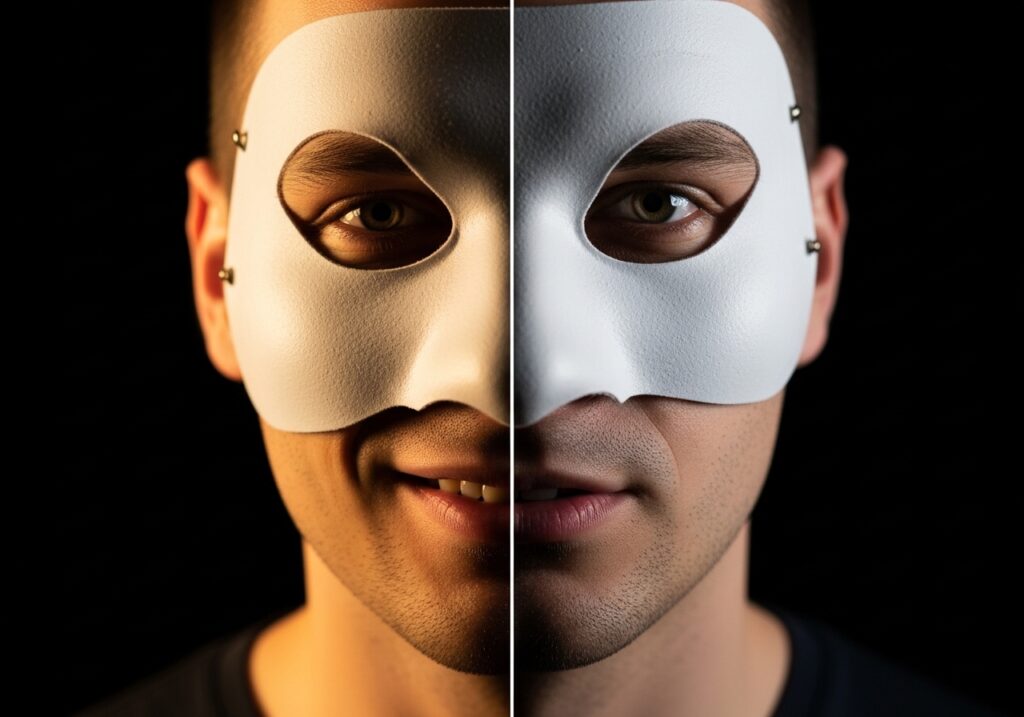
When the mask slips, what appears beneath it is often shocking in its contrast to the person you believed you knew. The sensitivity becomes contempt. The apparent humility becomes outright superiority. The gentle concern becomes overt criticism. The warmth you worked so hard to maintain becomes cold and distant in a way that no longer pretends to be about anything except punishment.
Many people in relationships with covert narcissists describe this moment as deeply disorienting — like suddenly seeing two entirely different people occupying the same body. The cognitive dissonance is extreme, because both versions have been real in their experience. The warm, perceptive, deeply feeling person was real — even if it was a construction. And the cold, contemptuous, entitled person emerging now is also real. Processing the relationship requires holding both truths simultaneously.
How to Protect Yourself — What to Watch For Early
Knowing how covert narcissists hide their red flags is only useful if it translates into things you can actually watch for — particularly in the early stages of a relationship, before the emotional investment has made clear-seeing harder.
Watch for mirroring that is too precise, too fast. When someone reflects your values, interests, and personality back at you with extraordinary accuracy very early in a relationship, ask whether you are experiencing genuine resonance or skilled performance. Genuine connection develops gradually. Instantaneous soul-mate-level understanding that arrives before two people actually know each other is worth questioning.
Notice how they handle your good news. Research on narcissism consistently identifies responses to a partner’s success as one of the most reliable early indicators. A genuinely supportive partner celebrates your wins. A covert narcissist may subtly minimize them, redirect to their own experiences, or produce a response that leaves you feeling vaguely flat after what should have been a joyful exchange.
Pay attention to how they talk about their past relationships. Covert narcissists almost universally have an explanation for why every significant past relationship ended that centers the other person’s failures and their own suffering. The pattern of being repeatedly wronged, misunderstood, or insufficiently appreciated by previous partners — with no genuine self-reflection on their own contribution — is a significant early signal.
Notice whether you feel more anxious or more at peace as the relationship progresses. In the early stages, some anxiety is normal — vulnerability is inherently uncertain. But a sustained pattern of low-grade anxiety, of always slightly bracing for something, of never feeling fully secure regardless of what they say, is your nervous system detecting something your conscious mind may not yet have named.
Watch what happens when you have a need. Not a large, demanding need — a small, reasonable one. A covert narcissist’s response to being genuinely needed — in a way that inconveniences them — will tell you more about who they are than months of carefully managed presentation.
Trust the moments of dissonance. Covert narcissists occasionally slip. A flash of contempt that disappears too quickly. A response that seems disproportionately cold for the situation. A moment where the warmth feels abruptly performative rather than genuine. Your nervous system registers these moments even when your conscious mind dismisses them. Write them down. Patterns reveal themselves in accumulation.
If You Are Already In It — What to Do Now
Perhaps you are reading this not as prevention but as recognition. Perhaps the architecture described in this article maps too precisely onto something you are already living.
If that is the case, the first thing to say is this: the confusion you feel is not a sign of weakness or stupidity. It is a sign that you have been in a relationship with someone who is specifically skilled at producing confusion — at making you doubt your perceptions, question your needs, and attribute their behavior to your own failings. The disorientation is a feature of the dynamic, not a reflection of your intelligence.
The second thing is that getting clear — genuinely, durably clear — almost always requires support outside the relationship. A therapist who understands narcissistic abuse patterns can help you separate what is real from what has been constructed, and begin the process of rebuilding the self-trust that has been systematically undermined. Friends and family who knew you before the relationship can offer a mirror that reflects a version of you that the relationship has obscured.
Document your experiences. Write down incidents as they happen, with dates and details. Covert narcissists depend on your doubt — keeping records is one of the most powerful ways to anchor yourself to your own perceptions when the gaslighting intensifies.
And begin, gently but honestly, to assess what the relationship is actually costing you. Not just the obvious things — the arguments, the withdrawal, the confusion. The subtler things. Who were you before this relationship? What did you believe about yourself? What did you do with your time and energy? What has quietly disappeared?
That audit is painful. It is also clarifying. And clarity — however uncomfortable — is the beginning of every meaningful change.

The Bottom Line — The Most Dangerous Red Flag Is the One You Cannot See
Covert narcissists hide their red flags not by eliminating them — but by burying them beneath layers of charm, apparent vulnerability, emotional intelligence, and precisely calibrated affection. By the time the flags become visible, the emotional investment is deep, the self-doubt is established, and the thought of leaving feels more disorienting than the thought of staying.
That is not an accident. It is the design.
Understanding this dynamic is not about becoming suspicious of everyone who is kind, perceptive, and emotionally available. Most people who are warm and attentive are exactly what they appear to be. But it is about developing the kind of grounded self-awareness that makes it harder to be swept away by intensity alone — and easier to trust the quiet signals that something is off, even when everything looks beautiful on the surface.
You deserve a relationship where you feel more like yourself as it deepens, not less. Where your confidence grows rather than quietly erodes. Where your needs are welcomed rather than managed. Where the warmth is consistent rather than strategically deployed.
That relationship exists. But it will not look like this one.
Know the difference. Trust yourself enough to act on what you know.
FAQ
Q: How do I know if someone is a covert narcissist or just emotionally unavailable? A: Emotional unavailability tends to be consistent and non-strategic — the person is simply limited in their capacity for intimacy and generally aware of it. Covert narcissism involves a specific pattern: strategic warmth and withdrawal, a consistent orientation toward their own needs beneath apparent sensitivity, and a relationship dynamic that systematically erodes your self-trust. The presence of gaslighting, triangulation, and manufactured self-doubt is the clearest distinction.
Q: Can a covert narcissist genuinely love their partner? A: This is one of the most painful questions in narcissism research, and the honest answer is complex. What covert narcissists feel for their partners is real — but it is more accurately described as attachment to the function the partner serves than to the partner as a full, independent person. It is love oriented toward the self rather than toward the other. It can feel like love from the inside — for both people — while producing effects that are fundamentally different from genuine, mutual care.
Q: Is covert narcissism treatable? A: With long-term, specialized psychotherapy — specifically approaches that address underlying shame and narcissistic defenses — some people with covert narcissistic patterns can develop greater genuine empathy and self-awareness. However, this requires the person to acknowledge the pattern and genuinely seek change, which is rare, because the defense structures of narcissism make self-examination extremely threatening. Change is possible but statistically uncommon.
Q: Why do I still love them even after recognizing these patterns? A: Because the person you fell in love with was real — even if the construction was strategic. The warmth, the connection, the feeling of being seen were genuine experiences, even if they were produced by manipulation. Loving someone and recognizing that the relationship is harmful to you are not mutually exclusive. The grief of that recognition is legitimate and does not have to be resolved before you can make a decision about what to do next.
Q: How long does recovery from a covert narcissistic relationship take? A: Recovery timelines vary significantly based on the length and intensity of the relationship, the individual’s support systems, and access to therapy. What research consistently shows is that recovery from narcissistic abuse takes longer than most people expect — because the damage is not just emotional but extends to self-trust, reality perception, and identity. Most clinicians suggest that meaningful recovery typically takes between one and three years of active, supported work. There is no shame in how long it takes. The wound went deep because it was designed to.
You Recognized Something in This Article. That Recognition Matters.
Whether you are reading this as prevention or as confirmation of something you have already been living — the fact that you are here means something important is happening. Trust it.
💾 Save this article right now — not just for yourself, but for the moment you need to explain to someone else what you have been experiencing and cannot find the words. This article has the words.
📤 Share it with someone whose relationship has always made you slightly uneasy — the friend who seems smaller than they used to be, the person whose confidence has quietly disappeared. One share could be the thing that finally names what they have been unable to name alone.
💬 Leave a comment below — at what point in reading this did something click? What was the moment of recognition? Your story matters here, and it may be exactly what someone else needs to read to feel less alone.
🔁 Tag someone who needs to see this — not to push them toward a decision, but to give them information they deserve to have. Awareness is the beginning of everything.
➕ Follow Truthsinside.com for more psychology-backed content on the relationship patterns that are hardest to see clearly from the inside — written with honesty, research, and genuine respect for how complicated this all really is.
📖 Read next: How to Respond When Your Partner Violates Your Boundaries — because once you name what has been happening, knowing how to respond is the next essential step.
📃 Related article: Signs He Likes You But Is Scared: 18 Behaviors Men Show When Afraid to Commit
You are not too sensitive. You are not too much. You have not been imagining it. Trust what you know.
🎵 Music
Maren Lull is a singer-songwriter who writes from the places most people don’t talk about out loud.
Not the dramatic grief. Not the obvious heartbreak. The quiet kind — the ordinary Tuesday emptiness, the habit of reaching for someone who isn’t there anymore, the particular exhaustion of being strong for so long that the strength itself wears thin.
Her music lives at the intersection of emotional honesty and soft beauty — breathy vocals over gentle piano, slow tempos, lyrics that feel less like songs and more like something you wrote in a private notebook at two in the morning and never showed anyone.
Maren Lull writes for the people who feel everything deeply and say very little about it. For the ones who listen to sad music not because they want to feel worse — but because being understood, even by a song, makes the feeling easier to carry.
📱 Follow Maren Lull:
→ Spotify
→ Apple Music
→ Youtube
→ Audiomack