
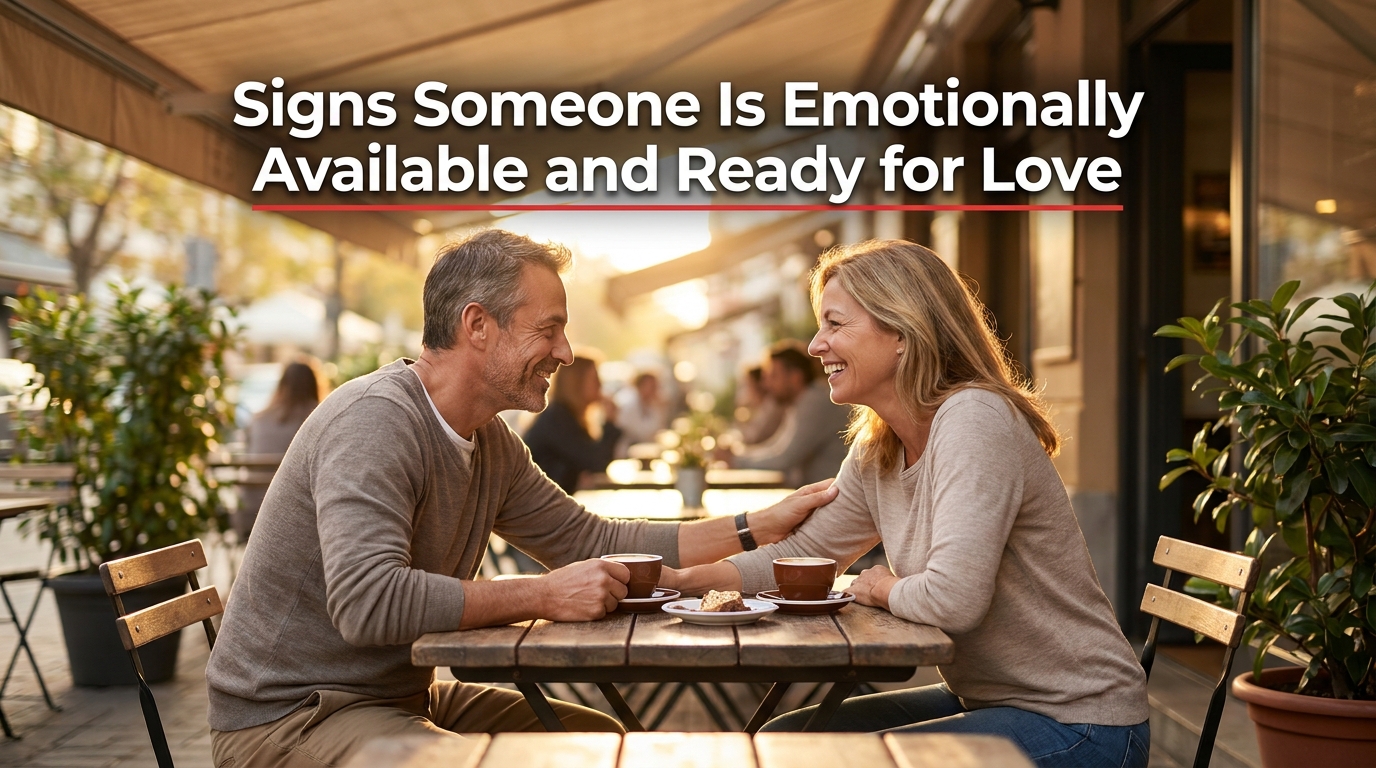
After enough almost-relationships, enough situationships, enough people who were wonderful until they were not — it becomes genuinely difficult to trust the good signs when they appear. You have learned, probably the hard way, to brace for the slow fade, the walls that go up after the first month, the moment when someone who seemed so present starts to feel like a stranger. So when someone shows up differently — calmly, consistently, with a warmth that does not flicker based on their mood or your neediness — you do not quite know what to do with it.
The signs someone is emotionally available and ready for love are not always dramatic. They are not grand declarations or perfect behavior. They are quiet, consistent patterns of presence that accumulate over time into something unmistakable — the feeling of being genuinely met by another person. Research in attachment psychology identifies emotional availability as one of the strongest predictors of relationship satisfaction and long-term partnership health. Yet most people, especially those who have spent time in emotionally unavailable dynamics, have lost their reference point for what it actually looks like.
This article is that reference point. Not a checklist to apply rigidly, but a grounded, psychology-informed guide to recognizing when someone is genuinely present — and genuinely ready — for what love actually requires.
Why Emotional Availability Is So Hard to Find — And So Hard to Recognize
Before exploring the signs, it helps to understand why emotional availability is both rarer and harder to recognize than it should be.
The first reason is that emotional unavailability is often invisible in the early stages of a relationship. The neurochemistry of early romantic connection — the dopamine, the oxytocin, the norepinephrine — produces a state of heightened focus and optimism that makes it genuinely difficult to see limitations clearly. Everyone looks more available in the first few weeks, when excitement is high and the pressure of real intimacy has not yet arrived. Emotional unavailability tends to reveal itself gradually, as the relationship deepens and the demands of genuine closeness begin to exceed what the person can comfortably offer.
The second reason is that many of us have been conditioned, through our early attachment experiences, to read emotional unavailability as normal — or even as exciting. If you grew up in an environment where love was inconsistent, unpredictable, or conditional, that pattern imprints itself as familiar. When you encounter genuine emotional availability — steady, warm, unambiguous — it can feel oddly flat in comparison. Not because there is anything wrong with it, but because it does not trigger the hypervigilant pursuit response that your nervous system learned to associate with love.
This is one of the reasons people with anxious attachment styles often describe emotionally available partners as “boring” or report that there is “no chemistry” — even when the person is genuinely wonderful. The absence of anxiety does not mean the absence of love. It means the absence of the fear that your nervous system has mistaken for excitement.
Understanding this is important because it means that recognizing the signs someone is emotionally available requires more than observation. It sometimes requires actively recalibrating your internal response system — learning to recognize security as desirable rather than dull, and consistency as romantic rather than pedestrian.

Sign 1 — They Are Consistent Without Being Prompted
The first and arguably most important sign someone is emotionally available is consistency — not perfection, but reliability. They do what they say they will do. They show up when they say they will show up. Their communication does not spike and dip dramatically based on mood, circumstance, or how much you pushed for their attention.
This consistency feels almost unremarkable when you first encounter it — and that unremarkability is the point. You are not spending emotional energy tracking their availability, bracing for a disappearance, or cataloguing evidence that they still care. They are simply there, at a relatively stable and predictable frequency, in a way that allows your nervous system to rest.
Psychologist Dr. John Gottman’s research on what he calls “turning toward” — the small, daily acts of emotional responsiveness that define the quality of a relationship — places consistency at the center of genuine partnership. Emotional availability is not primarily expressed in grand gestures. It is expressed in the ten thousand small moments when someone chooses to respond to you rather than away from you.
An emotionally available person returns your messages within a reasonable window — not because they are anxiously monitoring their phone, but because you are genuinely on their mind. They follow up on things you mentioned in passing. They remember. Not performatively — because they were actually listening.
Consistency is so ordinary that it can be easy to overlook. After a landscape of people who kept you guessing, consistent presence can feel almost too simple to be meaningful. It is not. It is the single most reliable indicator that someone is genuinely available — and genuinely interested.
Sign 2 — They Can Talk About Their Feelings Without Shutting Down or Overflowing
Emotional availability requires a specific kind of relationship with one’s own inner life — the ability to access feelings, articulate them honestly, and share them without either complete shutdown or unregulated overwhelm.
This is more nuanced than it sounds, because the extremes on either end of that spectrum are both forms of emotional unavailability. The person who cannot access or name their feelings — who responds to emotional questions with deflection, vagueness, or irritation — is unavailable in the direction of suppression. The person who is flooded by emotion constantly, who cannot engage in difficult conversations without escalation, who uses their emotional intensity to dominate rather than connect — is unavailable in the direction of dysregulation.
An emotionally available person occupies the middle ground. They are capable of saying “I have been feeling anxious about something and I want to talk through it” without either dismissing the feeling or catastrophizing around it. They can hear difficult things — your hurt, your disappointment, your needs — without becoming defensive or collapsing. They can be in an uncomfortable emotional space and stay present with it rather than fleeing.
This capacity is called emotional regulation — and research in both developmental psychology and relationship science consistently identifies it as foundational to genuine intimacy. You cannot be close to someone who cannot tolerate closeness. And closeness, at its essence, requires the ability to feel, share, and receive feelings without the process destroying the conversation.
Watch for how they handle emotional conversations — especially early ones that carry some genuine weight. Do they lean in or lean away? Do they get quieter and more present, or do they deflect with humor, change the subject, or become suddenly very busy? The answer to that question tells you more about their emotional availability than months of smooth, uncomplicated interactions.

Sign 3 — They Are Curious About You as a Whole Person
One of the quieter and more telling signs someone is emotionally available is the quality of their curiosity about you. Not the early-dating performance of interest — the questions asked because questions are expected, the attentiveness of someone making a good impression — but a genuine, sustained curiosity about who you are as a full, complex human being.
An emotionally available person asks follow-up questions. They remember things you told them weeks ago and return to them. They are interested in your interior life — your thoughts, your history, your perspective — not just your surface. They ask what you meant by something rather than assuming. They want to understand, not just to know.
This curiosity is the behavioral expression of something deeper: they see you as a separate, whole person with an interior life worth understanding. This may sound like a low bar. In practice, it is not. Many people in relationships experience being known only partially — as a role, as a function, as a source of particular things they need — rather than as a full person with a rich interior world that extends in every direction.
Emotional availability requires the ability to hold another person’s full complexity — their contradictions, their growth, their changing needs — without reducing them to something simpler and easier to manage. The emotionally available person is not falling in love with an idea of you. They are falling in love with the actual, specific, sometimes-inconvenient reality of you. And their curiosity is how they keep learning it.
Sign 4 — They Communicate Directly — Without Games or Guessing
After encounters with emotionally unavailable people, direct communication can feel almost startling. You ask if something is wrong, and they tell you honestly what is wrong. You express a need, and they respond to the need rather than the fact that you had one. You ask what they want, and they say what they want — not what they think you want to hear, not a performance of flexibility, not a deflection designed to avoid commitment to any position.
This directness is a sign of emotional availability because it requires self-awareness — you have to know what you feel and think in order to express it — and emotional security — you have to feel safe enough in the relationship to say something true, even if it is not perfectly received.
Emotionally available people do not play games with communication. Not because they are incapable of strategic thinking, but because they have no need to — they are not trying to manage your attachment or maintain power through ambiguity. They can say “I like you and I want to keep seeing you” without worrying that the vulnerability will be used against them. They can say “that hurt me” without it becoming a weapon or a performance.
“Directness in communication is not just a personality style. It is a form of respect — the implicit message that you believe the other person can handle the truth of what you actually think and feel.”
Watch especially for how they handle situations that carry some relational risk — moments where honesty might be uncomfortable. Do they say the real thing, or do they say the safe thing? The emotionally available person says the real thing, because they have enough internal security to tolerate the uncertainty of how it might be received.

Sign 5 — They Have a Life Outside the Relationship — And They Want You to Have One Too
This sign tends to surprise people when they first encounter it, because after experiences of emotional unavailability — where partners were either smothering or absent — a partner who actively encourages your independence can feel counterintuitive. Surely someone who loves you wants to be with you as much as possible?
Genuine emotional availability includes what relationship researchers call differentiation — the capacity to remain a distinct individual within a close relationship, and to support your partner’s distinctness as well. An emotionally available person has their own friendships, their own interests, their own commitments and goals. They do not expect you to become the entirety of their social and emotional world. And they do not expect to become yours.
This health looks specific in practice. They are genuinely happy when you spend time with your friends — not performatively accepting of it, but actually glad for you. They pursue their own interests without guilt or the expectation that you should be managing their time. They do not monitor your whereabouts or express anxiety about your independent activities. They trust you — and they trust themselves enough to know that your separateness does not threaten your connection.
This is particularly important because enmeshment — the collapse of individual identity into couple identity — is one of the most common relationship patterns that feels like love and functions like suffocation. The emotionally available person knows the difference between togetherness and merger. They want the former and understand that the latter, over time, diminishes both people.
Their independent life is not a sign of disinterest. It is a sign of security. And security in a partner — genuine, non-anxious, non-possessive security — is one of the most important things you can find in another person.
Sign 6 — They Handle Conflict Without Attacking or Disappearing
How someone behaves during conflict is one of the most reliable windows into their emotional availability — because conflict is precisely the moment when emotional regulation, self-awareness, and genuine care for the relationship are most clearly tested.
Emotionally unavailable people tend toward one of two extremes in conflict: they attack or they disappear. The attacker becomes defensive, critical, contemptuous, or dominating — turning the conflict into a contest to be won rather than a problem to be understood. The disappear-er goes cold, withdraws, stonewalls, or physically removes themselves from the conversation without resolution — leaving their partner in the particular anguish of an unfinished fight.
An emotionally available person does neither. They stay in the conversation. Not perfectly — they may need to take a breath, ask for a short pause to regulate before continuing, or acknowledge that they are feeling flooded. But they come back. They engage with the substance of what is happening rather than deflecting into attacks on character or retreating into total silence.
They can hear that they hurt you without treating your hurt as an accusation requiring immediate defense. They can say “you are right, and I am sorry” when they are wrong — not as a capitulation, but as the honest recognition of someone who values the relationship more than they value being correct. They can disagree without contempt, and they can repair without drama.
Research by Dr. John Gottman identifies the presence of repair attempts — small gestures or statements designed to de-escalate conflict and restore connection — as one of the strongest predictors of long-term relationship health. An emotionally available person makes repair attempts naturally, because the relationship matters more to them than the argument.

Sign 7 — Their Past Is Something They Have Processed, Not Buried or Weaponized
Everyone has a past. Everyone brings history — wounds, patterns, stories — into a new relationship. The question that matters is not whether someone has been hurt before. It is what they have done with that hurt.
An emotionally available person has done some degree of genuine work on their history. Not perfectly — no one is entirely resolved — but they have the self-awareness to understand their patterns, to recognize where their history is coloring their present experience, and to communicate about it without deploying it as justification for harmful behavior.
They can talk about a difficult past relationship without it becoming a performance of unresolved trauma that you are now expected to manage. They do not use their wounds as explanations that excuse current behavior. They do not punish you for what someone else did to them — or if they catch themselves doing it, they acknowledge it and take responsibility.
This is a crucial distinction: the emotionally available person treats their past as context, not as an ongoing crisis. They have grieved, or are actively grieving, what needs to be grieved. They are not asking you to love them back to wholeness — because wholeness is not something you can give another person. They are bringing a self that is, however imperfectly, doing its own work.
“An emotionally available person does not hand you their healing and ask you to complete it. They show up having already done — and continuing to do — the work themselves.”
This does not mean they need to be fully resolved, fully unburdened, or finished with growth before they can love well. It means they are oriented toward their own growth — that they see self-awareness and healing as their own responsibility, not something they outsource to a partner.
Sign 8 — They Make You Feel Secure, Not Intermittently Relieved
This sign lives in your body as much as your mind — and it is perhaps the most important one on this list, because it is the one you cannot fake your way into recognizing.
When you are with an emotionally unavailable person, your resting emotional state is a kind of vigilance. You are monitoring. You are reading signals. You feel relief when things are good — but relief is not the same as security. Relief is what you feel when something bad did not happen. Security is a different experience entirely.
With an emotionally available person, the baseline shifts. You are not bracing. You are not analyzing the most recent interaction for signs that something has changed. You trust, at a relatively deep level, that they want to be there — not because they have said it once in a romantic moment, but because their consistent behavior has established it as a reliable fact of your shared experience.
This security does not make the relationship unexciting. It makes it livable. It creates the kind of emotional space in which genuine intimacy — the kind where you can be fully known, fully seen, sometimes fully wrong — becomes possible. Because you cannot be truly vulnerable with someone whose next move you are constantly trying to predict.
Pay attention to how you feel in the hours and days between seeing this person. Not the longing — that is normal in early connection. But the quality beneath the longing. Is there a baseline of ease, of trust, of confidence that they are there? Or is there a baseline of anxiety, of monitoring, of waiting for the other shoe?
That baseline tells you almost everything you need to know.

What to Do With This Information — Using These Signs Practically
Reading a list of signs is useful. Knowing how to apply them — especially when the early-relationship neurochemistry is working against clear-seeing — requires something more intentional.
The most important thing to remember is that none of these signs should be assessed in a single interaction or a single week. Emotional availability is a pattern, and patterns require time to reveal themselves. The purpose of this list is not to evaluate someone after a first date — it is to give you a framework for observation over the weeks and months of early connection, before your emotional investment makes re-evaluation more difficult.
Notice which signs you are able to confirm through experience, and which you are still taking on faith. An emotionally available person will give you enough real experience — enough consistency, enough honest conversation, enough genuine presence — that you will not have to take much on faith. They will show you who they are. Your job is to let what they show you be your guide — not what you hope, not what they occasionally promise, but what their behavior reliably demonstrates.
Notice also your own response. If you are finding the consistency boring, or if the directness feels unfamiliar in a way that registers as a lack of chemistry, pay attention to that response without immediately trusting it. It may be your attachment system recalibrating — learning that security does not feel like the anxiety it has previously mistaken for love. Give yourself time in that unfamiliarity before you decide it means something.
And finally: recognize that you can only receive what you are also capable of offering. Emotional availability is not just something to look for in another person — it is something to cultivate in yourself. The clearest, most grounded path to finding an emotionally available partner is to become one. To do your own work. To build your own security. To show up in the ways you hope to be shown up for.
That work changes not just who you attract — it changes what you recognize as worth staying for.
The Bottom Line — Stop Mistaking Potential for Presence
For a long time, you may have been reading potential as a sign. Potential that they could open up, potential that they could be consistent, potential that they could love you the way you need to be loved — if only you were patient enough, present enough, giving enough for long enough.
The signs someone is emotionally available are not potential. They are presence. Actual, observable, consistently demonstrated behavior that tells you, without ambiguity, that this person is capable of and willing to show up for the full reality of what love requires.
You do not have to earn this. You do not have to be more convenient, less needy, or more impressive than you already are. The right person will not need you to be a more manageable version of yourself. They will show up for the actual version — with enough curiosity, enough security, and enough genuine warmth that being known feels like a relief instead of a risk.
That person exists. These signs will help you recognize them when they arrive.
Stop settling for almost. Start recognizing enough.
FAQ
Q: What is the difference between emotional availability and emotional intensity? A: Emotional intensity — deep feelings, strong chemistry, passionate connection — is not the same as emotional availability. Intensity is about the height of feeling. Availability is about the consistency, the regulation, and the sustained capacity for genuine intimacy over time. Some of the most intensely felt connections have been with emotionally unavailable people. The presence of strong feeling does not guarantee the presence of the qualities that make a relationship sustainable.
Q: Can someone become emotionally available if they were not when you met? A: Yes — people grow, and emotional availability can be developed through self-awareness, therapy, and conscious effort. But this development has to be driven by the person themselves, not by your patience or love. The question to ask is not “could they become available” but “are they actively working toward it, and is the current dynamic sustainable while they do?”
Q: How long does it take to know if someone is genuinely emotionally available? A: Most relationship psychologists suggest that the early neurochemical stage of romantic connection — which can mask genuine personality patterns — lasts approximately three to six months. Emotional availability becomes clearest when the initial excitement stabilizes and the real demands of intimacy arrive. Patterns of consistency, conflict behavior, and emotional communication are most reliably assessed after this initial stage.
Q: What if I am emotionally unavailable myself — can I still recognize these signs? A: Yes, and recognizing these signs can actually be part of your own growth process. Understanding what emotional availability looks like — and noticing your own responses to it — can reveal a great deal about your own patterns. If you consistently find yourself uninterested in people who display these signs, that is worth exploring, ideally with a therapist, as it may reflect your own attachment system’s relationship with safety.
Q: Is emotional availability the same as being “ready” for a relationship? A: They are closely related but not identical. Being ready for a relationship also involves practical circumstances — life stability, the completion of a grieving process after a previous relationship, intentionality about what you are looking for. Emotional availability is the internal capacity; readiness includes both that capacity and the external and intentional conditions that support it. Someone can be emotionally available but not yet ready — though in most cases, genuine availability and genuine readiness tend to arrive together.
You Now Know What to Look For — Trust It
This list exists because you deserve more than guessing. More than hoping. More than a relationship that keeps you on your toes in the wrong way.
💾 Save this article and use it as your actual reference the next time someone new enters your life. Screenshot it. Bookmark it. Come back to it when the chemistry is high and the clarity is low.
📤 Share it with someone who keeps falling for potential instead of presence — who sees the best version of someone and builds a life on the possibility of it. This article is for them.
💬 Tell us in the comments — which sign resonated most with you, and which one do you find hardest to find in the people you meet? Real conversation happens here, and your experience matters.
🔁 Tag someone who is currently dating and needs a clear framework for what to actually look for — not red flags for once, but the real green ones. This might be the most useful thing you send them this week.
➕ Follow Truthsinside.com for Signs & Signals content that gives you the tools to see clearly — in a world that makes seeing clearly very, very hard.
📖 Read next: Signs Someone Is Breadcrumbing You — because knowing what emotional availability looks like is most useful when you also know exactly what unavailability looks like in its most deceptive form.
📃 Related article: Signs He Likes You But Is Scared: 18 Behaviors Men Show When Afraid to Commit
Consistency is not boring. Security is not flat. Being genuinely chosen is what love is supposed to feel like — and you deserve to feel it.
🎵 Music
Maren Lull is a singer-songwriter who writes from the places most people don’t talk about out loud.
Not the dramatic grief. Not the obvious heartbreak. The quiet kind — the ordinary Tuesday emptiness, the habit of reaching for someone who isn’t there anymore, the particular exhaustion of being strong for so long that the strength itself wears thin.
Her music lives at the intersection of emotional honesty and soft beauty — breathy vocals over gentle piano, slow tempos, lyrics that feel less like songs and more like something you wrote in a private notebook at two in the morning and never showed anyone.
Maren Lull writes for the people who feel everything deeply and say very little about it. For the ones who listen to sad music not because they want to feel worse — but because being understood, even by a song, makes the feeling easier to carry.
📱 Follow Maren Lull:
→ Spotify
→ Apple Music
→ Youtube
→ Audiomack