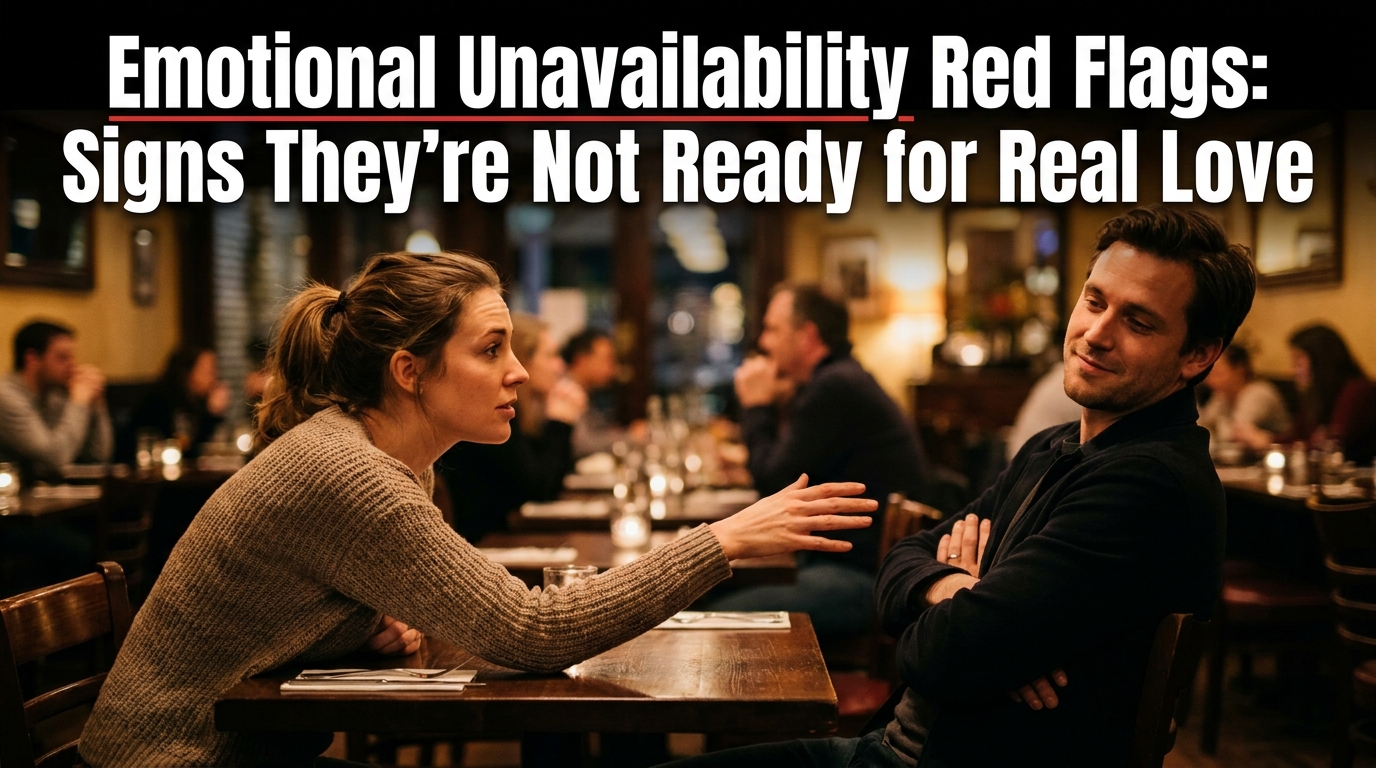
They were charming, engaging, even vulnerable in those early conversations. They said things that made you feel genuinely seen. They showed up — for a while — in ways that felt promising and real. And then, somewhere between the beginning and now, something shifted. The connection you felt stopped deepening. The conversations stayed on the surface. Every attempt to get closer was met with a subtle but unmistakable pulling back. And you have been left in the particular confusion of someone who can feel a wall but cannot find the door.
Emotional unavailability red flags are among the most important relationship signals to recognize early — because by the time the pattern becomes undeniable, the emotional investment has usually grown large enough to make clear-seeing genuinely difficult. Research in attachment psychology identifies emotional unavailability as one of the primary mechanisms behind failed relationships that began with genuine promise — not because the feelings were not real, but because one person was structurally unable to offer what genuine intimacy requires. A 2019 study published in the Journal of Personality and Social Psychology found that individuals with avoidant attachment patterns — the psychological foundation of most emotional unavailability — consistently underestimate their partners’ needs and overestimate the threat that closeness poses to their autonomy.
This article will give you every significant emotional unavailability red flag — what it looks like, what it means psychologically, and why it matters for the trajectory of the relationship you are trying to build.
What Emotional Unavailability Actually Is — And What It Is Not
Before the red flags, the definition — because emotional unavailability is one of the most commonly used and least precisely defined terms in popular relationship psychology.
Emotional unavailability is not introversion. A person can be quiet, private, and reserved — and still be genuinely emotionally present, responsive, and capable of deep intimacy. Introversion describes how someone processes social energy. Emotional unavailability describes how someone relates to intimacy and emotional closeness — and the two are entirely independent.
Emotional unavailability is not having a difficult week, going through a hard season, or being temporarily overwhelmed by work, grief, or stress. Everyone experiences periods of reduced emotional bandwidth. Genuine emotional unavailability is structural, not situational. It is a consistent orientation away from intimacy — a pattern that persists across time, circumstances, and emotional conditions.
Emotional unavailability is not necessarily conscious or malicious. Many emotionally unavailable people are not deliberately withholding. They are operating from deeply ingrained patterns — usually rooted in early attachment experiences where emotional closeness was associated with pain, loss, or inadequacy. They may genuinely want connection while being systematically unable to tolerate its full weight. That does not make them bad people. But it does make them, at this point in their development, genuinely limited as partners for someone who needs real intimacy.
At its core, emotional unavailability is the inability or unwillingness to be consistently, reliably present — emotionally responsive, genuinely vulnerable, and fully engaged in the relationship in a way that makes deep, sustained intimacy possible.
Understanding what it is — and is not — makes the red flags that follow easier to identify accurately.

Red Flag 1 — They Are Intensely Present Early, Then Progressively Distant
One of the most consistent and psychologically significant emotional unavailability red flags is a specific arc of engagement: intense, promising presence at the beginning that progressively gives way to emotional withdrawal as the relationship deepens and intimacy increases.
This pattern is not random. It is the direct behavioral expression of what attachment researchers describe as approach-avoidance conflict — a genuine desire for connection combined with an equally genuine terror of it. In the early stages of a relationship, when things are still surface-level and the threat of real intimacy has not yet arrived, the emotionally unavailable person can be extraordinarily engaging. There is genuine interest. There is warmth. There is what feels like real chemistry.
But as the relationship progresses — as deeper knowing becomes available, as vulnerability is invited, as the emotional stakes increase — the avoidant nervous system begins to register closeness as threat. And the response to threat, for the avoidantly attached person, is distance. The warmth cools. The communication thins. The person who was so present begins to feel like they are perpetually slightly somewhere else.
What makes this red flag particularly painful is that you have direct experience of who they can be — because they showed you in the beginning. The contrast between that person and the one retreating now is what keeps you in the dynamic, reaching for the version of them you know exists. That contrast is not evidence that they are choosing to withhold. It is evidence of the conflict at the center of their relationship with intimacy.
Watch the trajectory, not just the moment. A person who is genuinely available becomes more present as the relationship deepens. A person who is emotionally unavailable becomes less so — not because of what you have done, but because of what closeness activates in them.
Red Flag 2 — They Consistently Deflect Emotional Conversations
Every relationship reaches moments that require genuine emotional depth — conversations about needs, feelings, fears, the future, or the state of the relationship itself. These conversations are not tests or demands. They are the building material of real intimacy.
An emotionally unavailable person meets these conversations with consistent deflection. The deflection is rarely confrontational — it is smooth, often barely noticeable. They change the subject with a joke. They answer a question about their feelings with a statement about their opinions. They redirect the conversation to something practical, intellectual, or light whenever it begins to require genuine emotional exposure.
They are often quite skilled at making you feel that the conversation has happened when it has not. You came into the conversation wanting to discuss whether you both see a future together. You leave having talked around it for an hour without arriving anywhere. And you cannot quite identify the moment it went sideways.
This deflection is not always strategic — it is often reflexive. The emotionally unavailable person does not necessarily know they are doing it. What they know is that emotional conversations produce a particular internal discomfort — a tightness, a sense of being crowded, a desire to be elsewhere — and that deflection relieves that discomfort.
The result for their partner is a slow, cumulative frustration. Not the clean frustration of a clear conflict, but the murkier dissatisfaction of always feeling like you are on the edge of something real and never quite arriving there. Of conversations that circle without landing. Of closeness that approaches and then dissolves.
“With an emotionally unavailable person, you do not fight for the relationship. You wait for it — and waiting, dressed up as patience, becomes its own kind of pain.”

Red Flag 3 — Their Vulnerability Has a Ceiling
Genuine intimacy requires mutual vulnerability — the capacity to be known imperfectly, to share things that are uncomfortable, to let another person see the parts of yourself that are still unresolved, still tender, still works in progress.
An emotionally unavailable person has a ceiling on their vulnerability. They can share up to a certain depth — often a significant depth, particularly in the early stages of connection — but there is a point beyond which they will not go. A line they will not cross. A version of themselves they will not allow to be fully seen.
This ceiling is not always obvious. Emotionally unavailable people are often quite articulate about their past — they can describe difficult experiences from their history with a fluency that creates the impression of real openness. But there is a difference between narrating the past and being vulnerable in the present. They can tell you what happened to them ten years ago. They cannot tell you what they need from you today.
Watch for the asymmetry. Are they comfortable with your vulnerability — receiving it, responding to it, holding space for it — but noticeably less forthcoming with their own? Do their disclosures feel like they are moving toward you, or do they feel more like managed performances of openness that create the appearance of intimacy without the full reality of it?
Genuine vulnerability has a particular quality: it is slightly uncomfortable for the person sharing it. It involves some real risk of exposure. When someone’s vulnerability always feels polished, controlled, and perfectly timed — when it never costs them anything — what you may be seeing is not true openness but the performance of it.
Red Flag 4 — They Cannot Tolerate Your Emotional Needs
This red flag is one of the most telling — and one of the most frequently rationalized by people who are invested in the relationship.
An emotionally unavailable person struggles, at a structural level, with their partner having emotional needs. Not dramatic, unreasonable demands — just ordinary human needs. The need to be reassured when you are anxious. The need to process something out loud. The need for comfort when you are having a hard day. The need to feel that your emotional experience matters to the person who is supposed to care about you most.
These needs produce a specific response in the emotionally unavailable person. It might be impatience — a barely concealed irritation when emotional conversations arise, a sense that they are being asked to perform a function they find exhausting. It might be fixing — the reflexive move toward solutions when you need presence, because problem-solving is manageable and emotional attunement is not. It might be withdrawal — becoming less available precisely when you need them most, leaving you alone with your emotional experience in the specific loneliness of having a partner who cannot show up for it.
Over time, this pattern produces a particular kind of adaptation in their partners: the progressive suppression of emotional needs. You learn, through small repeated experiences, that needing things produces a negative response. And so you need less — or you learn to need things in smaller, more acceptable doses, or you stop bringing your emotional life into the relationship at all.
That adaptation is one of the most costly things a relationship can ask of you. Because your emotional life does not disappear when you stop expressing it. It just finds nowhere to go.

Red Flag 5 — They Keep the Future Vague and Undefined
A person who is emotionally available and genuinely invested in a relationship has a natural orientation toward the future — not as pressure or demand, but as the organic expression of someone who wants this thing to continue and grow.
An emotionally unavailable person maintains the future as vague and undefined — not necessarily because they are dishonest about their feelings, but because committing to a concrete future requires a level of emotional investment that their avoidant system finds threatening.
This vagueness has a particular texture. They are warm in the present — engaged, affectionate, apparently invested — but consistently unclear about what this is building toward. Questions about the future are met with generalities. “I really value what we have.” “I’m not really a planner.” “Let’s just see where things go.” These statements are not lies. But they are also not the kind of directness that allows another person to make informed decisions about their own emotional investment.
They may also demonstrate a pattern that relationship researchers sometimes call future faking — moments of specific, enthusiastic talk about future plans — trips together, things they want to show you, experiences they want to share — that never materialize. The future talk feels real in the moment. The follow-through is consistently absent.
For their partner, this vagueness produces a specific and exhausting uncertainty. You cannot make decisions about your own life clearly because the shape of the relationship is never defined clearly enough to plan around. You cannot assess whether your needs will be met long-term because long-term is never explicitly acknowledged. You exist in a perpetual present that feels almost — but never quite — like a real commitment.
Red Flag 6 — Conflict Causes Them to Shut Down or Disappear
How a person handles conflict is one of the most reliable indicators of their emotional availability — because conflict, by its nature, requires the capacity to remain emotionally present when things are uncomfortable, to hear criticism or hurt without collapsing or attacking, and to repair the connection afterward.
An emotionally unavailable person typically handles conflict through one of two avoidant strategies: shutdown or disappearance.
Shutdown looks like a sudden, comprehensive emotional withdrawal. The conversation is not resolved — it is simply ended, through silence, monosyllabic responses, or a physical stillness that communicates that they are no longer accessible. They do not storm off or escalate — they simply go somewhere internal that you cannot reach. And they may stay there for hours, sometimes days, leaving you in the particular anguish of an unfinished conflict with a partner who is present but completely unavailable.
Disappearance is the more physical version — they leave the space, go silent on their phone, become busy in ways that were not pressing moments before the conflict emerged. The message is not explicit, but it is clear: this discomfort is yours to sit with alone.
Both strategies have the same function: they protect the emotionally unavailable person from the discomfort of genuine conflict by removing themselves from it. And they have the same impact on their partner: the person who had a legitimate concern or hurt is now also managing the absence of their partner, which effectively ends any real possibility of resolution.
“Emotional unavailability is not just about what someone cannot give you. It is about what happens to your own needs when the person who should meet them consistently makes themselves unreachable.”
What is particularly damaging over time is what this pattern teaches the other person about conflict. When raising a concern reliably produces shutdown or disappearance, the rational adaptation is to stop raising concerns. And when concerns stop being raised, the relationship stops growing — because growth in relationships almost always emerges from the honest navigation of difference and difficulty.

Red Flag 7 — They Minimize Your Feelings Without Realizing It
There is a specific pattern that emerges in relationships with emotionally unavailable people that is less dramatic than gaslighting but equally corrosive over time: the consistent, reflexive minimization of their partner’s emotional experience.
This minimization is rarely malicious. It emerges from the emotionally unavailable person’s own discomfort with strong feeling — their own and others’. When your feelings are large or inconvenient, the instinctive response is to reduce them to something more manageable. “You’re overthinking it.” “It’s really not that big a deal.” “Why do you always make everything so emotional?” “You’re being too sensitive.”
Each of these statements, delivered consistently enough, accomplishes something deeply harmful: it teaches you to distrust your own emotional experience. Your feelings become problems to be managed rather than information to be received. And the relationship — which should be a space where your interior life is welcomed — becomes a space where you edit yourself before speaking.
The cumulative impact is a particular kind of self-doubt that extends beyond the relationship. People who have been in long relationships with emotionally unavailable partners frequently report that they lost confidence in their own emotional perceptions — that they stopped trusting their feelings as legitimate guides to their experience. That loss of self-trust is one of the most significant and longest-lasting costs of emotional unavailability in a partner.
Red Flag 8 — Intimacy Increases Their Distance, Not Their Closeness
This is perhaps the most defining behavioral signature of emotional unavailability, and it is one that becomes most visible across the arc of the relationship rather than in any single moment.
With most people, genuine intimacy — real knowing, real being known, real shared vulnerability — deepens connection. The more two people truly know each other, the more invested they become. The more they share, the closer they feel. Closeness produces more closeness.
With an emotionally unavailable person, the relationship between intimacy and distance is inverted. The closer the relationship gets, the more the avoidant nervous system activates its protective responses. The more deeply you know each other, the more the emotionally unavailable person feels the weight of that knowing — and the more urgently they need to create distance to restore their sense of safety and autonomy.
This inversion produces a profoundly disorienting experience for their partner. You are doing what you believe love requires — being present, being vulnerable, seeking genuine closeness — and the result is the opposite of what you expect. Each step toward genuine intimacy is followed by a step back on their part. Each moment of real connection is followed by a withdrawal that makes you question whether the connection was real at all.
It was. The connection is not the problem. The availability is.
Red Flag 9 — They Tell You They Are Not Ready — And You Do Not Listen
This last red flag is different from the others — because it is about the words that are actually spoken, plainly, often at the very beginning, and the way those words are heard and processed.
Emotionally unavailable people frequently tell the truth about themselves — early, directly, and with more honesty than they receive credit for. “I’m not really good at this stuff.” “I’ve been told I’m emotionally closed off.” “I don’t really do serious relationships.” “I’m not in a place for anything heavy right now.” “I tend to pull away when things get real.”
These are not always self-deprecating performances designed to lower expectations. Many of them are genuine attempts at honest communication — a person trying to tell you, clearly, what they are capable of offering. The problem is not the communication. The problem is that when someone is charming, warm, and compelling in every other way, these statements get filtered through hope rather than received as information.
You hear “I’m not good at this” and translate it, unconsciously, to “not good at this yet.” You hear “I tend to pull away” and believe that with the right person — with you — it will be different. You hear the warning and decide, on some level, that it does not apply to your situation.
Relationship psychology is consistent on this point: when people tell you clearly who they are at the start of a relationship, the most respectful and self-protective thing you can do is believe them. Not because people cannot grow and change — they can — but because growth requires a person’s own decision and their own sustained effort, not your faith in their potential.
Believing what someone tells you about themselves is not pessimism. It is the foundation of a relationship built on reality rather than projection.

Why Emotionally Unavailable People Are So Easy to Fall For
Understanding the emotional unavailability red flags is important. Understanding why they are so consistently overlooked — even by perceptive, self-aware people — is equally important.
The first reason is the intermittent reinforcement that emotional unavailability naturally produces. Because their warmth and presence are inconsistent, the moments when they are fully engaged feel extraordinary — not because those moments are objectively superior to what a consistently available person offers, but because they are rare. The dopamine system responds to unpredictability with heightened attention and intensified pursuit. You do not just want those good moments. You begin to crave them.
The second reason is the common human tendency to mistake what is challenging for what is worthwhile. A partner who requires work — who is complicated, guarded, inconsistent — can feel more significant than one who is simply, clearly, consistently present. This is not a character flaw. It is a pattern frequently rooted in early experiences where love was conditional or hard to access, making the pursuit of difficult love feel like the right shape of love.
The third reason is their genuine appeal. Emotionally unavailable people are often genuinely interesting, intelligent, and compelling. The same depth that makes full emotional presence difficult in them also makes them complex and engaging in ways that can feel rare. They are often not wrong about the connection that exists — they simply cannot sustain the presence that would let it fully become what it could be.
And the fourth reason is something attachment researchers call the anxious-avoidant trap: the specific, painful dynamic in which an anxiously attached person — one whose fear of abandonment produces a heightened need for reassurance — and an avoidantly attached person — one whose fear of engulfment produces a pull toward distance — find each other extraordinarily compelling. The avoidant’s distance activates the anxious person’s pursuit system. The anxious person’s pursuit activates the avoidant’s withdrawal system. Both cycles reinforce each other, and the dynamic becomes both deeply painful and extraordinarily difficult to leave.
What to Do When You Recognize These Red Flags
Recognition is the beginning, not the resolution. Seeing these red flags clearly does not automatically tell you what to do next — but it does give you a foundation for making more honest, more self-respecting decisions about the relationship you are in.
The first step is to name what you have observed — to yourself, honestly, without the filters of hope or rationalization. Not “they struggle to communicate sometimes” but “I have consistently been unable to get emotional presence from this person, and the pattern has continued despite clear communication about my needs.” The specificity of honest naming is where clarity begins.
The second step is a direct, honest conversation — not as an ultimatum, but as a genuine expression of what you need and what you have experienced. Some emotionally unavailable people, when confronted clearly and compassionately with the impact of their patterns, can access genuine self-awareness and genuine motivation to change. Others cannot — or will not. The response to that conversation is your most important data point.
The third step is to watch behavior, not words. An emotionally unavailable person who is genuinely working on their availability will demonstrate it through sustained behavioral change — not perfection, but direction. Therapy, visible effort, the willingness to stay in uncomfortable conversations rather than deflect or disappear. Words without behavioral change are not evidence of growth. They are evidence of management.
And the fourth step — the hardest one — is to make a decision that is grounded in who they have actually demonstrated themselves to be, rather than who you believe they could become. Potential is real. But potential that requires someone else’s sustained suffering to eventually actualize is not a foundation for a healthy relationship. It is a transaction — one in which you pay, repeatedly and in advance, for something that may never arrive.
You deserve emotional presence — not as an aspiration, not as an occasional reward, but as the consistent, reliable baseline of the relationship you choose to invest your life in.
The Bottom Line — Emotional Unavailability Is Not Something Love Can Fix
Perhaps the most important truth embedded in the psychology of emotional unavailability is this: it is not a problem that more love, more patience, or more perfect behavior from a partner can solve. It is an internal limitation — rooted in attachment patterns, personal history, and a relationship with closeness that was formed long before you arrived — and it can only change through the person’s own sustained and genuine work on themselves.
You cannot love someone into emotional availability. You can only love someone who has chosen, through their own effort and willingness, to become more available than they were. Those are fundamentally different relationships — and learning to tell them apart is one of the most important skills in navigating love honestly.
The emotional unavailability red flags in this article are not reasons to abandon every relationship that shows complexity or difficulty. They are a framework for seeing clearly — for distinguishing between someone who is genuinely working toward presence and someone who is simply not there yet in a way that may not change.
You deserve someone who shows up — not perfectly, not without their own wounds and growth edges, but consistently, reliably, and with genuine effort to meet you in the places that matter most.
That is not too much to want. It is exactly enough.
FAQ
Q: Can an emotionally unavailable person change? A: Yes — but only through their own sustained effort, usually including therapy, and only when they have genuinely recognized the pattern and are motivated to change it for themselves rather than to keep a specific relationship. Change driven by fear of losing someone tends to produce temporary behavioral adjustment rather than genuine development. The question to ask is not whether change is possible but whether it is actually happening — demonstrated through behavior, not promised through words.
Q: Is emotional unavailability the same as avoidant attachment? A: They are closely related. Avoidant attachment — the psychological pattern in which closeness is experienced as threatening and independence is prioritized as protection — is the most common underlying structure of emotional unavailability. Not all emotionally unavailable people have a fully avoidant attachment style, and avoidant attachment exists on a spectrum, but the behavioral signatures of emotional unavailability and avoidant attachment overlap significantly.
Q: What if I am the emotionally unavailable one? A: Recognizing this in yourself is genuinely significant — most emotionally unavailable people lack this self-awareness. If you identify with the patterns described in this article, individual therapy — particularly approaches that work with attachment, such as Emotionally Focused Therapy or schema therapy — can be transformative. The patterns of emotional unavailability are not permanent character traits. They are adaptations formed in response to early experiences, and they can be unlearned with genuine effort and the right support.
Q: How long should I wait for an emotionally unavailable partner to become available? A: There is no universal answer, but a useful framework: if you have communicated your needs clearly, if you have had honest conversations about the pattern, and if you have not seen sustained behavioral change over a period of three to six months, you have sufficient information to make a decision. Waiting indefinitely for someone to become ready is not patience — it is the sacrifice of your own time and emotional wellbeing on the hope of a change that may not come.
Q: Can an emotionally unavailable person have a successful long-term relationship? A: Yes — particularly if they are aware of their patterns, actively working on them, and partnered with someone who has a compatible attachment style and sufficient security to tolerate some degree of emotional independence in their partner. The most difficult dynamic is when an avoidantly attached person is partnered with an anxiously attached person — the anxious-avoidant trap — as both people’s patterns tend to intensify in response to each other. With self-awareness on both sides, the patterns can be worked with rather than simply endured.
If Something in This Article Named What You Have Been Living — Trust That Recognition
You did not get here by accident. Something in your experience made you look for this. That something is worth listening to.
💾 Save this article — not just for now, but for the future moment when you find yourself rationalizing the same pattern with a different person. Come back to it. Let it be the thing that helps you see clearly before the investment grows.
📤 Share it with someone you know who is deeply invested in a person who keeps almost showing up. Sometimes naming the pattern for someone else gives them the language they have been missing — and language is where change begins.
💬 Leave a comment below — which red flag on this list did you recognize most immediately? The one that made you pause, put the phone down, and sit with something for a moment? Real conversation happens in this community, and your experience matters here.
🔁 Tag someone who needs to read this — not to call out their relationship, but to give them the information that lets them make a real, informed decision about what they are building and with whom.
➕ Follow Truthsinside.com for Red Flags content that does not deal in surface-level warning signs — only the deep, psychology-grounded patterns that actually shape the quality of your relationships and your life.
📖 Read next: Signs Someone Is Emotionally Available and Ready for Love — because after learning what emotional unavailability looks like, knowing exactly what the opposite looks like is the most useful thing you can carry forward.
📃 Related article: Gaslighting in Relationships: How to Recognize, Name, and Leave It
You are not asking for too much. You are asking from someone who does not have it to give. Those are different problems — and only one of them is yours to solve.
🎵 Music
Maren Lull is a singer-songwriter who writes from the places most people don’t talk about out loud.
Not the dramatic grief. Not the obvious heartbreak. The quiet kind — the ordinary Tuesday emptiness, the habit of reaching for someone who isn’t there anymore, the particular exhaustion of being strong for so long that the strength itself wears thin.
Her music lives at the intersection of emotional honesty and soft beauty — breathy vocals over gentle piano, slow tempos, lyrics that feel less like songs and more like something you wrote in a private notebook at two in the morning and never showed anyone.
Maren Lull writes for the people who feel everything deeply and say very little about it. For the ones who listen to sad music not because they want to feel worse — but because being understood, even by a song, makes the feeling easier to carry.
📱 Follow Maren Lull:
→ Spotify
→ Apple Music
→ Youtube
→ Audiomack