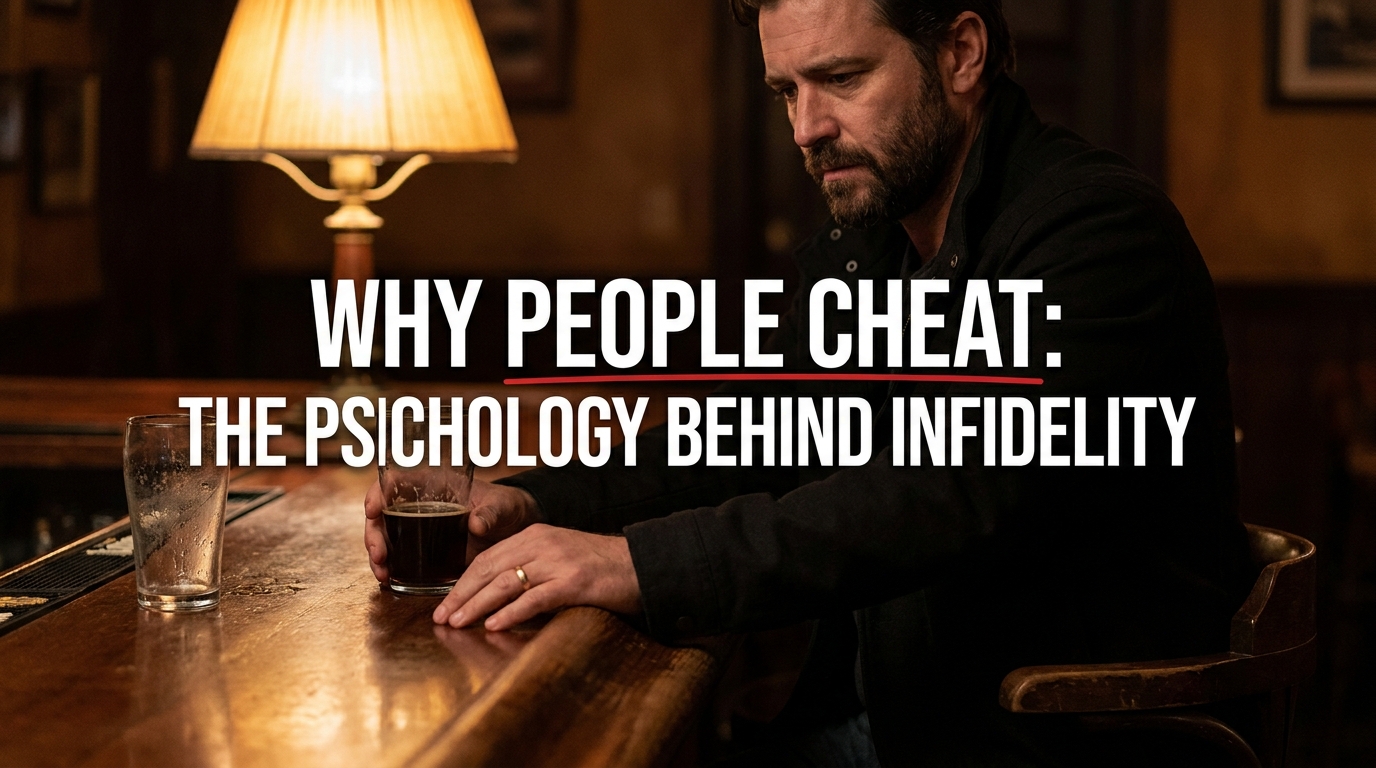
It is one of the most devastating things that can happen inside a relationship — and one of the least honestly discussed. Infidelity touches nearly every demographic, crosses every relationship structure, and lands in lives that were supposed to be immune to it. And yet the public conversation about why people cheat almost always collapses into the same simple verdict: they are selfish, they are weak, they did not love their partner enough. The psychology behind infidelity tells a far more complicated story.
Research from the American Association for Marriage and Family Therapy estimates that emotional affairs occur in approximately 35 percent of women and 45 percent of men, with physical infidelity rates ranging from 20 to 25 percent of married individuals. These numbers do not describe a fringe behavior. They describe a remarkably common human experience — one that demands a more serious psychological examination than moral condemnation alone can provide. Understanding why people cheat does not excuse it. It illuminates it. And illumination — honest, research-grounded, unflinching — is what makes it possible to prevent, survive, or meaningfully recover from.
This article will move through the full psychological landscape of infidelity — the motivations, the attachment dynamics, the neurological realities, the patterns, and what all of it actually means for the people on both sides of it.
What Counts as Infidelity — And Why the Definition Matters
Before the psychology, the definition. Because one of the most consistent findings in infidelity research is that people define it differently — and those differences in definition are themselves psychologically and relationally significant.
Most people, when asked, define infidelity as a physical sexual act with someone outside the relationship. But relationship researchers have long recognized a much broader spectrum. Emotional infidelity — forming a deep, intimate emotional bond with someone outside the relationship that meets needs the primary relationship is supposed to meet — is rated as equally or more devastating by many partners, particularly women, than physical betrayal.
Then there is the expanding category of digital infidelity: sustained secret flirtation, explicit messaging, or emotional intimacy maintained through technology. Fantasy relationships. Persistent romantic attention given to a specific person outside the relationship, even without physical contact. Lying about the existence or nature of outside relationships.
What all of these share is not a specific act but a specific structure: secrecy, a breach of the explicit or implicit agreements of the relationship, and the diversion of something — emotional energy, physical intimacy, romantic attention — that was understood to belong within the partnership.
The definition matters because it shapes what gets examined, what gets repaired, and what gets dismissed. Many people who have engaged in emotional affairs genuinely believe they have not cheated — and many of their partners would strongly disagree. Getting honest about what the agreements of a specific relationship were, and where they were broken, is foundational to any meaningful processing of what happened.
The Six Core Psychological Motivations Behind Infidelity
Research into why people cheat has produced a surprisingly consistent set of motivations — not random, not unpredictable, but rooted in specific psychological needs, relationship dynamics, and individual vulnerabilities. A landmark study published in the Journal of Sex Research by researcher Dylan Selterman and colleagues identified the primary motivations people themselves report for infidelity, and they cluster into six recognizable categories.
Motivation 1 — Unmet Emotional Needs
The most commonly reported motivation for infidelity — particularly emotional affairs — is the experience of emotional needs going chronically unmet within the primary relationship. Not a single bad week or a rough patch, but a sustained pattern of feeling unseen, unheard, unappreciated, or emotionally disconnected from a partner.
This matters psychologically because humans have a fundamental need for what attachment researchers call responsiveness — the experience of being known, cared about, and responded to by an important other. When that responsiveness disappears from a long-term relationship — through busyness, complacency, resentment, or simple drift — people do not typically stop needing it. They find it elsewhere.
The emotional affair often begins not with romantic intention but with relief. A colleague, a friend, someone online — who listens in a way a partner stopped listening. Who sees something the partner stopped noticing. Who responds to the person in a way that feels like coming back to life after a long numbness. The emotional intimacy deepens before either person has consciously decided that something is happening.
This is not a justification. Choosing to seek emotional intimacy outside the relationship rather than addressing its absence within it is a failure of courage and communication. But understanding the mechanism — the movement toward responsiveness when a primary attachment figure becomes emotionally unavailable — explains why emotional affairs often begin with people who were not looking for one.
Motivation 2 — Desire for Novelty and the Neurochemistry of New Attraction
Human beings are not neurochemically designed for the sustained sameness of long-term monogamy. This is not a nihilistic statement about the impossibility of fidelity — it is a biological reality that informed relationship psychology takes seriously.
The early stage of romantic love is powered by a neurochemical cocktail — dopamine, norepinephrine, and phenylethylamine — that produces states of heightened focus, excitement, and euphoria. This state is inherently temporary. As relationships stabilize and familiarity deepens, the neurochemistry normalizes. The intensity quiets. The relationship becomes something different — potentially something deeper, more genuinely intimate, more sustainable — but no longer neurochemically novel.
The desire for novelty — the pull toward the dopamine hit of new attraction — does not disappear when the neurochemistry of a primary relationship stabilizes. For many people, it is simply managed. For others, it becomes a motivation that, combined with opportunity and other factors, leads to infidelity.
Researcher Helen Fisher’s brain imaging studies at Rutgers University found that the neural systems for romantic love, attachment, and sexual desire are meaningfully separate — meaning it is neurologically possible to be deeply attached to one person, sexually attracted to another, and romantically compelled by a third simultaneously. Understanding this does not make infidelity inevitable or acceptable. But it does explain why “I love my partner and still cheated” is not the contradiction it is popularly treated as.
Motivation 3 — Low Self-Worth and the Search for Validation
For a significant subset of people who cheat, the infidelity is less about the outside person and more about themselves — specifically, about a chronic need for external validation that a single relationship cannot fully satisfy.
People with low self-esteem or unstable self-concept sometimes seek romantic or sexual attention from multiple sources as a way of managing an interior landscape of inadequacy. The affair provides proof — temporarily, incompletely, at significant cost — that they are desirable, interesting, and worth choosing. The validation is not really about the affair partner. It is about a wound that predates the relationship entirely.
This pattern is often connected to narcissistic traits — not necessarily full narcissistic personality disorder, but the constellation of fragile self-esteem, sensitivity to rejection, and need for admiration that characterizes narcissistic functioning. Research consistently identifies higher rates of infidelity in individuals who score higher on narcissism measures — not because narcissists are more sexually driven, but because their need for external validation is more constant and more difficult to satisfy.
Motivation 4 — Avoidance and the Escape Function of Infidelity
Sometimes infidelity functions primarily as an escape — from a relationship that has become conflictual, suffocating, or deeply unsatisfying, but which the person does not feel able or willing to leave directly.
The affair in this context is not primarily about the affair partner. It is about psychological relief — a breathing space from a relationship that has become emotionally claustrophobic. It provides what feels like a viable alternative without requiring the confrontation, grief, and disruption of actually ending the primary relationship.
Psychologically, this motivation is often connected to what therapists call conflict avoidance — a deep discomfort with direct confrontation or difficult conversations that leads people to manage relational problems through lateral movement rather than direct engagement. Rather than saying “I am deeply unhappy in this relationship and I need something to change or I need to leave,” the person acts — and the action becomes the thing that eventually forces the conversation they were unable to initiate directly.
“Sometimes an affair is not a choice someone makes toward something. It is a choice someone makes away from something they did not know how to leave.”
Motivation 5 — Situational Opportunity and the Collapse of Inhibition
Not all infidelity is the product of deep psychological motivation or chronic relational dissatisfaction. Research consistently identifies situational factors — opportunity, alcohol, physical proximity, the absence of perceived consequences — as significant contributors to infidelity that would not otherwise have occurred.
This is the category that is most uncomfortable to acknowledge, because it challenges the narrative that character is sufficient protection. The reality is that most people are more vulnerable to situational infidelity than they believe themselves to be — particularly in contexts that combine lowered inhibition, physical proximity to an attractive person, and emotional vulnerability.
Psychologist Shirley Glass, whose research on infidelity is among the most comprehensive in the field, used the metaphor of walls and windows to describe how affairs develop in apparently committed people. Healthy relationships have windows toward each other — openness and transparency — and walls toward the outside world. An affair begins when those walls and windows gradually reverse: the person becomes more open and intimate with someone outside the relationship than with their partner, and more closed and secretive with their partner about the outside relationship.
This reversal often begins not with physical infidelity but with small, seemingly innocent choices: allowing a friendship to become more emotionally intimate than it should be, sharing private information about the primary relationship with someone who is becoming an emotional confidant, maintaining a secret that would make a partner uncomfortable. Each small choice makes the next one easier.
Motivation 6 — Relationship Dissatisfaction and Conscious Evaluation
Finally, some infidelity is the product of a more or less conscious evaluation — a person who is deeply dissatisfied with their primary relationship, who sees a specific alternative, and who makes a choice that reflects their assessment of their options.
This motivation is the one that most closely resembles popular conceptions of infidelity — the deliberate decision of someone who wants something their relationship does not provide and decides to pursue it outside rather than ending the relationship to seek it freely. This version is perhaps the hardest to feel compassion for, because it involves the most conscious choice. It is also, research suggests, not the most common version — though it is real and worth naming honestly.

The Role of Attachment Style in Infidelity
Attachment theory — the psychological framework developed by John Bowlby and expanded by researchers including Mary Ainsworth, Phillip Shaver, and Cindy Hazan — has produced some of the most illuminating research on why certain individuals are more vulnerable to infidelity than others.
Attachment style describes the fundamental way a person relates to intimacy, closeness, and emotional dependency in romantic relationships — and it is largely shaped by early caregiving experiences. The three primary insecure attachment styles each carry specific vulnerabilities to infidelity.
Anxious attachment — characterized by fear of abandonment, intense need for reassurance, and hypervigilance about the relationship — is associated with infidelity driven primarily by the search for validation and the attempt to manage intense emotional pain. People with anxious attachment may seek outside connection as a way of self-soothing when the primary relationship does not provide the reassurance they need, or as an unconscious strategy to avoid the total devastation of abandonment by creating an alternative before it happens.
Avoidant attachment — characterized by discomfort with closeness, suppression of emotional needs, and a defensive preference for independence — is associated with a different infidelity pathway. The avoidantly attached person may seek outside connection as a way of maintaining emotional distance from their primary partner — of ensuring they never become so close that they are vulnerable. The affair keeps the primary relationship from feeling too consuming, too intimate, too threatening to their sense of autonomy.
Disorganized attachment — the most complex and often the most painful of the insecure styles, associated with early experiences of caregiving that was simultaneously a source of safety and fear — is associated with the highest rates of infidelity in research samples, often in ways that are driven more by unresolved trauma than by conscious choice.
Securely attached individuals — those who are comfortable with both intimacy and independence, who trust and are trustworthy — show consistently lower rates of infidelity in research. Not because they are immune to attraction or opportunity, but because they have sufficient internal security and relational skill to address needs and dissatisfactions directly, rather than through the lateral movement of infidelity.

Gender, Infidelity, and the Research
Popular narratives about infidelity tend to be heavily gendered — men cheat physically, women cheat emotionally, men cheat more often. Like most gender generalizations, these contain partial truth and significant distortion.
Research does identify some consistent gender patterns, though these have narrowed considerably over the past several decades as women’s social and economic independence has increased. Studies using data from the General Social Survey — one of the most reliable longitudinal surveys of American social behavior — show that men report higher rates of physical infidelity than women across most age groups, though the gap has narrowed significantly among younger cohorts. Women, on average, report greater emotional devastation from a partner’s emotional affair, while men, on average, report greater devastation from a partner’s physical affair — though this difference is less absolute than popular wisdom suggests.
What the research is increasingly clear about is that the motivational architecture of infidelity is more similar across genders than different. Both men and women cheat for emotional reasons. Both are vulnerable to situational opportunity. Both engage in emotional affairs that begin without explicit romantic intention. The differences are real but should not be overstated into the kind of gender essentialism that prevents individual understanding.
Age is also a significant variable. Infidelity rates peak in midlife for both men and women — a period often associated with reassessment of identity, life meaning, and the accumulated disappointments or unexplored directions of adult life. The midlife affair is a cliché precisely because it is a consistent psychological pattern: the encounter with mortality, the awareness of roads not taken, and the specific vulnerability that produces.
The Partner Who Was Cheated On — What the Research Says About the Experience
Understanding the psychology of infidelity requires attending not only to the person who cheated but to the person who was betrayed — because the psychological impact of being cheated on is severe, specific, and frequently underestimated by people who have not experienced it.
Research consistently shows that the discovery of a partner’s infidelity produces a trauma response that mirrors post-traumatic stress disorder in many of its features: intrusive thoughts, hypervigilance, emotional numbness alternating with intense affect, and a fundamental disruption of the person’s sense of safety and reality. The relationship with the cheating partner was a primary attachment relationship — one that organized a significant portion of the betrayed person’s emotional life. The betrayal does not just hurt. It destabilizes the architecture of a person’s daily reality.
The specific dimension of infidelity that produces this traumatic response is not always the sexual or romantic act itself — it is often the deception. The period of time during which the betrayed partner was living inside a reality that had been constructed as false. The evidence that the person they trusted most was actively deceiving them, sometimes for months or years. That knowledge fundamentally disrupts the ability to trust one’s own perceptions — which is why betrayed partners so often describe a loss of confidence in their own judgment that extends far beyond the specific relationship.
Recovery for the betrayed partner — whether they remain in the relationship or leave — almost always requires professional support. The particular combination of attachment disruption, trauma response, and identity destabilization that infidelity produces is not something that resolves through time alone.
“Infidelity does not just break the relationship. It breaks the betrayed partner’s trust in their own perception of reality — and that is the wound that takes the longest to heal.”
Can a Relationship Survive Infidelity — What the Research Actually Says
The question most people want answered: is it possible to recover from infidelity and build something healthy on the other side?
The research says yes — with significant qualification. Studies by relationship researchers including Dr. Don-David Lusterman and Shirley Glass found that with committed, sustained couples therapy, a meaningful percentage of relationships do survive infidelity and report genuine recovery — not just surface repair but a depth of understanding and intimacy that sometimes exceeds what existed before the betrayal.
But the research is equally clear about the conditions required. Recovery from infidelity is not a passive process. It requires full disclosure — not a managed, minimized version of events, but honest, complete information that allows the betrayed partner to make an informed decision about whether to stay. It requires genuine, sustained accountability from the person who cheated — not a single apology and an expectation that the relationship returns to normal, but an ongoing willingness to answer questions, tolerate the betrayed partner’s pain, and demonstrate changed behavior over time.
It requires a genuine examination — usually in couples therapy — of what was happening in the relationship and in the individual that created the conditions for infidelity. Not to assign blame for the affair to the betrayed partner — the choice to cheat belongs entirely to the person who made it — but to understand the relational dynamics honestly enough that they can be genuinely changed.
And it requires both people to be honest about whether they actually want to rebuild — not out of guilt, fear, financial entanglement, or the presence of children, but out of genuine desire for the specific relationship they could build together on the other side of this truth.
Many relationships do not meet these conditions. And ending a relationship after infidelity — choosing not to rebuild — is not a failure. It is sometimes the most honest and self-respecting choice available.

What Infidelity Is Almost Never About — Dismantling the Myths
Psychology research on infidelity has been particularly valuable in dismantling popular myths that cause significant harm to the people trying to make sense of what happened to them.
Myth: If they truly loved you, they would not have cheated. This conflates love with behavior control in a way that psychology does not support. People can and do love their partners genuinely while still being vulnerable to infidelity — through unmet needs, attachment wounds, situational factors, or individual psychological limitations. This does not mean the love was not real. It means love is not sufficient, by itself, to override all human vulnerability. The presence of infidelity is not definitive evidence of the absence of love.
Myth: Cheating is always about sex. Research consistently shows that a majority of affairs — particularly those that develop into ongoing relationships rather than one-time encounters — are primarily driven by emotional rather than sexual needs. Many people who cheat report that the physical dimension of the affair is less significant to them than the emotional intimacy, the validation, or the sense of being genuinely seen by someone.
Myth: It is the betrayed partner’s fault for not meeting their needs. This myth causes profound harm. The decision to address unmet needs through infidelity rather than through honest communication, couples therapy, or ending the relationship belongs entirely to the person who cheated. A partner can be less than perfect — less emotionally available, less sexually present, less attentive than they should be — and none of that constitutes responsibility for another person’s choice to deceive them.
Myth: Once a cheater, always a cheater. While infidelity history is a statistically significant predictor of future infidelity — people who have cheated before are more likely to cheat again — it is not deterministic. Genuine self-examination, therapy, and changed relational behavior can meaningfully alter the pattern. The question is not whether change is possible. It is whether it is happening.
Myth: Affairs are always passionate and romantic. Many affairs — particularly those that begin from situational opportunity or avoidance motivation — are described by the people who had them as confusing, disappointing, and emotionally hollow. The fantasy of infidelity, constructed partly by media representation and partly by the brain’s novelty-seeking system, frequently exceeds the reality. This does not make the harm less real. But it does complicate the narrative of infidelity as always representing a superior connection to the primary relationship.

What to Do With This Understanding — Whether You Cheated or Were Cheated On
Psychology is most useful not as a judgment but as a tool — for understanding, for prevention, and for recovery. If you are reading this in the aftermath of infidelity — from either position — here is what the research supports doing next.
If you were betrayed: Give yourself permission to have the full, messy, non-linear response that this experience deserves. Do not rush toward forgiveness because you think it is what healthy people do. Do not rush toward leaving because you think staying means weakness. Seek individual therapy — not primarily couples therapy, but therapy that is entirely yours, for your processing, your grief, your rebuilding of self-trust and self-regard. Take the time you need to make a decision that you have arrived at honestly, not from fear or obligation.
If you cheated: Honest reckoning is the only path forward that has integrity — whether you stay in the relationship or leave it. That means full disclosure without minimization, genuine accountability without the expectation that it produces forgiveness on any particular timeline, and serious individual work to understand what in you created the conditions for this choice. Not as self-flagellation, but as the kind of honest self-examination that makes genuine change — rather than better management — possible.
If you are trying to understand it from the outside: Hold the complexity. The person who cheated is not simply a villain, and the person who was cheated on is not simply a victim. Both are full human beings navigating the extraordinary difficulty of long-term intimacy in a world that has never been very good at teaching people how to do it. Understanding why people cheat does not excuse what they did. It makes it possible to learn something true about human beings — including yourself — from the experience.
The Bottom Line — Infidelity Is a Human Problem, Not a Monster Problem
The psychology behind infidelity ultimately points to something uncomfortable and important: the people who cheat are not a distinct category of broken, immoral, or fundamentally untrustworthy human beings. They are people — with attachment wounds, unmet needs, neurological vulnerabilities, and moments of failed courage — who made choices that caused significant harm.
That does not make what they did acceptable. It makes it understandable. And understanding — real, research-grounded, honest understanding — is what prevents, heals, and most importantly, teaches.
Every person who has been cheated on deserves the full weight of that harm to be acknowledged. Every person who has cheated deserves the opportunity for genuine accountability and genuine change. And every person trying to build a lasting, honest, deeply satisfying relationship deserves to understand the psychological landscape they are navigating — including its most difficult and least comfortable terrain.
This is that terrain. Understanding it does not make you cynical about love. It makes you honest about what love, in its fullest human expression, actually requires — and how much better equipped you are to provide it when you stop pretending the complicated parts do not exist.
FAQ
Q: Is infidelity more common in certain types of relationships? A: Research identifies several relationship characteristics associated with higher infidelity rates: relationships with significant sexual dissatisfaction, relationships with high levels of unresolved conflict, relationships where communication has broken down, and relationships where one or both partners have insecure attachment styles. Longer relationships are not inherently more vulnerable — relationship quality and communication patterns are more predictive than duration.
Q: What is the difference between a physical affair and an emotional affair — and which is worse? A: A physical affair involves sexual contact with someone outside the relationship. An emotional affair involves deep emotional intimacy, often including romantic feeling and extensive private communication, without necessarily involving physical contact. Research on which is experienced as more devastating is genuinely mixed — it depends significantly on the individual and their particular values and attachment style. Both represent a meaningful breach of relational agreement and both carry significant psychological impact.
Q: Why do people stay with partners who have cheated on them? A: For many interconnected reasons: genuine love for the partner, belief in the possibility of change and recovery, shared history and investment, presence of children, financial and practical entanglement, religious or cultural values about commitment, fear of being alone, and sometimes trauma bonding — a psychological attachment pattern that develops in relationships with high emotional intensity including betrayal. Staying is not always the product of weakness or denial. Sometimes it is the product of a complex, honest weighing of real factors.
Q: Can couples therapy actually help after infidelity — or does it just delay the inevitable? A: Research on couples therapy post-infidelity shows genuinely positive outcomes for couples who meet the conditions for recovery — full disclosure, genuine accountability, willingness to examine the relational dynamics honestly, and both partners’ actual desire to rebuild. Emotionally Focused Therapy and the Gottman Method both have research-supported protocols specifically for infidelity recovery. Therapy is not a guarantee, and it should not be used to delay a decision that has already been made. But for couples who genuinely want to try, it significantly improves the probability of meaningful recovery.
Q: If someone cheated in a previous relationship, should you be worried they will cheat again? A: Prior infidelity is a statistically significant predictor of future infidelity — but it is not deterministic. The more relevant questions are: What does this person understand about why it happened? What genuine work have they done since? Has their behavior in subsequent relationships demonstrated changed patterns? A person who has cheated, genuinely reckoned with it, and built a different relationship with themselves and with intimacy is meaningfully different from someone who has cheated repeatedly without self-examination. The pattern matters more than the history.
You Came Here Trying to Understand Something. That Already Matters.
Whether you are processing a betrayal, making sense of your own choices, or simply trying to understand one of the most complex dimensions of human relationship — the fact that you sought understanding rather than just verdict says something important about you.
💾 Save this article — infidelity is not a topic people discuss openly, which means when you or someone you know needs this level of honest, research-grounded information, it can be nearly impossible to find. Keep it somewhere accessible.
📤 Share it with someone who is in the middle of making sense of what happened to them — or what they did. Understanding is not absolution. But it is the beginning of everything that comes after.
💬 Leave a comment — what part of this shifted something for you? What question does this article raise that you are still sitting with? This is a space for honest conversation, and it is moderated with care.
🔁 Tag someone who needs a more nuanced conversation about infidelity than “once a cheater, always a cheater” — someone who deserves real information to make a real decision.
➕ Follow Truthsinside.com for psychology content that does not flatten complex human behavior into simple moral verdicts — because you deserve content that respects the full difficulty of being human.
📖 Read next: The Psychology of Forgiveness: Why Letting Go Is About You, Not Them — because whatever side of this experience you are on, forgiveness — on your own terms, in your own time — is eventually part of what comes next.
📃 Related article: Attachment Theory Explained: Which Style Are You?
Understanding why does not excuse what. But it makes it possible to move through it with honesty — and honesty is where healing actually begins.
🎵 Music
Maren Lull is a singer-songwriter who writes from the places most people don’t talk about out loud.
Not the dramatic grief. Not the obvious heartbreak. The quiet kind — the ordinary Tuesday emptiness, the habit of reaching for someone who isn’t there anymore, the particular exhaustion of being strong for so long that the strength itself wears thin.
Her music lives at the intersection of emotional honesty and soft beauty — breathy vocals over gentle piano, slow tempos, lyrics that feel less like songs and more like something you wrote in a private notebook at two in the morning and never showed anyone.
Maren Lull writes for the people who feel everything deeply and say very little about it. For the ones who listen to sad music not because they want to feel worse — but because being understood, even by a song, makes the feeling easier to carry.
📱 Follow Maren Lull:
→ Spotify
→ Apple Music
→ Youtube
→ Audiomack