Have you ever been in a relationship that felt so consuming, so necessary, so completely wrapped around your sense of self — that the idea of losing it felt less like heartbreak and more like annihilation? You told yourself it was love. Everyone around you probably called it love too. But somewhere beneath the intensity, beneath the need, beneath the way your entire nervous system seemed to organize itself around that one person — was it really love? Or was it something else entirely, wearing love’s face?
The difference between love and attachment is one of the most psychologically significant and least discussed distinctions in all of relationship science. And yet, confusing the two may be one of the single most common sources of relational suffering in human experience. Research published in the journal Motivation and Emotion found that individuals who reported higher levels of anxious attachment in relationships also reported significantly lower levels of relationship satisfaction — despite experiencing their attachment as intense love. A 2019 study from the University of Toronto found that people who struggled to distinguish between love and emotional dependency were measurably more likely to remain in unhealthy relationships, experience chronic loneliness even within partnerships, and report lower overall life satisfaction.
This article is not here to tell you that what you felt was not real. It is here to help you understand what it actually was — because that understanding may be the most liberating thing you have ever given yourself.

Understanding the Difference Between Love and Attachment
The difference between love and attachment begins not with feelings — because both can feel overwhelmingly powerful — but with the underlying psychological structure that produces those feelings and the needs those feelings are designed to serve.
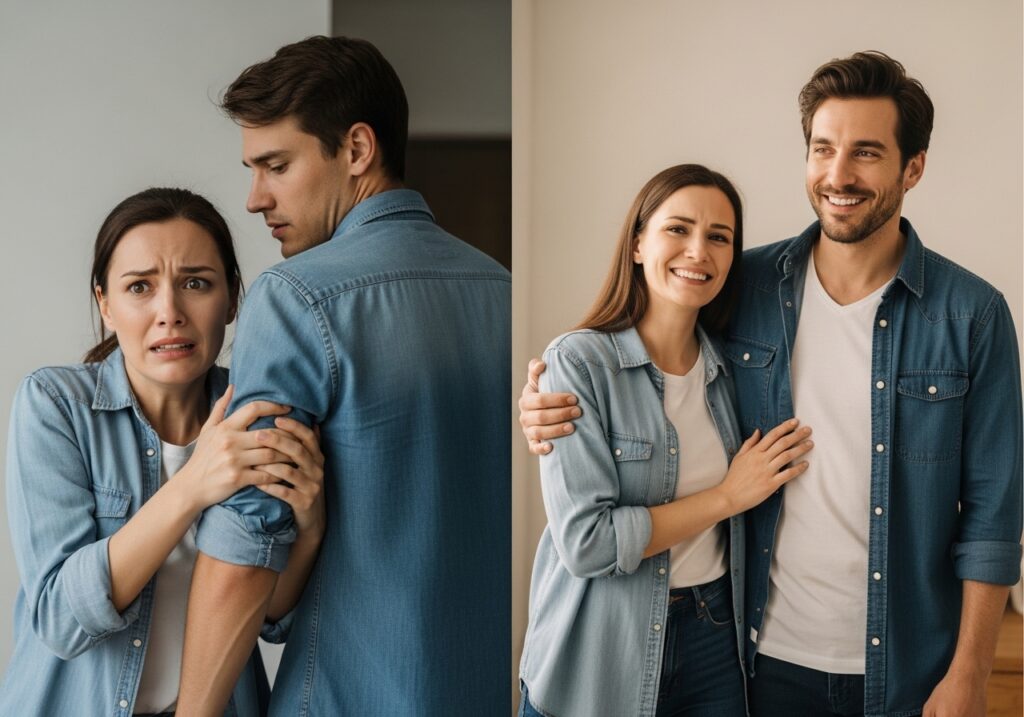
Love, at its most psychologically healthy, is an outward-oriented experience. It is fundamentally concerned with the other person — their wellbeing, their growth, their authentic happiness, even when that happiness does not center around you. True love holds the other person’s freedom as sacred. It does not require their constant presence to feel whole. It does not collapse into anxiety when the relationship is not perfectly harmonious. It exists as something generous, something expansive, something that — even at its most passionate — retains a fundamental quality of ease.
Attachment, by contrast, is an inward-oriented experience. It is fundamentally concerned with the self — specifically, with the self’s need for security, consistency, validation, and the regulation of its own emotional state through the presence of another person. Attachment says: I need you here. I need you to behave in specific ways. I need you to remain constant because my internal world destabilizes when you do not. Attachment is not inherently pathological — it is a core human drive, hardwired into the nervous system from birth. But when attachment is mistaken for love, it becomes the engine of enormous and often invisible suffering.
The Buddhist concept of “upadana” — often translated as clinging or grasping — describes this distinction with remarkable precision. In Buddhist psychology, attachment is the suffering that arises when we attempt to hold permanently onto something inherently impermanent. It is the pain of the grip, not the pain of the loss itself. Love, in this framework, is open-handed. Attachment is closed-fisted.
What Attachment Theory Tells Us About How We Love
To understand the difference between love and attachment with any psychological depth, you cannot avoid attachment theory — the foundational framework developed by British psychiatrist John Bowlby in the 1950s and expanded dramatically by researcher Mary Ainsworth through her landmark Strange Situation experiments.
Bowlby proposed that human beings are biologically prewired to seek closeness with a primary caregiver in infancy and early childhood — not as a luxury, but as a survival imperative. When that caregiver is consistently available, responsive, and emotionally attuned, the child develops what Ainsworth categorized as a secure attachment. They learn, at a cellular level, that relationships are safe, that their needs will be met, and that separation from a loved one does not equal abandonment or annihilation.
When the caregiver is inconsistent, emotionally unavailable, frightening, or absent, the child develops an insecure attachment style — either anxious, avoidant, or disorganized — each representing a different adaptive strategy for managing the pain of unreliable emotional connection.
Here is the critical link: these early attachment patterns do not stay in childhood. They travel with us directly into every adult romantic relationship we form, operating largely beneath conscious awareness, shaping how we interpret our partner’s behavior, how we respond to perceived distance or disconnection, and — most relevantly — how we experience what we call love.
For a securely attached individual, love and attachment are not dramatically at odds. They love from a place of genuine surplus, and their attachment needs are healthy and proportionate.
For an anxiously attached individual, love and attachment become deeply tangled. Their love is genuine — but it is threaded through with fear, with vigilance, with a relentless need for reassurance that they are loved in return. The intensity of their feeling is not a measure of the relationship’s health. It is often a measure of their nervous system’s alarm level.
For an avoidantly attached individual, the tangle looks different but is no less significant. They may genuinely care about a partner while simultaneously creating emotional distance, downplaying the relationship’s importance, or sabotaging intimacy the moment it gets too close — because closeness, at a nervous system level, feels like danger rather than safety.
“Love says: I want you to be happy, even when that happiness looks different from what I imagined. Attachment says: I need you to stay — because your staying is the only thing keeping me whole.”

Key Differences Between Love and Attachment — Side by Side
Understanding the difference between love and attachment becomes significantly clearer when specific emotional and behavioral patterns are examined in contrast. These distinctions are not judgments. They are observations — and recognizing them in your own experience is the beginning of genuine emotional intelligence.
Freedom vs. Control
Love, fundamentally, respects autonomy. A person who loves you genuinely wants you to live fully — to pursue your interests, your friendships, your individual path — because your flourishing matters to them as much as the relationship does.
Attachment operates from a different impulse entirely. When your emotional security is dependent on another person’s constant presence and behavior, their independence begins to feel like a threat. The partner who is attached rather than loving will often — consciously or not — create conditions that limit the other person’s freedom, not from malice, but from the genuine terror of what that freedom might mean for their own sense of stability.
Security vs. Anxiety
Love produces a baseline of emotional security. Not the absence of all vulnerability — love always carries some — but a foundational sense of safety within the connection. You can have a difficult conversation. You can spend a weekend apart. You can disagree without the relationship feeling like it is ending.
Attachment produces chronic relational anxiety. The question “do they still love me?” does not rest. Every unreturned message, every moment of emotional distance, every change in tone or behavior becomes data in an endless threat-assessment that never fully resolves. The relationship is experienced not as a place of rest, but as a problem to be continuously solved.
Acceptance vs. Idealization
Love sees the other person with clarity — their beauty and their flaws, their strengths and their contradictions — and chooses them anyway. It does not require them to be perfect, to remain consistent, or to fulfill a specific emotional function in order for the love to persist.
Attachment tends toward idealization — particularly in its early stages. The attached person often loves not quite the actual person in front of them, but a version of that person constructed from their own needs, projections, and desires. This is partly why the dissolution of attachment-driven relationships is often accompanied by a profound sense of having loved someone who did not quite exist in the form the grieving person believed they did.
Growth vs. Stagnation
Genuine love has a growth orientation. It wants the other person to evolve, to change, to become more fully themselves — even when that evolution is uncomfortable for the relationship or introduces new complexities. Love can hold change without feeling threatened by it.
Attachment resists change, because change introduces unpredictability, and unpredictability destabilizes the foundation that attachment depends on. A partner driven primarily by attachment may unconsciously resist their own growth, or resist their partner’s, because staying the same — even when staying the same means staying in pain — feels safer than the unknown of becoming different.
Presence vs. Possession
Love is present — it exists in the current moment, in the actual person, in the real relationship as it is today. It does not primarily live in the past, in the fear of future loss, or in the anxious monitoring of the relationship’s temperature.
Attachment is possessive — it experiences the relationship as something to be secured, held, and protected from the threat of change or loss. The language of attachment is I need, I cannot lose, I cannot imagine life without. The language of love is I choose, I appreciate, I am grateful for who you are right now.
How to Tell Which One You Are Experiencing Right Now
This is the question that requires the most honesty — and the most courage. Because the feelings of love and attachment are, on the surface, extraordinarily similar. Both are intense. Both are consuming. Both produce a profound orientation toward the other person. Distinguishing between them requires going beneath the feeling itself and examining what lives underneath it.
Ask yourself these questions — and try to answer them from your gut rather than your ego.
When you imagine your partner being happy without you — genuinely thriving in a life that does not include you — what do you feel?
If your primary feeling is warmth, genuine happiness for them, even within your own grief — that is love. If your primary feeling is panic, rage, or an immediate impulse to make yourself indispensable — that is attachment.
When you and your partner spend time apart, what happens to your sense of self?
If you remain fundamentally yourself — perhaps missing them, but still intact, still functional, still connected to your own life — that is love operating from a secure foundation. If their absence produces a kind of internal collapse, a loss of identity or direction, an anxiety that only their return can resolve — that is attachment performing the function of emotional regulation.
Are you in love with who they actually are — or who you need them to be?
This is perhaps the most confronting question of all. Genuine love has a quality of specificity — it is rooted in the actual person, their actual personality, their actual behavior. Attachment often loves a role more than a person — the role of partner, of anchor, of the one who makes you feel worthy or safe or chosen. When the person cannot or will not play that role consistently, the love can evaporate with surprising speed — which tells you something important about what was actually driving it.
How does disagreement or conflict feel in your body?
In a love-driven relationship, conflict is uncomfortable but survivable. It is a problem to be navigated, not a catastrophe to be avoided at all costs. In an attachment-driven experience, conflict can feel existential — like the entire foundation of your world is cracking. If you find yourself willing to suppress your own truth, your own needs, your own reality in order to prevent conflict, that is not love making you accommodating. That is attachment making you afraid.
“The most honest question you can ask yourself in any relationship is not ‘do I love them?’ It is ‘would I still want good things for them if they chose a life without me?’ The answer tells you everything.”
Why We Confuse Love and Attachment So Easily
The confusion between love and attachment is not stupidity or naivety. It is the predictable result of several powerful forces converging — neurological, psychological, and cultural — all pointing in the same direction and calling it love.
The Neurochemistry of Early Attachment
The early stages of romantic connection trigger a neurochemical cascade that is, quite literally, indistinguishable from the early stages of addiction. Dopamine creates the craving and the pleasure. Norepinephrine creates the heightened alertness and the intrusive thinking. Oxytocin creates the bonding and the sense of safety. Serotonin drops — producing the obsessive focus on the other person that characterizes new love and is virtually identical to the neural signature of obsessive-compulsive disorder.
In this neurochemical environment, the difference between love and attachment is essentially impossible to detect. Everything feels like love. Everything feels necessary and fated and profoundly meaningful. It is only as the neurochemical intensity settles — usually between twelve and twenty-four months into a relationship — that the underlying structure becomes visible. What was always there beneath the chemistry begins to surface: either a genuine, grounded connection between two secure selves, or an anxious entanglement between two nervous systems that have learned to regulate each other.
Cultural Conditioning and the Romanticization of Need
Every culture has a love mythology, and Western culture’s version is particularly saturated with the romanticization of need. “I cannot live without you.” “You complete me.” “I would die for you.” “Without you I am nothing.” These phrases are treated as the pinnacle of romantic expression — the proof of love’s depth and sincerity.
What they actually describe, psychologically, is not love. They describe enmeshment, codependency, and the complete dissolution of self into another person. When a culture teaches its members that loss of self is the highest expression of love, it produces generation after generation of people who mistake their attachment wounds for their deepest romantic feelings.
Childhood Templates
Perhaps most powerfully of all, many people confuse love and attachment because their earliest experiences of love were, in fact, experiences of anxious attachment. If you grew up in a household where love was conditional, inconsistent, or accompanied by anxiety and uncertainty, your nervous system learned to associate love with that particular emotional texture.
So when, as an adult, you experience the anxiety of uncertain attachment — the not knowing, the longing, the desperate need — it feels like love, because it feels like home. The chemistry is familiar. The emotional landscape is recognizable. And familiarity, to a nervous system shaped by early experience, registers as safety — even when it is anything but.

Moving From Attachment Toward Genuine Love
Understanding the difference between love and attachment is not about dismantling every deep feeling you have ever had. It is about developing the emotional maturity to love from a fuller, healthier, less frightened place. And that development is possible — not quickly, not easily, but genuinely.
Developing a Relationship With Your Own Self
The most foundational work in moving from attachment toward love is the development of a stable, nourishing relationship with yourself. Attachment — particularly anxious attachment — thrives in the absence of self. When you do not have a robust internal life, a clear sense of identity, a set of values and interests and connections that exist independently of any relationship, you will inevitably look to your partner to provide all of those things. And when one person is required to be everything to another person, the weight collapses the structure.
Building a self that exists richly outside of your romantic relationship is not selfishness. It is the most generous thing you can bring to a partnership. A person who is full — who has their own friendships, their own passions, their own internal world — loves differently than a person who is empty and looking to be filled. They love with surplus rather than desperation. They love with choice rather than need.
Learning to Tolerate Uncertainty
Attachment is, at its core, a response to uncertainty — a strategy the nervous system develops to manage the unbearable unpredictability of depending on another human being who is ultimately outside your control. Building a tolerance for uncertainty — through mindfulness practice, through therapy, through deliberate exposure to the discomfort of not-knowing — gradually reduces the urgency that drives attachment behavior.
This does not mean becoming indifferent. It means developing the internal capacity to hold uncertainty without letting it drive your behavior. To know that you do not know what tomorrow holds — and to remain present in today anyway.
Choosing Partners Who Support Your Growth
One of the most reliable ways to shift from attachment-driven relationships toward love-driven ones is to deliberately change the template of what you find attractive. Attachment-driven individuals often find themselves drawn to partners who replicate the emotional texture of their early attachment wounds — inconsistent, emotionally unavailable, hot-and-cold — because that texture feels like love. Consciously choosing partners who are emotionally consistent, psychologically available, and genuinely invested in your growth can feel, initially, shockingly boring. That boredom — the absence of anxiety — is not evidence of insufficient love. It is evidence of a nervous system meeting safety for the first time.
Working With a Therapist
The patterns that produce attachment confusion — particularly those rooted in early childhood experience — are genuinely difficult to address without professional support. Therapy, particularly modalities such as Emotionally Focused Therapy or attachment-based therapy, provides the space to examine the underlying architecture of your relational patterns, to develop new internal models of relationship, and to practice the vulnerability of genuine love in an environment that is specifically designed to hold it safely.

A Final Word: Loving Without Losing Yourself
The difference between love and attachment is ultimately the difference between two profoundly different ways of being in relationship with another human being. One is rooted in fear — fear of loss, fear of abandonment, fear of the emptiness that might exist if the other person is gone. The other is rooted in fullness — a genuine, chosen orientation toward another person that enhances both lives without consuming either one.
Neither place is where most of us begin. Most of us begin somewhere in the complicated middle — carrying our attachment wounds into every new relationship, genuinely hoping for love, genuinely trying for love, and sometimes producing something that looks like love from the outside while feeling like quiet desperation from the inside.
But the middle is not where you have to stay. Every honest question you ask yourself about what you are actually feeling and why — every moment of choosing self-awareness over comfortable self-deception — moves you incrementally toward the kind of love that does not cost you your peace, your identity, or your freedom.
Real love is possible. It is available to you — not as a reward for suffering enough or waiting long enough, but as the natural result of becoming someone who loves themselves enough to know the difference between what nourishes them and what merely feels familiar.
You deserve love that sets you free. Not love that builds a more comfortable cage.
💾 Save this article — read it again when a relationship feels confusing and consuming.
📤 Share it with someone who has ever confused intensity for love.
➕ Follow Truthsinside.com for love, emotion, and psychology content that actually goes beneath the surface.
📃 Related article: What Does It Actually Feel Like to Fall in Love? Science + Real Stories
Frequently Asked Questions
Q1: Can a relationship that started as attachment grow into genuine love?
Yes — absolutely, and this is in fact a common relational trajectory. Many relationships begin with a powerful cocktail of neurochemical infatuation and anxious attachment, and as both partners do the personal growth work of developing security, self-awareness, and emotional regulation, the foundation shifts beneath the relationship. The attachment-driven intensity softens, and something more sustainable and genuinely loving emerges in its place. This transformation is more likely when both partners are willing to examine their own patterns, ideally with professional support, and when the relationship has a foundational compatibility that was always present beneath the anxiety.
Q2: Is it possible to love someone without any attachment at all?
In practical human terms, no — and that is not the goal. Healthy attachment is a normal, necessary component of intimate human connection. The aim is not to eliminate attachment but to develop what attachment researchers call “secure attachment” — a way of being emotionally connected to a partner that provides comfort and closeness without producing anxiety, control, or loss of self. The difference between love and attachment is not about removing the attachment. It is about healing the attachment so that it no longer operates from fear.
Q3: How do I know if I actually love my partner or if I am just afraid of being alone?
One of the most clarifying exercises for this question is to ask yourself honestly: if you were guaranteed to never be lonely again — if you had a rich social life, a strong sense of self, meaningful work, and deep friendships — would you still choose this specific person? If the answer is yes — if you genuinely delight in who they are as a human being independent of what they provide for your emotional regulation — that is love. If the answer becomes far less certain, that is important information about the role the relationship is actually serving in your life.
Q4: Why does attachment feel so much like love in the moment?
Because, neurologically and emotionally, they activate many of the same systems. Both involve intense preoccupation with another person. Both involve pain at separation and pleasure in reunion. Both feel urgent and real and significant. The distinction only becomes fully apparent when examined at the level of what need is being served — the other person’s flourishing, or your own emotional regulation. In the heat of the feeling, that distinction is genuinely difficult to perceive, which is precisely why developing this awareness through reflection rather than solely through feeling is so important.
Q5: Can therapy help me stop confusing love and attachment?
Therapy is one of the most effective tools available for this specific work, and the evidence is substantial. Modalities such as Emotionally Focused Therapy directly target attachment patterns in the context of relationships. Individual attachment-based therapy helps you examine the early experiences that shaped your relational template and develop a more secure internal model of what relationship can and should feel like. Many people report that working through attachment patterns in therapy fundamentally changed not just their relationships, but their entire relationship with their own emotional life — producing a quality of peace and clarity in love that they had not previously believed was possible for them.
🎵 Music
Maren Lull is a singer-songwriter who writes from the places most people don’t talk about out loud.
Not the dramatic grief. Not the obvious heartbreak. The quiet kind — the ordinary Tuesday emptiness, the habit of reaching for someone who isn’t there anymore, the particular exhaustion of being strong for so long that the strength itself wears thin.
Her music lives at the intersection of emotional honesty and soft beauty — breathy vocals over gentle piano, slow tempos, lyrics that feel less like songs and more like something you wrote in a private notebook at two in the morning and never showed anyone.
Maren Lull writes for the people who feel everything deeply and say very little about it. For the ones who listen to sad music not because they want to feel worse — but because being understood, even by a song, makes the feeling easier to carry.
📱 Follow Maren Lull:
→ Spotify
→ Apple Music
→ Youtube
→ Audiomack