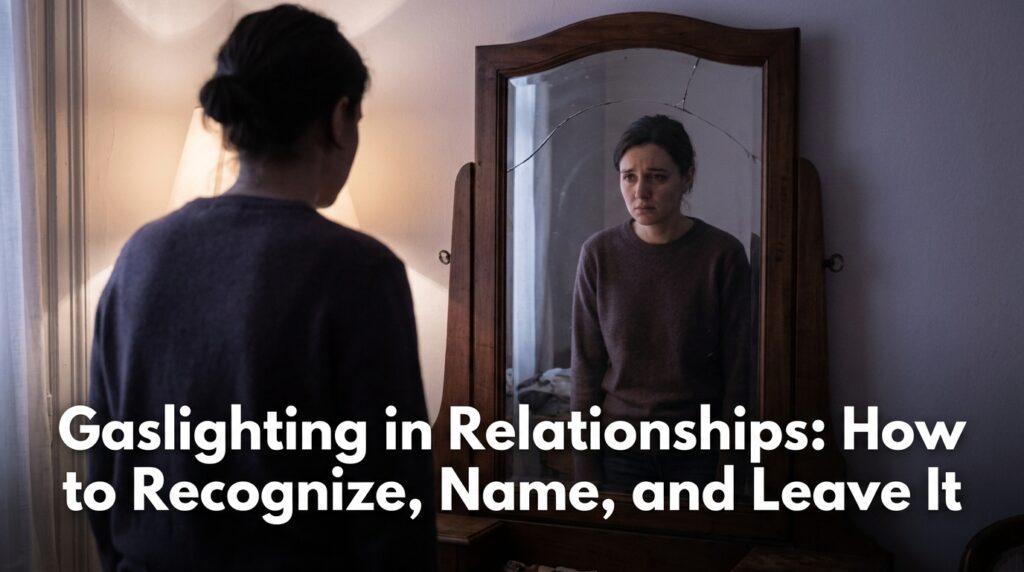
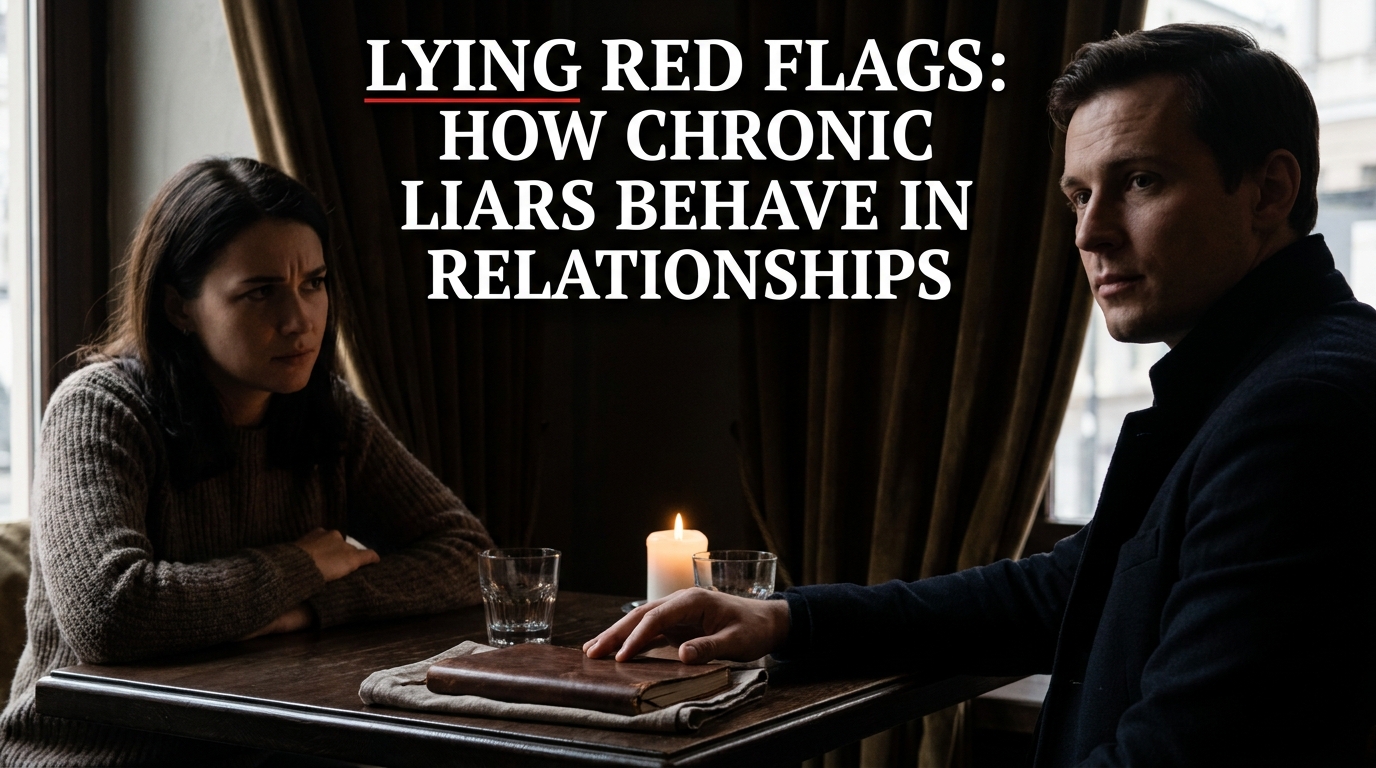
There is a specific kind of confusion that settles into a relationship with a chronic liar — not the sharp, clean pain of a single discovered betrayal, but a slow, accumulating fog that makes you question your memory, your perceptions, and eventually your own sanity. You cannot point to one definitive moment. You cannot produce the clean evidence that your gut is screaming for. You only know that something is consistently, persistently, disturbingly off — and that no matter how many times you convince yourself you have found the bottom of it, there seems to always be more beneath.
Lying red flags in relationships are among the most difficult warning signs to identify clearly, precisely because skilled chronic liars are extraordinarily good at what they do. According to research from the University of Massachusetts, studies show that 60 percent of people lie at least once during a ten-minute conversation — but chronic or pathological lying represents a far more entrenched and deliberate pattern.
A 2021 study published in PLOS ONE found that a small subset of the population — approximately five percent — accounts for the vast majority of lies told in social interactions, and that this group demonstrates consistent behavioral patterns that distinguish them clearly from ordinary social liars. Research by psychologist Dr. Aldert Vrij at the University of Portsmouth found that chronic liars develop specific behavioral strategies over time that make their deception increasingly difficult to detect — not because they become more nervous, but because they become more practiced, more confident, and more fluent in the language of false sincerity.
This article exists to give you what chronic liars specifically work to prevent you from having: clarity.

What Are Lying Red Flags — And Why Are They So Hard to See?
Lying red flags are the behavioral, linguistic, and relational patterns that chronic liars consistently display in intimate relationships — patterns that, once understood, reveal themselves as a coherent system of deception rather than isolated incidents of dishonesty.
The reason these red flags are so difficult to identify from inside the relationship is not a failure of intelligence or perception on the part of the person being deceived. It is the direct result of several converging factors that chronic liars, consciously or not, actively exploit.
First, intimacy itself creates vulnerability to deception. The trust extended to a romantic partner — the baseline assumption of honesty that healthy attachment requires — functions as a cognitive filter that makes deceptive information significantly more likely to be accepted at face value. When the person telling you something is someone you love, the brain extends an automatic credibility that it would not extend to a stranger.
Second, chronic liars are not amateur deceivers. They have been practicing — in many cases, since childhood — and they have developed sophisticated strategies for managing the perception of others that go far beyond the clumsy, obvious lying that most people imagine when they think of dishonesty.
Third, the confusion and self-doubt that sustained deception produces in the target actually functions as a protective mechanism for the liar. A person who is uncertain about their own perceptions is a person who is significantly less capable of holding their partner accountable with confidence.
Understanding these dynamics is not about excusing what chronic liars do. It is about dismantling the specific mechanisms that keep their behavior hidden — and giving you the clear-eyed perspective that the relationship has been systematically working to obscure.
The Psychology of Chronic Lying — Who Does It and Why
Before examining the specific lying red flags, understanding the psychological profile and motivation of the chronic liar provides essential context for everything that follows.
Pathological vs. Compulsive Lying
Clinical psychology distinguishes between several types of chronic lying behavior, each with different underlying drivers.
Pathological lying — also referred to in clinical literature as pseudologia fantastica — is characterized by a pervasive pattern of lying that appears to serve no obvious external purpose and that the person seems unable to control even when the lies create significant consequences for themselves. Pathological liars often construct elaborate, internally consistent false narratives that they appear, at times, to partially believe themselves.
Compulsive lying is similar in its habitual quality but is typically more consciously experienced by the person engaging in it — they know they are lying, they often feel uncomfortable about it, but they feel unable to stop the behavior without significant effort and usually professional intervention.
Instrumental or strategic lying — the most deliberately harmful form — is lying deployed consciously and purposefully as a tool for managing another person’s perception, obtaining specific outcomes, or maintaining control within a relationship. This form is most commonly associated with narcissistic, antisocial, and Machiavellian personality features.
In real relationships, these categories frequently overlap. A partner may combine compulsive habitual lying with strategic instrumental deception, making the behavioral pattern both deeply ingrained and deliberately deployed.
The Role of Shame, Control, and Self-Protection
For most chronic liars, the behavior originates in one of several psychological territories: shame avoidance, the need for control, or early survival adaptations.
Shame-driven lying develops when a person’s early environment made honesty consistently unsafe — environments where mistakes were met with disproportionate punishment, where vulnerability was exploited, or where the authentic self was consistently rejected. In these environments, lying becomes a survival strategy — a way of managing other people’s perceptions to avoid the unbearable consequences of being honestly known.
Control-driven lying develops when a person learns that managing information is the most reliable way to manage outcomes and other people’s behavior. The chronic liar who is primarily motivated by control experiences honesty as a loss of power — an unnecessary surrender of the informational advantage they rely on to feel safe.
“A chronic liar does not just lie about facts. They lie about who they are, what they feel, and what they have done — until the relationship exists inside a reality they have entirely constructed.”

Lying Red Flags: The Specific Behavioral Patterns to Recognize
The following patterns are the consistent behavioral signatures of chronic lying in intimate relationships. They are not isolated behaviors — their significance lies in their pattern quality, their recurrence, and the way they function together as a system of sustained deception.
Red Flag 1: Their Stories Contain Small but Persistent Inconsistencies
Chronic liars rarely construct single, isolated lies. They construct narratives — complex, internally consistent-seeming stories about their day, their past, their relationships, their feelings. The problem with constructed narratives is that they require ongoing maintenance, and that maintenance inevitably produces inconsistencies over time.
The inconsistencies themselves are rarely dramatic. They are small — a detail that contradicts something said three weeks ago, a timeline that does not quite add up on examination, a name that appears in one version of a story and is absent from another. When pointed out, these inconsistencies are smoothly explained away — misremembered, misunderstood, taken out of context.
The red flag is not any single inconsistency. It is the pattern of them. And the pattern of them, across multiple topics and multiple timeframes, tells a coherent story about someone who is managing a constructed reality rather than simply remembering their actual life.
Red Flag 2: They Are Defensively Over-Detailed When Not Asked
One of the most well-documented behavioral indicators of deception — identified consistently across decades of research in deception psychology — is the phenomenon of unsolicited over-explanation. The chronic liar, aware at some level of the lie’s vulnerability, preemptively fortifies it with detail.
You ask a simple question. You receive an elaborate narrative. Specific times, names, locations, sequences — far more detail than the question required, far more than would naturally accompany an honest account of an unremarkable event. The detail is not offered because the event was particularly memorable. It is offered because the detail creates the appearance of authenticity and makes the story harder to challenge.
Honest people, when recounting ordinary events, leave ordinary gaps. They say “I had lunch somewhere downtown” not “I had lunch at the Italian place on Fifth, the one next to the pharmacy, around twelve-thirty, with Marco from the office — you’ve met him, actually, remember the Christmas party two years ago?” The difference in the density and specificity of the account, when consistently observed, is a telling behavioral pattern.
Red Flag 3: They Deflect, Attack, or Redirect When Questioned
When a chronic liar is questioned about something that touches on a deception — even tangentially, even when the questioner has no specific suspicion — the response frequently follows one of several predictable patterns, all of which have the functional effect of shutting down the inquiry before it can produce clarity.
Deflection moves the conversation away from the uncomfortable topic onto something else, often something that requires your immediate emotional engagement. Suddenly there is a different problem, a different concern, a different conversation urgently needed.
Attack turns your question into evidence of your own failing — your insecurity, your controlling nature, your lack of trust, your history of being difficult. The question that was about their behavior becomes a conversation about your character.
Redirection inverts the power dynamic of the exchange — suddenly they are the one asking questions, the one who has concerns, the one who needs answers from you. The original question evaporates in the reorganized emotional landscape of the conversation.
None of these responses are random. They are the behavioral repertoire of someone who has learned, through extensive practice, that the best defense against a dangerous question is a strong and immediate offense.
Red Flag 4: They Compartmentalize Their Life Extensively
Chronic liars in relationships typically maintain strict and deliberate compartmentalization of different areas of their lives — keeping their relationship partner, their friends, their colleagues, and other social circles carefully separated from each other.
On the surface, this can appear as simply being a private person or as maintaining healthy boundaries between life domains. The distinction lies in the degree of separation and in the resistance that appears when the compartments are threatened with contact.
A partner who becomes significantly uncomfortable when you suggest meeting their friends, who deflects invitations to share social worlds, who keeps their phone, their email, or their social media aggressively private — who lives, in essence, as several different people in several different contained contexts — is maintaining the conditions that chronic deception requires. Compartmentalization protects the liar by ensuring that the people who know different versions of their story never compare notes.
Red Flag 5: They Have an Exceptional Memory for Their Own Lies but Claim Poor Memory Strategically
This is one of the most revealing and most overlooked behavioral patterns associated with chronic lying in relationships. The chronic liar who cannot remember the specific time they came home on a given evening, who cannot recall what they said in last week’s argument, who “honestly cannot remember” the promise made or the commitment stated — often displays an extraordinarily precise memory for other details when that precision serves their interests.
They remember, perfectly, the specific thing you said that can be used against you. They remember, precisely, an agreement you made that benefits them. They remember, with complete clarity, their own version of events that positions them favorably.
The selective quality of their memory — excellent when the recalled information serves their narrative, conveniently absent when it threatens it — is a consistent and diagnostically significant pattern. Memory does not work this way in the absence of motivated management. The motivation is the tell.

Red Flag 6: They Make You Feel Guilty for Questioning Them
One of the most psychologically sophisticated lying red flags — and one of the most effective at preventing detection — is the chronic liar’s consistent ability to transform your reasonable questioning into evidence of your own failure as a partner.
When you raise a concern about something that does not add up, you are met not with explanation but with emotional injury. You are told that your questioning means you do not trust them. That your doubt is the real problem in the relationship. That if you truly loved them, you would not need to ask. That they cannot believe, after everything they have done for you, that you would treat them like a suspect.
This response is devastatingly effective because it weaponizes your genuine care for them. Your desire to be a good partner — to not be the kind of person who interrogates and controls and doubts — is specifically exploited to silence the very instinct that is trying to protect you.
The result is a specific and deeply uncomfortable position: you have a legitimate concern that has not been addressed, and you also feel guilty for having it. That guilt is not organic. It was manufactured. And its primary function is to ensure you do not ask again.
Red Flag 7: The Truth Always Seems to Have Layers
In a relationship with a chronic liar, truth is rarely delivered in a single, complete disclosure. It arrives in layers — partial admissions that seem to resolve a concern but are later revealed to have been carefully constructed incomplete versions of a larger reality.
The first version of events is one thing. When pressed, a slightly different version emerges. When concrete evidence contradicts the second version, a third account appears that attempts to incorporate the evidence while still managing the damage. Each disclosure seems like the bottom of something — until more is revealed, and another layer is found beneath.
This phenomenon — sometimes described in clinical literature as “trickle truth” — is one of the most reliably documented behaviors of chronic liars in intimate relationships. The information is released in calculated minimum amounts, just enough to temporarily satisfy the partner’s concerns while preserving as much of the constructed reality as possible.
If the truth in your relationship consistently reveals itself in stages, with each apparent full disclosure eventually giving way to a more complete and more damaging account — that pattern is not coincidence and it is not poor communication. It is a deliberate management strategy.
Red Flag 8: Their Identity Seems to Shift Depending on Who They Are With
People naturally adjust their presentation in different social contexts — more formal at work, more relaxed with close friends, more careful in new relationships. This is normal social calibration.
The chronic liar’s shifting, however, operates at a different level of depth. Different people who know them hold fundamentally incompatible accounts of who they are. The person their friends describe is genuinely unrecognizable to their partner. The stories they tell about their past change depending on who they are telling them to. Their values, their history, their interests, their personality — these seem to reconfigure depending on the audience.
This extensive identity inconsistency is not simply the richness of a complex personality. It is the observable consequence of someone who has constructed multiple versions of themselves for multiple different relational contexts — because the truth of who they are and what they do cannot safely exist in a single coherent narrative.
The Impact of Living With a Chronic Liar
The psychological consequences of sustained exposure to chronic lying in an intimate relationship are significant, well-documented, and frequently underestimated by the people living within them — partly because the consequences build gradually, and partly because the confusion produced by the lying makes it difficult to accurately assess what is happening.
The Erosion of Reality Testing
The most fundamental and lasting impact of chronic lying in relationships is the gradual erosion of the target’s confidence in their own perceptions. When the information you receive from your closest person is systematically unreliable, your brain’s ability to accurately process reality becomes compromised.
You begin to doubt your own memory. You question whether you understood correctly, heard correctly, remembered correctly. You wonder whether the concern that felt so clear in the moment was actually justified. This self-doubt is not a psychological weakness — it is the predictable neurological consequence of sustained exposure to systematically unreliable information from a trusted source.
Psychologists who work with survivors of chronic deception in relationships describe this reality-testing erosion as one of the most difficult aspects of recovery — because the damage is not to any specific belief, but to the underlying cognitive mechanism that forms and evaluates beliefs.
Hypervigilance and Chronic Anxiety
Living with a chronic liar puts the nervous system into a state of sustained threat-detection. You are always scanning — for inconsistencies, for changes in tone, for the specific behavioral signals that something is being managed. This hypervigilance is exhausting, and it keeps the body’s stress response system in a state of near-constant low-level activation.
Over time, this chronic activation produces measurable physiological consequences: disrupted sleep, elevated cortisol levels, weakened immune function, heightened generalized anxiety, and a persistent underlying sense of unease that many people in these relationships describe as “never being able to fully relax” — even in moments when everything appears to be fine.
The Loss of Relational Trust as a Whole
One of the most painful and least-discussed long-term consequences of chronic lying in relationships is its effect on the target’s capacity for trust in subsequent relationships. When the person you were most intimate with, most open with, most fundamentally trusting of — was systematically deceiving you throughout that intimacy — the relational template that experience creates is one where closeness itself becomes associated with danger.
Survivors of chronic lying relationships frequently describe finding themselves hypervigilant in new, healthy relationships — scanning for lying red flags where none exist, struggling to extend the basic trust that genuine intimacy requires, and experiencing an internal conflict between the desire for closeness and the protective instinct to maintain sufficient emotional distance to never be that vulnerable again.
This is not damage that is permanent. But it is damage that is real, and it requires patient, deliberate healing — often with professional support — to work through.
“The longest-lasting lie a chronic liar tells is not any specific false statement. It is the one that makes you doubt your own perception — the one that replaces your reality with theirs.”

How to Respond When You Recognize Lying Red Flags
Recognizing lying red flags is the beginning of a process that requires both psychological clarity and practical strategy. The following approaches are designed to help you move from confusion toward informed, self-protective action.
Trust Your Pattern Recognition
The single most important thing you can do when you suspect you are in a relationship with a chronic liar is to take your pattern recognition seriously. Not individual incidents — patterns. If something has happened once, it may be an isolated event. If it has happened repeatedly, in similar ways, with similar behavioral responses — that is a pattern, and patterns are data.
Write down what you observe. Date it. Describe it specifically. Over time, the written record will tell a story that the fog of sustained deception tries to prevent you from seeing clearly — a coherent narrative of behavioral patterns that your partner’s explanations cannot individually address.
Stop Accepting Explanations as Evidence
One of the most psychologically difficult adjustments for people in relationships with chronic liars is learning to distinguish between an explanation and evidence. Chronic liars are exceptional at providing explanations. The explanation is always available — always plausible, always delivered with apparent sincerity, always sufficient to temporarily quiet the concern.
But an explanation is not evidence. Words are not proof. The question is not whether your partner has an explanation for the inconsistency you noticed. The question is whether the explanation is consistent with other observable facts — whether it holds up over time, whether it is corroborated by anything external to their account of events.
Begin requiring consistency rather than explanation. Watch whether the stories told today match the details offered three weeks ago. Pay attention to what can be independently verified and what cannot. This is not paranoia — it is basic epistemic hygiene in a relationship where the information environment has been systematically compromised.
Have a Direct Conversation From a Grounded and Documented Place
If the relationship feels safe enough for direct conversation, choose a calm, non-confrontational moment to express specifically what you have observed — not what you suspect, not what you feel, but what you have concretely observed. Specific dates. Specific statements. Specific contradictions.
Approach the conversation with the documented record of what you have observed rather than from the emotionally activated place of accumulated frustration. The calmer and more specific you are, the harder it is for the conversational deflection, attack, and redirection strategies to successfully operate.
Be honest with yourself about the response you receive. A partner capable of genuine honesty will engage with the specifics. They may be defensive initially, but they will ultimately move toward accountability. A chronic liar will deploy the familiar behavioral repertoire — attack, deflect, redirect, make you the problem — and the pattern of that response is itself the most important information the conversation produces.
Consult a Therapist — For Yourself
Individual therapy is one of the most valuable resources available to someone navigating a relationship with a chronic liar. A skilled therapist can help you rebuild your reality-testing capacity, process the specific psychological effects of sustained deception, and develop the clarity needed to make genuinely informed decisions about the relationship’s future.
The therapeutic relationship itself — with a professional whose explicit commitment is to your clarity and wellbeing rather than to the management of your perceptions — can provide the experience of being genuinely known and genuinely honest that chronic lying relationships systematically deny.
Make a Clear-Eyed Assessment of Whether Change Is Possible
Chronic lying — particularly at the level described in this article — is not typically resolved through a single honest conversation or a sincere promise. It is a deeply entrenched behavioral pattern that, in most cases, has been developing since childhood and is embedded in the person’s core psychological architecture.
Genuine change is theoretically possible. It requires the chronic liar to first acknowledge the pattern honestly — not just specific lies, but the full scope of the pattern. It requires sustained professional therapeutic work, typically over an extended period. It requires the development of the emotional capacity to tolerate honesty’s costs — the vulnerability, the accountability, the loss of control — without retreating to deception as a relief mechanism.
If your partner acknowledges the pattern with genuine, undefended accountability — not minimization, not partial admission, not blame-shifting — and demonstrates consistent and sustained behavioral change over an extended period of time, that is meaningful. If the response to being confronted with the pattern is more of the same — more deflection, more attack, more carefully constructed explanation — that response is the most honest thing they have said in the entire relationship.

When Chronic Lying Is Part of a Broader Dangerous Pattern
It is essential to acknowledge that in some relationships, chronic lying does not operate in isolation. It functions as one component within a broader pattern of coercive control, emotional abuse, or narcissistic manipulation — where deception is used not just as a personal coping mechanism but as a deliberate tool for establishing and maintaining power over a partner.
When chronic lying co-occurs with other controlling behaviors — financial control, isolation from support networks, emotional intimidation, monitoring, or physical harm — the combination represents a significantly more dangerous dynamic than deception alone.
If you recognize your situation in this description, please prioritize your safety above all else. Reach out to a trusted person in your life. Contact the National Domestic Violence Hotline at 1-800-799-7233, or text “START” to 88788. A safety plan, developed with professional support, is the most important immediate step.
Reclaiming Your Sense of Reality After Chronic Deception
For those who have recognized the lying red flags in their relationship and are beginning the process of either addressing them or leaving, the work of reclaiming your sense of reality is the most essential and the most healing thing you can do.
This reclamation begins with one foundational reassertion — your perceptions were not wrong. The things you noticed, the inconsistencies that troubled you, the concerns you were talked out of or made to feel guilty for — those perceptions were accurate. They were the most honest things in the relationship, and they were systematically targeted precisely because they were accurate.
The fog that chronic deception produces is real. But it is not permanent. With time, with honest support, and with the deliberate practice of trusting your own observations over the constructed narrative you were offered, the clarity that was taken from you returns.
You deserved honesty from the beginning. You deserve it now. And knowing that — fully, without the guilt or the self-doubt that the lying installed — is where rebuilding truly begins.
A Final Word: Seeing the Lying Red Flags Is Not the End — It Is the Beginning of Clarity
The lying red flags described in this article are not presented to create suspicion where none is warranted. They are presented to give language and structure to something that too many people experience in isolation — the disorienting, exhausting, reality-eroding experience of loving someone who lies as consistently as they breathe.
Seeing these patterns clearly — naming them, understanding them, recognizing them in your own experience — does not destroy the relationship. It gives you, perhaps for the first time, an accurate picture of what the relationship actually is. And from that accurate picture, you can make a genuine, informed, self-respecting decision about what you do next.
That decision — whatever it is — will be made from a place of clarity rather than confusion. From a place of knowledge rather than managed perception. And that difference — between deciding from clarity and deciding from fog — is the difference between a choice that serves your life and one that simply maintains someone else’s fiction.
You deserve the truth. Starting with the truth about what has been happening to you.
💾 Save this article — clarity is worth keeping close when the doubt tries to creep back in.
📤 Share it with someone who keeps explaining away the inconsistencies in someone else’s story.
➕ Follow Truthsinside.com for red flags, relationship psychology, and truth-telling content that never flinches.
📃 Related article: 15 Subtle Red Flags in a New Relationship Most People Miss
Frequently Asked Questions
Q1: What is the difference between a chronic liar and someone who occasionally lies?
The distinction lies primarily in pattern, frequency, and function. Most people lie occasionally — small social lubricants, protective omissions, or isolated moments of self-serving dishonesty. Chronic lying is distinguished by its pervasiveness, its automaticity, and its functional role in the person’s relational life. A chronic liar lies as a default mode of engaging with the world rather than as an occasional exception to honest behavior. The lies span multiple topics, multiple time periods, and serve the consistent function of managing other people’s perceptions and maintaining the liar’s control over the information environment of the relationship.
Q2: Can a chronic liar change and become honest in a relationship?
Change is possible but requires very specific conditions that are difficult to sustain without professional help. The chronic liar must first develop genuine, non-minimized awareness of the full scope of their pattern — not just specific lies, but the entire behavioral architecture of deception. They must engage in sustained therapeutic work, typically with a clinician experienced in personality-based behavioral patterns. And they must develop the psychological capacity to tolerate the vulnerability and loss of control that genuine honesty requires — which, for most chronic liars, means working directly with the shame or survival-based fear that originally drove the lying behavior. Evidence of genuine change is always behavioral and sustained over time, never simply declarative.
Q3: How do I confront a chronic liar without them turning it around on me?
The most effective approach is specificity, documentation, and emotional grounding. Come to the conversation with specific, concrete observations rather than general accusations. “On Tuesday you told me you were at work until eight. I later found out the office was closed at five.
I need to understand what actually happened” is significantly harder to deflect than “you’re always lying to me.” Stay focused on the specific observable fact rather than the character judgment. When deflection or attack occurs — and it likely will — calmly return to the specific question: “I hear that you’re frustrated. I still need to understand what happened on Tuesday.” Your consistency in returning to the specific question, without escalating emotionally, is the most effective counter to the deflection strategies.
Q4: Is it possible that I am misreading the signs and my partner is not actually a chronic liar?
Yes, and this honest question deserves a direct answer. Not every inconsistency is deception. Not every defensive response is guilt. Human memory is genuinely fallible, communication is genuinely imperfect, and some people become genuinely defensive when questioned because of past experiences of being unfairly accused rather than because they are hiding something.
The distinction lies in the pattern across multiple dimensions of behavior over time — not in isolated incidents. If the patterns described in this article appear consistently, across multiple topics, over an extended period, and are accompanied by the specific impact of reality-testing erosion and chronic self-doubt in you — that convergence is significant. If your concerns are more isolated, honest self-examination and possibly couples therapy are the appropriate next steps before conclusions are drawn.
Q5: How do I rebuild my ability to trust after being in a relationship with a chronic liar?
Rebuilding trust after chronic deception is a genuine and often extended healing process. The most important first step is distinguishing between the appropriate, earned wariness that chronic deception produces and the generalized hypervigilance that can unfairly color new, healthy relationships. Individual therapy — particularly approaches that address trauma responses and rebuild reality-testing capacity — is one of the most effective tools for this work.
Gradually allowing yourself to extend small amounts of trust in new relationships and observing whether that trust is honored over time — rather than either withdrawing all trust or extending unlimited trust immediately — is a practical approach to rebuilding the relational confidence that chronic lying erodes. Many survivors find that the clarity and self-awareness developed through this healing process ultimately produces a more grounded, discerning, and genuinely secure approach to intimacy than they had before the relationship that harmed them.
🎵 Music
Maren Lull is a singer-songwriter who writes from the places most people don’t talk about out loud.
Not the dramatic grief. Not the obvious heartbreak. The quiet kind — the ordinary Tuesday emptiness, the habit of reaching for someone who isn’t there anymore, the particular exhaustion of being strong for so long that the strength itself wears thin.
Her music lives at the intersection of emotional honesty and soft beauty — breathy vocals over gentle piano, slow tempos, lyrics that feel less like songs and more like something you wrote in a private notebook at two in the morning and never showed anyone.
Maren Lull writes for the people who feel everything deeply and say very little about it. For the ones who listen to sad music not because they want to feel worse — but because being understood, even by a song, makes the feeling easier to carry.
📱 Follow Maren Lull:
→ Spotify
→ Apple Music
→ Youtube
→ Audiomack