
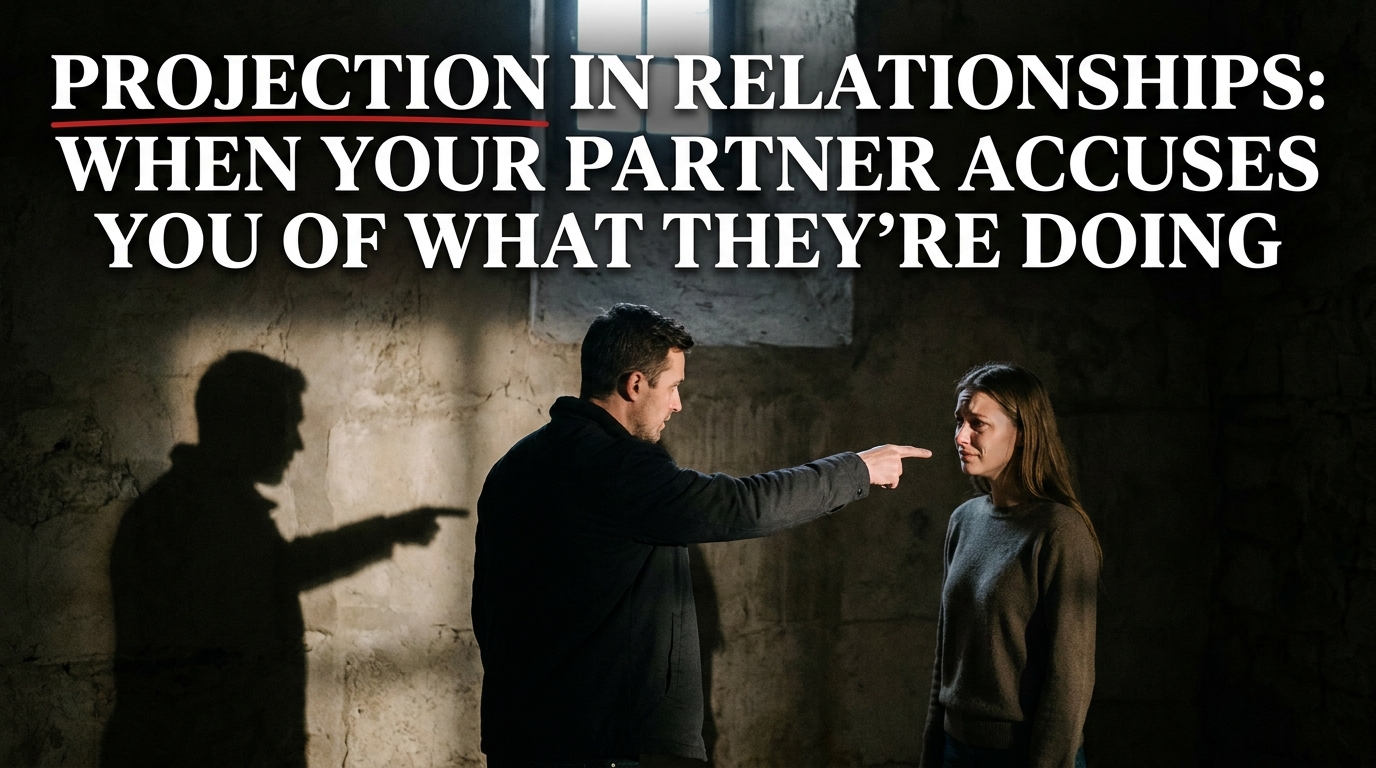
You are sitting across from the person you love, and somehow — again — you are on trial for something you did not do. They are accusing you of being distant, when you have been trying desperately to connect. They are calling you a liar, when you have been the one questioning the inconsistencies in their stories. They are telling you that you are selfish, manipulative, unfaithful — and they say it with such conviction, such apparent pain, that you begin to wonder, as you always seem to wonder in these moments, whether they might actually be right.
They are not right. But the accusation is not random either.
Projection in relationships is one of the most psychologically disorienting experiences a person can have in an intimate partnership — precisely because it inverts reality with such completeness that the person on the receiving end frequently loses their grip on what is actually true. Research published in the Journal of Personality and Social Psychology found that psychological projection is among the most commonly employed unconscious defense mechanisms in interpersonal relationships, with studies suggesting that individuals who engage in projection are often entirely unaware that they are doing so.
A 2019 study from Tilburg University in the Netherlands found a direct and significant correlation between individuals who scored high on measures of guilt and shame about their own behavior and the frequency with which they attributed those exact behaviors to close relationship partners.
This is not a rare psychological curiosity. It is happening in relationships everywhere, every day — and the people absorbing the accusations are often the ones least equipped to recognize the pattern, because the confusion it produces is part of the mechanism itself.

What Is Projection in Relationships — The Psychology Behind It
Projection in relationships is rooted in one of the foundational concepts of psychoanalytic psychology — the defense mechanism first comprehensively described by Sigmund Freud and later expanded by his daughter Anna Freud in her landmark 1936 work, The Ego and the Mechanisms of Defense.
In Freud’s original framework, psychological projection is the unconscious process by which an individual attributes their own unacceptable thoughts, feelings, impulses, or behaviors to another person. The mechanism functions as a psychological pressure valve — when internal content becomes too threatening, too shameful, or too cognitively dissonant to consciously acknowledge, the mind relocates it outward. The feeling does not disappear. It simply gets reassigned to a safer external address.
In the context of intimate relationships, this process takes on a specific and particularly painful form. The partner who is engaging in projection is not typically conscious of doing so. They are not, in most cases, deliberately manufacturing false accusations as a manipulation strategy — though in some presentations, particularly those associated with narcissistic or antisocial personality features, the line between unconscious projection and conscious deflection becomes significantly blurred.
What the projecting partner experiences internally is the unbearable weight of their own guilt, shame, inadequacy, or unacceptable desire. What emerges externally is an accusation directed at you — with the emotional conviction of someone who genuinely believes what they are saying, because at the level of their felt experience, they do believe it.
The result for the person receiving the projection is a specific and deeply disorienting psychological experience: being accused, with apparent sincerity and emotional intensity, of something that is not true — while simultaneously watching your partner display the exact behavior they are accusing you of, seemingly without any awareness of the contradiction.
The Psychological Roots: Why People Project in Relationships
Understanding why projection in relationships occurs is not about excusing the harm it causes. It is about understanding the psychological architecture that produces it — because that understanding is essential both for recognizing the pattern and for making informed decisions about how to respond to it.
Shame and the Unbearable Self
At the deepest level, projection is almost always a response to shame — not guilt, which is the uncomfortable feeling that you have done something wrong, but shame, which is the devastating conviction that you are something wrong. Shame researcher Dr. Brené Brown describes shame as the intensely painful feeling that we are unworthy of love and belonging — and it is precisely that intolerability that makes the mind reach for projection as a relief mechanism.
When a person is doing something in a relationship that, if fully consciously acknowledged, would produce intolerable shame — lying, betraying, manipulating, withdrawing — the psyche faces an impossible choice between acknowledging the self-indicting behavior and destroying the self-concept, or externally relocating the behavior and preserving it.
Projection chooses preservation. The behavior is not mine — it is yours. The accusation is not a confession — it is a deflection. And the projecting partner, genuinely experiencing you as the source of the very problem they are creating, pursues the accusation with the emotional authenticity of someone who believes themselves to be the aggrieved party.
Cognitive Dissonance and the Need for Internal Consistency
Cognitive dissonance — the psychological discomfort produced by holding two contradictory beliefs simultaneously — is one of the most powerful drivers of unconscious projection in relationships. When a person’s behavior fundamentally contradicts their self-image, the mind works urgently to resolve the contradiction.
For a person who identifies as honest, the realization that they are lying creates unbearable cognitive dissonance. The resolution that projection offers is elegant in its simplicity: I am not the liar. You are. The dissonance dissolves. The self-image is preserved. And the external accusation is experienced as entirely genuine — because internally, the distortion is complete.
Attachment Wounds and Early Relational Learning
For many individuals, projection in relationships is not just a situational defense mechanism. It is a deeply ingrained relational pattern rooted in early attachment experience. Children who grew up in environments where their own needs, feelings, and perceptions were consistently denied, dismissed, or blamed back onto them — “you’re making me feel this way,” “you’re too sensitive,” “if you hadn’t done that, I wouldn’t have reacted like this” — often internalize a relational template in which the assignment of blame to the other person is the default response to emotional discomfort.
As adults, these individuals do not consciously choose to project. They relate. They engage in the interpersonal dynamic that their nervous system has always known — one in which their own discomfort is someone else’s fault, and their own unacceptable behavior is someone else’s crime.
“Projection is the mind’s way of putting down a weight it cannot carry — by placing it quietly, and without consent, onto the person standing closest to it.”

What Projection in Relationships Actually Looks Like — Real Patterns
The theoretical framework of projection becomes most useful when it is grounded in the specific, recognizable patterns that appear in real relationship dynamics. The following are among the most commonly documented manifestations of projection in intimate partnerships.
The Cheating Accusation
This is perhaps the most classically recognized form of relational projection. A partner who is being unfaithful — or who is experiencing strong attraction or desire outside the relationship that they cannot consciously acknowledge — begins to accuse their partner of exactly that behavior. The accusations may be constant, seemingly baseless from the accused partner’s perspective, and accompanied by monitoring behaviors — checking phones, demanding location updates, creating scenes about interactions with others — that feel wildly disproportionate to any actual evidence.
The person being accused, bewildered by the intensity of the suspicion directed at them, often spends enormous amounts of emotional energy proving their fidelity and attempting to reassure their partner — while the actual infidelity or its emotional precursors remain entirely unexamined in the person making the accusation.
The Manipulation Accusation
When a partner who engages in controlling, manipulative, or emotionally coercive behavior accuses their partner of being manipulative — of “always twisting things,” of “playing games,” of “trying to control everything” — they are often describing their own behavioral repertoire with striking accuracy, while experiencing genuine conviction that the accusation is directed appropriately.
This form of projection is particularly disorienting for the person receiving it, because they are typically not engaging in manipulation — but they may be responding to their partner’s manipulation in ways that, taken out of the context of the larger dynamic, could be framed as resistance or pushback. The projecting partner selects these moments, removes them from context, and presents them as evidence of the accusation — a process that further disorients the target and deepens the confusion about who is actually driving the relational dynamic.
The Emotional Unavailability Accusation
A partner who is emotionally withdrawn, avoidant, or genuinely unable to maintain consistent emotional presence frequently projects this quality onto their partner. “You’re so cold.” “You never really connect with me.” “You’re not emotionally available.” These accusations are delivered with the pain and frustration of someone who genuinely experiences their partner as the source of the emotional distance — without any conscious awareness that the distance they are experiencing is, in large part, emanating from themselves.
This form of projection creates a particularly painful dynamic for the accused partner, who is typically making genuine and often exhausting efforts to create emotional connection — and who is being simultaneously penalized for their efforts and blamed for their absence.
The Selfishness Accusation
Partners who consistently prioritize their own needs, who struggle with genuine empathy or reciprocity, or who relate to the partnership primarily through the lens of what it provides for them, frequently accuse their partners of being selfish. Every request the partner makes for their own needs to be considered becomes evidence of the partner’s selfishness. Every moment the partner spends on their own interests or wellbeing is framed as a failure to prioritize the relationship.
The projecting partner, experiencing their own self-focus as entirely reasonable and their partner’s self-advocacy as an affront, pursues the accusation with complete apparent sincerity — while the actual pattern of whose needs consistently dominate the relationship remains entirely invisible to them.

The Impact of Projection on the Person Receiving It
The psychological consequences of sustained exposure to a partner’s projection are serious, well-documented, and often persist long after the relationship has ended. Understanding these impacts is essential — both for validating the experience of those living within it and for comprehending the full scope of why projection in relationships causes the harm that it does.
Erosion of Reality Testing
The most fundamental and most damaging impact of sustained relational projection is its effect on the target’s capacity for what psychologists call “reality testing” — the ability to accurately distinguish between what is objectively occurring and what is being suggested or implied by someone else.
When a person you love and trust accuses you, consistently and with apparent emotional sincerity, of behaviors and qualities that do not align with your own experience of yourself, the cognitive weight of the sustained accusation begins to erode your confidence in your own perceptions. You begin to wonder whether you are the manipulative one. Whether you are the distant one. Whether you are, in some way you cannot fully see, the problem.
This erosion of reality testing — when it reaches its more severe expressions — is clinically indistinguishable from the effects of gaslighting. In fact, projection and gaslighting frequently operate in concert, with projection providing the content of the distorted reality and the projecting partner’s apparent sincerity providing the social proof that makes the distortion believable.
Chronic Self-Doubt and the Internal Critic
Living within a sustained projection dynamic installs what many survivors describe as a permanent internal critic — a voice that reflexively questions their own motives, their own perceptions, their own character. This internal critic is not a pre-existing feature of the person’s psychology. It is a direct psychological import from the projecting partner’s accusation pattern.
Over time, the external accusations are internalized. You no longer need your partner to accuse you — you have learned to accuse yourself first, preemptively, in an attempt to stay one step ahead of the next indictment. This pattern of self-directed blame can persist for years after the relationship ends, requiring deliberate therapeutic work to dismantle.
Emotional Exhaustion and Identity Loss
The sustained cognitive and emotional effort required to defend against projections — to continually provide evidence of your own innocence, to attempt to communicate the reality of what is actually happening, to manage your partner’s emotional state while simultaneously processing your own confusion — is genuinely exhausting in a way that compounds over time.
Many people in projection-heavy relationships describe a gradual but profound loss of self — a sense that the person they were before the relationship, with their clear sense of their own character and their own reality, has been replaced by someone who is perpetually uncertain, perpetually defensive, and perpetually seeking permission to trust their own experience.
Projection vs. Gaslighting — Understanding the Difference and the Overlap
Because projection and gaslighting so frequently co-occur in unhealthy relationship dynamics, and because their effects on the target are remarkably similar, it is worth clarifying the distinction between the two.
Projection is primarily about the projecting partner’s internal psychological process — the unconscious externalization of their own unacceptable content onto another person. It is about where their discomfort goes.
Gaslighting is primarily about the target’s perception of reality — the deliberate or semi-deliberate manipulation of the target’s sense of what is real, what happened, and what they are experiencing. It is about what your reality becomes under sustained manipulation.
The overlap occurs because projection, when consistently applied over time, produces a gaslighting effect in the target — regardless of whether the projecting partner has any conscious intent to manipulate reality. The target ends up in the same disoriented, self-doubting place whether the mechanism was conscious manipulation or unconscious defense.
In relationships involving narcissistic personality features, the two often operate simultaneously and deliberately — the projection provides the accusation, and conscious gaslighting reinforces it when the target pushes back. In relationships driven primarily by insecure attachment or unresolved shame, the projection may be genuinely unconscious — but the harm to the target is no less real.
“Being accused by someone you love of the exact thing they are doing to you is not just confusing — it is a specific kind of psychological violence that rewrites your relationship with your own truth.”

How to Recognize and Respond to Projection in Your Relationship
Recognizing projection in relationships while you are inside one requires a specific kind of dual awareness — the capacity to hold both your own experience and a broader psychological framework simultaneously. The following strategies are designed to help you develop and sustain that awareness.
Document Your Own Experience Consistently
One of the most powerful tools against the reality-eroding effects of sustained projection is the practice of documentation. Keep a private journal — accessible only to you — in which you record specific incidents, your honest experience of them, and the contrast between what was accused and what you actually observed in yourself and in your partner.
This practice serves two functions. First, it provides a concrete external record that resists the revisionism that projection dynamics tend to produce over time. Second, it helps you develop and maintain a clear narrative of your own experience — one that exists independently of your partner’s version of events.
Name the Pattern Without Escalating the Conflict
When a specific projection is occurring in real time, one approach that can be effective — particularly with partners who have some capacity for self-reflection — is calm, non-accusatory naming of the pattern. Not “you’re projecting” — which will almost certainly be received as an attack and trigger defensiveness — but something more grounded: “I notice that when you feel distant from me, you often tell me that I’m the one pulling away. I want to understand what’s actually happening between us, not just respond to the accusation.”
This framing invites reflection without launching a counter-attack, and it models the kind of honest self-examination that the projection is specifically designed to avoid.
Maintain a Strong Relationship With Your Own Reality
In a projection-heavy relationship, your sense of your own reality becomes a resource that needs active maintenance. This means regularly checking in with trusted people outside the relationship — friends, family members, or a therapist — who can provide a reality anchor that your partner’s projections are actively trying to dislodge.
It means taking your own perceptions seriously rather than automatically deferring to your partner’s version of events. It means developing the internal practice of asking yourself, before accepting an accusation, whether it actually reflects your honest self-assessment — or whether you are simply feeling the pressure of someone else’s conviction.
Seek Professional Support — For Yourself
Individual therapy is one of the most valuable resources available to someone navigating a relationship with significant projection dynamics. A skilled therapist can help you distinguish between legitimate self-examination and the internalized accusation patterns that projection installs. They can help you rebuild your reality-testing capacity, process the emotional consequences of sustained doubt and self-blame, and develop the clarity you need to make informed decisions about the relationship’s future.
This therapeutic work is valuable regardless of whether you ultimately remain in or leave the relationship. The clarity it produces is yours — independent of any decision about the partnership.
Assess Whether Change Is Possible
The most important long-term question in a relationship with significant projection dynamics is not whether the pattern exists — it is whether the projecting partner has the self-awareness, the motivation, and the capacity for genuine change.
Change is theoretically possible. It requires the projecting partner to develop the ability to tolerate the shame and guilt that the projection is designed to protect them from — to bring their own unacceptable content into conscious awareness and take genuine responsibility for it. This is extraordinarily difficult work, and it almost always requires professional therapeutic support to achieve.
If your partner consistently dismisses psychological explanations, refuses to examine their own patterns, responds to every honest conversation about the dynamic with escalating projection or defensive attack, and shows no genuine movement toward self-reflection over extended time — that absence of movement is itself significant data about the relationship’s prognosis.

When Projection Is Part of a Larger Pattern of Emotional Abuse
It is essential to address the reality that in some relationships, projection does not operate as a standalone psychological defense mechanism. It operates as one component within a broader pattern of emotional abuse — alongside gaslighting, coercive control, verbal aggression, and deliberate reality manipulation.
In these contexts, what may appear to be unconscious psychological projection is often more accurately understood as a strategic tool — used to keep the target off-balance, to preemptively establish a narrative of the target’s culpability, and to deflect accountability from the actual source of harm in the relationship.
If you recognize the projection dynamic described in this article, and if it co-occurs with other patterns — intimidation, isolation, chronic disrespect, financial control, threats, or physical harm — please take that combination seriously. Reach out to a trusted support person or mental health professional. Contact the National Domestic Violence Hotline at 1-800-799-7233 if you feel unsafe. The presence of multiple controlling patterns significantly changes both the risk level and the appropriate response strategy.
Reclaiming Your Sense of Reality After Projection
If you have been living inside a projection dynamic — whether you are still in the relationship or have recently left it — the work of reclaiming your own sense of reality is one of the most important things you can do for your psychological recovery.
This work begins with one foundational reassertion: your experience of yourself is legitimate data. Your honest self-assessment matters. The persistent accusation that you were something you were not — that you were the liar, the manipulator, the unfaithful one, the cold one, the selfish one — does not become true through the force of your partner’s conviction. It remains false regardless of how sincerely it was delivered or how thoroughly you were pressured to accept it.
Rebuilding reality after sustained projection takes time. It requires patience with yourself — with the moments when the internalized critic is louder than your own voice, with the days when the accumulated self-doubt feels more real than your honest self-knowledge.
But it is possible. And it begins with the simple, radical act of deciding to trust yourself again — to take your perceptions seriously, to extend to yourself the same compassion and basic benefit of the doubt that you extended to the person who accused you of everything they could not face in themselves.
You were not what they said you were. You are allowed to know that. And knowing it — fully, deeply, without the constant need for external confirmation — is the beginning of coming home to yourself.
A Final Word: Understanding Projection Is Not About Blame — It Is About Clarity
The goal of understanding projection in relationships is not to create a new category of villain — the projecting partner as deliberate psychological predator. For many individuals who project, the mechanism is genuinely unconscious, rooted in unresolved shame and early attachment wounds that they did not choose and may not even be fully aware of.
The goal is clarity. The clarity to recognize a pattern that is causing you harm. The clarity to stop absorbing accusations that were never yours to carry. The clarity to see the relationship as it actually is — not as the distorted version constructed by a partner who could not face their own reflection — and to make informed, self-respecting decisions about your future based on that clear-eyed assessment.
You deserved a partner who looked inward when something was wrong. Who took responsibility for their own shadow. Who brought you their honest self rather than their deflected shame.
That is still what you deserve. And knowing the name of what has been happening to you is the first step toward choosing it.
💾 Save this article — your clarity is worth protecting, and this is worth reading again.
📤 Share it with someone who has spent too long apologizing for things that were never their fault.
➕ Follow Truthsinside.com for psychology and relationship content that helps you see beneath the surface of what is really happening.
📃 Related article: Anxious Attachment: Signs, Causes, and How to Heal
Frequently Asked Questions
Q1: How can I tell the difference between my partner projecting and me actually having the flaw they are describing?
This is one of the most important questions to sit with honestly — and it requires genuine self-examination rather than reflexive defensiveness. The clearest indicators that you are dealing with projection rather than legitimate feedback are these: the accusation is inconsistent with how the majority of people who know you well perceive you;
the accusation appears specifically in contexts where your partner seems to be experiencing guilt or discomfort about their own behavior; objective evidence consistently contradicts the accusation; and the pattern is one of accusation without genuine dialogue — your partner makes the claim but shows no real interest in understanding your perspective or in examining the dynamic together. If you can honestly examine the accusation, check it against multiple sources of genuine self-knowledge, and it still does not hold, that is meaningful information.
Q2: Can someone project without knowing they are doing it?
Yes — and in fact, the majority of psychological projection operates entirely outside conscious awareness. This is what defines it as a defense mechanism rather than a deliberate manipulation strategy. The projecting partner genuinely experiences the accused person as the source of the quality or behavior they are projecting. Their conviction is real. Their pain is real. What is not real is the accuracy of the attribution. The unconscious nature of the process does not reduce its impact on the target, but it does suggest that confronting the person directly about “projecting” is unlikely to be received as useful feedback, since they have no conscious awareness of the process.
Q3: Is projection always a sign of a toxic or abusive relationship?
Not necessarily. Mild, occasional projection is a genuinely common feature of most close relationships — because projection is a universal human defense mechanism that everyone uses to some degree. The distinction between normal and problematic projection lies in frequency, severity, and the projecting partner’s capacity for self-reflection when the pattern is pointed out. Occasional projection that a partner can acknowledge and examine with some degree of honesty is very different from sustained, pervasive projection that consistently inverts reality, resists all self-reflection, and produces significant harm to the other partner’s psychological wellbeing.
Q4: What should I do if I recognize that I have been the one projecting in my relationship?
The self-awareness required to recognize your own projection is genuinely significant and deserves acknowledgment. If you recognize yourself as the projecting partner — if you can see that you have been attributing your own fears, guilt, or unacceptable impulses to your partner — the most important next steps are taking full, undefended responsibility for the pattern with your partner, and engaging in professional therapeutic work to understand and address the underlying shame, attachment wounds, or cognitive patterns driving the projection.
This work is challenging precisely because it requires you to face the internal content that the projection was designed to shield you from. But it is the only path toward genuine change — and toward the kind of relationship that does not require either person to carry the other’s shadow.
Q5: How do I recover my sense of self after being on the receiving end of sustained projection for a long time?
Recovery from sustained projection dynamics is a real and significant psychological process that benefits enormously from professional support. Key elements of recovery include rebuilding your reality-testing capacity through honest self-examination and trusted external feedback; working with a therapist to identify and dismantle the internalized critical voice that the projection installed; deliberately reconnecting with your own perceptions, values, and self-knowledge as legitimate and trustworthy sources of information; and allowing yourself to grieve both the relationship and the version of yourself that was gradually eroded within it.
Many survivors of projection-heavy relationships find that the recovery process, while genuinely difficult, ultimately produces a level of self-awareness and emotional clarity that they describe as one of the most transformative experiences of their lives.
🎵 Music
Maren Lull is a singer-songwriter who writes from the places most people don’t talk about out loud.
Not the dramatic grief. Not the obvious heartbreak. The quiet kind — the ordinary Tuesday emptiness, the habit of reaching for someone who isn’t there anymore, the particular exhaustion of being strong for so long that the strength itself wears thin.
Her music lives at the intersection of emotional honesty and soft beauty — breathy vocals over gentle piano, slow tempos, lyrics that feel less like songs and more like something you wrote in a private notebook at two in the morning and never showed anyone.
Maren Lull writes for the people who feel everything deeply and say very little about it. For the ones who listen to sad music not because they want to feel worse — but because being understood, even by a song, makes the feeling easier to carry.
📱 Follow Maren Lull:
→ Spotify
→ Apple Music
→ Youtube
→ Audiomack