
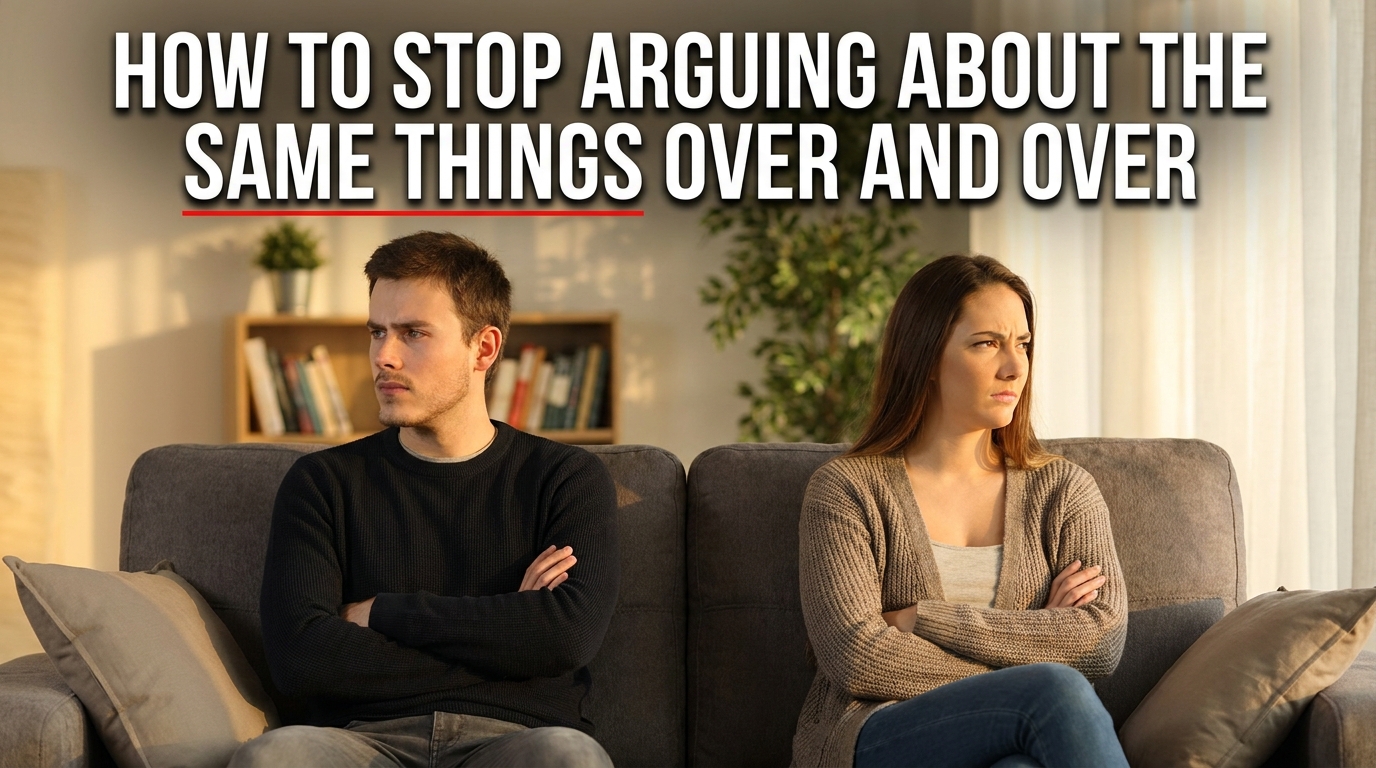
Every couple argues. But when you find yourself having the exact same fight for the hundredth time — same words, same tone, same slammed doors — something deeper is going on beneath the surface. Research from the Gottman Institute shows that 69% of relationship conflicts are perpetual problems, meaning they never fully get resolved. That number might feel discouraging, but here is the truth: the goal is not to eliminate conflict. The goal is to understand it — and finally break free from the same argument loop that keeps pulling you both under.
If you feel like you and your partner are stuck on repeat, you are not broken. You are human. And this article is going to show you exactly why it keeps happening and what you can actually do about it.

Why You Keep Having the Same Fight Over and Over
The first thing you need to understand is this: the argument you think you are having is almost never the real argument.
When couples fight about dishes left in the sink, they are rarely actually fighting about dishes. When they argue about who forgot to pay a bill or who spends too much time on their phone, the surface-level topic is just the entry point. Underneath it is something much older, much more personal, and much more emotionally loaded.
Psychologists call this emotional layering. The top layer is the visible conflict — the thing you are yelling about. But the layer below it is the emotional need that is not being met. And the layer below that is often a deep-rooted fear, a wound from childhood, or a pattern that was modeled for you by the people who raised you.
Dr. John Gottman, one of the world’s leading researchers on relationships, found that recurring arguments are almost always tied to fundamental differences in personality or unmet emotional needs. These are not problems that get solved in one conversation. They are problems that get managed — through empathy, communication, and intentional change.
The reason you keep circling back to the same fight is because the emotional need underneath it has never actually been addressed. You resolve the surface issue temporarily, but the wound stays open. And the next time something pokes that wound, the argument erupts again — sometimes over something completely unrelated.
The Hidden Triggers Behind Repetitive Arguments
Understanding your triggers is one of the most powerful things you can do to break the same argument loop. A trigger is any word, tone, behavior, or situation that activates an emotional response in you — usually before your rational brain even has a chance to respond.
Triggers are almost always connected to past experiences. If you grew up in a household where money was a source of constant stress and conflict, any conversation about finances with your partner might immediately put you on the defensive. If you experienced emotional neglect as a child, being ignored by your partner — even casually — might activate a deep fear of abandonment that floods your nervous system.
When you are triggered, you are no longer fully in the present. Your body and brain are responding to an old story. And your partner, who does not have access to that story, experiences your reaction as disproportionate, confusing, or unfair. They then get defensive. And suddenly you are both in fight-or-flight mode, saying things you do not mean, and reinforcing the very pattern you are trying to escape.
Here are some of the most common hidden triggers in relationships:
- Fear of being controlled — leads to arguments about independence, decisions, or autonomy
- Fear of abandonment — leads to arguments about attention, time, and prioritization
- Fear of not being good enough — leads to arguments about criticism, comparison, or effort
- Fear of being unheard — leads to arguments about communication, dismissal, or being talked over
- Fear of financial insecurity — leads to arguments about spending, saving, and financial decisions
Identifying which fears live inside you — and which ones live inside your partner — is the beginning of real change.

The Four Communication Traps That Keep You Stuck
Dr. Gottman identified four specific communication patterns that are so destructive to relationships that he named them the Four Horsemen. These are patterns that, if left unchecked, will keep you locked in the same argument loop indefinitely — and eventually predict relationship breakdown with startling accuracy.
1. Criticism
This is different from a complaint. A complaint focuses on a specific behavior: “You forgot to call me and I felt worried.” Criticism attacks the person’s character: “You never think about anyone but yourself.” When arguments escalate into personal attacks, the other person stops listening to the content and starts defending their identity.
2. Contempt
This is the single most dangerous communication pattern in relationships. Contempt includes eye-rolling, sarcasm, mockery, and any behavior that communicates that you see your partner as beneath you. Contempt signals disgust — and it is impossible to resolve conflict constructively when one or both partners feel disrespected at that level.
3. Defensiveness
When we feel attacked, the natural response is to defend ourselves. But defensiveness blocks listening. If every concern your partner raises is met with “Well, what about what YOU do,” the conversation goes nowhere and the original issue never gets addressed.
4. Stonewalling
This is when one partner emotionally shuts down, goes silent, or physically leaves the conversation. It often happens because the person is genuinely overwhelmed — their nervous system is flooded. But to the partner on the receiving end, it feels like abandonment or punishment.
Recognizing which of these patterns you default to — and which ones your partner defaults to — is not about blame. It is about awareness. Because you cannot change what you cannot see.
“The goal of resolving conflict is not to win the argument. It is to understand the person you chose to love — and to be understood in return.”
How to Break the Pattern: Practical Steps That Actually Work
Breaking the same argument loop requires more than just “communicating better.” It requires a structural change in the way you and your partner approach conflict — before it starts, during it, and after it ends.
Before the Argument: Create a Safe Environment
One of the most underrated relationship skills is the ability to talk about how you argue during a moment of calm. This means having intentional conversations about your communication patterns when neither of you is triggered, emotional, or defensive.
Ask each other questions like:
- What makes you feel unheard during an argument?
- What do I do that tends to escalate things between us?
- What would help you feel safe enough to stay in a difficult conversation?
These conversations build what psychologists call emotional safety — the sense that you can be honest with your partner without fear of judgment, punishment, or rejection. Without emotional safety, no conflict resolution strategy will work long-term.

During the Argument: Slow Everything Down
When an argument starts to escalate, the worst thing you can do is keep pushing. Neuroscience shows that once your heart rate exceeds 100 beats per minute, your ability to think rationally, listen effectively, and empathize with another person drops dramatically. You are no longer problem-solving. You are surviving.
This is why taking a break — a real, intentional break — is not avoidance. It is strategy.
When you feel the conversation escalating, try saying: “I want to talk about this because it matters to me, and I want to be present for it. Can we take 20 minutes and come back to this?” Then use that 20 minutes to genuinely calm your nervous system — not to rehearse your arguments.
During the conversation itself, practice active listening rather than reactive listening. Active listening means you are focused on understanding your partner’s experience, not on planning your rebuttal. Reflect back what you heard. Ask clarifying questions. Validate their feelings before defending your own position.
Try this formula: “I hear that you felt [emotion] when [situation]. Is that right?”
It sounds simple. It is not easy. But it is transformational.
After the Argument: The Repair Conversation
Most couples end an argument and then move on — without ever actually discussing what happened. The fight ends because someone apologizes, or because you both get tired, or because life moves forward and the topic gets buried. Until next time.
The repair conversation changes this. It is a calm, post-conflict check-in where both partners reflect on what happened — not to reopen the wound, but to understand it better.
In a repair conversation, you might discuss:
- What triggered each of you, and why
- What each person needed but did not ask for directly
- What you each wish you had said or done differently
- What you can do next time to handle it better
Repair conversations build relational intelligence — the shared understanding between two people that deepens over time. Couples who practice repair conversations regularly report significantly higher satisfaction and significantly lower rates of recurring conflict.

When the Argument Is Really About Unmet Needs
Here is the shift that changes everything: Start translating complaints into needs.
Every recurring argument contains, buried inside it, an unmet emotional need. When your partner says “You never make time for me,” the complaint is about time. But the need is for connection, for feeling like a priority, for love expressed in quality time.
When you or your partner can identify and articulate the need beneath the complaint — and when the other person can hear that need with compassion rather than defensiveness — the entire dynamic of the conversation shifts.
Try this exercise with your partner: Next time you feel an argument forming, pause and ask yourself, “What do I actually need right now?” Not what you want to say. Not what you want them to fix. What do you need to feel — to feel loved, respected, secure, seen, or heard?
Then say that instead.
This does not mean you never address problems directly. It means you address them from a place of vulnerability rather than attack. And vulnerability, unlike aggression, invites connection instead of defense.
“Underneath every repeated argument is a person who is trying to say something they do not yet have the words for. Your job — together — is to find those words.”
The Role of Therapy and Professional Support
There is no shame in needing help to break deeply ingrained patterns. In fact, seeking couples therapy is one of the most proactive, self-aware things two people can do for their relationship.
A skilled therapist does not take sides. They help both partners identify the patterns underneath the conflict, develop communication tools tailored to the specific dynamic in the relationship, and create a structured space where difficult conversations can happen safely.
Research published in the Journal of Marital and Family Therapy found that approximately 70% of couples who enter therapy show significant improvement. The couples who benefit most are those who seek help early — before resentment has had years to calcify.
If therapy feels out of reach financially or logistically, structured self-help resources like the Gottman Institute’s books and workbooks, or apps designed for couples communication, can also be genuinely effective starting points.
The most important thing is this: do not wait until the relationship is on the edge of collapse to ask for help. The time to build better communication patterns is before things fall apart — not after.

Small Daily Habits That Prevent Big Arguments
Breaking the same argument loop is not just about what happens during conflict. It is also about what happens in the everyday moments between conflicts.
Couples who maintain strong emotional connection between arguments are significantly more resilient when conflict does arise. Here are habits that build that connection daily:
Daily check-ins — Even five minutes of genuine, device-free conversation about how each person is feeling can dramatically improve relational attunement. Not “how was your day” — but “what was hard today, and what was good?”
Expressing appreciation intentionally — Gottman’s research shows that healthy relationships maintain a 5:1 ratio of positive interactions to negative ones. Make expressing specific appreciation a daily habit, not a special occasion behavior.
Physical affection outside of conflict — Touch is one of the most powerful regulators of the nervous system. Regular non-sexual physical affection — a hug, a hand on the shoulder, a longer-than-usual kiss — keeps partners physically and emotionally connected.
Respecting each other’s decompression needs — Not everyone processes the day the same way. Some people need to talk. Others need quiet. Knowing and respecting your partner’s decompression style prevents misread signals from becoming unnecessary conflict.
Acknowledging bids for connection — Gottman also identified “bids for connection” as one of the most important predictors of relationship health. A bid is any small attempt one partner makes to connect — a question, a comment, a gesture. Turning toward those bids, rather than away from them, is one of the most powerful things you can do for your relationship every single day.
You Can Break the Loop — But It Takes Both of You
The hard truth about breaking the same argument loop is this: one person cannot do it alone.
If only one partner is doing the self-reflection, making the repairs, and trying to communicate better — while the other continues on autopilot — the pattern will not change. Sustainable change in a relationship requires both people to be willing to look at their own contributions to the dynamic.
That does not mean you both have to do it perfectly. It means you both have to be willing. Willing to be wrong. Willing to be vulnerable. Willing to try something different even when the old pattern feels more familiar and comfortable.
The same argument loop is not a sign that your relationship is failing. It is a sign that there is something important that has not yet been fully heard, understood, or healed. And that is something you can work on — together.
Save This. Share This. Follow for More.
If this article helped you see your relationship patterns in a new way, save it so you can come back to it. Share it with your partner — not as a weapon, but as an invitation to grow together.
Follow Truthsinside.com for more honest, research-backed relationship advice that meets you where you are.
📃 Related article: What Does It Actually Feel Like to Fall in Love? Science + Real Stories
Frequently Asked Questions
Q1: Why do couples keep having the same arguments even after they’ve resolved them?
Because most arguments are resolved on the surface without addressing the underlying emotional need. Until that need is named and met, the conflict will keep returning in different forms.
Q2: Is it normal to argue about the same things in a relationship?
Yes — research shows that 69% of relationship conflicts are perpetual. The goal is not to eliminate recurring differences but to develop better ways of navigating them together.
Q3: How do I know if our arguments are a sign that we’re incompatible?
Recurring arguments alone are not a sign of incompatibility. The more important indicators are whether both partners are willing to grow, whether there is underlying respect and affection, and whether the conflict includes contempt or emotional cruelty.
Q4: What should I do if my partner refuses to work on communication?
Express your needs clearly and without blame. If your partner remains unwilling to engage after repeated honest conversations, seeking individual therapy can help you gain clarity and decide what is best for you.
Q5: How long does it take to break repetitive argument patterns?
There is no fixed timeline. With consistent effort and — ideally — professional support, many couples begin to notice meaningful change within a few months. Deeply ingrained patterns may take longer, but change is possible at any stage of a relationship.
🎵 Music
Maren Lull is a singer-songwriter who writes from the places most people don’t talk about out loud.
Not the dramatic grief. Not the obvious heartbreak. The quiet kind — the ordinary Tuesday emptiness, the habit of reaching for someone who isn’t there anymore, the particular exhaustion of being strong for so long that the strength itself wears thin.
Her music lives at the intersection of emotional honesty and soft beauty — breathy vocals over gentle piano, slow tempos, lyrics that feel less like songs and more like something you wrote in a private notebook at two in the morning and never showed anyone.
Maren Lull writes for the people who feel everything deeply and say very little about it. For the ones who listen to sad music not because they want to feel worse — but because being understood, even by a song, makes the feeling easier to carry.
📱 Follow Maren Lull:
→ Spotify
→ Apple Music
→ Youtube
→ Audiomack