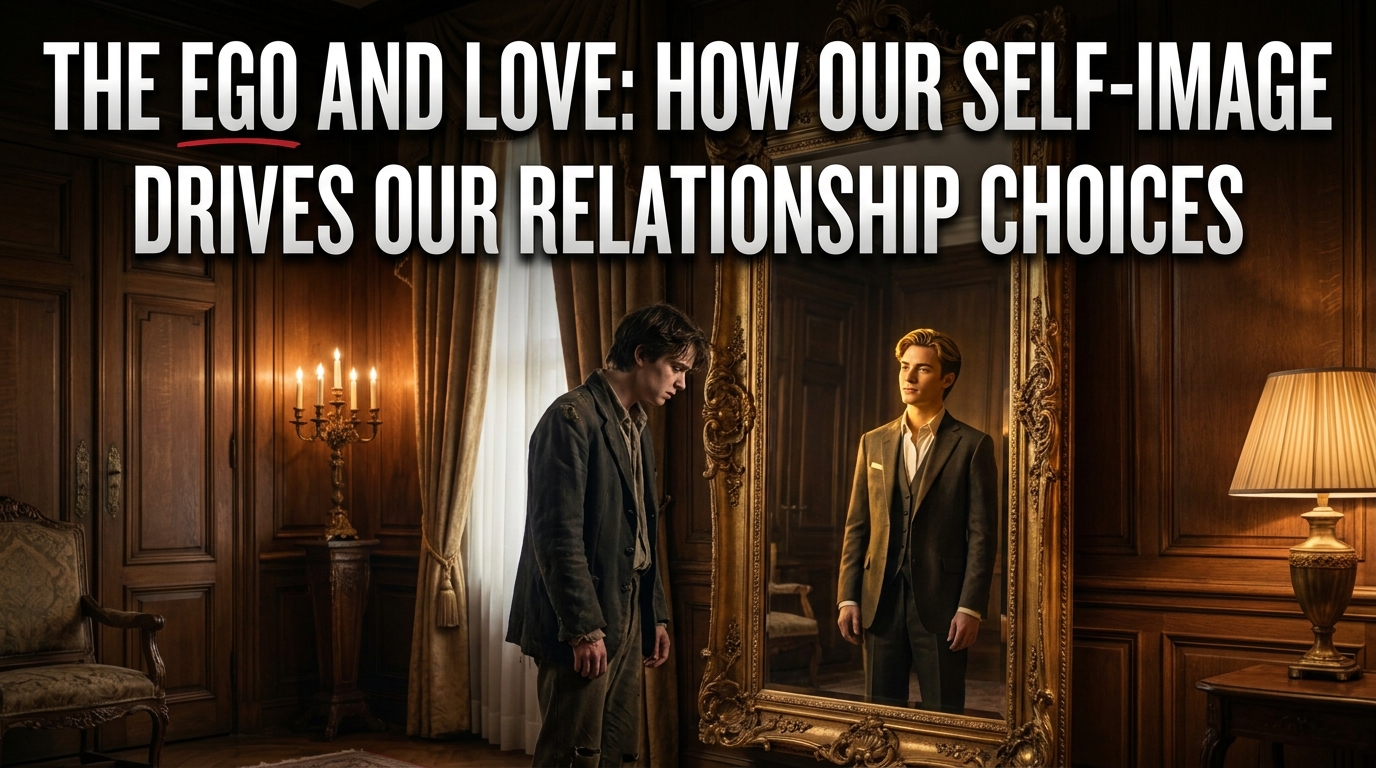
Most people believe they choose their partners based on chemistry, compatibility, or love. But psychology tells a more complicated — and far more revealing — story. At the center of nearly every relationship choice you have ever made sits something you may rarely examine: your ego. Your self-image — the story you carry about who you are, what you deserve, and how much you matter — quietly shapes every person you are drawn to, every boundary you accept or allow to be crossed, and every relationship pattern you repeat across years and partners.
Research in social psychology consistently shows that people do not choose partners randomly. They choose partners who confirm what they already believe about themselves. Understanding the link between ego and love is not about feeding your pride. It is about understanding the invisible force that has been steering your heart all along.

What Is the Ego, Really?
Before we can talk about how the ego shapes love, we need to define what the ego actually is — because it is far more nuanced than the word suggests in everyday conversation.
In popular culture, “ego” is often used as a synonym for arrogance or self-importance. But in psychology, the ego is something much broader and more foundational. Rooted in Freudian theory and expanded by generations of psychologists since, the ego is essentially the mediating structure of the self — the part of your psyche that sits between your primal desires and the demands of the external world.
More practically, the ego is the narrative you carry about who you are. It is the lens through which you interpret your experiences, evaluate your worth, and decide what you do and do not deserve. It is built over years — shaped by how your parents treated you, how your peers responded to you, how your early romantic experiences unfolded, and how the world reflected you back to yourself.
This internal narrative is not always accurate. In fact, it rarely is. The ego is not a mirror — it is a painting, filtered through emotion, memory, and meaning-making. And like any painting, it contains both truth and distortion.
When your ego is healthy, it provides a stable foundation of self-worth that allows you to enter relationships from a place of security and genuine choice. When your ego is wounded — fragile, inflated, or built on false foundations — it drives you toward relationships that confirm its distorted narrative, no matter how painful that confirmation might be.
The Relationship Between Self-Image and Partner Selection
Here is one of the most important things psychology has revealed about human attraction: we are not simply attracted to people we find appealing. We are attracted to people who feel familiar.
And familiarity, in the context of romantic attraction, is almost always about self-image.
Social psychologist Elaine Hatfield and her colleagues identified what they called the matching hypothesis — the finding that people tend to seek out romantic partners who they perceive as roughly equivalent to themselves in terms of attractiveness, social value, and desirability. On the surface, this sounds straightforward. But it goes much deeper than physical appearance.
What the matching hypothesis really reveals is that we calibrate our romantic choices to match our internal sense of what we deserve. If you believe, at a core level, that you are lovable, capable, and worthy of care — you will instinctively seek out partners who treat you that way. You will feel uncomfortable in relationships where you are treated as less, and you will naturally filter out people who do not meet a certain standard of respect.
But if your self-image is wounded — if somewhere beneath the surface you carry the belief that you are too much, not enough, unlovable, or fundamentally flawed — your relational compass will point toward people and dynamics that confirm that belief. You may find yourself repeatedly drawn to emotionally unavailable partners. You may tolerate mistreatment because some part of you believes it is what you deserve. You may sabotage relationships that feel genuinely loving because the kindness feels unfamiliar and, therefore, untrustworthy.
This is not a character flaw. It is psychology. And it can be changed.

The Inflated Ego in Love: When Pride Becomes a Wall
Not all ego-driven relationship problems stem from low self-worth. Some of the most destructive patterns in love come from the opposite direction — an ego that is inflated, brittle, or deeply defended against vulnerability.
An inflated ego in a relationship often presents as:
- An inability to apologize or admit fault
- A tendency to interpret a partner’s needs as personal attacks
- Competitive dynamics where “winning” the argument matters more than resolving it
- Difficulty truly listening because the ego is too busy defending its position
- A pattern of choosing partners who are clearly “lesser” in some way — in status, confidence, or assertiveness — so that the ego always feels superior
What is important to understand is that an inflated ego is almost always a defense mechanism. Beneath the bravado, the certainty, and the need to be right, there is usually a self-image that is far more fragile than it appears. The inflation is a wall built to protect a wound.
Psychologist Alfred Adler spent much of his career studying what he called the inferiority complex — the idea that feelings of inadequacy and inferiority are so unbearable that the psyche constructs elaborate defenses to compensate for them. An inflated, domineering ego is often one of those defenses.
In love, this plays out as control. As emotional unavailability. As the need to always be the one who cares less, who walks away first, who holds the power in the dynamic. Because if you never fully surrender to love, the ego tells you, you can never be truly hurt by it.
“The ego does not fall in love. The ego negotiates love — calculating what it can gain, what it must protect, and what it cannot afford to feel. Real love begins where the ego learns to let go.”
The Wounded Self-Image: How Low Self-Worth Shapes Love
On the other side of the inflated ego is the wounded self-image — and this is where some of the most heartbreaking relationship patterns are born.
When a person carries a deep-seated belief that they are not enough — not attractive enough, not smart enough, not worthy of consistent love — that belief does not stay tucked away in private moments of self-doubt. It actively shapes their relationship choices, their behavior within relationships, and the way they interpret their partner’s actions.
People-pleasing is one of the most common expressions of a wounded self-image in relationships. When you do not believe you are inherently worthy of love, you compensate by trying to earn it. You become hypervigilant to your partner’s needs, suppressing your own. You say yes when you mean no. You apologize for things that are not your fault. You make yourself smaller in order to be easier to love — and in doing so, you often attract partners who are comfortable with that imbalance.
Staying in relationships that have long passed their expiration date is another pattern tied to low self-worth. Leaving requires the belief that something better is possible — and that you deserve it. When neither of those things feels true, staying in something painful feels safer than stepping into the unknown.
Jealousy and possessiveness, too, are deeply rooted in self-image. Research published in the Journal of Social and Personal Relationships found that individuals with lower self-esteem reported significantly higher levels of relationship jealousy — not because their partners were more likely to be unfaithful, but because their internal narrative told them they were not enough to keep someone loyal.
None of these patterns are permanent. But they cannot be changed without first being seen.

Ego Defense Mechanisms and How They Sabotage Intimacy
Sigmund Freud introduced the concept of ego defense mechanisms — unconscious psychological strategies the ego uses to protect itself from anxiety, pain, and unwanted truths. In everyday life, these mechanisms serve a purpose. In intimate relationships, they can be profoundly destructive.
Here are the most common ego defense mechanisms that sabotage love:
Projection
This is when you attribute your own unacknowledged feelings or qualities to your partner. If you are insecure but cannot admit it, you might accuse your partner of being insecure. If you are tempted to stray but cannot face that impulse, you might become convinced that your partner is unfaithful. Projection keeps the ego safe from self-examination — at the cost of constantly distorting your perception of your partner.
Rationalization
This is when the ego constructs logical-sounding reasons for choices that are actually driven by fear or self-protection. “I didn’t call because I was busy” when the truth is “I didn’t call because I was terrified of how much I’m starting to feel.” Rationalization allows the ego to avoid vulnerability by hiding behind reason.
Denial
In relationships, denial shows up as the refusal to acknowledge problems that are clearly present. Denial keeps the ego comfortable in the short term while allowing damage to accumulate beneath the surface. By the time denial breaks down, the relationship may already be beyond repair.
Displacement
This is when emotions that belong in one context get redirected toward a safer target. You are furious at your boss but you cannot express it there, so you come home and pick a fight with your partner over something minor. The real source of the emotion remains unaddressed, and your partner absorbs the impact of feelings that were never about them.
Withdrawal and Avoidance
Perhaps the most relationship-damaging of all, emotional withdrawal is the ego’s ultimate self-protection strategy. When intimacy begins to feel threatening — when vulnerability feels like too much of a risk — the ego retreats. It builds walls, creates emotional distance, and tells the person inside that isolation is safety.
Recognizing these patterns in yourself is not comfortable. But it is the beginning of being able to love without armor.
How a Healthy Ego Transforms Your Relationships
Here is the truth that shifts everything: the goal is not to destroy the ego. The goal is to develop a healthy, grounded, flexible ego — one that can hold a stable sense of self without requiring the relationship to constantly confirm it.
A person with a healthy ego enters love differently. They do not need their partner to be perfect because their self-worth is not contingent on their partner’s behavior. They can hear criticism without collapsing. They can express needs without shame. They can tolerate their partner’s emotional distance on a difficult day without interpreting it as rejection or abandonment.
They can be vulnerable — genuinely, openly vulnerable — because the ego is secure enough to survive being seen.
Psychologist Carl Rogers described this as unconditional positive regard toward the self — the capacity to hold yourself with warmth and acceptance even when you are flawed, failing, or uncertain. When you can offer that to yourself, you stop requiring your partner to fill the gap. And paradoxically, when you stop requiring it, the relationship has space to offer it freely.
Building a healthier self-image is not a weekend project. It is a gradual, often nonlinear process that may involve therapy, intentional self-reflection, new relational experiences, and a willingness to challenge the stories you have carried about yourself for decades.
But every step in that direction changes the quality of love you are able to give — and the quality of love you are willing to receive.
“You will never be able to receive more love than your self-image believes you deserve. Healing your ego is not vanity. It is the most generous thing you can do for every relationship in your life.”

The Ego in Long-Term Relationships: When the Mirror Shifts
Something fascinating — and sometimes painful — happens in long-term relationships. Over time, a partner begins to serve as a mirror. They reflect back parts of you that you may not have seen, or may have been actively avoiding.
Early in a relationship, the ego is often protected by the honeymoon effect — the neurochemical flood of new love that filters out information that does not fit the idealized narrative. But as that initial intensity settles, the mirror becomes clearer. Your partner begins to see you in your ordinariness, your contradictions, and your unresolved wounds. And you begin to see theirs.
This is the moment many relationships become vulnerable. The ego, suddenly exposed, has two choices: defend or grow.
When it defends, it often does so through blame, resentment, or emotional withdrawal. It tells you that your partner has changed, that you made a mistake, that you deserve better — when in truth, what has changed is simply that the protective fog of new love has lifted and you are now doing the real work of intimacy.
When it chooses to grow, something extraordinary becomes possible. Long-term relationships become one of the most powerful vehicles for psychological development available to human beings. The sustained, intimate encounter with another person — with all their differences, their needs, and their imperfections — gradually erodes the rigidity of the ego and opens space for a deeper, more integrated sense of self.
This is why the relationships that survive and deepen over decades are almost never the ones between two perfect people. They are the ones between two people who were willing to keep growing — together and individually — even when it was uncomfortable.

Practical Steps to Heal Your Self-Image and Love More Freely
Understanding the psychology is the first step. Here is how to begin translating that understanding into real change:
Notice your relationship patterns without judgment. Look back at your significant relationships and ask: What did they have in common? What role did you consistently play? What did you repeatedly tolerate or seek out? Patterns are data, not verdicts.
Identify the core beliefs underneath your patterns. Ask yourself: What do I believe, at the deepest level, about what I deserve in love? Where did that belief come from? Is it actually true — or is it a story that was handed to me?
Practice self-compassion as a daily discipline. Research by psychologist Kristin Neff shows that self-compassion — treating yourself with the same kindness you would offer a close friend — is one of the most powerful predictors of psychological wellbeing and relationship satisfaction. It is also one of the most direct antidotes to ego fragility.
Seek relationships that challenge your ego gently. Look for partnerships where you feel both safe and stretched — where you are accepted as you are and also encouraged to grow. These are the relationships that heal.
Consider therapy as ego work. A skilled therapist can help you identify the specific ways your self-image is shaping your relational choices — and guide you through the process of building something more solid and true in its place.
Save This. Share This. Follow for More.
If this article gave you a new lens for understanding yourself or your relationships, save it and come back to it. Growth happens in layers — and each time you return, you will likely see something new.
Share it with someone who is doing the quiet, courageous work of understanding themselves more deeply.
Follow Truthsinside.com for more psychology-rooted insights on love, identity, and the inner life of relationships.
📃 Related article: Signs He Likes You But Is Scared: 18 Behaviors Men Show When Afraid to Commit
Frequently Asked Questions
Q1: Can ego problems be fixed in a relationship, or do they require individual work first?
Both are often necessary. Individual therapy or self-reflection addresses the root of ego patterns, while couples work helps apply those insights in the relational context. Neither one alone is always sufficient.
Q2: How do I know if my ego is driving my relationship choices?
Look for patterns. If you repeatedly end up in the same type of dynamic, repeatedly attract the same type of partner, or repeatedly respond to conflict in the same self-defeating ways — your ego’s narrative is likely at the wheel.
Q3: Is having a strong ego bad for relationships?
Not if the ego is healthy and grounded. A strong, secure sense of self actually supports better relationships. The problem arises with a fragile, inflated, or wounded ego — not with self-confidence itself.
Q4: Can someone with a deeply wounded self-image have a healthy relationship?
Yes — but it typically requires conscious work. Awareness of the wound, willingness to heal it, and a partner who is emotionally secure and patient can create the conditions for genuine growth and a healthy dynamic.
Q5: What is the difference between self-love and ego in relationships?
Self-love is a warm, stable acceptance of yourself that does not require external validation. Ego, in the fragile sense, constantly seeks that external validation to feel okay. Self-love liberates you in relationships. A fragile ego imprisons you in them.
🎵 Music
Maren Lull is a singer-songwriter who writes from the places most people don’t talk about out loud.
Not the dramatic grief. Not the obvious heartbreak. The quiet kind — the ordinary Tuesday emptiness, the habit of reaching for someone who isn’t there anymore, the particular exhaustion of being strong for so long that the strength itself wears thin.
Her music lives at the intersection of emotional honesty and soft beauty — breathy vocals over gentle piano, slow tempos, lyrics that feel less like songs and more like something you wrote in a private notebook at two in the morning and never showed anyone.
Maren Lull writes for the people who feel everything deeply and say very little about it. For the ones who listen to sad music not because they want to feel worse — but because being understood, even by a song, makes the feeling easier to carry.
📱 Follow Maren Lull:
→ Spotify
→ Apple Music
→ Youtube
→ Audiomack