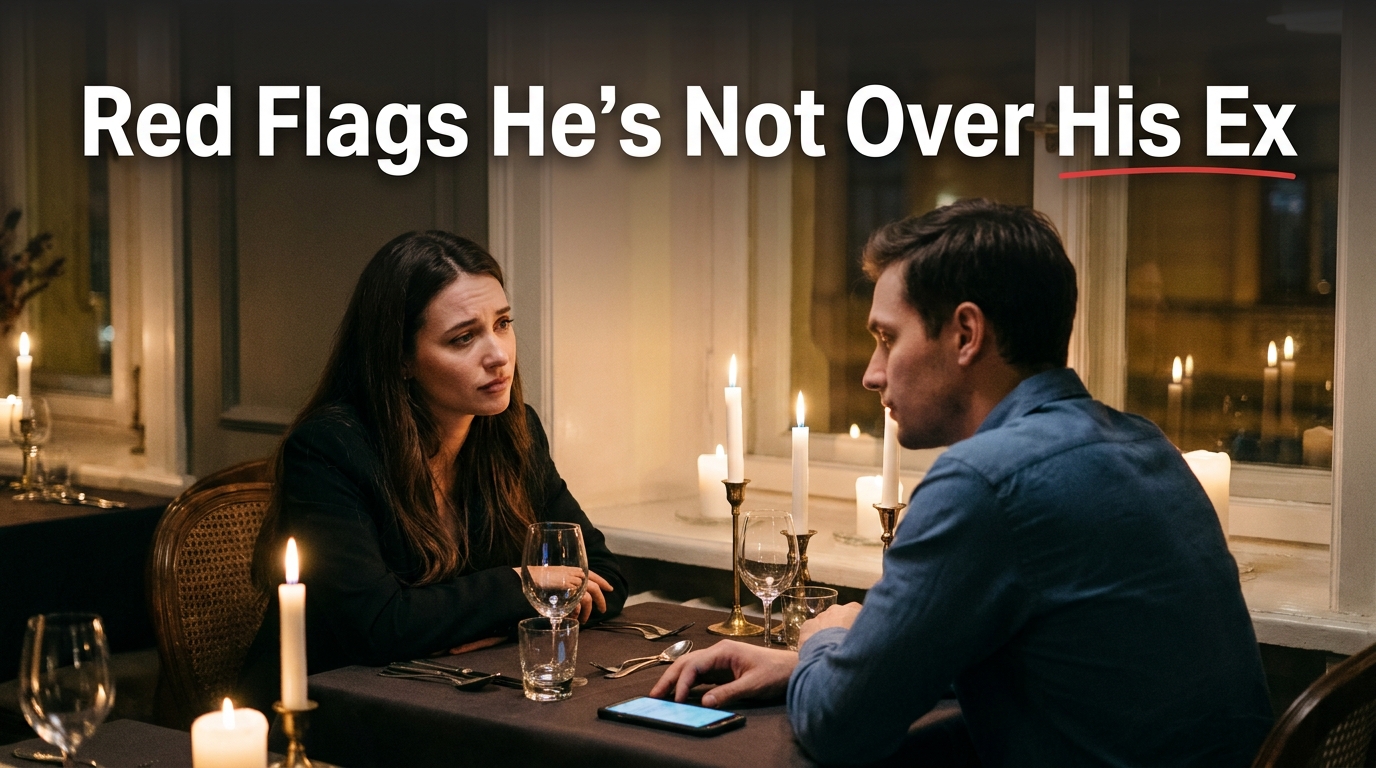
Something feels off. You cannot quite name it, but it sits in the back of your mind on quiet evenings, in the middle of good dates, and in the pause before he answers certain questions. You like him. Maybe you are starting to love him. But there is a shadow in the room that neither of you has fully addressed — and that shadow has a name. Research from Kansas State University found that lingering attachment to an ex-partner is one of the most significant predictors of dissatisfaction in a new relationship, affecting not just emotional intimacy but long-term commitment.
If you have been wondering whether you are truly his present or just a placeholder while his heart catches up, this article is going to give you the clarity you deserve. These are the real red flags he’s not over his ex — and what they mean for you.

Why Some Men Never Fully Leave Their Past Relationships
Before we get into the specific red flags he’s not over his ex, it is worth understanding why this happens in the first place — because it is rarely as simple as “he still loves her.”
Unresolved attachment to an ex can take many different forms. Some men grieve relationships openly and process the ending before moving on. But many do not. They move quickly into the next relationship — sometimes consciously to distract themselves, sometimes genuinely believing they are ready — while carrying emotional weight that has never been properly examined or released.
Psychologist Dr. Ramani Durvasula notes that avoidant individuals in particular often jump into new relationships as a coping mechanism, using the excitement of new love to bypass the grief of the old. The new relationship becomes an emotional painkiller rather than a genuine new beginning.
There is also the matter of relationship identity. When a long-term relationship ends, especially one where two people built a shared life, the loss is not just the person — it is a version of yourself, a set of routines, a future you had planned. Processing that loss takes time. And when someone has not given themselves that time, the past has a way of leaking into the present — through behavior, through emotional unavailability, through the comparisons that slip out in unguarded moments.
None of this means the man you are seeing is a bad person. But it does mean that his unfinished emotional business has very real consequences for you — and you deserve to see it clearly.
Red Flag 1: He Brings Her Up More Than the Situation Warrants
Pay attention to how often she comes up in conversation — and what prompts it.
It is natural and healthy for people to occasionally mention their past relationships in the context of sharing their history. That is not a red flag. The red flag is when she appears in conversations where she has no logical place. When you are talking about a restaurant and he mentions that his ex loved that place. When you are discussing your weekend plans and a story about her somehow surfaces. When her name comes up with a frequency that feels disproportionate to how long ago the relationship ended.
What this tells you is that she is occupying significant mental and emotional real estate in his mind. People talk about what they are thinking about. When someone is truly over a past relationship, the ex fades into the background of their mental landscape — referenced occasionally, but not constantly present.
There is another version of this red flag that is more subtle but equally telling: the deliberate effort to not mention her. You can sometimes sense when someone is being unnaturally careful to avoid a topic — the slight hesitation, the redirect, the way certain conversations seem to have walls around them. That deliberate avoidance can signal that she is so present in his thoughts that talking about her feels dangerous or overwhelming.
Both versions — the one who mentions her constantly and the one who avoids her with suspicious precision — are telling you the same thing. She is still there.

Red Flag 2: His Social Media Behavior Around Her Is Telling
In the modern landscape of dating, social media has become one of the clearest windows into someone’s emotional reality. And when it comes to red flags he’s not over his ex, what a man does — and does not do — on social media can be extraordinarily revealing.
Watch for these specific patterns:
He still follows her, views her stories, and reacts to her posts — especially if the breakup was not recent and especially if the relationship ended badly. Keeping close digital tabs on an ex is rarely about casual curiosity. It is about maintaining a thread of connection that he is not ready to cut.
Her photos are still up on his profile — particularly if significant time has passed since the breakup. While not everyone scrubs their social media clean after a relationship ends, the selective preservation of certain photos — especially intimate ones — suggests an attachment that has not been released.
He gets visibly uncomfortable or defensive when you bring up what you have noticed — the defensiveness itself is information. If there were nothing there, your observation would be easy to address. The discomfort suggests he knows something is unresolved.
He checks her social media in front of you without seeming to realize it — or, worse, tries to hide it. Both behaviors reveal that his attention is being pulled toward her in ways he either cannot control or does not want you to see.
None of these behaviors on their own constitute a verdict. But in combination — and especially when paired with other red flags — they form a picture worth paying attention to.
Red Flag 3: He Compares You to Her — Directly or Indirectly
Comparisons are one of the most painful and damaging red flags in a new relationship — and they are almost always a sign that someone is not finished processing the past.
Direct comparisons are the obvious ones. “My ex used to make this dish.” “She would have loved this.” “You remind me of her in this way.” These statements, however casually delivered, reveal that she is the reference point against which you are being measured — consciously or not.
But indirect comparisons can be just as harmful, and they are sometimes harder to identify. They show up as:
- Criticism of your behavior that seems to carry emotional weight disproportionate to the situation, suggesting a wound from the previous relationship is being triggered
- Unrealistic expectations that feel like they were shaped by someone else — preferences, routines, or standards that seem oddly specific and non-negotiable
- Moments where he seems almost surprised or grateful for something you do that should be ordinary — suggesting the previous relationship may have lacked it
- Reactions to your behavior that seem more intense than the situation calls for, as if he is responding to a history you were not part of
When you find yourself wondering whether you are being seen as yourself — or as a version of someone else — that question is a red flag in itself. You deserve a partner who is fully present with who you actually are, not someone who is using you to rewrite a story that ended before you arrived.
“You should never have to compete with a ghost. If someone is still living in their past, they are not yet available to fully live in your present — and you deserve someone who is completely here.”
Red Flag 4: He Keeps Tabs on Her Life Through Mutual Friends
This one is easy to miss because it does not involve direct contact between him and his ex. But the behavior is just as revealing.
If he regularly asks mutual friends about what she is doing, who she is seeing, or how she is doing — and especially if he seems to adjust his mood based on the information he receives — he is maintaining an emotional investment in her life that signals unfinished business.
Pay attention to how he reacts when someone mentions she is dating someone new. Does he seem genuinely indifferent, the way someone would be about a coworker from a job they left three years ago? Or is there a flicker of something — tension, forced casualness, a change in subject — that tells you the information landed somewhere significant?
A person who has truly moved on does not need ongoing intelligence about their ex’s life. The curiosity fades because the emotional investment fades. When the curiosity remains active — when he is still tracking the chapters of her story through whatever channels are available — it means he is not yet willing to close the book.

Red Flag 5: He Is Emotionally Unavailable in Specific, Telling Ways
Emotional unavailability is not always a personality trait. Sometimes it is situational — the direct result of someone carrying unresolved grief from a past relationship that has closed off their capacity for full emotional presence in a new one.
The kind of emotional unavailability that signals he is not over his ex looks like this:
He flinches at commitment language. Conversations about the future — moving in together, meeting family, exclusivity — make him visibly uncomfortable in ways that seem outsized for where you are in the relationship. He deflects, jokes, or goes quiet when these topics arise.
He is physically present but emotionally somewhere else. There are moments — sometimes mid-conversation, sometimes mid-intimacy — where he seems to disappear behind his eyes. He is in the room but not fully reachable. When you ask what he is thinking about in those moments, the answer feels evasive.
He pulls back every time things get deeper. There is a ceiling on the emotional intimacy he will allow. Each time the relationship begins to develop more depth — more vulnerability, more genuine closeness — he creates distance. He gets busy. He becomes less available. The intimacy reaches a certain level and then retreats.
He cannot talk about the previous relationship with any emotional resolution. When his ex does come up, he either becomes visibly upset, speaks about her with lingering bitterness or sadness that feels raw rather than processed, or describes the relationship’s end in ways that suggest he still has not made peace with what happened.
Emotional unavailability in a partner is always worth examining — but when it is specifically tied to the patterns above, it is almost always connected to an attachment that has not yet been released.
Red Flag 6: He Reaches Out to Her or Allows Her to Reach Out Without Telling You
Boundaries with an ex are a complex and personal topic. Some couples end relationships and transition successfully into genuine friendship. Others need complete distance to heal. There is no universal rule.
But here is what matters: transparency.
If he is in contact with his ex — whether he initiated it or she did — and he is not telling you about it, that concealment is the red flag. People hide things they believe will upset their partner. And they believe something will upset their partner because, on some level, they know it crosses a line.
If you find out about contact not from him but through a notification you caught a glimpse of, a mutual friend, or a moment where the story did not add up — the issue is not just the contact. It is the choice to conceal it. That choice suggests he knows his investment in the connection to her is not something he is ready to honestly examine — or honestly discuss with you.
Red Flag 7: Your Intuition Has Been Whispering About This for a While
This is perhaps the most important red flag on the entire list — and the one most likely to be dismissed.
Your gut knows things before your conscious mind has assembled the evidence. That low-grade unease you feel. The way certain moments land strangely. The question that keeps returning no matter how many times you try to push it down. These are not signs of insecurity or paranoia. They are your nervous system doing its job — tracking subtle patterns and inconsistencies in someone’s behavior and translating them into a feeling.
Research in cognitive psychology has established that intuitive processing draws on a vast wealth of observed information that the conscious mind has not yet organized into a logical argument. When your gut says something is off, it is usually because something is off — and your brain is simply still gathering the words to describe it.
If you have been feeling something about this for a while, honor that feeling. Not by acting on it impulsively or with accusation, but by taking it seriously enough to examine the evidence — and to have the honest conversation that you may have been avoiding.

What to Do When You Recognize These Red Flags
Recognizing these red flags does not automatically mean the relationship is over or that he is beyond hope. What it means is that there is something real here that needs to be addressed — honestly, directly, and with care for both yourself and the dynamic you are building.
Start with an honest conversation. Not an interrogation. Not an accusation. A genuine conversation where you share what you have noticed and how it has made you feel. Use language that expresses your experience rather than indicting his character. “I have noticed that she comes up a lot and I want to understand where things stand” lands very differently from “You are obviously still in love with her.”
Listen to how he responds — not just what he says. A man who is self-aware and genuinely invested in the relationship with you will hear your concern, take it seriously, and be willing to reflect honestly. A man who immediately becomes defensive, dismissive, or turns the conversation around to make you feel insecure for raising it — that response is itself a significant piece of information.
Be honest with yourself about your needs. You deserve to be with someone whose heart is fully available to you. If he is not there yet, the question is not whether you can force him to be — you cannot. The question is what you need right now, and whether this relationship in its current form is actually meeting those needs.
Give it time — but not unlimited time. Change is possible. People do finish processing past relationships, do show up fully, and do build genuine new love. But that process needs to be happening actively — not theoretically. If months pass and the patterns remain unchanged, the patterns are telling you something important.
“Loving someone who is not yet finished loving someone else is one of the loneliest experiences there is. You deserve to be someone’s whole story — not a chapter they added while rewriting the last one.”

You Deserve Someone Who Is Fully Here
The most important thing to take away from this article is not a checklist. It is a permission slip.
You are allowed to want a partner who has genuinely moved on. You are allowed to take seriously the signs that something is unresolved. You are allowed to name what you see without being told you are too sensitive, too needy, or too suspicious.
Recognizing red flags he’s not over his ex is not about being controlling or insecure. It is about being honest — with yourself, with him, and about the kind of relationship you are building together.
The right person will not make you wonder if you are enough. They will show you — consistently, through their actions and their presence — that you are exactly where they want to be.
Save This. Share This. Follow for More.
If this article helped you name something you have been feeling, save it so you can return to it. Share it with a friend who might need to hear it — sometimes the clarity we need is someone else’s story giving us permission to trust our own.
Follow Truthsinside.com for more honest, psychology-backed content on red flags, relationship patterns, and knowing what you deserve.
📃 Related article: Gaslighting in Relationships: How to Recognize, Name, and Leave It
Frequently Asked Questions
Q1: How long does it typically take someone to get over an ex?
There is no universal timeline, but research suggests it takes an average of 11 weeks to begin feeling better after a breakup — and significantly longer for long-term relationships. The key factor is not time alone but whether the person actively processes the grief rather than suppressing or bypassing it.
Q2: Is it a red flag if he is still friends with his ex?
Not necessarily. Healthy post-breakup friendships exist. The red flag is not the friendship itself but the lack of transparency about it, the emotional charge surrounding it, or the way it appears to interfere with his full investment in the relationship with you.
Q3: Can someone be in love with two people at once?
Emotionally, yes — attachment is complex and does not always switch off cleanly. But sustained love requires presence and choice. Someone who is genuinely committed to building something with you will make the internal choice to invest fully — and their behavior will reflect that over time.
Q4: Should I give him time to get over his ex, or is that a mistake?
Giving someone space to process is reasonable, but it should not come at the cost of your own emotional wellbeing. There is a difference between patience and self-abandonment. If you find yourself consistently minimizing your own needs to accommodate his unresolved past, that is worth examining carefully.
Q5: What is the difference between him not being over his ex and him just being emotionally unavailable in general?
The patterns can overlap, but the distinction often lies in specificity. Situational emotional unavailability tied to an ex tends to be more targeted — activated by specific triggers, comparisons, or topics related to the past relationship. General emotional unavailability tends to be more pervasive across all areas of intimacy and connection, regardless of the romantic history involved.
🎵 Music
Maren Lull is a singer-songwriter who writes from the places most people don’t talk about out loud.
Not the dramatic grief. Not the obvious heartbreak. The quiet kind — the ordinary Tuesday emptiness, the habit of reaching for someone who isn’t there anymore, the particular exhaustion of being strong for so long that the strength itself wears thin.
Her music lives at the intersection of emotional honesty and soft beauty — breathy vocals over gentle piano, slow tempos, lyrics that feel less like songs and more like something you wrote in a private notebook at two in the morning and never showed anyone.
Maren Lull writes for the people who feel everything deeply and say very little about it. For the ones who listen to sad music not because they want to feel worse — but because being understood, even by a song, makes the feeling easier to carry.
📱 Follow Maren Lull:
→ Spotify
→ Apple Music
→ Youtube
→ Audiomack