
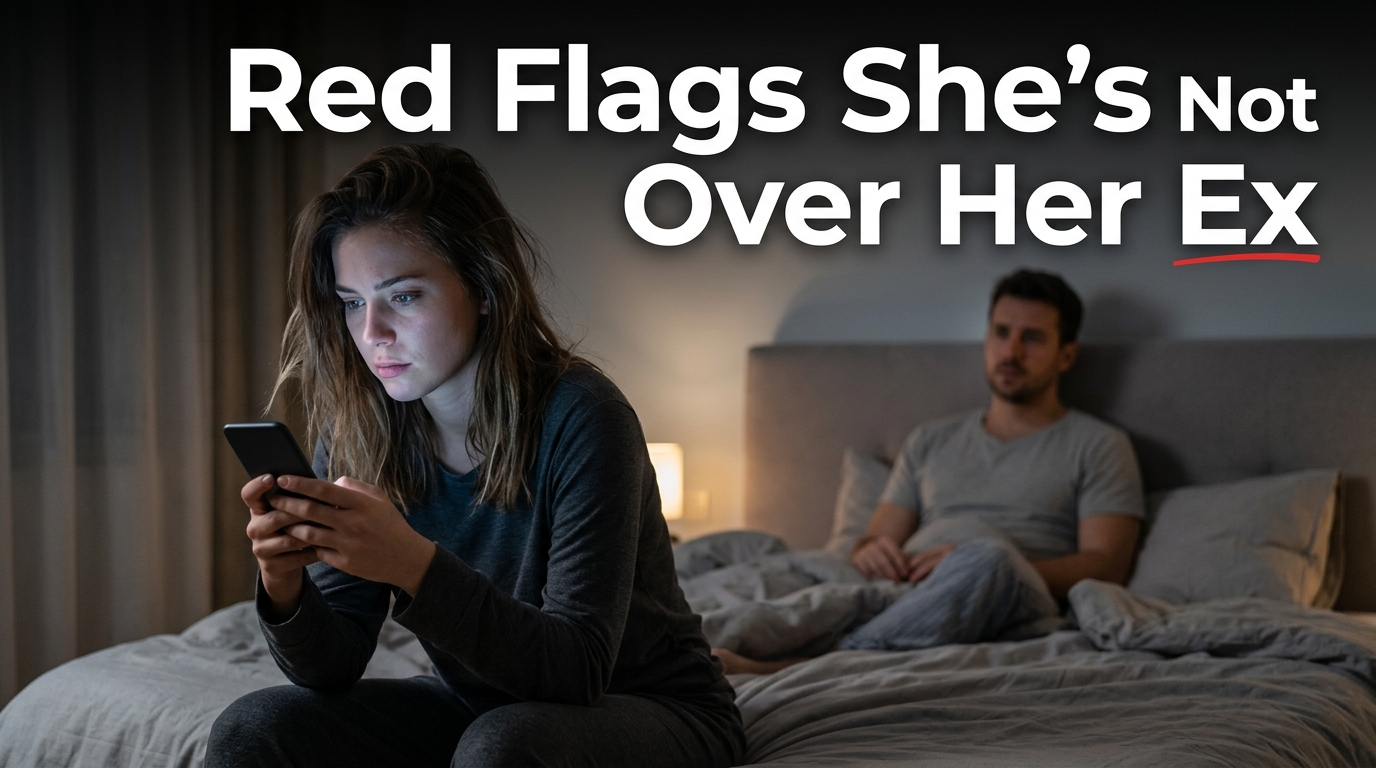
Falling for someone new is one of the most hopeful feelings in the world. But what happens when the person you are falling for has not fully fallen forward with you? If you have ever had that quiet, unsettling feeling that something is emotionally off — that she is present but not fully here — you are not imagining it. The red flags she’s not over her ex are real, they are rooted in psychology, and they matter more than most people realize.
Research from the Journal of Social and Personal Relationships found that lingering emotional attachment to an ex-partner is one of the most common hidden obstacles to forming secure new relationships — and it affects both men and women across all age groups. If you are reading this, you deserve clarity — not confusion.
This article is not about blame. People do not always choose how long healing takes. But you deserve to understand what you are walking into — and whether the relationship you are investing in has the emotional space for you to actually exist in it.

Why Red Flags She’s Not Over Her Ex Are Easy to Miss
Before we go into the specific signs, it is worth understanding why these red flags are so frequently overlooked — and why even the person displaying them often does not realize what they are communicating.
Emotional attachment does not end when a relationship ends. This is not a failure of character. It is basic neuroscience. The brain processes romantic love through many of the same neural pathways associated with addiction — specifically dopamine and oxytocin systems that create deep, habituated bonds. When a significant relationship ends, the brain does not simply switch those systems off. It enters a kind of withdrawal process that can last months or even years, depending on the depth of the relationship and the circumstances of the breakup.
This means that someone can genuinely believe they are ready to move on — can sincerely want to move on — and still be carrying an invisible emotional weight that shapes their behavior in a new relationship.
The red flags she’s not over her ex are not always dramatic or obvious. They are often subtle, quietly recurring, and easy to rationalize away individually. But when you see them as a pattern, the picture becomes clear.
Red Flag 1: She Brings Him Up Constantly — And Not Always Negatively
One of the clearest signs that someone has not emotionally released a past relationship is how frequently their ex appears in conversation.
Pay attention to how often his name comes up without being invited into the conversation. She is talking about a restaurant she wants to try — and she mentions that she went there with him. She is talking about a movie — and she brings up how he hated that genre. She references what he would say, what he would think, what he used to do.
Now, context matters here. If the relationship was long and formative, some references are natural. People are shaped by their significant relationships, and those references do not disappear overnight.
But the frequency, the emotional charge, and the direction of those references tell you a great deal. If she brings him up often, in many different contexts, especially unprompted — that is her mind returning to something it has not finished processing.
Equally revealing is the tone. Many people assume that talking negatively about an ex is a sign of being over them. It is not. Sustained anger, bitterness, and resentment are forms of emotional attachment just as much as longing and sadness are. As psychologist Dr. Judith Orloff notes, the opposite of love is not hate — it is indifference. If he still provokes a strong emotional response in her, the emotional bond is still alive.

Red Flag 2: She Reacts Too Strongly — Or Too Deliberately Calm — When He Contacts Her
The way someone responds when their ex reaches out tells you almost everything about where they emotionally stand.
Watch for disproportionate reactions in either direction. If she receives a message from him and suddenly becomes anxious, flustered, or noticeably distracted — her nervous system is responding to something that still has emotional weight. If she goes out of her way to perform indifference — “oh it’s just him, whatever” — said with slightly too much casualness, slightly too quickly — that too is a signal. Genuine indifference does not need to be announced.
Watch also for privacy around those interactions. Does she suddenly angle her phone away? Does she take calls from him in another room? Does she become vague or defensive when you ask who she was texting? Healthy transparency comes naturally to people with nothing emotionally conflicted to hide.
This does not mean that she is necessarily doing anything wrong. But it does mean that those interactions carry a weight she has not fully settled inside herself.
“When someone is truly over an ex, that person becomes background noise — not a presence that still shifts the emotional temperature of the room.”
Red Flag 3: She Compares You to Him — Consciously or Not
Comparison is one of the most telling red flags she’s not over her ex — and one of the most painful to be on the receiving end of.
These comparisons do not always come as direct statements. Sometimes they are framed as compliments: “You’re so much more patient than he was.” Sometimes they surface as subtle criticism: “He used to do this thing where…” followed by something she clearly misses. Sometimes they appear as standards you are somehow expected to meet — or surpass — without being given the rulebook.
When an ex becomes the internal benchmark against which you are being measured, it means he is still occupying a primary psychological reference point in how she understands romantic relationships. He has not stepped out of the story. You have simply been cast alongside him.
This is not about insecurity on your part. Being compared to someone your partner has not emotionally released is a legitimate relational issue — one that affects your ability to build something genuinely new together, free of an invisible third presence.
Red Flag 4: She Is Reluctant to Define the Relationship or Commit to the Future
Emotional unavailability often masquerades as being “laid back” or “not wanting to rush things.” And while there is nothing wrong with taking a relationship at a comfortable pace, there is a difference between healthy pacing and avoidance of commitment driven by unresolved attachment.
If she consistently deflects conversations about where things are going, becomes uncomfortable when the future is mentioned, or seems to be holding the relationship at arm’s length despite genuine connection — it is worth asking what she might still be protecting.
People who are not fully over a past relationship often resist full commitment to a new one because part of them is still — consciously or not — leaving a door open. Not necessarily because they plan to go back. But because fully committing to someone new means fully accepting that the previous relationship is over. And that acceptance can feel like loss all over again.

Red Flag 5: She Still Follows His Life — Closely
In the age of social media, one of the most honest indicators of where someone’s attention lives is their digital behavior.
Does she still follow him across platforms? Does she know details of his life — new posts, new people he is spending time with, where he has been — without those things naturally coming up? Does she check his profile when she thinks you are not paying attention? Does she seem to know things about his current life that would only be known through active monitoring?
Social media following is a personal choice, and some people genuinely maintain casual contact with exes without emotional complication. But if she is actively tracking his life, reacting emotionally to what she sees, and that monitoring is consistent and ongoing — her emotional attention is partially living in his world, not fully in yours.
This is not about jealousy or control. You are not entitled to dictate who she follows. But you are entitled to recognize what it signals about where her emotional investment actually sits.
Red Flag 6: She Talks About the Breakup Like It’s Still Unresolved
How someone speaks about the end of a past relationship reveals a great deal about how completely they have processed it.
There is a significant difference between someone who can speak about a past relationship with reflection and equanimity — acknowledging the pain, understanding what they learned, and having genuine distance from it — and someone whose account of the breakup is still saturated with raw emotion, unresolved questions, and narrative that has not reached its conclusion.
If she frequently returns to the details of how it ended, if there is ongoing grief, confusion, or anger that feels immediate rather than historical, if she uses present-tense language about past pain — “I don’t understand why he did that” rather than “I used to not understand why he did that” — she is still emotionally inside an experience that has not closed.
Listen also for whether she has reached self-compassionate understanding about the relationship — what it taught her, how she grew from it, what she would do differently. A relationship that has been truly processed is one a person can reflect on with some degree of peace, even if the memories still carry sadness. Unresolved attachment produces a very different quality of storytelling.
“A closed chapter can still be remembered. An unfinished one keeps getting reread — whether someone admits it or not.”
Red Flag 7: She Emotionally Checks Out During Intimacy
Physical presence does not guarantee emotional presence. And one of the quietest red flags she’s not over her ex is the pattern of emotional absence during moments that require full emotional availability.
This might look like a faraway quality during close moments together — like she is partially somewhere else. It might look like difficulty making emotional (not just physical) contact. It might look like moments of unexpected sadness or flatness that she cannot explain and you cannot account for. It might look like a resistance to vulnerability — a glass ceiling on how close she will allow things to get.
People carry their unprocessed emotional lives into their bodies and into their intimate moments. When a significant portion of someone’s emotional energy is still tied to something unresolved, there is simply less of them available to be fully present with you.
This is not a judgment of her character. But it is a reality of her current emotional state — and you deserve to understand it.

Red Flag 8: She Gets Defensive When You Bring It Up
This one is crucial. How someone responds when you raise a concern about their emotional availability tells you nearly as much as the behavior itself.
A partner who is secure, self-aware, and genuinely open to the relationship will meet your concern with curiosity and care — even if they initially feel defensive, they will come back around, take your perspective seriously, and engage honestly with the question.
A partner who is not over her ex and is not ready to acknowledge it will often meet this conversation with dismissal, deflection, or escalation. Your concern becomes “jealousy.” Your observation becomes “insecurity.” The conversation gets turned around on you — and suddenly you are explaining why you raised the issue rather than actually having the conversation.
This defensive response is not necessarily a sign of dishonesty. It can be a sign that she genuinely has not confronted what she is carrying. Denial is one of the mind’s most powerful protective mechanisms. It is possible to believe sincerely that you are over someone while behaving in ways that reveal something entirely different.
Red Flag 9: She Has Kept Things She Doesn’t Need to Keep
Physical objects can carry powerful emotional significance — and what someone chooses to keep, display, or hold onto from a past relationship can be a quiet but telling signal.
There is a difference between keeping a photo buried in a box as part of a personal history, and keeping a photo displayed, checking old texts regularly, holding onto gifts with visible sentimentality, or maintaining mementos in prominent places in her living space.
None of these things, in isolation, are necessarily damning. But in the context of other patterns described in this article, they contribute to a picture of someone who has not fully symbolically — and therefore emotionally — released a past relationship.

What You Should Actually Do With This Information
Reading through these signs and recognizing several of them in your relationship is difficult. But awareness is not the same as a verdict — and this article is not telling you what decision to make. What it is telling you is that the information you are sitting with deserves to be taken seriously.
Here is what a grounded, honest response looks like.
Start with a conversation — not an accusation. The goal is not to confront her with a list of evidence. The goal is to share how you have been feeling, from your own experience. “I’ve been feeling like there’s some emotional distance between us, and I want to understand it together” opens a very different conversation than “I think you’re still in love with your ex.”
Create space for honesty without punishment. If she feels safe enough to be honest with you, she may actually tell you things that are difficult to hear — but that honesty is the beginning of either real movement forward or real clarity about what is possible. Punishing honesty with anger closes that door permanently.
Set clear internal standards for yourself. You deserve a relationship where you are not competing with a ghost. That is not a dramatic standard — it is a basic one. Knowing that clearly will help you navigate whatever comes next with self-respect intact.
Consider the timeline. How long ago did her relationship end? How long were they together? How did it end? These factors genuinely matter. Someone three months out of a seven-year relationship is in a very different place than someone two years out of a six-month relationship. Context does not excuse patterns, but it helps you understand them.
And if the patterns persist despite honest conversation — trust what you see over what you are told. People show you where they are long before they can say it out loud.
When It’s Worth Staying — And When It Isn’t
Not every one of these signs means the relationship is doomed. People heal at different rates. Emotional unavailability is not a permanent state — it is a current one. And some of the most secure, committed relationships on earth were built by two people who needed time and patience to fully arrive for each other.
The question is not only “is she over her ex?” The question is also: “Is she aware of where she is? Is she honest about it? Is she actively choosing to move forward? And is she capable, with time and intention, of being fully here?”
If the answer to those questions is yes — or at least a genuine, effortful maybe — then patience paired with honest communication may create the space for something real to grow.
But if you are consistently deprioritized, consistently gaslit about what you observe, and consistently making peace with less than you deserve — that is not a work in progress. That is a pattern. And you deserve to decide what you will and will not build your emotional life around.
💾 Save this article — you might need to come back to it.
📤 Share it with someone who has been questioning what they feel in their relationship.
👣 Follow Truthsinside.com for honest, psychology-backed content on relationships, red flags, and emotional health.
📃 Related article: Signs He Likes You But Is Scared: 18 Behaviors Men Show When Afraid to Commit
Frequently Asked Questions
Q1: How long does it normally take to get over an ex?
There is no universal timeline. Research suggests that on average it takes about half the length of the relationship to emotionally process it — but this varies enormously based on the depth of the bond, the circumstances of the breakup, the individual’s emotional processing style, and whether they have sought support. Some people take months. Some take years. The important thing is whether active healing is happening.
Q2: Can a relationship work if she’s not fully over her ex?
It can — but only if she is honest about where she is, genuinely committed to doing the emotional work of healing, and you are both patient enough to allow that process without one person carrying all the emotional cost. A relationship built on one person suppressing unresolved attachment rarely reaches its full potential without that underlying issue being addressed.
Q3: Is it normal to still have feelings for an ex while in a new relationship?
Residual feelings for a significant ex are common and do not automatically make someone a bad partner. What matters is the intensity of those feelings, how they are being managed, and whether they are interfering with full emotional availability in the current relationship. Feeling nostalgic is different from being emotionally loyal to someone who is no longer your partner.
Q4: Should I ask her directly if she’s over her ex?
Yes — but how you ask matters enormously. Frame it as a genuine, curious conversation rather than an interrogation or accusation. Express your own feelings first. Make it safe for her to be honest by responding to honesty with openness rather than anger. The conversation itself, handled well, can be one of the most connecting things you do — regardless of what it reveals.
Q5: What if I recognize these signs in myself rather than my partner?
That self-awareness is genuinely valuable and takes real courage to acknowledge. If you recognize that you may not be fully over a past relationship while in a current one, the most honest and respectful thing you can do — for yourself and your partner — is to seek support, whether through therapy, honest conversation, or both. Moving on is not about forgetting. It is about completing something internally so that you can be fully present for something new.
🎵 Music
Maren Lull is a singer-songwriter who writes from the places most people don’t talk about out loud.
Not the dramatic grief. Not the obvious heartbreak. The quiet kind — the ordinary Tuesday emptiness, the habit of reaching for someone who isn’t there anymore, the particular exhaustion of being strong for so long that the strength itself wears thin.
Her music lives at the intersection of emotional honesty and soft beauty — breathy vocals over gentle piano, slow tempos, lyrics that feel less like songs and more like something you wrote in a private notebook at two in the morning and never showed anyone.
Maren Lull writes for the people who feel everything deeply and say very little about it. For the ones who listen to sad music not because they want to feel worse — but because being understood, even by a song, makes the feeling easier to carry.
📱 Follow Maren Lull:
→ Spotify
→ Apple Music
→ Youtube
→ Audiomack