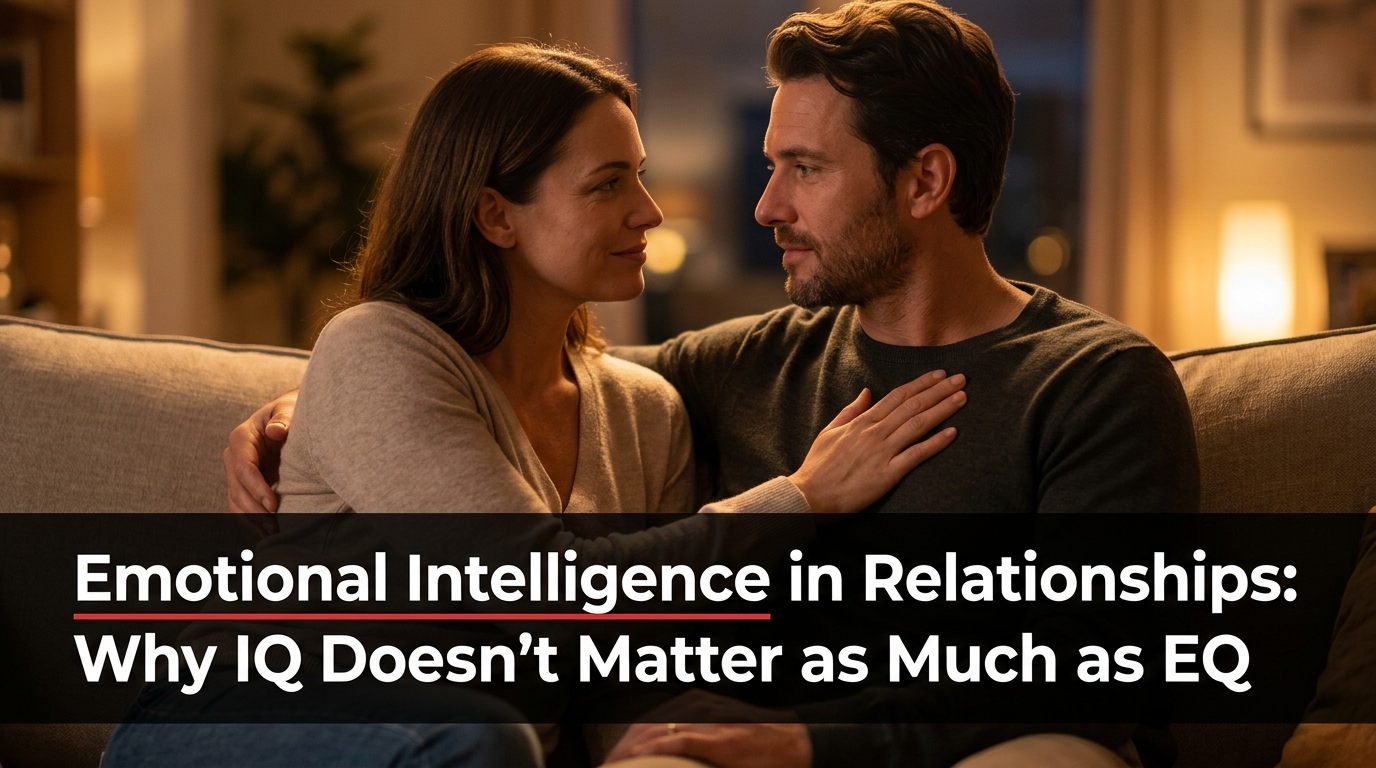
You can have a brilliant mind and still be terrible at love. You can solve complex problems, lead organizations, and command rooms full of people — and still go home and say exactly the wrong thing to the person you care about most. Emotional intelligence in relationships is the missing variable that most people never learned to measure. A landmark study by psychologist Dr. Daniel Goleman found that emotional intelligence accounts for up to 58% of performance in all types of relationships — far outweighing IQ as a predictor of relational success. If you have ever wondered why being smart is not enough to make love work, this article is your answer.
This is not about being soft, overly sensitive, or endlessly patient. Emotional intelligence is one of the most powerful and practical skill sets a human being can develop — and it is learnable at any age, at any stage of a relationship.

What Emotional Intelligence in Relationships Actually Means
Before we go deeper, let’s establish what we are actually talking about — because emotional intelligence is one of those terms that gets used frequently and understood rarely.
Emotional intelligence, often referred to as EQ (Emotional Quotient), is the ability to recognize, understand, manage, and effectively express your own emotions — and to recognize, understand, and influence the emotions of others.
The concept was formally introduced in academic literature by psychologists Peter Salovey and John Mayer in 1990, and later brought into mainstream culture by Dr. Daniel Goleman’s groundbreaking 1995 book, simply titled Emotional Intelligence. Goleman organized EQ into five core components that are especially relevant inside relationships.
The first is self-awareness — knowing what you are feeling, why you are feeling it, and how your emotional state is influencing your behavior. The second is self-regulation — the ability to manage your emotional reactions rather than being controlled by them. The third is motivation — a drive that goes beyond external reward, rooted in internal values and purpose. The fourth is empathy — the ability to understand and share the feelings of another person. The fifth is social skills — the practical ability to manage relationships, communicate clearly, resolve conflict, and build genuine connection.
In a relationship context, all five of these operate simultaneously. Every conversation, every conflict, every moment of closeness or distance between two people is filtered through the emotional intelligence — or lack thereof — of both individuals.
And the data is clear: couples with higher collective EQ report greater relationship satisfaction, lower rates of chronic conflict, higher trust, and more resilient connection in the face of stress and difficulty.
Why IQ Alone Will Never Be Enough
Intelligence is genuinely valuable. It helps you navigate complexity, make sound decisions, and communicate ideas effectively. Nobody is arguing against being smart.
But here is what IQ cannot do: it cannot tell you what your partner is feeling when they go quiet. It cannot help you regulate the surge of anger that comes when you feel criticized. It cannot teach you how to sit with someone else’s pain without immediately trying to fix it. It cannot help you apologize in a way that lands as genuine rather than transactional. It cannot help you recognize when your own fear is masquerading as irritability.
These are emotional tasks — and they require emotional tools.

Dr. Travis Bradberry, co-author of Emotional Intelligence 2.0, conducted research across more than a million people and found that people with average IQs outperform those with the highest IQs about 70% of the time — specifically in interpersonal and relational domains. This was not because the high-IQ individuals were less capable in an intellectual sense. It was because cognitive intelligence and emotional intelligence use different neural pathways and are developed through entirely different experiences.
A person with a high IQ and low EQ will often approach relationship problems the way they approach intellectual problems — by analyzing, arguing logic, seeking to be right, and expecting that the most rational solution will win. But relationships are not logic puzzles. They are living, breathing ecosystems of two people’s emotional histories, attachment needs, fears, and desires. Logic alone cannot navigate that terrain.
In fact, one of the most common complaints in couples therapy — particularly when one partner identifies as highly analytical or intellectual — is some version of: “I give them all the logical reasons why they shouldn’t feel that way, and they just get more upset.” That pattern is a direct symptom of high IQ, low EQ thinking. Because the emotion does not disappear when you disprove its logic. Emotions do not operate by the rules of evidence.
The Five Pillars of EQ and What They Look Like in Love
Let us walk through each of the five core components of emotional intelligence and examine what they look like — and what their absence looks like — inside a romantic relationship.
Self-Awareness in Love
A self-aware partner knows their emotional patterns. They know that they tend to shut down when they feel criticized, or that they become controlling when they feel anxious, or that their anger is almost always sadness in disguise. They can say, in the middle of a difficult moment, “I’m noticing I’m getting defensive right now — let me take a breath.”
A partner lacking self-awareness will genuinely believe that their emotional reactions are always justified as-is. They cannot observe themselves from a slight distance. Every feeling is treated as a fact about the external world rather than information about their internal one.
“Self-awareness is not the ability to eliminate difficult emotions. It is the ability to see them clearly enough that they stop running your life without your permission.”
Self-Regulation in Love
Self-regulation does not mean suppressing your feelings or pretending you are fine when you are not. It means that you have enough internal control to choose how and when you express what you feel — rather than having your emotions choose for you.
A partner with strong self-regulation can feel deeply hurt and still decide to say “I need a few minutes before we talk about this” instead of saying the thing they know they will regret. They can be furious and still stay in their body. They can feel the flood coming and choose not to drown the conversation in it.
A partner with poor self-regulation will often describe themselves as “just being honest” or “not being able to help how they feel.” Both of those things may be true — but honesty without regulation is not intimacy. It is impact without intention.
Motivation in Love
In a relationship context, emotional motivation refers to the degree to which you are driven by internal values — love, growth, partnership, integrity — rather than external validation. Partners with high emotional motivation show up for the relationship even when it is not easy. They invest in the relationship not just when it feels good, but because they are genuinely committed to something larger than comfort.
Partners with low emotional motivation in relationships often operate in what psychologists call a reward-cost framework — giving when they receive, withdrawing when they do not. This creates a transactional dynamic that slowly drains the emotional bank account of the relationship.
Empathy in Love
Empathy is the heartbeat of emotional intelligence in relationships. It is the ability to step out of your own perspective and genuinely inhabit your partner’s experience — not to agree with everything they feel, but to understand it.

Empathy sounds like: “That makes sense that you felt that way.” Not “I didn’t mean it like that” — which centers your intention. Not “You’re being too sensitive” — which dismisses their experience. But “That makes sense.” Full stop.
Low empathy in a relationship often looks like conversations that quickly become debates about who is right. It looks like dismissing your partner’s feelings because you would not feel the same way in their situation. It looks like someone who can intellectually understand a situation but cannot emotionally land inside it with you.
Social Skills in Love
The final pillar — social skills — refers to the practical, applied ability to navigate relational dynamics with awareness and intention. In a romantic relationship, this includes how you repair after conflict, how you express appreciation, how you make requests rather than demands, how you keep emotional bids alive, and how you build a relationship culture of safety and respect over time.
The Empathy Gap: One of the Most Underrated Relationship Problems
One of the most painful and least-discussed dynamics in relationships is what researchers call the empathy gap — the tendency for people in a calm emotional state to dramatically underestimate how intense or overwhelming it feels to be in a heightened emotional state.
In plain terms: when you are not upset, it is genuinely difficult to understand why your partner is so upset. And that difficulty leads to minimization — which lands as invalidation to your partner, even when that was never your intention.
Dr. Brené Brown’s research on empathy versus sympathy offers a crucial distinction here. Sympathy looks down at someone’s pain from a safe distance and says “that must be hard.” Empathy climbs down into the pain alongside someone and says “I’m here with you.” In relationships, sympathy maintains separation. Empathy creates connection.
The empathy gap is not a character flaw. It is a neurological reality. But emotional intelligence gives you the tools to bridge it — to consciously choose to stretch beyond your current emotional state and reach toward your partner’s experience, even when it does not come naturally.
“Empathy is not about having the same feelings as your partner. It is about being willing to be changed by what they feel.”
Can You Build Emotional Intelligence? The Research Says Yes
This is perhaps the most hopeful thing about EQ: unlike IQ, which remains relatively stable throughout a person’s life, emotional intelligence is genuinely developable. The neural pathways associated with emotional regulation, empathy, and self-awareness are plastic — meaning they can be strengthened with intentional practice.
Here is what the research-backed pathways to higher EQ actually look like.
Mindfulness practice has been shown in multiple peer-reviewed studies to directly increase activity in the prefrontal cortex — the area of the brain responsible for emotional regulation and perspective-taking. Even ten minutes of daily mindful awareness builds your capacity to observe your emotions without being immediately hijacked by them.
Journaling about emotional experiences strengthens the brain’s ability to name and differentiate emotions — a skill psychologists call “affect labeling.” Research by Dr. Matthew Lieberman at UCLA found that simply putting feelings into words reduces the intensity of the emotional response in the amygdala. When you can name it, you can regulate it.
Active listening practice — genuinely listening to understand, not to respond — rewires social engagement patterns over time. This means making eye contact, putting down devices, resisting the urge to prepare your counter-argument while your partner is still speaking, and reflecting back what you heard before offering your own perspective.
Therapy and coaching — particularly modalities like Emotionally Focused Therapy, Cognitive Behavioral Therapy, and somatic-based approaches — directly target the emotional patterns and attachment wounds that drive low-EQ behavior in relationships. Many people experience profound shifts in their emotional intelligence within a relatively short period of therapeutic work.

What Low EQ Actually Looks Like in a Relationship — Honest Examples
Sometimes the most useful thing is not theory — it is recognition. Here are some honest, real-world patterns that signal low emotional intelligence in a relationship context. Read these without judgment. Many of us will recognize ourselves in at least some of them.
Turning every emotional conversation into a debate about who is factually correct. Saying “I was just being honest” after saying something hurtful, as if honesty removes responsibility for impact. Going silent for hours or days as a default response to conflict, without communicating what you need. Struggling to apologize genuinely — either not apologizing at all, or apologizing in ways that include “but you also…” Rolling your eyes, sighing loudly, or using dismissive body language during serious conversations. Interpreting your partner’s emotional expression as manipulation or drama rather than as a genuine communication of pain.
None of these behaviors make someone a bad person. But all of them, left unaddressed, erode the emotional safety that every lasting relationship depends on.
The Relationship Between EQ and Emotional Safety
Emotional safety is the invisible architecture of every healthy relationship. It is the internal sense that you can be honest, vulnerable, imperfect, and afraid — and still be loved. Still be chosen. Still be safe.
Emotional safety is not built through grand romantic gestures. It is built through thousands of small moments where one partner chooses understanding over judgment, curiosity over criticism, presence over distraction.
Every time you regulate your reaction instead of unleashing it, you build safety. Every time you validate your partner’s feelings even when you see things differently, you build safety. Every time you repair after a rupture — genuinely, humbly, without defensiveness — you build safety.
Emotional intelligence is the engine that makes all of those moments possible. Without it, love may exist — but it cannot fully land. It cannot fully be felt. Because feeling loved requires feeling safe. And feeling safe requires emotional intelligence in both directions.

Building EQ Together as a Couple
One of the most powerful things two people can do is decide to build emotional intelligence together — as a shared project, not a solo performance.
This looks like agreeing on a signal that means “I’m getting flooded, I need five minutes” so that stepping back does not feel like abandonment. It looks like building a vocabulary for emotional states beyond “fine,” “upset,” or “angry” — using a feelings wheel, practicing naming secondary emotions, getting comfortable with words like “vulnerable,” “dismissed,” “overwhelmed,” or “unseen.”
It looks like creating a ritual of appreciation — daily or weekly — where both partners intentionally name something they are grateful for in each other. Dr. Gottman’s research found that healthy couples maintain a ratio of at least five positive interactions to every one negative interaction. Emotional intelligence helps you make those positive interactions genuine and specific, rather than performative.
It looks like reading articles like this one together, having the conversation it opens up, and being willing to look honestly at your own patterns without shaming each other for them.
Growing EQ as a couple is not a project with an end date. It is a practice — ongoing, imperfect, and one of the most worthwhile things two people can commit to.
The Bottom Line on Emotional Intelligence in Relationships
You did not choose your attachment style. You did not choose the emotional lessons your childhood taught you. You did not choose the neural patterns that were laid down long before you ever fell in love.
But you can choose what you do with them now. You can choose awareness over autopilot. You can choose curiosity over contempt. You can choose to stretch toward your partner’s experience even when your instinct is to retreat into your own.
Emotional intelligence in relationships is not a personality trait you either have or you don’t. It is a capacity that grows every time you choose presence over performance, every time you name what you feel instead of showing what you feel through behavior, and every time you stay in the conversation long enough to actually hear what your partner needs.
IQ may have gotten you here. But EQ is what will make staying worth it — for both of you.
💾 Save this article and revisit it when you need it most.
📤 Share it with someone who leads with their head when their relationship needs their heart.
👣 Follow Truthsinside.com for more psychology-backed relationship insight, every week.
📃 Related article: Anxious Attachment: Signs, Causes, and How to Heal
Frequently Asked Questions
Q1: What is the difference between EQ and IQ in relationships?
IQ measures cognitive intelligence — the ability to reason, analyze, and solve logical problems. EQ measures emotional intelligence — the ability to recognize, manage, and respond effectively to emotions in yourself and others. In relationships, EQ is consistently a stronger predictor of satisfaction, conflict resolution, and long-term connection than IQ.
Q2: Can someone with low emotional intelligence change?
Yes — and this is one of the most well-supported findings in modern psychology. Unlike IQ, which is relatively fixed, emotional intelligence is neurologically plastic and can be developed through intentional practice, therapy, mindfulness, and sustained relational effort. Change is not instant, but it is genuinely possible at any age.
Q3: How do I know if my partner has low emotional intelligence?
Common signs include difficulty acknowledging or discussing emotions, turning emotional conversations into logical debates, struggling to apologize genuinely, frequently dismissing your feelings, stonewalling during conflict, and an inability to take perspective. These patterns do not mean your partner does not love you — they may mean their emotional development needs intentional attention.
Q4: Is emotional intelligence more important than compatibility?
They are not mutually exclusive — but research suggests that two emotionally intelligent people with moderate compatibility will build a more resilient relationship than two highly compatible people with low EQ. Emotional intelligence creates the conditions under which compatibility can actually be experienced and sustained.
Q5: What is the fastest way to improve emotional intelligence in a relationship?
Start with self-awareness — specifically, begin tracking your emotional reactions in moments of conflict. Ask yourself: what am I actually feeling beneath the surface emotion? What need of mine is not being met right now? Combine this with active listening practice and genuine curiosity about your partner’s inner experience. For deeper work, Emotionally Focused Therapy (EFT) is one of the most evidence-backed approaches for rapidly building EQ in a relational context.
🎵 Music
Maren Lull is a singer-songwriter who writes from the places most people don’t talk about out loud.
Not the dramatic grief. Not the obvious heartbreak. The quiet kind — the ordinary Tuesday emptiness, the habit of reaching for someone who isn’t there anymore, the particular exhaustion of being strong for so long that the strength itself wears thin.
Her music lives at the intersection of emotional honesty and soft beauty — breathy vocals over gentle piano, slow tempos, lyrics that feel less like songs and more like something you wrote in a private notebook at two in the morning and never showed anyone.
Maren Lull writes for the people who feel everything deeply and say very little about it. For the ones who listen to sad music not because they want to feel worse — but because being understood, even by a song, makes the feeling easier to carry.
📱 Follow Maren Lull:
→ Spotify
→ Apple Music
→ Youtube
→ Audiomack