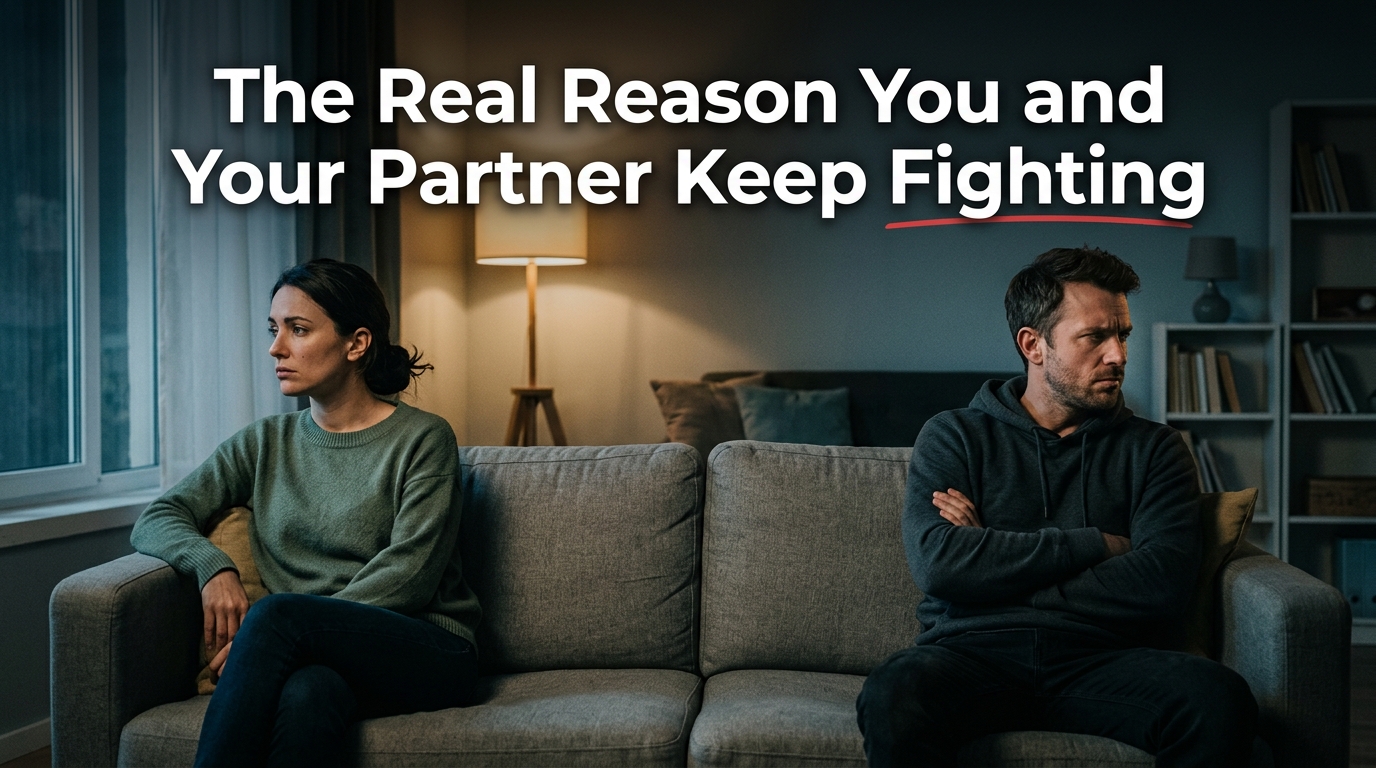
If you and your partner keep fighting about the same things over and over again, you are not alone — and you are not failing at love. Research published in the Journal of Marriage and Family found that nearly 69% of relationship conflicts are recurring, meaning most couples argue about the same core issues repeatedly without ever truly resolving them. That statistic might feel disheartening at first — but it is actually one of the most hopeful things you can learn about relationships. Because once you understand why the cycle exists, you finally have the power to break it.
This is not an article about who is right or wrong. This is about what is really happening beneath the surface every time a small disagreement spirals into a full-blown argument that leaves both of you feeling hurt, exhausted, and disconnected.

The Surface Argument Is Never the Real Argument
This is the most important thing to understand about why you and your partner keep fighting.
When you fight about dirty dishes, being five minutes late, spending too much money, or forgetting a small task — you are almost never truly fighting about those things. Those are what psychologists call “presenting issues.” They are the visible, manageable-sounding triggers that sit on top of something much deeper and much more emotionally loaded.
Dr. John Gottman, one of the world’s leading relationship researchers, spent over four decades studying couples. His findings revealed something profound: the majority of arguments in committed relationships are driven by unmet emotional needs, not logical disagreements. People do not argue because they have different opinions about how to load a dishwasher. They argue because one person feels unseen, unappreciated, dismissed, or unloved — and the dishwasher becomes the lightning rod for all of that pain.
Think about the last fight you had with your partner. On the surface, what was it about? Now ask yourself: what were you actually feeling in that moment? Were you feeling ignored? Disrespected? Like you don’t matter? Like nothing you do is ever enough?
Those feelings are the real fight. The dishes are just the vehicle.
This distinction is everything. Because when you understand that the argument is not really about the argument, you stop trying to win a debate about logistics and you start asking a much more important question: “What does my partner actually need right now, and what do I need too?”
Emotional Triggers and Why They Run the Show
Every person alive carries emotional triggers shaped by their past experiences, childhood, previous relationships, and core beliefs about themselves and the world.
A trigger is not a weakness. It is simply a place inside you where old pain lives. When something in the present moment resembles something that once hurt you, your nervous system reacts as if the threat is happening again right now — even when it is not.

This is why the same fight keeps happening. Your partner does something — forgets to respond to a message, uses a certain tone of voice, prioritizes something else over you in a small moment — and suddenly your body is not in the present moment anymore. It is in every time you were made to feel unimportant, abandoned, criticized, or unloved. Your reaction feels proportionate to years of accumulated pain, even though the actual event was minor.
Your partner, watching this escalation, may not understand where it is coming from. And they likely have their own triggers being activated in response to your reaction. This is the trigger loop — and it is one of the most common reasons couples feel like they are going in circles.
“In most recurring arguments, neither partner is overreacting. Both are reacting to something real — just not necessarily to what is happening right now.”
The goal is not to eliminate your triggers. That is not realistic. The goal is to become aware of them, to name them, and to be able to communicate what is actually happening inside you instead of projecting it outward as blame.
Attachment Styles: The Hidden Script Driving Your Conflicts
One of the most powerful psychological frameworks for understanding why couples fight is attachment theory — originally developed by psychologist John Bowlby and later expanded by researchers like Dr. Sue Johnson and Dr. Mary Ainsworth.
Attachment theory tells us that how we bonded with our primary caregivers as children shapes the way we relate to romantic partners as adults. And these attachment styles create very predictable conflict patterns that play out in relationships — often without either partner realizing it.
The four main attachment styles are secure, anxious, avoidant, and disorganized. The most common conflict-generating combination in couples is anxious-avoidant pairing.
Here is how it typically plays out:
The anxiously attached partner feels disconnected or uncertain about the relationship. Their nervous system interprets distance as danger. They reach out — sometimes in escalating, urgent ways — seeking reassurance and connection.
The avoidantly attached partner, on the other hand, learned early in life that expressing emotional needs leads to rejection or overwhelm. When they feel emotional pressure, their instinct is to withdraw, go quiet, or shut down — as a form of self-protection.

Now here is where the conflict explodes.
The anxious partner’s reaching feels like pressure to the avoidant partner, who withdraws further. The avoidant partner’s withdrawal feels like abandonment to the anxious partner, who reaches even harder. Both are now in survival mode. Neither feels safe. And neither is actually getting what they need.
This cycle has a name in couples therapy: the pursue-withdraw dynamic. And it is remarkably common. Dr. Sue Johnson, founder of Emotionally Focused Therapy, describes it as one of the most destructive patterns in romantic relationships — not because the people involved are broken, but because the pattern itself creates conditions where neither person can feel safe enough to be vulnerable.
Understanding your attachment style and your partner’s attachment style does not excuse bad behavior. But it creates compassion. And compassion is where real change begins.
The Communication Breakdown Nobody Talks About
Here is a truth that most people are never taught: there is a significant difference between speaking and communicating.
Most of us, during a conflict, are not actually communicating. We are defending. We are explaining. We are trying to be heard. We are building our counter-argument while the other person is still talking. We are expressing frustration in ways that land as attacks, even when that was not our intention.
Dr. Gottman identified what he calls the “Four Horsemen” of relationship conflict — four communication patterns that, if left unchecked, predict relationship breakdown with startling accuracy. They are: criticism, contempt, defensiveness, and stonewalling.
Criticism is different from a complaint. A complaint addresses a specific behavior: “I felt hurt when you didn’t text me back.” Criticism attacks the person: “You never think about anyone but yourself.” The shift from complaint to criticism is small in wording but enormous in emotional impact.
Contempt is the most damaging of the four. It involves treating your partner with disrespect — eye-rolling, sarcasm, dismissiveness, mockery. Contempt communicates: “I am above you.” It is corrosive.
Defensiveness is a natural human response to feeling attacked. But when both partners are defensive, no one is listening. Both people are talking. No one is being heard.
Stonewalling happens when someone emotionally shuts down and withdraws from the conversation entirely — not always out of coldness, but often because their nervous system has become so overwhelmed that disengagement feels like the only option.
“The antidote to criticism is speaking about your own feelings. The antidote to contempt is genuine appreciation. The antidote to defensiveness is taking responsibility. The antidote to stonewalling is taking a break — and coming back.”
Recognizing these patterns in yourself, not just in your partner, is where growth happens.

Unspoken Expectations: The Invisible Rules Destroying Your Peace
Every person enters a relationship carrying a set of expectations — about how love should look, how conflict should be handled, how much space is healthy, how often you should say “I love you,” who handles what responsibilities, and what a good partner does and does not do.
Most of these expectations are never spoken out loud.
They come from how your parents related to each other. They come from past relationships — what worked, what hurt, what you swore you would never accept again. They come from movies, social media, and cultural ideas about romance. They come from your own deep, private definition of what love is supposed to feel like.
And when your partner does not meet an expectation you never told them about, it feels like a betrayal — even though they had no way of knowing.
This is one of the most silent and destructive sources of recurring conflict in relationships. You are holding your partner accountable to rules they were never given. They are doing the same to you. And both of you feel perpetually let down without being able to articulate exactly why.
The fix is uncomfortable but transformative: you have to say it out loud. You have to be willing to feel vulnerable enough to say “I need you to…” or “It really matters to me when…” or “I feel most loved when…”
This is not weakness. This is one of the most courageous things you can do in a relationship.
Emotional Flooding: Why You Can’t Think Straight Mid-Fight
Have you ever been in the middle of an argument and said something you immediately regretted? Or felt so overwhelmed that you completely shut down and went cold?
That is emotional flooding, and it has a physiological explanation.
When conflict escalates, the brain’s threat-detection system — the amygdala — takes over. This is the part of the brain responsible for the fight-or-flight response. When it is activated, blood flow is literally redirected away from the prefrontal cortex — the part of your brain responsible for rational thinking, empathy, and emotional regulation.
In other words: when you are flooded, you are physically incapable of having a productive conversation. Your intelligence is still there. Your love for your partner is still there. But your access to both of them is temporarily cut off.
This is why it is not just a good idea to take breaks during heated arguments — it is neurologically necessary. Dr. Gottman’s research suggests that it takes approximately 20 minutes for the nervous system to return to a regulated state after flooding. During those 20 minutes, you should not be making any important decisions, sending any text messages, or trying to resolve anything.
You should be breathing, moving, doing something calming — and giving your brain the chance to come back online.

How to Finally Break the Cycle
Understanding the real reason you and your partner keep fighting is the foundation. But understanding alone does not create change. Here is what actually does.
Slow down before you escalate. Learn to recognize your own early signs of flooding — tightening chest, raised voice, racing thoughts — and take a break before the conversation reaches the point of no return. Agree with your partner in advance that breaks are not abandonment. They are a tool.
Lead with feelings, not accusations. “I feel lonely when we don’t spend time together” lands completely differently than “You never make time for me.” One invites connection. The other triggers defense.
Get curious about your partner’s behavior, not just reactive. When your partner does something that hurts you, ask yourself: what might they be feeling or needing right now? This does not excuse harmful behavior, but it opens a door that blame always closes.
Name the pattern, not the person. Instead of “You always do this,” try “We keep ending up in this same place, and I want us to figure out how to change it together.” Framing the problem as something you both face, rather than something one of you causes, changes everything about how the conversation unfolds.
Seek professional support without shame. Couples therapy is not a last resort for relationships that are falling apart. It is a tool for couples who care enough about each other to stop guessing and start learning. Emotionally Focused Therapy (EFT) in particular has a remarkable success rate for breaking exactly the kinds of patterns described in this article.
You Are Not Enemies — You Are Teammates Who Forgot
The fights feel personal. They feel like evidence that you are incompatible, or that love is not enough, or that you chose the wrong person. But most of the time, none of that is true.
You are two people who came from different histories, carrying different wounds, speaking different emotional languages — trying to build something together without a shared manual.
The fact that you keep fighting does not mean your relationship is broken. It means there is something important trying to be heard. The most meaningful shift you can make is to stop asking “how do I win this argument?” and start asking “how do we both feel safe enough to stop fighting altogether?”
That question, asked together, is where the healing begins.
💾 Save this article to come back to it.
📤 Share it with someone who needs to hear this.
👣 Follow Truthsinside.com for more real, research-backed relationship and psychology content.
📃 Related article: 15 Signs She Is Testing You: Why Women Test Men and What to Do
Frequently Asked Questions
Q1: Is it normal for couples to fight a lot?
Yes — conflict is a natural and unavoidable part of any relationship. What matters is not the frequency of conflict, but the patterns within it. Recurring, unresolved arguments that follow the same emotional script are the warning sign, not the presence of disagreement itself.
Q2: What does it mean when you keep having the same argument?
Recurring arguments almost always point to an unresolved underlying need — often related to feeling heard, respected, valued, or secure. The surface topic changes, but the emotional core stays the same until that core need is addressed directly.
Q3: Can a relationship recover from constant fighting?
Absolutely. Many couples who have spent years in destructive conflict patterns have gone on to build deeply secure, fulfilling relationships — often with the help of therapy and a genuine commitment from both partners to understand and change the pattern, not just each other.
Q4: How do I get my partner to stop being so defensive?
Defensiveness is typically a response to feeling attacked or blamed. The most effective way to reduce your partner’s defensiveness is to change the way you approach conflict — leading with feelings rather than accusations, using “I” statements, and making it clear that your goal is connection, not victory.
Q5: When should a couple consider therapy?
If you find yourself having the same arguments repeatedly without resolution, if one or both of you feel chronically unheard or disconnected, or if conflicts are becoming more intense or frequent — those are all strong signals that a professional therapist could offer tools and perspective that are difficult to access on your own. Seeking help early, before patterns become entrenched, is always the most effective approach.
🎵 Music
Maren Lull is a singer-songwriter who writes from the places most people don’t talk about out loud.
Not the dramatic grief. Not the obvious heartbreak. The quiet kind — the ordinary Tuesday emptiness, the habit of reaching for someone who isn’t there anymore, the particular exhaustion of being strong for so long that the strength itself wears thin.
Her music lives at the intersection of emotional honesty and soft beauty — breathy vocals over gentle piano, slow tempos, lyrics that feel less like songs and more like something you wrote in a private notebook at two in the morning and never showed anyone.
Maren Lull writes for the people who feel everything deeply and say very little about it. For the ones who listen to sad music not because they want to feel worse — but because being understood, even by a song, makes the feeling easier to carry.
📱 Follow Maren Lull:
→ Spotify
→ Apple Music
→ Youtube
→ Audiomack