
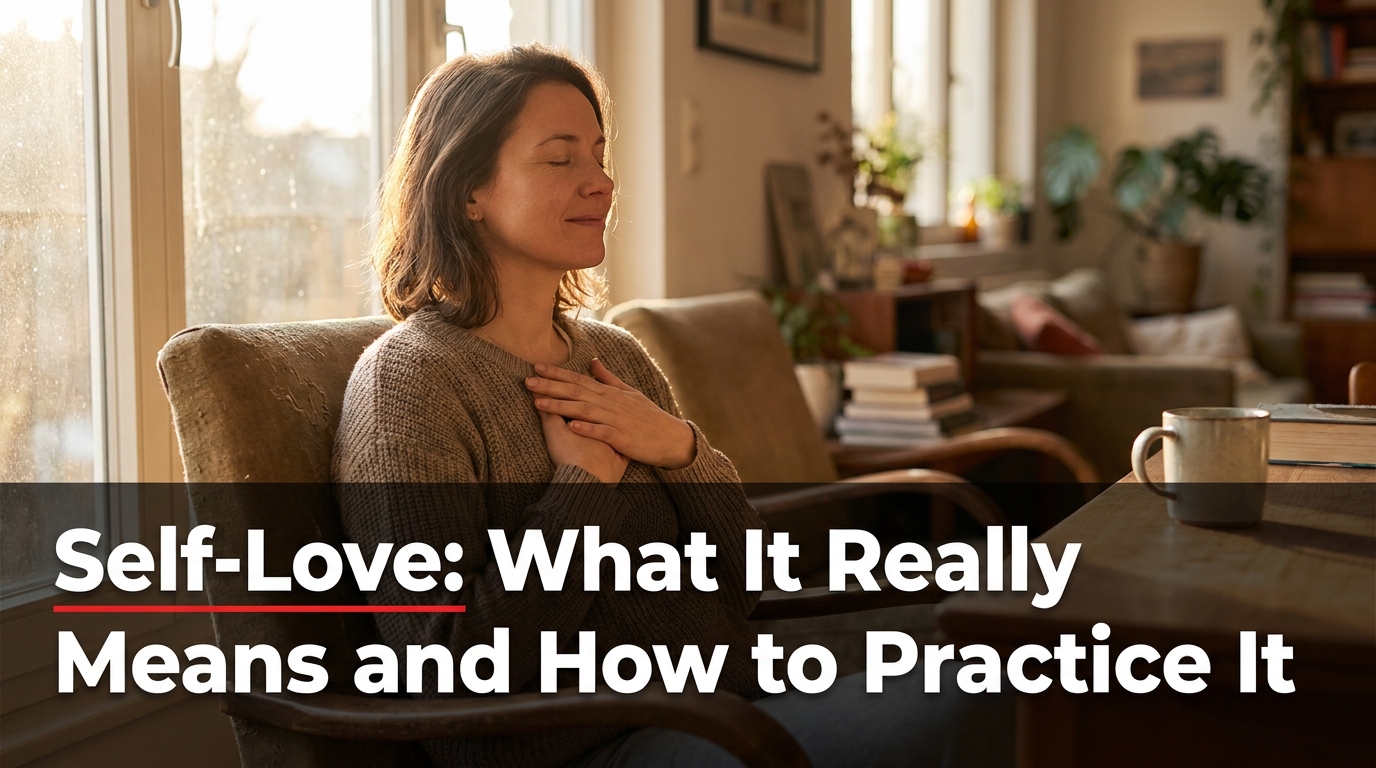
Most of us have heard the phrase “you have to love yourself first” so many times it has almost lost its meaning. But the research behind it is anything but hollow. A landmark study published in the journal Self and Identity found that individuals with a strong sense of self-compassion — a core pillar of genuine self-love — reported significantly lower rates of anxiety, depression, and relationship dissatisfaction than those who depended primarily on external validation for their sense of worth.
Self-love is not a luxury or a personality trait reserved for the naturally confident. It is a foundational psychological need — and its absence quietly shapes the way you relate to yourself, to others, and to life itself. If you have ever felt that no amount of external love truly fills the emptiness inside, this article is the beginning of understanding why — and what to do about it.
This is not going to be an article about bubble baths and positive affirmations. What follows is an honest, psychology-grounded exploration of what self-love actually is, why so many people struggle to access it, and how to build it in ways that are real, lasting, and genuinely transformative.

What Self-Love Actually Is — And What It Is Not
Before we talk about how to practice self-love, we need to dismantle what most people think it is — because the cultural version of self-love has become so diluted that it often leads people further from the real thing.
Self-love is not self-indulgence. It is not choosing comfort over growth every time something gets hard. It is not posting affirmations you do not actually believe. It is not treating yourself to expensive things to fill an emotional gap. And it is absolutely not the same as narcissism — a conflation that causes many people, particularly those raised to prioritize others above themselves, to feel guilty every time they begin moving toward it.
The most rigorous psychological definition of self-love — grounded in the work of Dr. Kristin Neff, one of the world’s leading researchers on self-compassion — describes it as having three interconnected components.
The first is self-kindness: treating yourself with the same warmth, understanding, and patience you would offer a close friend who is struggling. Not harsh self-judgment. Not relentless inner criticism. Genuine care directed inward.
The second is common humanity: recognizing that suffering, failure, and imperfection are universal human experiences — not personal evidence that something is uniquely and irreparably wrong with you.
The third is mindfulness: holding your painful thoughts and feelings in balanced awareness rather than suppressing them or being consumed by them. Seeing clearly without dramatizing or denying.
These three elements together create something far more powerful than any surface-level self-care routine. They create a stable internal foundation from which you can face difficulty, disappointment, and your own limitations without collapsing.
Why So Many People Struggle to Love Themselves
Understanding why self-love is so difficult for so many people is just as important as understanding what it is. Because if you have spent years — perhaps your entire life — struggling to feel genuinely worthy, there are real reasons for that. And those reasons are not evidence of weakness.
The way we relate to ourselves is largely learned. In childhood, we internalize the voices, attitudes, and behaviors of our primary caregivers. If those early environments were critical, emotionally withholding, inconsistent, or demanding — we do not simply experience that as something happening to us. We absorb it as something that is true about us.
A child who is consistently criticized begins to develop an inner critic that mirrors that external voice. A child whose emotional needs are dismissed learns to dismiss their own emotional needs. A child who is loved conditionally — only when they perform, achieve, or comply — learns that love must be earned rather than simply received.
These patterns become deeply embedded beliefs operating beneath conscious awareness. And they continue to run in the background of adult life, shaping everything from how you handle failure to who you allow yourself to be loved by.

Dr. John Bradshaw, author and family systems therapist, described the result of these early experiences as “toxic shame” — a deep, pervasive sense of being fundamentally flawed rather than simply someone who sometimes makes mistakes. Toxic shame says: “I am bad.” Healthy guilt says: “I did something bad.” That distinction is profound. Because a person living under the weight of toxic shame does not feel unworthy of love in specific, manageable moments. They feel unworthy of love at the core of who they are.
If this resonates with you — if there is a voice inside you that has always quietly insisted you are too much, not enough, undeserving, or fundamentally flawed — that voice is not the truth about you. It is a record of an old wound playing on repeat. And it can change.
The Difference Between Self-Love and Self-Esteem
Many people use these terms interchangeably, but they describe meaningfully different things — and understanding the distinction can fundamentally change how you approach your relationship with yourself.
Self-esteem is largely evaluative and conditional. It rises when you succeed, perform well, receive validation, or feel attractive. It falls when you fail, are criticized, feel rejected, or fall short of a standard. High self-esteem feels wonderful — but because it is contingent on external outcomes, it is inherently unstable. It requires constant feeding.
Self-love, and particularly self-compassion, is unconditional. It does not fluctuate based on whether you hit your goals or received a compliment today. Dr. Neff’s research demonstrates that self-compassion is actually a more robust predictor of psychological wellbeing than self-esteem — precisely because it does not depend on the outside world cooperating.
People with high self-esteem but low self-love often appear confident and accomplished on the surface while privately being terrified of failure, deeply sensitive to criticism, and locked in perpetual comparison with others. Their worth is always one bad outcome away from collapse.
People with genuine self-love may not have sky-high confidence in every area of their lives — but they have a stable internal ground that does not disappear when things go wrong. They can fail and still feel fundamentally okay. They can be imperfect and still feel deserving of care. That groundedness is not arrogance. It is security.
“Self-love is not about thinking you are better than others. It is about no longer needing to compare yourself to others to feel okay about yourself.”
How Self-Love Transforms Your Relationships
One of the most misunderstood aspects of self-love is that it is somehow self-centered — that choosing yourself means withdrawing from others. The research says exactly the opposite.
People who practice genuine self-love bring a fundamentally different energy into their relationships. They do not seek partners to complete them — they seek partners to complement them. They do not tolerate mistreatment because they cannot imagine deserving better. They do not give endlessly from an empty cup and then resent the people they gave to.
Dr. Sue Johnson, founder of Emotionally Focused Therapy, consistently notes that the most securely attached individuals — those who build the healthiest, most resilient relationships — are those who have a stable sense of their own worth. Not because they never need reassurance or support, but because their fundamental sense of value does not depend on their partner’s constant affirmation.
When you do not love yourself, you will unconsciously seek from your relationships what you cannot give yourself. You may tolerate behavior that diminishes you because some attention feels better than none. You may become anxiously attached, seeking constant reassurance because you cannot find security inside yourself. You may give compulsively — not from genuine generosity, but from the unconscious belief that love must be earned through sacrifice.
Conversely, when you love yourself — genuinely, groundedly — you are capable of loving others from a place of abundance rather than need. You can give without resentment. You can set limits without guilt. You can receive love without suspicion. The quality of every relationship in your life is shaped by the quality of the relationship you have with yourself.

What Self-Love Actually Looks Like in Practice
Here is where many articles fall short. They tell you to love yourself but give you a checklist of activities that scratches only the most surface layer of what genuine self-love requires. Real self-love is less about what you do and more about how you relate to yourself — and that internal shift is more nuanced and more demanding than any list of habits.
That said, there are genuine practices — grounded in psychological research — that build self-love over time when approached with intention and honesty.
Developing your inner witness
The first and most foundational practice is learning to observe yourself — your thoughts, feelings, and reactions — with curiosity rather than judgment. Most people live almost entirely inside their thoughts, mistaking every internal narrative for objective truth. The thought “I am such a failure” feels like a fact rather than an opinion shaped by mood, history, and interpretation.
Mindfulness teaches you to create a small but crucial distance between yourself and your thoughts — to see them as weather patterns moving through your mind, not permanent facts about who you are. When you can observe “I am having the thought that I am not enough” rather than simply believing “I am not enough” — you have taken the most important first step toward self-love.
Practicing self-compassion actively
Dr. Neff developed a practice she calls the Self-Compassion Break — and research on it is remarkably encouraging. In moments of difficulty or self-criticism, you pause and consciously offer yourself the same words you would offer a good friend. You acknowledge the pain: “This is really hard right now.” You recognize the universality: “Struggling like this is part of being human.” You offer kindness: “May I be gentle with myself in this moment.”
This is not about bypassing accountability. You can acknowledge that you made a mistake and still treat yourself with kindness in the process of learning from it. In fact, research shows that self-compassion — not self-criticism — produces better behavioral outcomes. People who are self-compassionate after failure are more likely to try again, improve, and grow. Self-criticism produces shame, and shame produces paralysis.
“You cannot think your way into self-love. You have to practice it — in the small, unglamorous moments when your inner critic is loudest and your instinct is to agree with it.”
Setting limits as an act of love
This is one of the most counterintuitive but essential expressions of self-love. Many people associate setting limits with rejection, conflict, or selfishness. In reality, limits are one of the clearest ways you communicate to yourself — and to others — what you value and what you will not sacrifice.
Every time you say no to something that violates your values, your energy, or your wellbeing — you are telling yourself that your needs matter. Every time you say yes when you mean no — out of fear of disapproval, or the compulsive need to be needed — you are telling yourself the opposite.
Limits are not walls. They are the honest communication of where you end and where someone else begins. And building the capacity to honor them — even when it is uncomfortable, even when someone is disappointed — is an act of profound self-love.
Addressing the inner critic directly
Almost everyone has an inner critic. But for many people, particularly those with difficult early experiences, the inner critic is not a mild background voice. It is relentless, punishing, and pervasive — a constant, cruel commentary on every perceived inadequacy.
One of the most effective therapeutic approaches to the inner critic — developed in Internal Family Systems therapy by Dr. Richard Schwartz — involves recognizing that the inner critic is not your enemy. It is a part of you that learned, very early, that being self-critical first would protect you from the pain of being criticized by others. It developed as a survival strategy.
When you can approach your inner critic not with hatred but with genuine curiosity — asking “what are you trying to protect me from right now?” — something begins to shift. The critic softens. Because what it needed all along was not to be fought, but to be understood.

Healing your relationship with your body
Self-love cannot live only in the mind. Your body is not a vehicle to be managed or a problem to be solved. It is where you live — and how you relate to it reflects and reinforces your broader relationship with yourself.
This means different things for different people. For some, it means releasing years of habitual body criticism and learning to inhabit their physical self with basic kindness. For others, it means learning to listen to their body’s signals — rest, movement, hunger, stress — rather than overriding them in service of productivity or approval.
It does not require loving everything about your body every day. It requires relating to your body as you would relate to someone you care for — with patience, attention, and a basic commitment to their wellbeing.
Choosing environments and people that reflect your worth
Self-love is not only an internal practice. It expresses itself in the external choices you make — particularly in who you spend your time with and what environments you choose to inhabit.
People who have done genuine self-love work naturally begin to notice that certain relationships feel depleting, disrespectful, or fundamentally misaligned with who they are. And they become less willing to shrink themselves to fit into spaces that do not honor them.
This does not mean ruthlessly cutting everyone who has ever hurt you out of your life. It means gradually, honestly re-evaluating which relationships nourish you and which ones cost you more than they give. And it means developing the courage — slowly, imperfectly — to choose the ones that reflect the worth you are learning to give yourself.

The Ongoing Nature of Self-Love
One of the most important things to understand about self-love is that it is not a destination you arrive at and then maintain effortlessly. It is a practice — ongoing, imperfect, and non-linear.
There will be days when the inner critic is loud and you believe it. There will be setbacks where old patterns resurface with surprising force. There will be moments where you catch yourself giving yourself away again — tolerating something you said you would not, shrinking in a space where you promised yourself you would stand.
These moments are not evidence that you have failed at self-love. They are part of its practice. The goal is not to eliminate every self-critical thought or to feel at peace with yourself every single moment. The goal is to build a relationship with yourself that is honest enough, kind enough, and strong enough to hold you through the moments when it is hardest.
Dr. Neff describes this beautifully: self-compassion is not about being positive all the time. It is about relating to your suffering with kindness rather than with war. You are allowed to struggle and still be worthy of love. You are allowed to fail and still be worth fighting for.
You — exactly as you are, in this imperfect, still-becoming moment — are already worthy of the love you are trying to learn to give yourself.
The Bottom Line on Self-Love
Self-love is the relationship that makes all other relationships possible. It is the foundation beneath your capacity to give, to receive, to set limits, to stay, to leave, to grow, and to heal.
It is not built in a weekend retreat or through a morning routine alone. It is built in thousands of small, daily choices to be on your own side — to speak to yourself with kindness, to honor what you need, to refuse the relationships and environments that tell you that you are less than what you are.
It is built every time you choose presence over performance. Every time you rest without guilt. Every time you say no and mean it. Every time you look at your own imperfection and choose understanding over cruelty.
Self-love is not the finish line. It is how you learn to walk.
💾 Save this article — return to it on the days when you need reminding.
📤 Share it with someone who gives endlessly to others and forgets themselves completely.
👣 Follow Truthsinside.com for honest, psychology-backed content on love, emotions, and the relationship with yourself.
📃 Related article: What Does It Actually Feel Like to Fall in Love? Science + Real Stories
Frequently Asked Questions
Q1: Is self-love the same as being selfish?
No — and this is one of the most important distinctions to understand. Selfishness involves prioritizing your own needs at the expense of others with disregard for their wellbeing. Self-love involves honoring your own needs so that you have something genuine and sustainable to offer others. Research consistently shows that people with higher self-compassion are actually more generous, more empathetic, and more emotionally available to others — not less.
Q2: What is the fastest way to start building self-love?
The most immediately accessible entry point is practicing self-compassion in moments of failure or difficulty. When you catch yourself engaging in harsh self-criticism, pause and ask: “What would I say to a close friend who was going through exactly this?” Then say that to yourself. It feels strange at first. It becomes more natural with practice. That single habit, applied consistently, begins to rewire the internal patterns that make self-love feel impossible.
Q3: Can you truly love someone else if you don’t love yourself?
You can love others deeply and genuinely without fully loving yourself — love is not all-or-nothing. But the quality and sustainability of that love is significantly affected by your relationship with yourself. Without self-love, love for others often becomes entangled with need, fear, resentment, or compulsive self-sacrifice. Building self-love does not make you love others less. It makes the love you give cleaner, freer, and more lasting.
Q4: How do I practice self-love when I don’t feel I deserve it?
The feeling of not deserving love is itself a symptom of the wound — not evidence that the wound is true. You do not have to feel deserving before you begin practicing. You begin practicing despite the feeling. Start small: one moment of self-kindness, one small act of honoring your own needs, one time catching the inner critic and choosing not to agree with it. Feeling comes after practice, not before it.
Q5: How does therapy help with building self-love?
Therapy — particularly approaches like Internal Family Systems, Compassion-Focused Therapy, and somatic therapies — provides a structured, supported environment in which the roots of self-rejection can be explored and gently addressed. A skilled therapist does not tell you to love yourself. They create conditions in which you can begin to experience yourself as someone worthy of care — often for the first time — and build from there. For many people, the therapeutic relationship itself becomes one of the first safe spaces in which genuine self-acceptance begins to grow.
🎵 Music
Maren Lull is a singer-songwriter who writes from the places most people don’t talk about out loud.
Not the dramatic grief. Not the obvious heartbreak. The quiet kind — the ordinary Tuesday emptiness, the habit of reaching for someone who isn’t there anymore, the particular exhaustion of being strong for so long that the strength itself wears thin.
Her music lives at the intersection of emotional honesty and soft beauty — breathy vocals over gentle piano, slow tempos, lyrics that feel less like songs and more like something you wrote in a private notebook at two in the morning and never showed anyone.
Maren Lull writes for the people who feel everything deeply and say very little about it. For the ones who listen to sad music not because they want to feel worse — but because being understood, even by a song, makes the feeling easier to carry.
📱 Follow Maren Lull:
→ Spotify
→ Apple Music
→ Youtube
→ Audiomack