
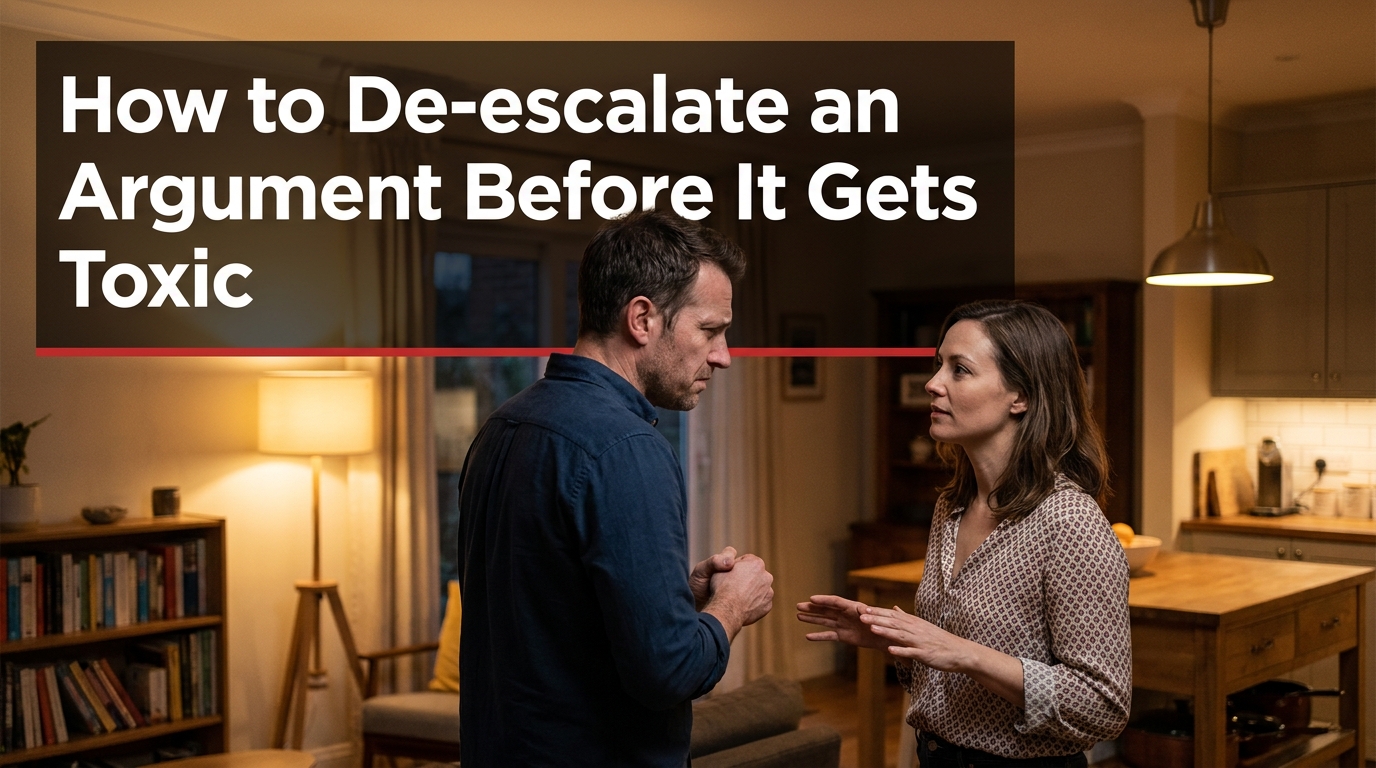
Every couple argues. But there is a critical difference between an argument that ultimately brings two people closer and one that leaves lasting damage — and that difference almost always comes down to what happens in the minutes before things turn toxic. Knowing how to de-escalate an argument is not a passive skill or a sign of weakness. It is one of the most powerful, relationship-protecting tools any person can develop. Research from the Gottman Institute found that couples who develop effective repair mechanisms — deliberate behaviors that interrupt conflict before it escalates — report significantly higher relationship satisfaction and dramatically lower rates of long-term relational damage.
The good news is that de-escalation is entirely learnable. The even better news is that it only takes one person to begin it.
This article is not about avoiding conflict or pretending everything is fine. Conflict is natural and even necessary in close relationships. This is about making sure that when conflict happens, it does not become the kind that leaves wounds neither of you asked for.

Why Arguments Escalate — The Psychology Behind the Spiral
To understand how to de-escalate an argument, you first need to understand why arguments escalate in the first place. Because escalation is not random — it follows a remarkably predictable psychological and neurological pattern.
When a conflict begins, the body’s threat-detection system — the amygdala — activates. This is the brain region responsible for the fight-or-flight response, and it does not distinguish between a physical threat and an emotional one. A raised voice, a dismissive tone, a pointed accusation — these register in the nervous system with similar urgency to genuine danger.
As the amygdala activates, it begins flooding the body with stress hormones — cortisol and adrenaline. Heart rate increases. Breathing shallows. Muscles tighten. Blood flow is redirected away from the prefrontal cortex — the rational, empathetic, perspective-taking part of the brain — and toward the systems responsible for survival.
This neurological sequence is what Dr. John Gottman calls “flooding.” And once flooding occurs, the brain is literally operating in a compromised state. Access to nuance, empathy, and rational communication is significantly reduced. This is why things said in the heat of an argument so often feel impossible to take back — they were generated by a brain in survival mode, not a brain capable of full relational care.
Understanding this is not an excuse for harmful behavior during conflict. It is a framework that explains why learning to intervene before flooding occurs is so much more effective than trying to have a productive conversation once it is already underway.
The Window of Opportunity — And Why Most People Miss It
There is a moment in every argument — a brief, often overlooked window — that exists before the conversation crosses from heated but manageable into genuinely toxic. Skilled de-escalation is almost entirely about learning to recognize that window and making a deliberate choice inside it.
Most people miss this window because their attention during conflict is directed outward — at their partner’s words, their partner’s tone, the argument they are building in response. They are so focused on being heard that they are not paying attention to what is happening inside their own body and mind.
The window announces itself through physical signals: a tightening in the chest, a clenching in the jaw, the sensation of heat rising in the face, a narrowing of focus, an impulse to say the sharpest possible thing. These are the body’s early warning system — the alert that flooding is beginning.
People with high emotional intelligence learn to treat these signals not as cues to escalate but as invitations to slow down. Not to surrender. Not to go silent indefinitely. But to consciously interrupt the neurological sequence before it reaches the point where both people are operating from their most reactive, least resourced selves.
That interruption — small, deliberate, and often uncomfortable — is where de-escalation begins.
“De-escalation is not about suppressing what you feel. It is about refusing to let what you feel in a heightened moment speak for what you actually mean.”
Technique 1: Regulate Your Own Nervous System First
This is the most foundational de-escalation technique — and the one most people skip because it feels counterintuitive in the middle of a conflict.
When an argument begins to escalate, the instinct is to focus entirely on the other person — what they are saying, what they are doing, how they need to change. But you cannot effectively de-escalate a conflict from inside a flooded nervous system. The first and most essential act of de-escalation is internal.
Physiological regulation — deliberately slowing your breathing, lowering your physical tension, and activating your parasympathetic nervous system — begins to counteract the flood of stress hormones within minutes. Dr. Andrew Huberman, neuroscientist at Stanford University, identifies the physiological sigh as one of the fastest and most effective tools for nervous system regulation: a double inhale through the nose followed by a long, slow exhale through the mouth. This breathing pattern actively deflates the stress response at a biological level.
Even thirty seconds of deliberate slow breathing during an escalating argument can meaningfully shift your physiological state — giving the prefrontal cortex enough oxygen and circulation to come back online. And when you come back online, you make better choices. You access more of who you actually are. You speak from something other than your most reactive place.
Regulate first. Respond second. The order matters enormously.

Technique 2: Call a Time-Out — The Right Way
The idea of taking a break during an argument is not new. But most people execute it in a way that makes things significantly worse rather than better — and understanding the difference is critical.
A poorly executed time-out sounds like: “I’m done with this conversation.” “Fine, whatever.” Silence followed by leaving the room without any communication. These versions of stepping away land as abandonment, stonewalling, or contempt — and they tend to escalate the other person’s emotional response, not reduce it.
A well-executed time-out is communicated explicitly and returned to deliberately. It sounds like: “I’m starting to feel flooded and I don’t want to say something I’ll regret. I need twenty minutes to calm down and then I genuinely want to come back and talk about this.”
That version does three things simultaneously. It takes responsibility for your own internal state without blaming your partner for it. It makes clear that you are not abandoning the conversation — you are protecting it. And it gives the other person a timeline, which reduces the anxiety and abandonment response that open-ended silence creates.
Dr. Gottman’s research suggests that approximately twenty minutes is the minimum time required for a flooded nervous system to return to baseline — though for some people and some situations it may be longer. Whatever time you take, the agreement to return is not optional. It is the foundation that makes the time-out a tool rather than a weapon.
Technique 3: Lower Your Physical Presence Deliberately
This is one of the most immediately effective and least discussed de-escalation techniques available to anyone in a heated argument — and it requires no words at all.
The body communicates volumes during conflict, often louder than language. Standing with a squared, forward-facing posture, maintaining sustained intense eye contact, pointing, leaning in — all of these physical cues register to the other person’s nervous system as escalation, even when no threatening words are being spoken.
Deliberately lowering your physical presence — sitting down, stepping slightly back, uncrossing your arms, softening your facial muscles, reducing the directness of your gaze — sends physiological signals of safety to your partner’s nervous system. It communicates, on a level beneath language, that the threat level is reducing.
This is not performance. It is regulation made visible. When you physically soften during conflict, you are not only signaling safety to your partner — you are also reinforcing your own nervous system’s transition out of fight-or-flight mode. The body and the mind are in constant conversation, and the signals travel in both directions.
The next time you feel an argument beginning to spiral, try simply sitting down. The effect is often immediate and sometimes remarkable.

Technique 4: Change the Language from Accusation to Disclosure
One of the primary engines of argument escalation is the language of accusation — statements that place the entire weight of the problem on your partner’s character or behavior.
“You always do this.” “You never listen.” “You’re being ridiculous.” “You don’t care about anyone but yourself.”
These statements — even when they contain grains of truth — land as attacks. And attacks trigger defenses. And defenses trigger counter-attacks. And within a few exchanges, both people are in full combat mode, and the original issue has been buried entirely under layers of mutual wounding.
The alternative is not silence or self-erasure. It is the deliberate shift from accusation to disclosure — from “you” statements to “I” statements that communicate your actual internal experience.
“I feel dismissed when this happens.” “I’m scared that we keep ending up here.” “I feel like I’m not being heard right now and it’s really hard.” “When this happens, I feel like you don’t care about what I need — and that terrifies me.”
These statements do something accusatory language cannot do: they make you vulnerable. And vulnerability — genuine, undefended vulnerability — is extraordinarily difficult to attack. It invites connection rather than combat. It gives your partner something real to respond to rather than a wall to tear down.
This shift in language is not easy. It requires you to know what you are actually feeling beneath the surface emotion of anger — which is almost always something softer and more vulnerable underneath: fear, sadness, loneliness, a need to matter. But that excavation, done consistently, changes the entire architecture of how you fight.
“Accusation says ‘you are the problem.’ Disclosure says ‘I am in pain.’ One starts a war. The other opens a door.”
Technique 5: Use a Repair Attempt — Even an Imperfect One
Dr. Gottman’s research identified repair attempts as one of the single most important predictors of relationship health — and one of the most underutilized tools in conflict. A repair attempt is any gesture, word, or action intended to reduce tension and de-escalate a conflict — even in the middle of it.
Repair attempts can be verbal: “I don’t want to fight with you.” “I love you even right now.” “Can we slow down for a second?” “I know this matters to you and I want to get it right.” They can be physical: a brief touch on the arm, a pause accompanied by eye contact that communicates care rather than combat. They can even be humor — though this one requires care, because poorly timed humor can land as dismissiveness.
What makes repair attempts so powerful is not their sophistication. It is their existence. The willingness to reach toward your partner in the middle of conflict — to prioritize the relationship over the argument — signals something profound: that you are still on the same side, even when things feel adversarial.
In relationships where the emotional climate has become predominantly negative, repair attempts often fail — not because they are the wrong tool, but because the emotional bank account is too depleted for them to land. This is why consistent, daily investment in the relationship’s positive emotional climate is not a luxury. It is the infrastructure that makes de-escalation possible when you need it most.
Technique 6: Name What Is Happening Without Blame
There is a surprisingly powerful de-escalation move that many people never think to use: simply naming the dynamic that is occurring, out loud, without assigning blame for it.
It sounds like this: “I notice we’re starting to escalate.” “I can feel this conversation getting heated.” “We’re doing the thing where we both stop listening.” “I think we’re both triggered right now.”
This technique works because it shifts perspective. Instead of being inside the argument — two people fighting each other — it creates a momentary shared view from slightly above the argument, where both people can observe the pattern together rather than being consumed by it.
Naming the dynamic positions the pattern as the problem — not your partner, and not you. “We’re escalating” is a fundamentally different framing than “you’re making this worse.” It invites collaboration rather than combat. It says: “Let’s look at what’s happening between us, together.”
This requires a degree of self-awareness and emotional distance that is genuinely difficult to access mid-conflict. But with practice, it becomes more natural — and its effect on the trajectory of an argument can be immediate and significant.

Technique 7: Return to the Relationship, Not Just the Argument
This technique is about reorienting the conversation around something larger than the immediate conflict — and it can be one of the most powerful de-escalators available, particularly in relationships where there is genuine love and commitment beneath the argument.
It sounds like: “I love you and I don’t want us to damage something I care deeply about over this.” “Our relationship matters more to me than winning this argument.” “I want to solve this because being close to you matters.”
Statements like these do something critical: they remind both people of the larger context in which the conflict is occurring. Arguments feel absolute in the moment — like this is all that exists, like the entire relationship is at stake in this specific exchange. Returning to the relationship — naming it explicitly, claiming it out loud — disrupts that tunnel vision.
This is not manipulation. It is not a tactic to shut the conversation down or avoid accountability. It is the honest truth of why de-escalating matters in the first place: because there is something between you worth protecting. Saying so — in the middle of a conflict, when it costs something to say — is one of the most powerful acts of love available to any partner.
What To Do After the Argument Has De-escalated
De-escalating an argument successfully is a significant achievement — but it is not the end of the process. What happens after the conflict cools down is equally important for the long-term health of the relationship.
Once both nervous systems have returned to baseline and the emotional temperature has genuinely reduced, it is essential to return to the original issue — not to re-ignite the conflict, but to actually address what it was about. Many couples make the mistake of using de-escalation as a way to permanently avoid the uncomfortable topic that triggered the argument. The relief of the tension breaking can create a false sense that things have been resolved when they have only been paused.
A conversation that begins with acknowledgment — “I know things got heated earlier and I want to come back to what we were trying to talk about, because it matters” — is far more likely to reach genuine resolution than either a second eruption or a permanent avoidance.
This is also the time for genuine repair: a real apology if something was said that caused harm, a genuine acknowledgment of what your partner was trying to communicate, and a shared commitment to how you want to handle things differently next time.
The goal of the post-conflict conversation is not to assign blame for the escalation. It is to understand what each of you was actually trying to communicate, to close the emotional loop that the argument left open, and to build — slowly, imperfectly — a shared language for handling conflict that gets better over time.

The Couple That Learns to Fight Better, Lasts Longer
No relationship is conflict-free. And anyone who tells you otherwise is describing a relationship in which honesty has been sacrificed for surface peace — which is its own kind of damage.
The goal of learning how to de-escalate an argument is not to eliminate the difficult conversations. It is to ensure that those conversations remain conversations — exchanges between two people who are trying to understand each other — rather than battles between two people who have forgotten they are on the same side.
Every time one of you chooses to breathe instead of retaliate — to disclose instead of accuse — to reach across the tension instead of hardening against it — you are building something. You are building a shared capacity for conflict that grows stronger with use. You are building evidence that this relationship is safe enough to be honest in, and strong enough to hold the weight of your most difficult truths.
That is not a small thing. It is, in fact, the whole thing.
Learning to de-escalate is not about being the bigger person. It is about being the person who loves something enough to protect it — even in the moments when protection is hardest.
💾 Save this article — keep it somewhere you can find it before the next argument.
📤 Share it with your partner or someone whose relationship deserves better tools.
👣 Follow Truthsinside.com for psychology-backed relationship and communication content that actually helps.
📃 Related article: What Does It Actually Feel Like to Fall in Love? Science + Real Stories
Frequently Asked Questions
Q1: What does it mean to de-escalate an argument?
De-escalating an argument means deliberately interrupting the psychological and physiological spiral that turns a manageable conflict into a damaging one. It involves recognizing the early signs of escalation — in yourself and in the dynamic between you — and making conscious choices to reduce the emotional temperature before it reaches the point where both people are operating from their most reactive, least resourced state. De-escalation is not the same as conflict avoidance. It is conflict protection.
Q2: Is it healthy to walk away from an argument?
Walking away from an argument can be one of the healthiest things you do — if it is done correctly. The critical variables are communication and return. Walking away without explanation tends to escalate the other person’s anxiety and anger. Walking away with a clear, caring statement — “I need time to calm down and I will come back to this” — and then genuinely returning creates a very different outcome. The break itself is not the issue. The presence or absence of a committed return is what determines whether it is a tool or a wound.
Q3: What do I do if my partner won’t de-escalate?
You cannot force another person to de-escalate. But you can change the dynamic unilaterally — and that matters more than most people realize. Research shows that when one person in a conflict genuinely and visibly lowers their emotional temperature, the other person’s nervous system often responds in kind — even without a conscious decision to do so. Focus on your own regulation, your own language, and your own physical presence. You cannot control the other person’s response, but you can dramatically change the conditions that make escalation more or less likely.
Q4: Why do I always say things I regret during arguments?
This is one of the most universal experiences in conflict — and it is neurologically explained. When the brain is flooded with stress hormones during a heated argument, the prefrontal cortex — responsible for impulse control, perspective-taking, and careful language — is effectively offline. The words that come out are generated by the survival-focused, reactive part of the brain rather than the thoughtful, relational part. The solution is not trying harder to control yourself in the moment of maximum flooding. It is learning to recognize flooding earlier and intervene before it reaches that point.
Q5: Can learning to de-escalate actually save a relationship?
Yes — and this is supported by decades of research from relationship scientists. Dr. Gottman’s longitudinal studies found that the ability to repair conflict effectively — to de-escalate, return, and genuinely resolve — is one of the strongest predictors of long-term relationship success. Couples who develop this capacity together do not have fewer conflicts than those who do not. They have conflicts that become less damaging and more connecting over time. The skill itself, built and practiced together, becomes one of the most powerful forms of relational intimacy available.
🎵 Music
Maren Lull is a singer-songwriter who writes from the places most people don’t talk about out loud.
Not the dramatic grief. Not the obvious heartbreak. The quiet kind — the ordinary Tuesday emptiness, the habit of reaching for someone who isn’t there anymore, the particular exhaustion of being strong for so long that the strength itself wears thin.
Her music lives at the intersection of emotional honesty and soft beauty — breathy vocals over gentle piano, slow tempos, lyrics that feel less like songs and more like something you wrote in a private notebook at two in the morning and never showed anyone.
Maren Lull writes for the people who feel everything deeply and say very little about it. For the ones who listen to sad music not because they want to feel worse — but because being understood, even by a song, makes the feeling easier to carry.
📱 Follow Maren Lull:
→ Spotify
→ Apple Music
→ Youtube
→ Audiomack