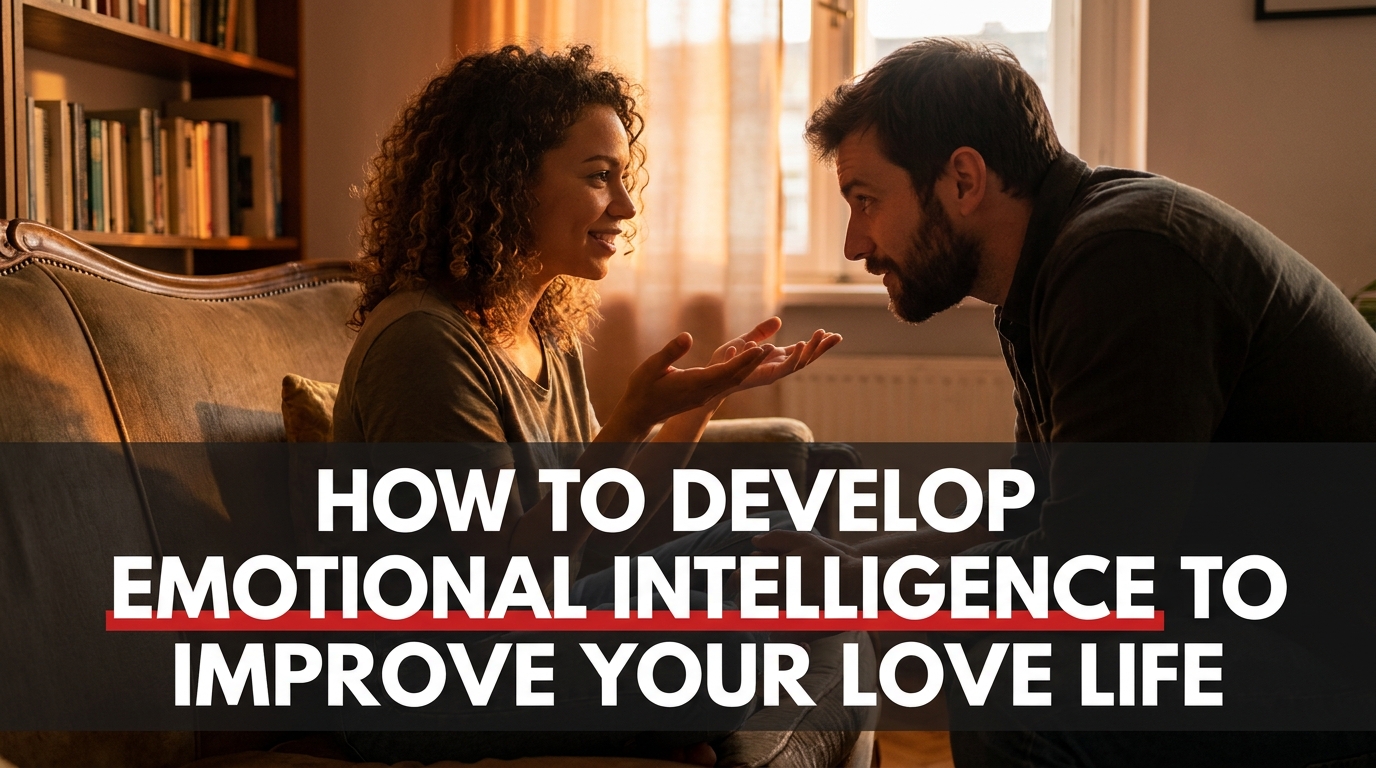
You can be deeply in love with someone and still consistently hurt them in ways you do not fully understand. You can want a great relationship with every part of you and still repeat the same patterns that keep it from becoming one. The missing variable — in relationship after relationship, conflict after conflict, disconnection after disconnection — is almost always the same: the ability to develop emotional intelligence to improve your love life.
A study published in the Journal of Marriage and Family found that emotional intelligence was a stronger predictor of relationship satisfaction than personality compatibility — meaning that two people who are intentional about building their EQ can outperform couples who seem naturally suited but never do the emotional work. This is one of the most hopeful findings in modern relationship psychology. It means that your love life is not fixed. It means it can grow — and so can you.
This article is not a list of quick fixes. It is a practical, psychology-grounded roadmap for doing the real work of emotional development — the kind that actually changes how you experience love, how you show up in conflict, and how deeply you are able to connect with another person.

Why Developing Emotional Intelligence Changes Everything in Love
Before we go into the specific strategies, it is worth understanding why emotional intelligence has such a profound impact on the quality of romantic relationships — because the mechanism is not always obvious.
Romantic love, at its most fundamental level, is an attachment experience. It activates the same neural systems that governed our earliest bonds with caregivers — systems built around safety, attunement, and emotional recognition. When we feel emotionally seen by a partner, our nervous system registers safety. When we feel emotionally dismissed, misunderstood, or alone in the relationship, the nervous system registers threat — even in the absence of any obvious danger.
This means that the quality of emotional attunement between partners — how well each person can recognize, regulate, and respond to their own and each other’s emotional experience — is not a peripheral feature of the relationship. It is its central architecture.
Every moment of genuine emotional connection — of feeling truly understood — is a deposit into the relationship’s emotional bank account. Every moment of emotional misattunement, dismissal, or reactive behavior is a withdrawal. And the long-term health of a relationship is largely a function of whether that account is in surplus or deficit over time.
Emotional intelligence is the skill set that determines which way that balance moves. It governs how many deposits you make, how significant your withdrawals are, and how quickly and genuinely you repair when a withdrawal has been made.
Developing it is not self-improvement for its own sake. It is the most direct investment you can make in the quality of your most important relationships.
Step 1: Build Genuine Self-Awareness — Know What You’re Actually Feeling
The foundation of emotional intelligence — the skill from which every other EQ capacity grows — is self-awareness. And specifically, emotional self-awareness: the ability to recognize what you are feeling, name it accurately, and understand why it is present.
This sounds simple. It is not.
Most people live at a significant distance from their own emotional experience. They know the broad categories — happy, angry, sad, anxious — but the richer, more specific emotional landscape beneath those labels remains largely unexamined. And that gap between what you are actually feeling and what you are able to name and communicate is one of the primary sources of relational misfire.
Consider a common scenario. You come home from a day at work during which you felt repeatedly dismissed and undervalued. Your partner, without knowing this, makes a small joke at your expense — nothing they would consider significant. But you react with disproportionate sharpness that confuses both of you.
What is actually happening? You are not angry at your partner. You are carrying accumulated hurt and vulnerability from earlier in the day, and the joke activated a sensitivity that was already live. But because you cannot locate that inner experience specifically enough to name it, it comes out sideways — as irritation toward the person closest to you.
Self-awareness would allow you to say: “I’m feeling really tender today — I had some experiences at work that made me feel undervalued, and I think I’m carrying that.” That disclosure changes everything about what happens next. It creates connection rather than conflict. It gives your partner something real to respond to.
How to build emotional self-awareness practically:
Begin keeping an emotion journal — not a diary of events, but a daily record of your emotional states. The goal is specificity. Rather than “I felt bad today,” push toward: “I felt dismissed in the meeting and that activated the familiar fear that my contributions don’t matter.” The act of labeling emotions with precision — what psychologists call affect labeling — has been shown in neuroscience research to reduce the intensity of the emotional response and increase regulatory capacity over time.
Use a feelings wheel. Developed by psychologist Dr. Gloria Willcox, the feelings wheel expands the emotional vocabulary beyond the basic five and helps people locate the more precise, nuanced emotions beneath surface reactions. Moving from “angry” to “humiliated” or “betrayed” or “overwhelmed” is not just semantic — it changes what you understand about yourself and what you are able to communicate to another person.
Practice the pause. Before reacting to something your partner says or does that provokes a strong response, build the habit of a brief internal check-in: “What am I actually feeling right now? What need of mine is activated?” Even five seconds of that internal inquiry begins to interrupt the automatic reactivity that causes so much relational damage.

Step 2: Develop Emotional Regulation — Choose Your Response
Self-awareness tells you what you are feeling. Emotional regulation determines what you do with it.
This is where many people hit a wall — because they conflate emotional regulation with emotional suppression, and they are not the same thing. Suppression means pushing feelings down, pretending they are not there, or bypassing the emotional experience entirely in the name of keeping the peace. This approach consistently backfires, producing emotional buildup that eventually erupts with far greater force than a regulated expression would have.
Genuine emotional regulation means that you have the internal capacity to feel your emotions fully without being immediately controlled by them. You can be intensely angry and still choose not to say the sharpest possible thing. You can feel deeply hurt and still make a request rather than an accusation. You can feel overwhelmed and still communicate that you need time rather than going silent for three days.
The difference between regulation and suppression is the difference between holding something and burying it. Regulated emotions are present, acknowledged, and metabolized. Suppressed emotions are present, denied, and compressed — until they are not.
“Emotional regulation is not the absence of strong feeling. It is the presence of enough internal space to choose what you do with what you feel.”
How to build emotional regulation in relationships:
Develop your physiological toolkit. The fastest pathway to emotional regulation is through the body, not the mind. Slow, deliberate breathing — particularly extended exhalation — activates the parasympathetic nervous system and begins to counteract the stress response within minutes. Physical movement, cold water on the face or wrists, and grounding exercises that bring attention to the present physical environment are all evidence-supported tools for rapidly reducing emotional flooding.
Learn your personal escalation signals. Everyone has a recognizable pattern of physical signals that precede their emotional hijacking — the tightening of the chest, the heat in the face, the narrowing of attention. Identifying yours specifically, through reflection after conflict, allows you to catch the early warning before you are already over the threshold.
Practice the 90-second rule. Neuroscientist Dr. Jill Bolte Taylor discovered that the physiological chemical response to an emotion — the actual neurological flood — lasts approximately 90 seconds if you do not continue to feed it with thought. After 90 seconds, if you are still in the emotional state, it is because your thinking is sustaining it. This knowledge gives you agency: you can choose, after the initial wave, to breathe and interrupt rather than continue the internal narrative that keeps flooding you.
Build the pause into your relationship as a shared practice. Agree with your partner in advance that either of you can call a brief pause using a specific signal — a word, a gesture — that means “I need a moment to regulate before I continue.” Remove the shame from needing regulation. Normalize it as the intelligent, relationship-protecting behavior that it is.
Step 3: Cultivate Empathy — The Heart of Emotional Connection
If self-awareness is the foundation of emotional intelligence and self-regulation is its discipline, empathy is its heart. And in the context of romantic relationships, empathy is arguably the single most important EQ skill you can develop.
Empathy is the ability to step genuinely outside your own perspective and inhabit your partner’s emotional experience — not to agree with everything they feel, not to abandon your own perspective, but to understand theirs from the inside rather than observing it from the outside.
Most people believe they are more empathic than they actually are. This is not a criticism — it is a function of the empathy gap: the neurologically documented difficulty of accurately imagining another person’s emotional state, particularly when your own emotional state is elevated.
In a conflict, for example, the brain’s threat-detection system narrows attention inward. Your capacity for perspective-taking — for genuinely accessing what your partner is experiencing — is significantly reduced at precisely the moment when it is most needed. This is one of the central paradoxes of relational conflict, and one of the most important reasons why building empathy as a deliberate practice, rather than relying on it arising naturally in difficult moments, is so essential.

How to actively develop empathy in your relationship:
Practice perspective-taking as a daily discipline. After an interaction with your partner that felt charged or disconnected, ask yourself deliberately: “What might they have been feeling in that moment? What need of theirs was present that I may not have seen? What was the world looking like from inside their experience?” This deliberate exercise, done consistently, builds the neural pathways associated with perspective-taking and makes empathy more accessible in real-time.
Listen to understand — not to respond. This is one of the most frequently cited communication guidelines and one of the least frequently practiced. Most people listen with part of their attention while the rest is already formulating a response, a defense, or a counter-argument. Genuine empathic listening means temporarily suspending your own perspective and giving your full attention to what your partner is actually communicating — both the words and the emotional experience beneath them.
Reflect before you respond. Before offering your perspective in a difficult conversation, reflect back what you heard your partner express — their words, their feeling, their underlying need. “It sounds like you felt invisible in that moment and that really hurt” is not agreement. It is recognition. And recognition, more than agreement, is what most people are actually seeking when they express emotional pain.
Ask questions from genuine curiosity. “What was that like for you?” “What did you need from me in that moment?” “Help me understand what you’re feeling.” These questions communicate that your partner’s inner world matters to you — and that you are interested in understanding it, not just in responding to the version of it that is most convenient for you.
Step 4: Expand Your Emotional Vocabulary — Name It to Tame It
This step is frequently overlooked in discussions of emotional intelligence development — and it is one of the most practically powerful changes you can make in how you experience and communicate in relationships.
Most English-speaking adults operate with a relatively limited emotional vocabulary. Research by Dr. Marc Brackett, founding director of the Yale Center for Emotional Intelligence, found that the average person can identify and name only a small fraction of the emotional states they actually experience. And the gap between what you feel and what you can name creates a gap between what you feel and what you can communicate — which produces chronic misunderstanding in relationships.
When you can only say “I feel bad,” your partner cannot understand what kind of bad you are experiencing — and therefore cannot respond in a way that actually meets your need. Are you feeling lonely? Ashamed? Overwhelmed? Disappointed? Resentful? Scared? Each of these states has a different origin, requires a different response, and points toward a different need. Collapsing them all into “bad” or “upset” or “fine” makes genuine emotional communication nearly impossible.
Expanding your emotional vocabulary — actively learning to identify and articulate more nuanced emotional states — directly improves the quality of your emotional communication, which directly improves the quality of your relational connection.
“The words you have for your feelings determine the conversations you can have about them. And the conversations you can have determine the depth of connection you can build.”
Practical steps to expand your emotional vocabulary:
Work with a feelings wheel regularly — not just in journaling but in conversation. Practice using specific emotional language with your partner: “I’m feeling a bit resentful about this” rather than “I’m upset.” “I feel proud of you” rather than “that’s great.” Specificity creates intimacy.
Read broadly — fiction in particular. Research by psychologist Dr. Raymond Mar found that reading literary fiction is one of the most effective ways to build the brain’s capacity for emotional recognition and empathy, because it requires sustained perspective-taking inside complex inner worlds. Books are, in a very real sense, an EQ training tool.
Step 5: Develop Social Awareness — Read the Room and Your Partner
Social awareness — the ability to read emotional cues accurately in others and respond to them appropriately — is the EQ skill that translates internal development into external relational competence.
In a romantic relationship, social awareness means being attuned to your partner’s emotional state even when they are not explicitly communicating it. It means noticing the subtle shift in their tone, the slight drop in their energy, the way they are holding their body — and being curious about what those signals might mean rather than ignoring them or responding reactively to them.
It also means understanding emotional bids — a concept developed by Dr. Gottman — and responding to them effectively. Emotional bids are the small, often subtle attempts partners make to connect throughout the day: a comment about something they noticed, a touch on the shoulder, a question about your day. They are not always explicitly emotional. But they are always emotionally significant. They are saying, beneath the surface: “Are you there? Do I matter to you?”
Partners who respond to bids — who turn toward rather than away — build relationship equity over time that makes everything else, including conflict and vulnerability, more manageable. Partners who consistently miss or dismiss bids slowly drain the relationship of the emotional oxygen it needs to survive.
Developing social awareness in your relationship means training yourself to notice and respond to these bids — to be present enough to catch the small moments that are actually large moments in disguise.

Step 6: Build Relationship Management Skills — Apply EQ in Real Time
All of the previous steps — self-awareness, regulation, empathy, vocabulary expansion, social awareness — converge in what is ultimately the most practical domain of emotional intelligence: relationship management. The ability to apply everything you have developed, in real time, inside the actual dynamics of your relationship.
Relationship management in a love context includes how you navigate conflict, how you express needs and desires, how you repair after ruptures, how you express appreciation, and how you maintain emotional connection over time — through the inevitable seasons of stress, change, and difficulty that every committed relationship passes through.
This is where the rubber meets the road. Because it is one thing to understand emotional intelligence intellectually and quite another to access it in the moment your partner says something that activates your deepest wound, or when you are exhausted and depleted and still need to show up for someone you love.
Real-time relationship management practices:
Make repair a priority, not an afterthought. After any significant conflict or hurtful interaction, intentional repair is not optional — it is the relational immune response that prevents lasting damage. Repair means genuine acknowledgment of impact, a real apology that does not contain the word “but,” and a shared conversation about what you both want to do differently. The longer repair is delayed, the more the nervous system consolidates the painful experience as representative of the relationship overall.
Create rituals of connection. Dr. Gottman’s research identifies daily rituals of emotional connection — however brief — as one of the most powerful protective factors in long-term relationships. This might be a genuine check-in conversation each evening, a morning moment of physical affection, a weekly conversation about how each person is actually doing beneath the surface. These rituals do not need to be elaborate. They need to be consistent and emotionally real.
Express appreciation specifically and frequently. General appreciation — “you’re great” — is pleasant but does not create the same relational impact as specific appreciation: “I noticed that you handled that situation today with a lot of patience, and it made me feel proud to be with you.” Specificity communicates that you are actually paying attention — and being truly seen is one of the deepest emotional needs in any relationship.
Ask for what you need directly. One of the most damaging patterns in relationships is the expectation that a loving partner should automatically know what you need without being told. This expectation — however understandable — sets both people up for chronic disappointment. Developing the emotional courage to say “I need reassurance right now” or “I need some space this evening to recharge” is an act of emotional intelligence that simultaneously respects your own needs and gives your partner the genuine opportunity to meet them.

The Role of Therapy and Professional Support in EQ Development
No article on developing emotional intelligence to improve your love life would be complete without acknowledging what professional therapeutic support offers that self-guided learning cannot fully replicate.
Therapy — particularly modalities like Emotionally Focused Therapy, Internal Family Systems, and Cognitive Behavioral Therapy — provides a structured, safe relational environment in which the roots of low EQ behavior can be explored at depth. Many of the patterns that undermine emotional intelligence in relationships — the defensive reactivity, the empathy gaps, the emotional avoidance — are not simply habits. They are adaptations built in response to early relational experiences, often operating beneath conscious awareness.
A skilled therapist does not just teach you techniques. They help you understand why you operate the way you do — and create the conditions in which those patterns can genuinely shift rather than simply being managed.
Couples therapy, in particular, offers something that individual work cannot: the opportunity to develop EQ skills inside the actual relational dynamic with the support of a trained third party who can see patterns neither partner can see from inside the relationship.
This is not a last resort. This is one of the most intelligent investments available to anyone who is serious about improving their love life through genuine emotional development.
Growing Together — When Both Partners Commit to EQ Development
The most powerful version of everything described in this article is not one person developing emotional intelligence while the other remains static. It is both partners committing — together, explicitly, without shame — to becoming emotionally more intelligent people and emotionally more intelligent partners.
When both people in a relationship are developing self-awareness, they can share what they discover about themselves with curiosity rather than defensiveness. When both are developing regulation skills, they can call time-outs without it feeling like abandonment. When both are expanding their emotional vocabulary, they can have conversations that reach a level of depth and honesty that feels genuinely connecting rather than frightening.
This shared commitment does not require both people to be at the same level or to develop at the same pace. It requires only that both people are honestly oriented in the same direction — toward growth, toward understanding, toward the version of the relationship that is possible when two people refuse to stop learning how to love better.
That version is not a fantasy. It is what happens when emotional intelligence becomes the language you choose to speak together.
Your Love Life Is Not Fixed — And Neither Are You
The most important thing this article can leave you with is this: the capacity to develop emotional intelligence to improve your love life is not something you were either born with or without. It is a skill. And like every skill, it grows with practice, intention, and the willingness to look honestly at where you currently are without making that an indictment of who you ultimately are.
You do not have to be perfect at this. You do not have to transform overnight. You do not have to have it all figured out before you begin. You simply have to begin — one honest moment of self-awareness, one regulated response, one empathic question, one specific act of appreciation — and build from there.
Every small step in the direction of emotional intelligence is a step toward the love life you actually want. And you are more capable of taking that step than you have perhaps yet allowed yourself to believe.
💾 Save this article and revisit it as you grow.
📤 Share it with your partner and start the conversation it opens.
👣 Follow Truthsinside.com for psychology-grounded content on love, relationships, and emotional development that actually matters.
📃 Related article: Signs He Likes You But Is Scared: 18 Behaviors Men Show When Afraid to Commit
Frequently Asked Questions
Q1: How long does it take to develop emotional intelligence?
Emotional intelligence develops over time through sustained practice — there is no fixed timeline. Research suggests that meaningful shifts in self-awareness and regulation capacity can occur within weeks of intentional practice, while deeper changes in empathy and social awareness often develop over months and years. The pace is less important than the consistency. Small, daily acts of emotional attention compound significantly over time.
Q2: Can emotional intelligence be developed if my partner isn’t interested in growing?
Yes — and the impact of one partner’s EQ development on the relationship dynamic is often significant even without the other actively participating. When you regulate better, the escalation pattern changes. When you listen more empathically, your partner feels safer. When you express needs more clearly, the relationship has less room for chronic misunderstanding. You cannot force growth in another person — but your own growth consistently changes the relational environment both of you inhabit.
Q3: Is emotional intelligence more important than love in a relationship?
Emotional intelligence and love are not competing forces — they work together. Love provides the motivation. Emotional intelligence provides the tools. A relationship with deep love but low EQ often produces a cycle of painful misattunement and recurring conflict despite genuine affection. A relationship with high EQ and genuine love provides both the desire and the capacity to build something truly lasting.
Q4: What is the first sign that my emotional intelligence is improving in my relationship?
One of the earliest and most reliable signs is the increased ability to pause before reacting — to notice a charge in your body during conflict and have a moment of choice rather than immediate reactivity. Another early sign is increased specificity in how you describe your emotional experience — moving from “I feel fine” or “I’m upset” to more accurate, nuanced emotional language. These small shifts, seemingly minor, often produce immediate and noticeable changes in relational quality.
Q5: Are there specific books that help develop emotional intelligence for relationships?
Several books are particularly well-regarded for this purpose. Emotional Intelligence by Daniel Goleman is the foundational text on EQ theory. Hold Me Tight by Dr. Sue Johnson applies attachment theory and EFT principles directly to romantic relationships. Self-Compassion by Dr. Kristin Neff provides the emotional self-care foundation that makes EQ development sustainable. The Gifts of Imperfection by Dr. Brené Brown addresses the vulnerability and shame patterns that frequently block emotional intelligence in love. Reading any of these — especially with a partner — can be a powerful complement to the practices described in this article.
🎵 Music
Maren Lull is a singer-songwriter who writes from the places most people don’t talk about out loud.
Not the dramatic grief. Not the obvious heartbreak. The quiet kind — the ordinary Tuesday emptiness, the habit of reaching for someone who isn’t there anymore, the particular exhaustion of being strong for so long that the strength itself wears thin.
Her music lives at the intersection of emotional honesty and soft beauty — breathy vocals over gentle piano, slow tempos, lyrics that feel less like songs and more like something you wrote in a private notebook at two in the morning and never showed anyone.
Maren Lull writes for the people who feel everything deeply and say very little about it. For the ones who listen to sad music not because they want to feel worse — but because being understood, even by a song, makes the feeling easier to carry.
📱 Follow Maren Lull:
→ Spotify
→ Apple Music
→ Youtube
→ Audiomack