
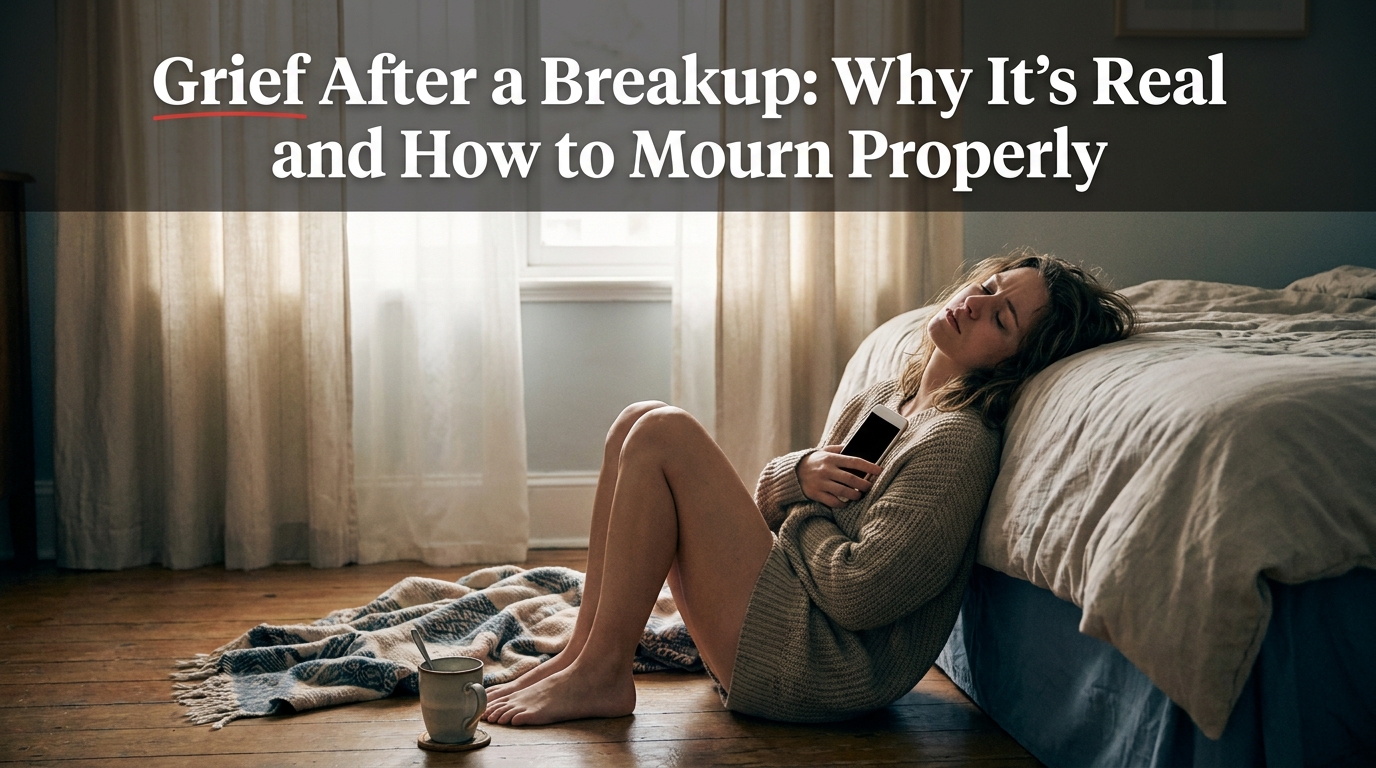
Nobody hands you a bereavement card when a relationship ends. There is no funeral. No socially sanctioned period of mourning. No casserole on your doorstep from neighbors who understand you are not okay. And yet grief after a breakup is not a metaphor — it is a measurable, physiological, neurological reality that researchers have documented with the same rigor applied to the study of any other form of profound human loss.
A landmark study published in the Journal of Neurophysiology used brain imaging to show that romantic rejection activates the same neural regions as physical pain — specifically the anterior cingulate cortex, the region associated with the distress component of physical injury. You are not being dramatic. Your brain is genuinely in pain.
What makes breakup grief particularly complicated — and particularly underserved — is the cultural dismissiveness surrounding it. “There are plenty of fish in the sea.” “You will get over it.” “At least you were not married.” As if the depth of a loss is determined by its legal status rather than by the magnitude of what was real inside it.
The truth is that the end of a significant relationship is the end of a life — not your biological life, but a constructed, inhabited, deeply personal life. The future you imagined. The routines you shared. The version of yourself that existed within that specific love. All of it ends. And grief after a breakup, when it is real, is mourning all of those deaths simultaneously.
This article is an honest, compassionate, and psychologically grounded guide to understanding why heartbreak grief is real, what it actually looks like across its many dimensions, and how to mourn it in a way that genuinely moves you through — rather than endlessly around — the pain.
Why Grief After a Breakup Is Scientifically Legitimate
The cultural minimization of breakup grief is not just unhelpful — it is factually incorrect. And understanding the science behind why heartbreak hurts the way it does is one of the most validating and empowering things you can do for yourself in the aftermath of loss.
The Neurochemistry of Love and Loss
When you are in love, your brain operates in a state of neurochemical abundance. Dopamine — the reward and motivation neurotransmitter — surges in the presence of your partner, creating feelings of euphoria, excitement, and deep craving for their company. Oxytocin — sometimes called the “bonding hormone” — builds attachment, trust, and a sense of safety. Serotonin levels fluctuate in ways that mirror the brain states associated with obsessive thinking.
What this means neurologically is that a committed romantic relationship fundamentally reorganizes your brain chemistry. Your partner is not just emotionally significant — they are chemically integrated into your neurological baseline. They become, in a very real sense, a substance your brain has become accustomed to receiving.
When the relationship ends, all of those neurochemical systems are disrupted simultaneously. The dopamine reward loop collapses. Oxytocin levels drop sharply. The brain enters a state that is measurably similar to withdrawal from an addictive substance. This is not poetry. This is pharmacology.
The Loss of Identity
Beyond the neurochemistry, grief after a breakup involves the loss of something that is rarely named but profoundly felt: your relational identity. In a significant relationship, you develop a version of yourself that exists specifically within that partnership — the way you were with that person, the jokes that only made sense between you, the shared language, the roles you occupied, the future self you had constructed around a shared life.
When the relationship ends, that version of you becomes unmoored. Psychologists call this “self-concept disruption” — the destabilizing loss of identity content that was stored in the relationship. Research by Dr. Arthur Aron and colleagues has shown that close romantic relationships produce genuine cognitive overlap between self and other — meaning your partner becomes, neurologically, part of how you think of yourself. Losing them is therefore, in a measurable psychological sense, losing part of yourself.
This explains why one of the most disorienting aspects of breakup grief is not simply missing the person — it is not knowing who you are without them.
Grief Without a Body: The Ambiguous Loss
Psychiatrist Pauline Boss introduced the concept of “ambiguous loss” — grief that occurs without a clear, socially recognized loss event. Unlike death, which provides a defined endpoint and cultural rituals of mourning, breakup grief is ambiguous. The person still exists. You may see them on social media. They may move on visibly. There is no closure ceremony.
This ambiguity makes the grief more complicated to process. The brain struggles to complete the mourning process when there is no clean break — when the person is simultaneously gone and not gone, lost and still present in the world, absent from your life but not from your thoughts, your phone’s photo library, or the mutual friends you share.
Understanding these mechanisms is not about making your pain sound impressive. It is about giving yourself permission to take it seriously.

The Stages of Grief After a Breakup — And Why They Are Not Linear
Most people have heard of the Kübler-Ross stages of grief — denial, anger, bargaining, depression, acceptance. Originally developed in the context of terminal illness and death, these stages have been widely applied to breakup grief, sometimes helpfully and sometimes misleadingly.
The most important thing to understand about grief stages in the context of a breakup is that they are not sequential, predictable, or tidy. They do not arrive in order. They overlap. They repeat. You can reach what feels like acceptance on a Tuesday and find yourself back in bargaining by Thursday. You can feel genuinely fine for two weeks and then hear a song on the radio that collapses you entirely.
This non-linearity is not a sign that you are grieving wrong. It is a sign that you are grieving truthfully — because real grief does not respect timelines or narrative structures.
Denial and Shock
In the immediate aftermath of a breakup — particularly one that was unexpected or unwanted — the psyche frequently enters a state of protective disbelief. The reality of the loss has not yet been fully integrated. You may function normally on the surface. You may feel strangely calm. You may find yourself thinking of things you want to tell them before remembering they are no longer yours to tell things to.
This is not numbness in the sense of feeling nothing. It is the mind’s mercy — a temporary buffer while the system processes the magnitude of what has happened.
Anger
Anger in breakup grief is frequently misunderstood — particularly when the anger feels disproportionate to specific events. You may feel furious at things that seem petty on the surface — the way they never put dishes in the dishwasher, a comment they made six months ago, the song they liked that you never actually enjoyed.
The anger is rarely really about those things. It is often the emotion that grief puts on when sadness feels too vulnerable, too bottomless, too frightening to fully inhabit. Anger has energy. It provides momentum and a sense of agency. It can feel safer than the raw helplessness of loss.
This does not mean the anger is not real or not legitimate. It means it deserves to be felt fully and expressed safely — not suppressed because it seems irrational, and not weaponized outward in ways that extend the damage of the breakup.
Bargaining
Bargaining in breakup grief sounds like: “If I change this specific thing about myself, they will come back.” “If I had handled that one fight differently, everything would be different.” “If I reach out just once more and say the right thing, this can be fixed.”
Bargaining is the mind’s attempt to impose control on a situation of profound helplessness. It is the grief stage that most frequently pulls people back into contact with their former partners — not because reconnection is genuinely desired or advisable, but because the bargaining impulse needs somewhere to go.
Understanding bargaining for what it is — a stage of grief, not a plan of action — can help you feel it without necessarily acting on it. The urge to reach out at 2 a.m. is real. Following through on it is optional.
Depression and Deep Sadness
This is the stage that most people recognize as grief — the weight, the disinterest in ordinary pleasures, the difficulty getting out of bed, the crying that arrives without warning, the pervasive sense that color has drained from everything. It is important to distinguish between grief-related depression, which is a normal and necessary part of mourning, and clinical depression, which may require professional intervention.
Normal grief depression has a relationship to the loss — it rises and falls in connection with reminders, anniversaries, and moments of particular absence. Clinical depression tends to be more persistent, more global, and more resistant to any positive stimulus.
If your sadness feels completely disconnected from the breakup and pervades every aspect of your functioning for an extended period, seeking professional support is not weakness — it is wisdom.
Acceptance
Acceptance does not mean feeling good about the loss. It does not mean agreeing that the breakup was right. It does not mean you have stopped caring or that you are fully healed. Acceptance, in its most honest form, is simply the state of no longer fighting reality — of being able to hold the loss in your hands, acknowledge it fully, and begin to take genuine steps forward without requiring the past to be different than it was.
Acceptance, when it arrives, often arrives quietly. Not as a dramatic breakthrough but as a gradual, barely perceptible shift — a morning where the first thought you have is not about them. A day where you notice beauty without immediately wanting to share it with someone who is gone. A week where the weight, though still present, feels more like a scar than an open wound.
“Grief after a breakup does not mean you are weak or that you loved too much. It means something real ended — and real things, when they end, deserve to be mourned with the full weight of what they were.”
What Grief After a Breakup Actually Looks Like — Beyond the Obvious
Popular culture’s image of breakup grief — ice cream, crying, sad movies — captures only the most surface-level expression of what is actually a complex, multidimensional experience. Here is what grief after a breakup can look like that rarely gets acknowledged:
Physical symptoms. Chest tightness. A literal aching sensation in the sternum. Loss of appetite or compulsive eating. Sleep disruption — either insomnia or hypersomnia. Fatigue so heavy it feels physical even when nothing physical is wrong. Compromised immune function — getting sick in the weeks following a breakup is genuinely common because the chronic stress of grief suppresses immune activity.
Cognitive disruption. Difficulty concentrating. Intrusive thoughts about the person or the relationship that arrive without invitation and resist dismissal. Rumination — the compulsive mental replaying of conversations, moments, and alternative outcomes. A strange inability to envision the future, as if the imagination itself has gone temporarily offline.
Identity confusion. A loss of interest in things you previously enjoyed. Uncertainty about your preferences, opinions, and desires when they are no longer being shaped in relation to another person. The strange experience of not knowing what to do with yourself — not just emotionally, but practically, in the structure of your ordinary days.
Social withdrawal. A pulling away from people who knew you as part of the couple. Difficulty explaining your pain to people who do not understand why it is still affecting you weeks or months later. Sometimes, the isolation of feeling that your grief is too much, too long, or too intense for the people around you to receive.
The phantom partner phenomenon. Reaching for your phone to text them about something funny. Starting to tell someone a story before remembering they are already in it. Waking in the morning with a half-second of forgetting before reality reasserts itself. These phantom moments are among the most quietly devastating aspects of breakup grief — and among the least discussed.
All of these are normal. None of them mean you are damaged, dependent, or incapable of moving forward. They mean you loved something real.

What Does Not Help: The Things We Do Instead of Grieving
Grief after a breakup is uncomfortable enough that most people develop strategies — conscious and unconscious — to avoid fully inhabiting it. These strategies are understandable. They are also, in almost every case, prolonging the pain rather than resolving it.
Immediate rebound relationships. The impulse to replace the lost attachment as quickly as possible is neurologically predictable — the brain wants to restore its neurochemical baseline. But entering a new relationship before the grief of the previous one has been genuinely processed means carrying unfinished emotional business into a new dynamic. The grief does not disappear. It waits.
Social media stalking. Monitoring your former partner’s accounts is one of the most universally practiced and universally harmful post-breakup behaviors. Every post they publish — every smile, every social event, every sign that their life is continuing — either confirms your worst fears or triggers a new wave of bargaining. Research consistently finds that continued Facebook surveillance of ex-partners is associated with greater grief, more negative feelings, and slower emotional recovery.
Forcing positivity. “Good vibes only.” “Everything happens for a reason.” “I am fine — I am actually doing great.” Premature positivity is the performance of healing rather than the experience of it. Grief that is not allowed to be sad does not resolve. It goes underground and resurfaces — usually at inconvenient times and in displaced forms.
Overworking and over-scheduling. Filling every moment of time to avoid the silence where grief lives. This can look productive and healthy from the outside. Inside, it is avoidance. And avoidance, in the context of grief, is a delay, not a solution.
Numbing. Alcohol, substances, compulsive eating, excessive screen time, any behavior that serves to quiet the signal of pain rather than listen to what it is communicating. Numbing is borrowed time. The pain is patient.
None of this is judgment. Every person who has grieved a relationship has done at least one of these things. The recognition is simply this: these strategies cost more than they save. The only direction that leads out of grief is through it.
How to Mourn Properly: A Real, Compassionate Guide
“Properly” is perhaps the wrong word — because grief is not a performance that can be executed correctly or incorrectly. What is meant here is: how to mourn in a way that allows the grief to move through you, that honors the reality of what was lost, and that genuinely — over time — leads somewhere.
1. Give the Loss Its Actual Name
Resist the cultural pressure to minimize. Resist the internal pressure to minimize. This was real. It mattered. It is gone. Say so — to yourself, and to at least one person in your life who can hear it without trying to fix it. The act of naming a loss accurately is the first and most foundational step of mourning.
2. Create Space for the Grief — Literally
Schedule it, if necessary. This sounds clinical, but it is practical wisdom. Set aside twenty to thirty minutes each day — particularly in the early weeks — to feel what you feel without distraction. Cry if it comes. Write if it helps. Sit with the ache rather than running from it. Containing the grief to a dedicated space also means you can function outside of it — and that containment gradually expands your capacity to be present in your life again.
3. Grieve What Specifically Was Lost
Generic grief is harder to process than specific grief. Rather than grieving “the relationship” as an undifferentiated whole, try to identify and mourn the specific things that are gone. The Sunday morning rituals. The feeling of being known. The future you had planned. The version of yourself you were with them. Each of these deserves its own acknowledgment. Specificity gives grief somewhere to land.
4. Write the Story You Actually Lived
Journaling after a breakup is one of the most well-researched psychological tools for processing emotional experience. But not just any journaling — what researchers call “expressive writing” specifically about the experience, including both the positive and the painful, creates what psychologists call a “coherent narrative” of the relationship. Coherent narratives help the brain file the experience as completed rather than leaving it as an open loop that keeps pulling attention.
Write what you loved. Write what hurt. Write what you miss. Write what you are relieved to be free of, even if admitting relief feels disloyal. All of it is part of the story. All of it deserves to be written.
5. Resist the Urge to Delete — And the Urge to Dwell
There is no universally right answer on whether to delete photos, messages, and mementos. What matters is the intention behind the choice. Deleting everything immediately, before you have had time to process, can be another form of avoidance — an attempt to erase a reality that has not yet been grieved. Keeping everything accessible and returning to it compulsively is rumination, not mourning. If possible, put things away rather than deleting them — a box in a closet, an archived folder — accessible when you are genuinely ready, not constantly in front of you.
6. Rebuild Structure When You Are Ready
One of the most destabilizing aspects of a breakup is the loss of the relational structure that organized your days and weeks. When you are ready — not as a distraction, but as genuine rebuilding — begin reestablishing structure for yourself. Not based around what you had with them, but around what you want for yourself. This might be a new morning routine, a creative project you had postponed, a fitness goal, a friendship you had let lapse. The structure of a new life does not erase the old one. It gives you somewhere to live while you heal.
7. Let Other People In
Grief is not meant to be carried alone. The isolation that grief often produces — the sense that your pain is too much, or has gone on too long, for others to tolerate — is one of grief’s most damaging symptoms. Find one person — a friend, a family member, a therapist — who can receive your grief without immediately trying to resolve it, reframe it, or rush it. The experience of being genuinely witnessed in your pain is, itself, healing.

“The goal of mourning is not to reach a place where the relationship never mattered. It is to reach a place where it mattered, it ended, and you are still here — changed, but whole.”
The Timeline Question: How Long Is Too Long to Grieve?
Almost everyone going through breakup grief encounters — either from others or from the internal critic — the question of whether they are taking too long. Whether they should be over it by now. Whether something is wrong with them.
Here is what the research actually says: there is no clinically established “normal” timeline for breakup grief. Duration is influenced by the length and depth of the relationship, whether it was wanted or unwanted, whether there was infidelity or other betrayal, the individual’s attachment style, their history of loss, and whether they are receiving adequate support.
What research does indicate is that the active, acute phase of grief after a breakup typically begins to soften somewhere between three months and one year for most people — not disappear, soften. And that the persistent, intrusive quality of the early grief — the inability to stop thinking about the person, the physical symptoms of distress — typically decreases with time, provided the person is genuinely engaging with the grief rather than avoiding it.
The question to ask is not “Am I taking too long?” but rather “Am I moving through this grief or am I stuck in it?” Moving through looks like: the waves are still coming, but there is more space between them. Getting stuck looks like: the waves are as frequent and as high as they were in week one, months later, with no forward movement at all.
If you feel genuinely stuck — if the grief is as raw six months later as it was in the first week, if it is preventing you from functioning in essential areas of your life, if it has merged with persistent hopelessness or thoughts of self-harm — please seek professional support. Complicated grief is a real clinical condition, and it responds well to treatment. You do not have to earn the right to ask for help by suffering long enough.

When You Are Ready to Love Again
This question — when to love again — cannot be answered with a timeline. It can only be answered with honest self-examination of where you actually are, not where you think you should be or where others expect you to be.
Some indicators that you may be genuinely ready to open to love again include:
Your interest in a new person is not primarily driven by the desire to fill the absence of the old one. You can think about your former relationship with some degree of equanimity — not indifference, but the ability to hold it as part of your story without it dominating your present. You have a reasonable understanding of your role in the relationship’s dynamics — not just a narrative where you were entirely wronged and they were entirely at fault, or vice versa. You feel curious about who you are as an individual — not just who you might be in relation to someone new.
None of these need to be complete or perfect. Human readiness is never complete or perfect. But they are honest indicators that the foundation you are building from is stable enough to bear the weight of something new.
Loving again after loss is not betrayal of what was. It is the fullest possible expression of the belief that love — despite everything it costs — is worth attempting again.

Final Thoughts
Grief after a breakup is real. It is physiological, psychological, and deeply human. It does not require justification. It does not have an expiration date. It does not become less legitimate because no one sent flowers or because the person you lost is still walking around somewhere, living their life.
You are allowed to grieve the future that will not happen. The routines that are gone. The version of yourself that lived inside that love. The ordinary Tuesday nights that will never be repeated.
You are allowed to take it seriously.
And you are also — when the time comes, at whatever pace is truthful for you — allowed to come back. To yourself. To the world. To the possibility that what love cost you this time does not have to be the final word on what love can be.
Mourn it fully. Every layer. Every specific, irreplaceable thing that was real and is now gone. Mourn it with the weight it deserves.
And then, slowly, on your own terms — begin again.
Save this article — for the nights when the grief feels too heavy to carry alone.
Share it with someone who is minimizing their own heartbreak because the world told them it was not serious enough to fall apart over.
Follow Truthsinside.com for more honest, research-grounded writing on love, loss, emotions, and the deeply human work of healing.
Related article: What Does It Actually Feel Like to Fall in Love? Science + Real Stories
Frequently Asked Questions
Q1: Is it normal to grieve a relationship that was not even healthy?
Yes — and this is one of the most confusing aspects of breakup grief. You can mourn a relationship that was painful, unhealthy, or even abusive, because grief is not about whether the relationship was good. It is about the loss of attachment, familiarity, hope, and identity — all of which exist even within unhealthy dynamics. Sometimes the grief after leaving a difficult relationship is particularly complex because it contains not just loss but also relief, shame, and confusion simultaneously.
Q2: How do I stop thinking about them constantly?
Intrusive thoughts about an ex-partner are a normal feature of grief, not a sign of pathological dependency. Attempting to suppress them — telling yourself firmly not to think about them — tends to increase their frequency through a psychological phenomenon called ironic process theory. A more effective approach is to acknowledge the thought without engaging it deeply, then deliberately redirect your attention to a specific present-moment task. Over time, as the grief processes, the frequency naturally decreases.
Q3: Why does seeing them move on hurt more than the breakup itself?
Witnessing an ex-partner move on activates a specific psychological response — a combination of loss confirmation, social comparison, and what researchers call “romantic jealousy” — that can feel more acute than the initial breakup. The breakup contains ambiguity. Seeing them with someone new closes that ambiguity in the most painful possible way. It is also worth noting that social media presentations of people “moving on” are performative and rarely reflect their actual emotional state.
Q4: Should I maintain no contact after a breakup?
Research generally supports a period of no contact — or significantly reduced contact — in the immediate aftermath of a breakup, particularly if the breakup was unwanted on your side. Continued contact in the early stages of grief disrupts the neural adaptation process — essentially re-exposing the brain to the attachment cue before it has had time to begin adjusting to its absence. This does not mean no contact must be permanent, particularly where co-parenting or other practical realities require ongoing communication.
Q5: When should I consider therapy for breakup grief?
Consider seeking professional support if the grief is significantly impairing your functioning at work, in relationships, or in basic self-care for an extended period. Also seek support if the grief is accompanied by persistent hopelessness, thoughts of self-harm, or if you find yourself engaging in numbing behaviors that are themselves becoming problematic. Grief therapy — particularly approaches like Complicated Grief Treatment developed by Dr. Katherine Shear — has a strong evidence base and can meaningfully accelerate and deepen the healing process.
🎵 Music
Maren Lull is a singer-songwriter who writes from the places most people don’t talk about out loud.
Not the dramatic grief. Not the obvious heartbreak. The quiet kind — the ordinary Tuesday emptiness, the habit of reaching for someone who isn’t there anymore, the particular exhaustion of being strong for so long that the strength itself wears thin.
Her music lives at the intersection of emotional honesty and soft beauty — breathy vocals over gentle piano, slow tempos, lyrics that feel less like songs and more like something you wrote in a private notebook at two in the morning and never showed anyone.
Maren Lull writes for the people who feel everything deeply and say very little about it. For the ones who listen to sad music not because they want to feel worse — but because being understood, even by a song, makes the feeling easier to carry.
📱 Follow Maren Lull:
→ Spotify
→ Apple Music
→ Youtube
→ Audiomack