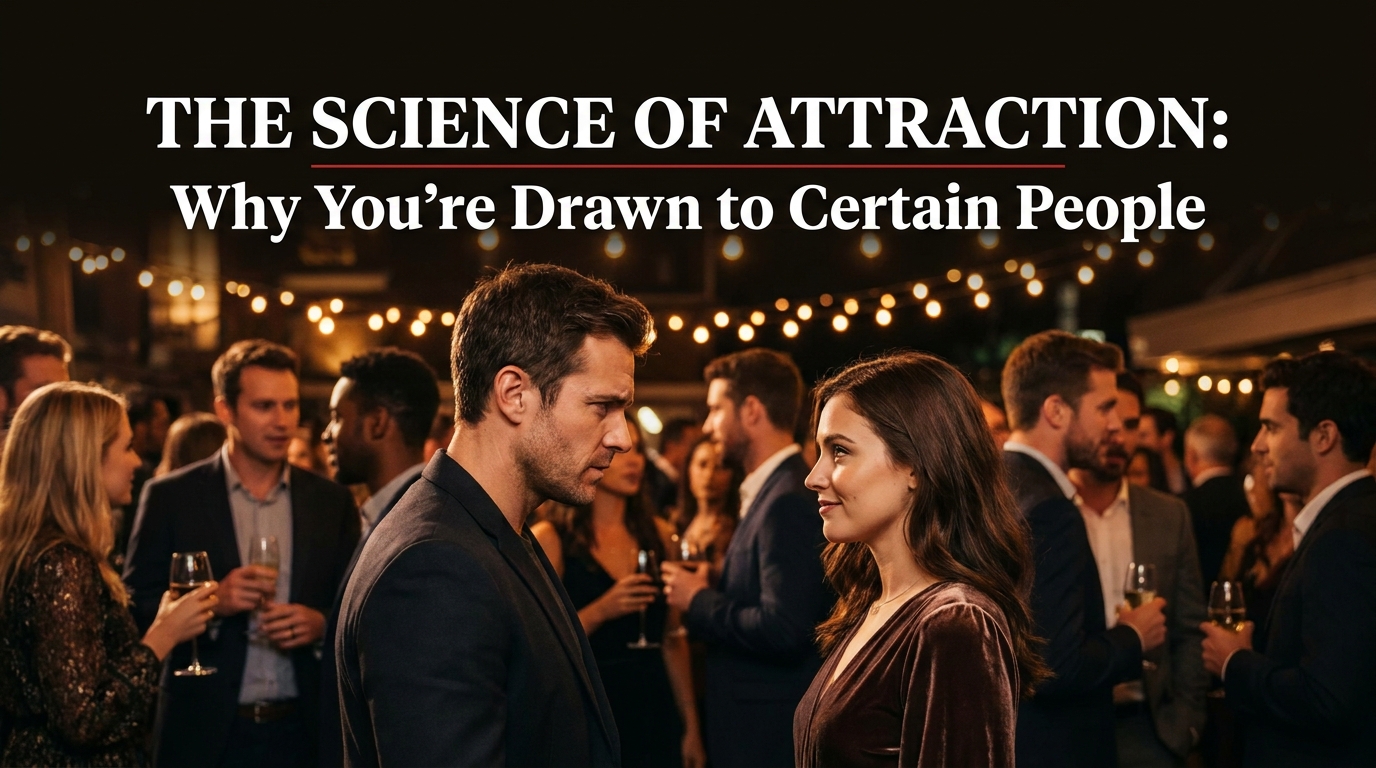
You walk into a room full of people and something happens. Not with everyone — with one specific person. A pull you did not choose, did not plan, and cannot fully explain. The science of attraction is the study of exactly that phenomenon — why human beings are drawn to specific others with a force that feels almost gravitational, and what is actually happening in the brain, the body, and the psychology when it does. Research from Syracuse University found that falling in love takes approximately one fifth of a second — a single glance triggering a neurochemical cascade involving twelve distinct brain regions simultaneously.
What feels like magic is, in the most literal sense, a measurable biological event. But the science does not diminish the experience. If anything, understanding why you are drawn to certain people makes the experience more fascinating — and more useful. Because attraction is not random. It follows patterns — neurological, psychological, evolutionary, and deeply personal — that are consistent enough to study, surprising enough to challenge your assumptions, and honest enough to sometimes reveal things about yourself you did not expect to find.
This article explores those patterns with the depth and honesty they deserve. From brain chemistry to childhood attachment, from evolutionary biology to the surprising role of familiarity — the science of attraction is one of the most illuminating maps available to the territory of human love.
What Is Attraction, Biologically Speaking?
Attraction is not a single thing. It is a constellation of neurological, hormonal, and psychological processes that activate simultaneously and interact with each other in complex, context-dependent ways.
Researchers broadly identify three distinct but overlapping systems involved in human attraction and romantic love:
The Lust System — driven primarily by testosterone and estrogen, this system generates the basic drive for sexual gratification. It is the most indiscriminate of the three systems — producing generalized desire rather than specific attachment to a particular person.
The Attraction System — driven primarily by dopamine, norepinephrine, and serotonin, this system generates the focused, energized, obsessive quality of early romantic attraction. This is the system responsible for the racing heart, the narrowed attention, the intrusive thoughts about a specific person that arrive uninvited and resist dismissal. Helen Fisher of Rutgers University, whose decades of neuroimaging research on romantic love is foundational in this field, describes this system as functionally similar to the craving state of addiction — driven by the same reward circuitry, producing the same motivational intensity.
The Attachment System — driven primarily by oxytocin and vasopressin, this system generates the deeper, quieter sense of bonding, security, and long-term connection. This is the system that sustains relationships beyond the initial intensity of attraction — producing the calm, sustained warmth of genuine partnership rather than the frantic urgency of new desire.
Understanding that these three systems are distinct — and can be activated in different combinations and sequences — helps explain some of attraction’s most bewildering qualities. You can feel intense lust without attraction. Deep attachment without lust. Overwhelming attraction without the security of attachment. The systems do not automatically activate together, which is why human romantic experience is so varied and sometimes so confusing.

The Role of Dopamine: Why Attraction Feels Like Obsession
Of all the neurochemicals involved in attraction, dopamine is the one most responsible for attraction’s consuming, almost addictive quality.
Dopamine is the brain’s primary reward and motivation neurotransmitter — released in anticipation of rewarding experiences rather than simply in response to them. This anticipatory quality is what makes dopamine so powerful in the context of attraction: the mere thought of the person you are attracted to triggers dopamine release, creating a craving state that motivates approach behavior even when no reward is guaranteed.
This is why attraction feels like obsession. The intrusive thoughts. The constant mental return to the person. The way you find yourself manufacturing reasons to encounter them. The heightened alertness in any environment where they might appear. These are not personality quirks or signs of psychological instability — they are the behavioral outputs of a dopamine system that has been strongly activated by a specific person and is now generating powerful motivational drive toward that person.
Neuroimaging studies by Fisher and colleagues at Rutgers found that when people who described themselves as “intensely in love” were shown photographs of their romantic partner, the ventral tegmental area — the brain’s primary dopamine production hub — showed dramatically increased activity. The same region that lights up in cocaine users shown images of their drug lit up in people shown images of their beloved.
The neurological parallel is not coincidental. Both experiences involve the dopamine reward system in intense, activated states. Both produce craving, narrowed focus, and powerful motivational drive. Both can produce withdrawal-like symptoms when the stimulus is removed.
This understanding does not reduce romantic attraction to mere chemistry. It explains why the feeling is so powerful — and why willpower alone is so rarely effective at managing it.
Evolutionary Drivers of Attraction: What Your Biology Is Looking For
The science of attraction cannot be fully understood without engaging with its evolutionary dimension — the idea that many of our attraction preferences are not culturally constructed but biologically programmed, reflecting adaptations that evolved over millions of years to maximize reproductive success and offspring survival.
This does not mean human attraction is purely mechanical or that conscious values and experience do not matter. It means that beneath the cultural and personal layers of attraction, there are biological signals the nervous system is evaluating — often below the threshold of conscious awareness.
Physical symmetry is one of the most consistently documented cross-cultural attractors. Research demonstrates that facial symmetry — the degree to which the left and right sides of a face mirror each other — is perceived as attractive across virtually all cultures studied, by both men and women. Evolutionary psychologists explain this as a marker of developmental stability and genetic health — symmetry indicates that development proceeded without significant disruption from disease, malnutrition, or genetic anomaly.
Voice pitch carries significant attractiveness information that operates largely below conscious awareness. Research has found that women tend to rate men with lower-pitched voices as more attractive, dominant, and physically imposing — while men tend to rate women with slightly higher-pitched voices as more feminine and attractive. Both preferences appear to reflect biological signals of sex hormone levels and reproductive fitness.
Scent and MHC compatibility represents one of the most fascinating evolutionary dimensions of attraction. Major histocompatibility complex (MHC) genes — a cluster of immune system genes — produce distinctive body odors that potential partners can detect, and research has shown that people are typically most attracted to the scent of partners whose MHC genes are sufficiently different from their own. The evolutionary logic is elegant: MHC-dissimilar partners produce offspring with broader, more robust immune coverage. Your nose may be performing an immune compatibility assessment without your conscious knowledge.
Physical indicators of health and fertility — including clear skin, body proportion, and facial features that signal hormonal balance — are consistently identified as attractive across cultures because they historically correlated with reproductive viability.
The important caveat: these evolutionary attractors are tendencies, not deterministic rules. They exist as biological inputs into a system that also processes enormous quantities of personal, cultural, and experiential information. They explain some of the consistency in human attraction. They do not explain all of it.

The Psychology of Attraction: Beyond Biology
While evolutionary biology explains some consistent cross-cultural patterns in attraction, psychology explains the profoundly personal, idiosyncratic dimension — why specific individuals are drawn to specific others in ways that their biology alone cannot predict.
The Mere Exposure Effect
One of the most robust and counterintuitive findings in attraction psychology is the mere exposure effect — the phenomenon documented by psychologist Robert Zajonc in which repeated exposure to a stimulus increases liking for it, even without conscious awareness that the exposure is occurring.
In the context of attraction, this means that familiarity itself generates attraction. The person you see regularly at the coffee shop, your workplace, your commute — repeated exposure alone increases how attractive you find them, independent of any interaction. You become more favorably disposed toward someone simply by virtue of having seen them before.
This finding has significant implications for understanding how attraction develops — and why it so frequently develops in the context of proximity and repeated contact rather than dramatic first encounters.
Similarity Attraction
The popular notion that “opposites attract” is, according to the research, largely a myth. Decades of studies on attraction and relationship formation consistently find that similarity — in values, attitudes, interests, backgrounds, and personality traits — is one of the strongest predictors of initial attraction and long-term relationship satisfaction.
The mechanism appears to be partly cognitive — similar others confirm our existing worldview and make us feel validated and understood. Partly emotional — shared values and interests create natural common ground and ease of interaction. And partly evolutionary — similarity in certain traits may signal shared genetic background, which historically correlated with in-group safety.
The nuance: what attracts and what sustains are not identical. Initial attraction does show some complementarity effects — people are sometimes drawn to others who have strengths where they feel lacking. But long-term relationship satisfaction is more strongly predicted by similarity than by complementarity.
Reciprocity of Liking
Research consistently demonstrates that knowing someone is attracted to you is itself a powerful attractor. The knowledge that you are liked — genuinely, unmistakably liked — triggers attraction toward the person who likes you at a rate significantly above baseline.
This is not purely vanity. It is a social safety signal. Someone who finds you attractive is unlikely to harm you socially, is motivated to treat you well, and has demonstrated the taste to recognize your value. The nervous system, ever alert to social threat and safety, registers this as a favorable cue.
The reciprocity of liking effect also explains why confident, direct expression of interest tends to be attractive — it provides the unmistakable signal of genuine liking that activates this mechanism in the other person.
“Attraction is not what happens when you find the right person. It is what happens when a specific constellation of biological signals, psychological history, and present-moment chemistry converges in a direction you did not choose and cannot fully explain. The science does not make it less magical. It makes it more human.”
Attachment Theory and the Template of Attraction
Perhaps the most psychologically significant — and personally relevant — dimension of attraction science concerns the role of early attachment experiences in shaping who we find attractive in adult life.
Attachment theory, developed by John Bowlby and later expanded extensively by researchers including Mary Ainsworth and Phillip Shaver, proposes that the patterns of relating to caregivers that we develop in early childhood create internal working models — mental templates of what relationships look like, how they feel, and what to expect from them.
These templates do not stay in childhood. They travel with us into adult romantic relationships — shaping not just how we behave in those relationships, but who we are drawn to in the first place.
Secure attachment — developed through consistent, responsive, emotionally available caregiving — produces adults who find it relatively natural to trust, to be vulnerable, and to engage in mutual, equitable relationships. Securely attached people tend to be drawn to emotionally available, consistent partners and to find genuine intimacy attractive rather than threatening.
Anxious attachment — developed through inconsistent caregiving, where the caregiver was sometimes available and sometimes not — produces adults with a heightened sensitivity to abandonment cues and a powerful drive toward closeness. Anxiously attached people often find themselves most powerfully attracted to emotionally unavailable or inconsistent partners — because the unpredictability activates the familiar attachment anxiety that, while painful, feels like home.
Avoidant attachment — developed through consistently emotionally unavailable caregiving — produces adults who are uncomfortable with closeness and tend to value self-sufficiency above intimacy. Avoidantly attached people may find themselves drawn to partners who are somewhat emotionally demanding — because the demand for closeness confirms their belief that intimacy is overwhelming, while simultaneously providing a familiar relational dynamic.
The critical insight here is not deterministic — attachment patterns can be modified through conscious work, therapy, and consistently positive relationship experiences. But understanding your attachment style and how it shapes your attraction patterns is one of the most practically useful pieces of self-knowledge available.
If you consistently find yourself powerfully attracted to emotionally unavailable people — if the ones who are clearly interested feel somehow less compelling than the ones who keep you guessing — that pattern is not bad taste or bad luck. It is your attachment system recognizing a familiar dynamic and generating the sensation of attraction in its presence.

The Role of Proximity, Context, and Timing
The science of attraction reveals something that challenges the romantic notion of destined meeting across crowded rooms: where you are, when you are there, and what is happening in your life at that moment profoundly shapes who you find attractive.
Proximity is one of the oldest and most robust findings in attraction research. Studies dating to the 1950s — including the classic Westgate Housing Study by Festinger, Schachter, and Back — found that physical proximity was one of the strongest predictors of friendship and romantic attraction formation. Simply living near someone, working near someone, or regularly occupying the same space significantly increases the probability of attraction.
The mechanism involves the mere exposure effect described earlier — but also something more fundamental. Proximity enables the accumulation of shared experience, the gradual development of familiarity, and the repeated opportunities for interaction that attraction requires to develop in most cases.
Situational arousal plays a surprisingly significant role in attraction. A famous study by psychologists Dutton and Aron — the “suspension bridge” experiment — demonstrated that men who encountered an attractive woman on a high, swaying bridge over a gorge (producing arousal through fear) found her more attractive than men who encountered the same woman on a low, stable bridge. The physiological arousal produced by the situation was being misattributed to the woman — experienced as attraction rather than fear.
This misattribution of arousal effect has been replicated across various contexts and has significant implications: the context in which you meet someone — exciting, novel, emotionally heightened — influences how attractive you find them in ways that have nothing to do with the person themselves.
Life stage and readiness also profoundly shape attraction. Research consistently finds that people are most powerfully drawn to potential partners during periods when they are psychologically ready for romantic connection — when the attachment system is, in a sense, actively seeking. Periods of transition, growth, or emotional openness tend to produce higher attraction sensitivity than periods of relative stability or emotional closure.
Why We Are Sometimes Attracted to What Is Not Good for Us
This dimension of attraction science is the most personally relevant and the most commonly glossed over — and it deserves direct, honest engagement.
The attachment template finding explains a significant portion of the attraction-to-unavailability pattern. But there are additional psychological mechanisms that contribute to attraction toward people and dynamics that are not genuinely healthy.
Familiarity as safety signal. The nervous system registers familiar dynamics as safe — even when those dynamics are objectively harmful — because familiar means known, and known means survivable. An emotional dynamic that resembles a painful childhood experience may generate attraction precisely because the nervous system has already developed a coping strategy for it. The familiarity reads as safety even when the situation is not safe.
Idealization and projection. As discussed in other articles on this site, a significant portion of what feels like powerful attraction is projection — the attribution of desired qualities to a person based on limited information. The less you know someone, the more of your attraction is to your own construction. And constructions, being perfect by definition, are more powerfully attractive than real, complex, imperfect people.
Trauma bonding. In relationships or proto-relationships that involve cycles of tension and relief — intermittent warmth and withdrawal, moments of intense connection followed by distance or unavailability — the nervous system can develop a specific form of attachment driven by the reward chemistry of relief after distress. This is not love. But it can feel indistinguishable from it from the inside.
Understanding these mechanisms is not about eliminating the experience of attraction toward complicated people — that is neither possible nor necessary. It is about developing enough self-awareness to distinguish between attraction that is pointing toward genuine compatibility and attraction that is pointing toward a familiar, possibly painful, template.
The two feel different, if you have enough quiet to notice. Healthy attraction tends to feel curious, warm, and energizing. Familiar-but-unhealthy attraction tends to feel urgent, anxious, and consuming in a way that has more of desperation than of genuine desire.

Can You Control Who You Are Attracted To?
This is one of the most commonly asked questions about attraction science — and the honest answer is: not directly, but meaningfully.
You cannot choose, through an act of will, to feel attracted to someone you are not attracted to. You cannot choose, through an act of will, to stop feeling attracted to someone you are strongly drawn to. These processes operate largely below the threshold of conscious control — in the limbic system, the dopamine circuits, the attachment templates that were shaped before you had the cognitive capacity to influence them.
What you can influence is what you do with attraction, how you evaluate it, and over time — through conscious attention, experience, and therapeutic work — the patterns that shape what you find attractive.
Specifically:
You can develop the self-awareness to recognize when attraction is pointing toward a familiar unhealthy template rather than genuine compatibility — and choose not to act on it, even when the feeling is powerful.
You can deliberately create the conditions — proximity, repeated positive interaction, emotional availability — under which attraction toward healthier people is more likely to develop.
You can do the therapeutic and self-examination work that gradually updates your attachment template, shifting the nervous system’s definition of “familiar” toward healthier dynamics.
And you can give time and attention to people who may not produce immediate, intense attraction but who demonstrate the consistent, respectful, emotionally available behavior that genuine long-term compatibility requires — understanding that for many people with secure attachment, attraction grows through knowing rather than preceding it.
Attraction is not entirely outside your influence. It is outside your direct control. The distinction matters.
Final Thoughts
The science of attraction is the study of one of the most powerful forces in human life — one that shapes who we love, how we love, and why we sometimes love in ways that confuse or hurt us.
Understanding it does not make attraction less beautiful. It makes it more honest. It replaces the mythology of pure fate with something considerably more interesting — the recognition that who you are drawn to is a reflection of your neurology, your history, your biology, and your deepest psychological templates, all operating simultaneously in the fraction of a second before thought arrives.
That recognition carries responsibility. If your attraction patterns are consistently leading you toward people who cannot genuinely meet you — who activate the familiar feeling but not the genuine flourishing — understanding why gives you something to work with.
And if your attraction patterns are leading you toward someone who is genuinely good for you — who activates the warmth and the curiosity and the ease alongside the pull — then understanding the science only deepens the wonder of what is happening.
Save this article — for anyone trying to understand why they fall for who they fall for.
Share it with someone who has ever been confused by their own attraction patterns and deserves a real explanation.
Follow Truthsinside.com for more psychology-rooted, science-grounded content on love, the brain, and the endlessly fascinating territory of human connection.
Related article: Signs He Likes You But Is Scared: 18 Behaviors Men Show When Afraid to Commit
Frequently Asked Questions
Q1: Is attraction purely physical or does personality matter?
Both matter — and their relative weight shifts across different stages of attraction. Initial attraction tends to be heavily influenced by physical cues because those are what is available before interaction begins. But research consistently shows that personality, humor, emotional intelligence, and character become increasingly significant as attraction develops — and that for many people, particularly those with secure attachment, personality is the primary driver of sustained attraction rather than physical appearance alone. Attraction that is primarily physical tends to be less stable over time than attraction that is grounded in genuine admiration for who someone is.
Q2: Why do I always seem to be attracted to the same type of person?
This consistency almost always reflects your attachment template — the internal working model of relationships shaped by early caregiving experiences. The type you are consistently drawn to is the type that activates a familiar relational dynamic in your nervous system. If that type is consistently unavailable, inconsistent, or emotionally distant, that is important information about your attachment pattern rather than your destiny. This pattern can be understood and meaningfully shifted through therapy and genuine self-examination.
Q3: Can attraction grow over time, or does it have to be immediate?
Attraction can absolutely grow over time — and research suggests this is actually the more common pattern for people with secure attachment styles. Immediate, intense attraction is neurologically driven by novelty and the dopamine system’s response to uncertainty and excitement. Grown attraction develops through accumulated positive experience, increasing knowledge of the person, and the gradual deepening of trust and admiration. Both are real. The grown variety tends to be more stable.
Q4: Why does attraction sometimes fade in long-term relationships?
The neurochemical intensity of early attraction — driven by the dopamine system’s response to novelty and uncertainty — naturally moderates as a relationship becomes established and familiar. This is not the death of attraction; it is the transition from the infatuation system to the attachment system. The quieter, warmer bond of attachment is not less real than the frantic urgency of early attraction — it is differently real. Couples who mistake this moderation for attraction dying, and who respond by seeking novelty elsewhere, miss the opportunity to develop the deeper, more sustainable form of attraction that long-term intimacy makes possible.
Q5: Does the science of attraction suggest that love is just chemistry?
No — and this is an important distinction. Chemistry is a component of attraction, not its totality. The neurochemical processes involved in attraction operate within a vast context of personal history, values, psychology, culture, and conscious choice. Reducing love to chemistry is like reducing music to sound waves — technically accurate at one level and completely missing the point at another. The science of attraction explains some of the mechanisms through which love operates. It does not explain away the love itself.
🎵 Music
Maren Lull is a singer-songwriter who writes from the places most people don’t talk about out loud.
Not the dramatic grief. Not the obvious heartbreak. The quiet kind — the ordinary Tuesday emptiness, the habit of reaching for someone who isn’t there anymore, the particular exhaustion of being strong for so long that the strength itself wears thin.
Her music lives at the intersection of emotional honesty and soft beauty — breathy vocals over gentle piano, slow tempos, lyrics that feel less like songs and more like something you wrote in a private notebook at two in the morning and never showed anyone.
Maren Lull writes for the people who feel everything deeply and say very little about it. For the ones who listen to sad music not because they want to feel worse — but because being understood, even by a song, makes the feeling easier to carry.
📱 Follow Maren Lull:
→ Spotify
→ Apple Music
→ Youtube
→ Audiomack