
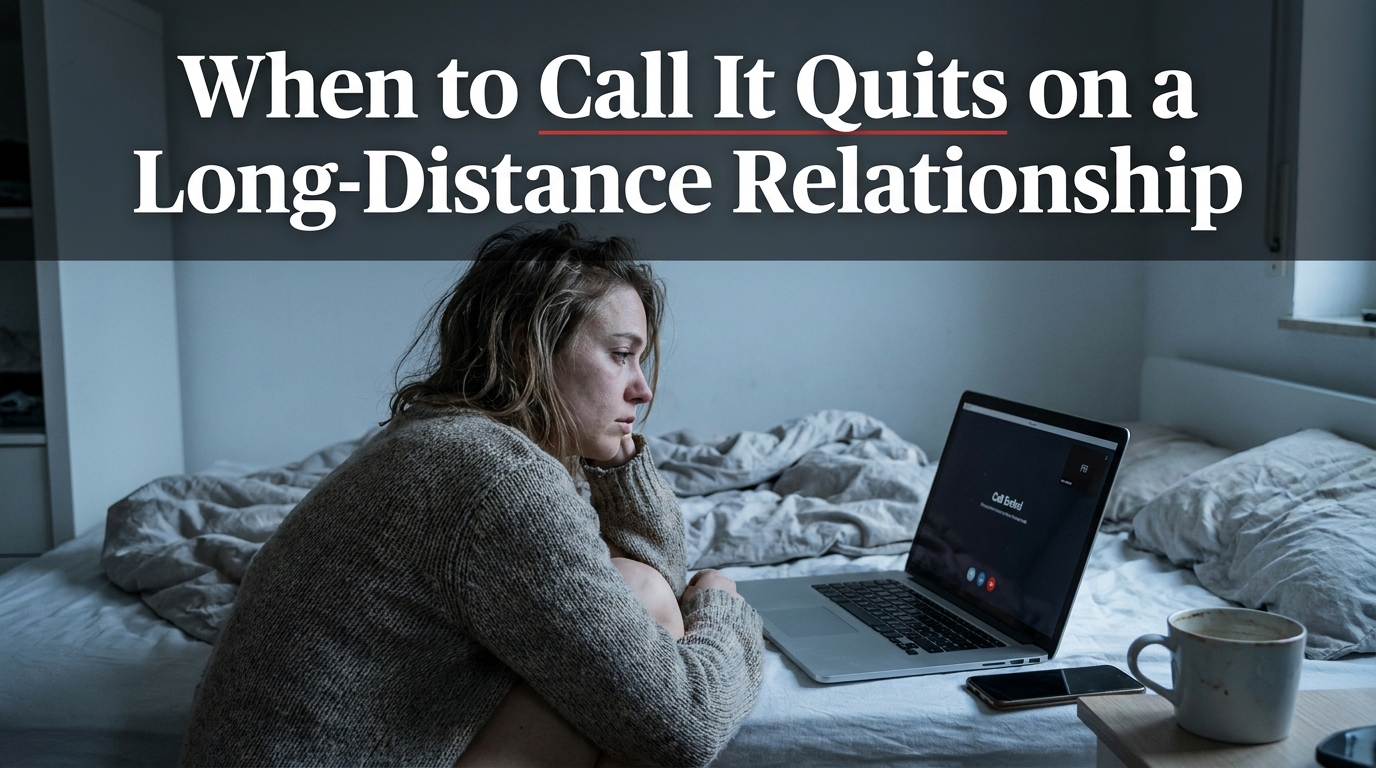
Nobody enters a long-distance relationship expecting to have this conversation with themselves. You entered it with hope — with the belief that what you had was worth the miles, the time zones, the video calls that never quite replace the real thing, the missing that becomes the background frequency of your daily life. And maybe it was worth it, for a while. Maybe it still is. But something has shifted — quietly, gradually, or suddenly — and you are here, reading this, which means a part of you is already asking the question that the rest of you is afraid to answer.
When to call it quits on a long-distance relationship is one of the most genuinely difficult decisions a person can face — because it sits at the intersection of real love, real pain, real investment, and the terrifying possibility that you might be giving up on something that could still become what you hoped for. Research from the Journal of Communication found that long-distance relationships are no more likely to fail than geographically close ones — but they are significantly more likely to end when the distance has no defined endpoint, when communication quality has deteriorated, or when one partner has begun to build a life that does not practically include the other. These are not just statistics.
They are the patterns that most people in ending long-distance relationships recognize, in retrospect, as the signs they ignored. This article does not tell you what to decide. It gives you the honest framework to decide for yourself — with clarity, without the distortion of fear or guilt, and with the full weight of your own life’s needs genuinely considered.
Why This Decision Is So Hard — And Why That Difficulty Is Legitimate
Before naming the signs, it is worth acknowledging why deciding to end a long-distance relationship is particularly agonizing — and why the difficulty is not weakness or indecision but a legitimate response to a genuinely complex situation.
The sunk cost of distance. Long-distance relationships require sacrifices that geographically close relationships do not. You have already paid a significant cost — in missed experiences, in the emotional labor of maintaining connection across distance, in the life decisions that were made with this relationship in view. The human mind is psychologically resistant to abandoning something it has already invested heavily in — a cognitive bias called the sunk cost fallacy. Recognizing that past investment, however real, is not a reason to continue a relationship that is no longer serving either person is genuinely difficult because it requires overriding a deeply wired psychological tendency.
The hope problem. Long-distance relationships exist, in significant part, on hope — the belief that the current difficulty is temporary, that the future will resolve what the present cannot. Hope is one of the most sustaining and one of the most blinding forces available to the human psyche. It can keep you in a relationship long past the point where honest assessment would counsel otherwise — because hope does not require evidence, and ending requires overcoming it.
The love problem. You can genuinely love someone and still be in a relationship that is not working and cannot be made to work. Love and compatibility are not the same thing. Love and sustainability are not the same thing. Love and mutual readiness to close the distance are not the same thing. The presence of real love is not, by itself, sufficient evidence that continuing the relationship is the right decision — and knowing this intellectually does not make it emotionally easier to act on.
The guilt problem. Long-distance relationships involve two people who have both sacrificed for something. Ending the relationship means ending it for both of them — including the one who did not initiate the ending, who may have been entirely committed and may experience the ending as a profound betrayal of that commitment. The guilt that attaches to being the person who ends it is real and heavy. It should not, however, be the reason the relationship continues.

Sign 1: There Is No Real Plan to Close the Distance — And There Has Not Been for a Long Time
This is the most fundamental sign — and the one most worth examining first, because everything else in a long-distance relationship depends on it.
Long-distance is designed to be temporary. The research on long-distance relationship sustainability is consistent on this point: couples who have a defined, realistic, mutually committed plan for closing the distance sustain significantly higher relationship quality and satisfaction than those in open-ended arrangements. The defined endpoint gives the present difficulty its purpose. It makes the sacrifice feel purposeful rather than indefinite.
When that endpoint has dissolved — when what was once a clear plan has become a vague aspiration, when the timeline keeps shifting without genuine concrete progress, when conversations about closing the distance have become uncomfortable or are being avoided altogether — the relationship is operating without the structural foundation that makes long-distance sustainable.
Ask yourself honestly: Do we have a genuine, specific, actively pursued plan for when and how this distance will close? Not “someday we will figure it out.” Not “when things settle down.” A real plan — with a realistic timeline, mutual commitment to its execution, and evidence of actual progress toward it.
If the honest answer is no — and particularly if the honest answer has been no for a significant period of time — that absence is one of the most important pieces of information available about the relationship’s actual trajectory.
Sign 2: Communication Has Become an Obligation Rather Than a Connection
Remember when the calls were something you looked forward to? When seeing their name on your screen produced a specific warmth that made whatever you were doing feel interruptible?
The shift from genuine anticipation to obligation is one of the earliest and most reliable signals that something significant has changed in the relationship’s foundation.
In a long-distance relationship, communication is not supplementary — it is the relationship. It is the primary medium through which the connection is maintained, developed, and kept real. When that communication begins to feel like a task to be completed rather than a connection to be enjoyed — when you find yourself dreading calls you once looked forward to, when the conversations feel effortful and hollow rather than natural and nourishing, when both people are going through the motions of connection without actually experiencing it — that shift is telling you something important.
This is not about having off days. Every relationship has communication lulls, periods of stress-induced reduced depth, and occasional calls that feel less connected than usual. The sign worth taking seriously is the pattern — the persistent, sustained shift from genuine connection to performed connection that both people can feel but neither is addressing directly.
Sign 3: One Person Is Carrying the Relationship Alone
Long-distance relationships require consistent, mutual investment to sustain — and when that investment becomes chronically imbalanced, the relationship begins to collapse under the weight of the imbalance.
The signs of carrying the relationship alone are specific and recognizable:
You are consistently the one initiating contact. You are the one making more of the emotional effort — the vulnerability, the depth, the honest disclosure. You are the one who brings up the future plan and tries to move it forward. You are the one whose sacrifices toward closing the distance are concrete and active while your partner’s remain theoretical and deferred. You are the one who notices when something is wrong in the relationship and raises it — and the one who does most of the work to address it.
Persistent imbalance of this kind is not just exhausting. It is revealing. When one partner is doing the work of two people to maintain a relationship that exists across distance — where the baseline difficulty is already high — the question of whether the investment is genuinely mutual cannot be deferred indefinitely.
If you have raised this imbalance honestly and seen no genuine, sustained change — if the pattern has persisted despite your partner’s stated awareness of it — that persistence is the answer to the question of whether genuine mutual commitment exists.
“A long-distance relationship is not just difficult. It is effortful in ways that require both people to show up consistently. When one person has stopped showing up — or has never really started — the effort of the other becomes the only thing holding a relationship that cannot be held by one person alone.”

Sign 4: The Trust Has Broken Down and Has Not Been Rebuilt
Trust in a long-distance relationship carries a different weight than in a geographically close one — because the ordinary, low-level reassurance of daily physical presence is not available. You cannot see your partner’s life. You cannot verify, through ordinary co-existence, the accuracy of what they share with you. Long-distance trust is, by necessity, a more deliberate and more vulnerable act than proximity trust.
When that trust has been significantly damaged — through discovered dishonesty, through behavior that contradicted what was being communicated, through a pattern of inconsistency between what is said and what is done — and when genuine, sustained effort to rebuild it has either not occurred or has not succeeded, the relationship is operating without the foundation it needs to function across distance.
Broken trust in a long-distance relationship is more damaging and more difficult to repair than in a geographically close one, for the simple reason that the behaviors that rebuild trust — consistent presence, behavioral evidence of changed patterns, the gradual accumulation of reliability through direct experience — are all significantly harder to perform and harder to witness across distance.
If the trust has broken down and the distance prevents genuine rebuilding — if you find yourself in a cycle of suspicion, reassurance, and renewed suspicion that the distance makes it impossible to escape — that cycle is not just painful. It is a sign that the relationship’s structural requirements exceed what the current arrangement can provide.
Sign 5: Your Individual Lives Have Grown in Incompatible Directions
People change. This is not a failure — it is the natural, inevitable consequence of living, experiencing, and growing. But when two people who are already navigating the challenge of distance have grown in directions that have become genuinely incompatible — in their values, their life goals, their vision of what a shared future looks like — that incompatibility is not something that the closing of the distance will resolve.
This sign requires a specific kind of honest examination — one that goes beyond the immediate emotional experience of the relationship and looks at the full picture of who each person has become and what they actually want.
Are your life goals still aligned? Not in the abstract, romantic sense — but specifically. Where do you want to live? What kind of life do you want to build? What are your actual priorities for the next five to ten years? And does what you honestly want align with what your partner honestly wants — not just what they say they want in moments of connection, but what their actual choices and behaviors indicate they are building toward?
People who were compatible when the relationship began are not guaranteed to remain compatible after years of separate development. This is not anyone’s fault. It is the honest reality of two people growing, sometimes in different directions, during a period of their lives when growth is particularly active.
Sign 6: Visits Feel Like Relief From Tension — Not Return to Connection
Pay attention to what visits actually feel like — not the idealized version, but the honest texture of them.
In a healthy long-distance relationship, visits are restorative — they replenish the connection that distance depletes, remind both partners of what they are sustaining the distance for, and send both people back to their separate lives with renewed sense of purpose and affection.
When visits have shifted in character — when they are characterized by unresolved tension that surfaces quickly, by arguments that were deferred from the last visit and arrive with fresh force at this one, by a felt distance between the two people even when they are physically together, by a relief when the visit ends that neither person fully acknowledges — that shift is significant.
The accumulation of deferred conflict, unaddressed hurt, and suppressed distance does not disappear between visits. It waits. And visits that are too short and too emotionally loaded to do the repair work that the accumulation requires begin to feel less like reunions and more like confrontations — with each other and with the gap between how the relationship is supposed to feel and how it actually does.

Sign 7: You Have Stopped Imagining a Future Together
This sign is quiet. It does not announce itself. It is noticed in retrospect — when you realize that the future-imagining, which once came easily and naturally and with genuine excitement, has stopped.
You no longer find yourself thinking about what your shared life will look like when the distance closes. The future that once felt like the destination of all the current difficulty has become something you avoid thinking about specifically — because thinking about it produces discomfort or blankness rather than the warmth and anticipation it once did.
When the imagination of the shared future goes quiet, it is often because something deeper has already assessed the situation and reached a conclusion that the conscious mind has not yet articulated. The heart sometimes knows before the mind catches up.
This is not a definitive sign on its own — there are periods in every relationship where the future feels less vivid than the present difficulty. But combined with other signs on this list, the quiet disappearance of future-imagining is one of the most honest internal signals available.
Sign 8: You Feel More Relief Than Sadness When You Imagine It Ending
This is the sign that most people find the most confronting — and the most informative.
The thought of ending the relationship produces two possible dominant emotional responses. One is grief — the genuine, visceral, “I cannot lose this” response of someone whose primary experience of the relationship’s ending is loss. The other is relief — the release of tension, the return of something that feels like space, the cessation of a pressure that has been sustained for so long it had become the background frequency of daily life.
Relief as a dominant response to imagining the relationship ending is not proof that ending is the right decision. But it is significant information. It means that the relationship has become, on some level, a source of sustained strain rather than a source of sustenance. It means the weight of what is not working has become heavier than the warmth of what is.
Sit with this honestly. Not performatively — not asking yourself what you are supposed to feel or what the most loving response would be — but genuinely. When you imagine this relationship ending, what is the first feeling that arrives?
If it is primarily grief — that is meaningful.
If it is primarily relief — that is also meaningful.
Neither verdict is final. Both deserve honest examination rather than immediate suppression.
“If imagining the end of your relationship produces more relief than grief, that is not a sign that you are heartless or that the love was not real. It is a sign that something has been costing you more than you have been admitting — and that the honest acknowledgment of that cost is the beginning of a decision you have been afraid to make.”
Sign 9: Your Core Needs Are Not Being Met — And Cannot Be Met From a Distance
Every person in a relationship has core needs — for emotional support, for physical affection, for a sense of being chosen and prioritized, for the particular kind of companionship that comes from shared daily life. Different people weight these needs differently, but they are real for everyone.
Long-distance relationships are structurally limited in their ability to meet certain of these needs — particularly the physical and the everyday-companionship ones. The question is not whether those needs are being fully met across distance — in most cases they are not. The question is whether the current arrangement is meeting enough of them, well enough, to be sustainable for both people’s genuine wellbeing.
When the honest answer is no — when you are experiencing a sustained deficit of needs that the distance prevents from being met, and when the closing of the distance is not imminent enough to make the deficit temporary — the relationship is asking you to sustain a cost that it cannot reciprocally pay.
This is not a moral failing of the relationship or the partner. It is a structural reality. Some people’s needs and some periods of their lives are compatible with long-distance. Some are not. Acknowledging which category you are genuinely in is one of the most honest and most self-respecting things you can do.

How to Have the Conversation If You Decide to End It
If your honest examination of these signs leads you to the decision that it is time to end the relationship, how you end it matters — both for the other person and for yourself.
Do it in a conversation, not a message. A relationship that has sustained itself across distance through real, effortful communication deserves to end in real communication — a video call at minimum, an in-person conversation if that is at all possible. A text or an email, however carefully worded, is not adequate for ending something that mattered.
Be honest without being cruel. The reasons for ending the relationship deserve to be communicated clearly enough that the other person is not left in confusion or false hope — but they do not require exhaustive detail or the cataloging of every grievance. The honest, core truth — stated with care — is what the other person needs and deserves.
Be definitive. One of the most unkind things you can do at the end of a relationship is leave it ambiguous — to end things while simultaneously suggesting that “maybe someday” or “when circumstances are different.” If you have decided the relationship is not viable, say so clearly and compassionately. Ambiguity is not kindness. It is a prolongation of the other person’s pain.
Allow for grief — theirs and yours. Ending a relationship you genuinely cared about is a loss, even when it is the right decision. Your grief is legitimate. So is theirs. Allowing both to exist without suppressing them in the name of moving on quickly is the beginning of genuine processing for both people.
Do not go back and forth. Repeated breaking up and getting back together — the on-again-off-again cycle — is particularly damaging in long-distance relationships because each return to the relationship involves the resumption of sacrifice and the regeneration of hope. If you have made the decision, make it clearly and hold it — not out of cruelty, but out of respect for both people’s time, energy, and capacity to heal.
When to Keep Going Instead
In the interest of full honesty — because this article is not a universal argument for ending long-distance relationships — there are circumstances in which the honest answer to the question of whether to call it quits is not yet.
If the plan for closing the distance is real, concrete, and actively being pursued — and if the timeline is genuinely manageable within both people’s capacity — the presence of difficulty does not, by itself, constitute a reason to end.
If the communication has suffered due to a specific, identifiable external stressor — work crisis, family emergency, mental health challenge — rather than a fundamental shift in investment, that is different from the persistent pattern of disconnection described above.
If both people are genuinely willing to have the honest conversations this article has described — about the future plan, about the imbalance, about the state of the trust, about the needs that are not being met — and if those conversations produce genuine, sustained change rather than temporary reassurance, the relationship may have more life in it than the current difficulty suggests.
The question is always the same: is what you are experiencing a temporary difficulty within a fundamentally viable relationship, or is it a fundamental non-viability that temporary difficulty is making visible? That question cannot be answered by any article. It can only be answered by the most honest examination you are capable of — of the relationship, of your partner’s actual demonstrated investment, and of your own genuine needs and limits.
Final Thoughts
Deciding when to call it quits on a long-distance relationship is not a decision that anyone else can make for you. This article has given you the honest framework — the signs, the questions, the considerations. What you do with them is yours.
What can be said clearly is this: staying in a relationship that is no longer working — out of guilt, out of sunk cost, out of fear of the grief that ending will produce — is not love. It is obligation. And obligation, sustained across distance, in a relationship that is no longer genuinely reciprocal or genuinely building toward anything, costs both people something they cannot recover while the relationship continues.
Ending a long-distance relationship that has genuinely run its course is not giving up. It is choosing clarity over comfortable avoidance. It is choosing your own life — and the other person’s — over the prolongation of something that has stopped serving either of you.
That is not a small thing. That is courage.
Save this article — for when the question gets loud enough that you cannot ignore it anymore.
Share it with someone who is in a long-distance relationship that feels like it has become more about endurance than about love.
Follow Truthsinside.com for more honest, psychologically grounded content on relationships, love, and the decisions that require the most courage to make clearly.
Related article: 15 Signs She Is Testing You: Why Women Test Men and What to Do
Frequently Asked Questions
Q1: How do I know if I am giving up too early or waiting too long?
The honest answer involves examining two things: first, whether the specific problems you are experiencing are solvable within the current arrangement or require the closing of the distance to address — and whether the distance is closing in a genuinely realistic timeframe. Second, whether both people are genuinely, actively working on the problems — or whether one person is doing most of the work while the other is passively present. Giving up too early typically involves ending during a temporary, addressable difficulty. Waiting too long typically involves staying through a persistent, structural non-viability out of guilt, hope, or sunk cost reasoning.
Q2: Is it possible to end a long-distance relationship and remain friends?
Possible — but rarely immediate and rarely uncomplicated. The period immediately following the end of a long-distance relationship typically requires real distance for both people to process the loss and begin genuine healing. Whether a genuine friendship can develop afterward depends on factors including: how the ending was handled, how much time has passed, whether both people have genuinely moved through their respective grief, and whether the friendship is genuinely desired by both people rather than being a consolation offered to soften the ending.
Q3: Should I end a long-distance relationship if I have feelings for someone nearby?
The development of feelings for someone in your immediate life during a long-distance relationship is a signal worth taking seriously — not necessarily as a verdict on your character, but as information about unmet needs and your actual emotional state. The question to examine honestly is whether those feelings are primarily a symptom of what is missing in the long-distance relationship — proximity, daily companionship, physical presence — or whether they reflect a genuine incompatibility in the long-distance relationship that was already present. Either way, the long-distance relationship deserves honest evaluation on its own terms rather than being ended simply as a consequence of new feelings.
Q4: What if my partner does not agree that we should end it?
Ending a relationship does not require both people’s agreement — it only requires one person’s genuine, considered decision that the relationship is not viable for them. If you have reached that decision honestly, your partner’s disagreement is painful but does not obligate you to continue. What their disagreement does deserve is honest, compassionate communication — a real conversation about why you have reached this decision, delivered with care for how it lands, and without the cruelty of ambiguity or false hope.
Q5: How do I cope with the guilt of ending a long-distance relationship?
Guilt in this context is almost universal — and largely unavoidable, because ending means causing pain to someone who likely did not want the relationship to end. What helps is distinguishing between guilt that reflects genuine wrongdoing and guilt that is simply the painful consequence of a decision that was right but costly. If you ended the relationship honestly, compassionately, and after genuine examination — not impulsively, not cruelly, not for reasons that disrespect the other person — the guilt you feel is the grief of causing pain to someone you cared about, not the guilt of having done something wrong. Both deserve acknowledgment. Only one deserves sustained self-condemnation.
🎵 Music
Maren Lull is a singer-songwriter who writes from the places most people don’t talk about out loud.
Not the dramatic grief. Not the obvious heartbreak. The quiet kind — the ordinary Tuesday emptiness, the habit of reaching for someone who isn’t there anymore, the particular exhaustion of being strong for so long that the strength itself wears thin.
Her music lives at the intersection of emotional honesty and soft beauty — breathy vocals over gentle piano, slow tempos, lyrics that feel less like songs and more like something you wrote in a private notebook at two in the morning and never showed anyone.
Maren Lull writes for the people who feel everything deeply and say very little about it. For the ones who listen to sad music not because they want to feel worse — but because being understood, even by a song, makes the feeling easier to carry.
📱 Follow Maren Lull:
→ Spotify
→ Apple Music
→ Youtube
→ Audiomack