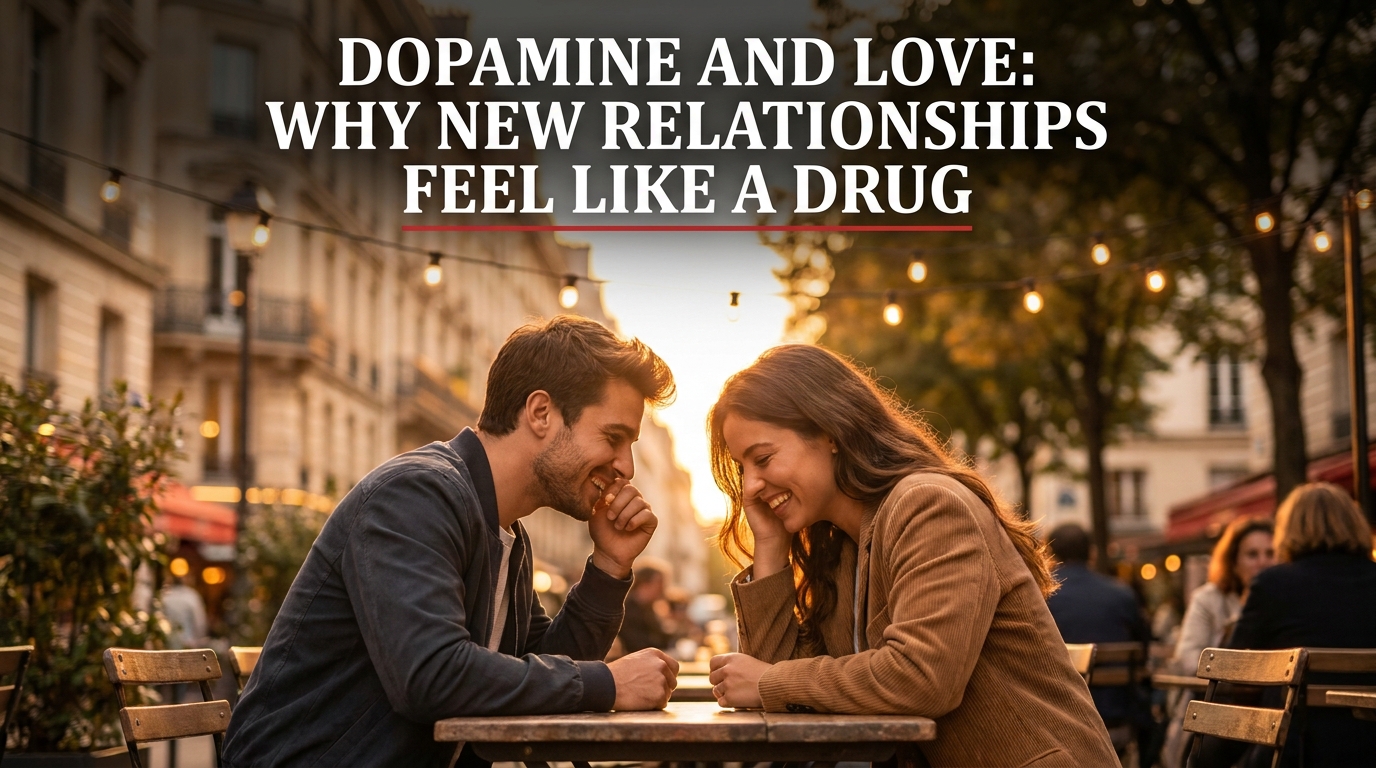
You cannot stop thinking about them. You check your phone constantly, heart lifting at every notification. You replay conversations in exquisite detail. You feel simultaneously euphoric and anxious, energized and unable to concentrate, certain about something you have known for three weeks. If this sounds less like falling in love and more like a clinical description of addiction — that is because neurologically, it is remarkably close to both. Dopamine and love are connected in ways that science has only fully begun to map in the last two decades,
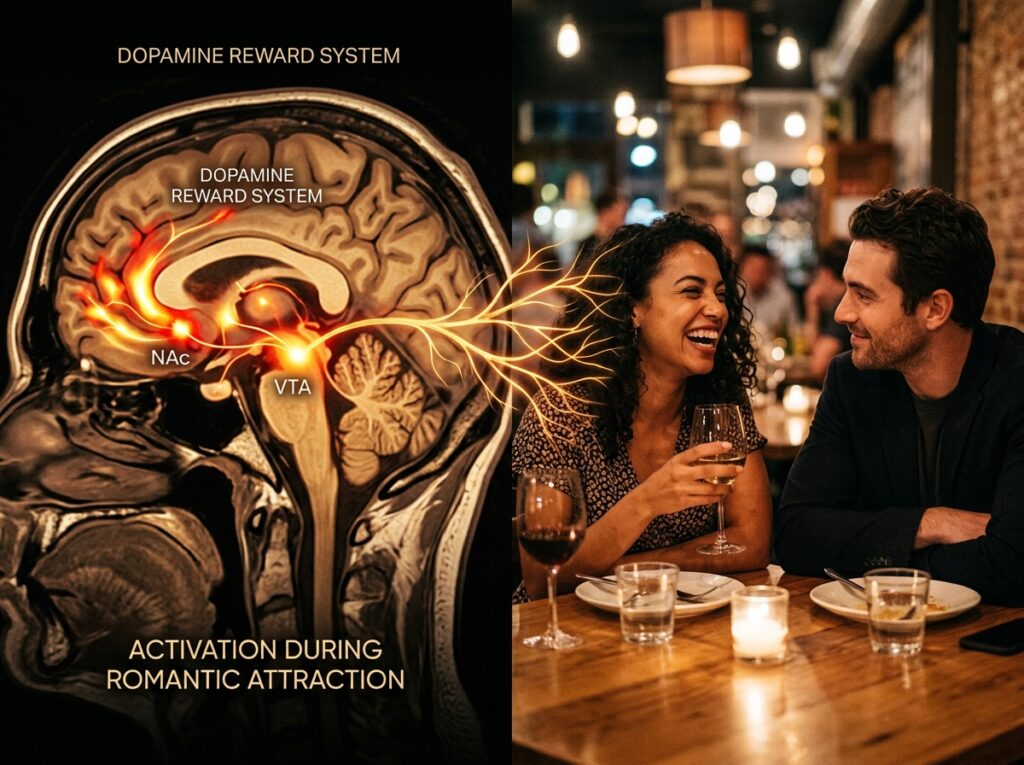
and what that mapping reveals is extraordinary: a study from Stony Brook University found that early romantic love activates the ventral tegmental area — the brain’s primary dopamine production hub — in patterns virtually identical to those observed in cocaine users. The experience of new love is not just emotionally intense. It is neurochemically engineered to be consuming, obsessive, and extraordinarily difficult to think clearly inside of.
This is not a diminishment of love. It is an explanation of why it feels the way it does — and why understanding the neuroscience behind the feeling is one of the most practically useful things you can do for your relationship life. Because the dopamine high of new love is real, it is temporary, and what happens when it fades determines almost everything about whether what you built on top of it was genuine or was simply the neurochemical weather of a particular season.
What Dopamine Actually Is — And What It Is Not
Before exploring what dopamine does in the context of love, it is worth correcting a persistent and consequential misconception: dopamine is not the pleasure chemical. This framing — pervasive in popular culture — fundamentally misrepresents how the molecule actually functions and produces significant confusion about why we behave the way we do under its influence.
Dopamine is the anticipation chemical. The wanting chemical. The motivation and drive molecule that fires not in response to receiving a reward but in anticipation of one. Neuroscientist Kent Berridge’s foundational research at the University of Michigan demonstrated this distinction clearly — separating the neural systems for “wanting” (dopamine-driven) from those for “liking” (opioid-driven). These systems overlap but are distinct. And in the context of attraction, it is primarily the wanting system — the dopamine system — that is most intensely activated.
What this means practically is that the dopamine high of new love is not really about pleasure. It is about craving. The elevated dopamine state of early romantic attraction produces an intense motivational drive toward the person — a wanting that is relentless, that does not fully satisfy even when the person is present, and that intensifies when they are absent or when the reward is uncertain.
This anticipatory, craving quality is precisely why new love feels so consuming. The dopamine system is not designed to produce satisfied contentment. It is designed to produce motivated pursuit. It keeps you wanting, keeps you reaching, keeps you engaged — which is evolutionarily adaptive for sustaining courtship behavior long enough for attachment to form.
It is also, when you understand it clearly, the neurological explanation for why the person you just started seeing feels so urgently important, so exquisitely present in your mind, so impossible to think clearly about.

The Neurochemistry of New Love: What Is Actually Happening in Your Brain
When you fall for someone new, the brain does not simply generate a pleasant feeling. It launches a coordinated neurochemical event involving multiple systems simultaneously.
Dopamine fires in the ventral tegmental area and floods the nucleus accumbens — the brain’s primary reward center — creating the craving, the focused attention, and the motivational urgency that characterizes early attraction. This is the system that makes them feel like the most important thing in your world.
Norepinephrine is released alongside dopamine, producing the physiological arousal of early attraction — the racing heart, the heightened alertness, the slightly trembling feeling of nervous excitement in the presence of the person or when anticipating their contact. Norepinephrine is also responsible for the intrusive, persistent thoughts — the way the person occupies your mental space even when you are actively trying to focus on something else.
Serotonin drops — significantly. Research by Donatella Marazziti at the University of Pisa found that people in the early stages of romantic love show serotonin levels comparable to those of patients with Obsessive Compulsive Disorder. Lower serotonin is associated with intrusive, repetitive thought patterns — which elegantly explains why new love produces the obsessive quality of constantly returning to thoughts of the person regardless of your intention.
Cortisol rises in early attraction — a mild stress response that contributes to the heightened, slightly edge-of-seat quality of new love. The nervous system registers the importance of this person to you partly through a stress signal — making the stakes feel high in a way that is physiologically as well as emotionally real.
Phenylethylamine (PEA) — sometimes called the “love chemical” — is released during early attraction, producing feelings of excitement, alertness, and a specific kind of natural high that has led researchers to note its structural similarity to amphetamines.
Together, these neurochemicals create what Helen Fisher describes as “one of the most addictive substances on earth” — a state that is neurologically compelling, cognitively distorting, emotionally consuming, and extraordinarily difficult to regulate through will alone.
Why New Love Feels Like Addiction — The Parallel Is Precise
The comparison between new love and addiction is not a metaphor. It is a neurological description.
Research using fMRI brain imaging consistently demonstrates that the brain activation patterns of people in early romantic love overlap substantially with those of individuals under the influence of addictive substances — particularly cocaine and other dopaminergic stimulants. The same regions activate. The same reward circuits light up. The same motivational urgency is produced.
The behavioral parallels are equally striking:
Tolerance. Just as drug users require increasing amounts of the substance to achieve the same high, new love relationships frequently show an escalating quality — the need for more contact, more reassurance, more intensity to maintain the same level of the feeling that less produced earlier.
Withdrawal. Separation from the person you are in the early love stage with produces symptoms that parallel substance withdrawal — restlessness, anxiety, intrusive thoughts, difficulty concentrating, a pervasive sense of something being wrong. These are not dramatic metaphors. They are the felt consequences of a dopamine system that has been elevated by the presence of a specific stimulus and is now registering its absence.
Craving and compulsive seeking. The impulse to check the phone, to manufacture reasons to make contact, to seek proximity to the person even when it is impractical — these are the behavioral outputs of a dopamine system that has identified a specific source of anticipated reward and is generating powerful motivational drive toward it.
Cognitive narrowing. Addictive substances narrow the focus of attention toward the substance and away from other sources of meaning and reward. Early love does precisely the same thing — producing a temporary but significant narrowing of cognitive and emotional attention toward the romantic target, at the expense of other relationships, interests, and priorities.
Loss of rational judgment. Both addiction and early love are associated with reduced activity in the prefrontal cortex — the brain region responsible for rational evaluation, risk assessment, and impulse regulation. This is not incidental. It is the neurological explanation for why people in new love make decisions they would not make under ordinary cognitive conditions — moving too fast, overlooking red flags, making commitments before they have adequate information.
“The brain in new love is not operating at its most rational. It is operating at its most motivated — which is a very different thing. Understanding that distinction is the beginning of navigating the dopamine state of early love without letting it make all your decisions for you.”
The Role of Uncertainty in Amplifying the Dopamine Response
One of the most important and most counterintuitive findings in the neuroscience of love and attraction concerns the role of uncertainty in amplifying the dopamine response.
Dopamine neurons fire most intensely not in response to guaranteed rewards but in response to uncertain ones. Research by Wolfram Schultz at Cambridge University demonstrated that dopamine release is maximized when reward probability is approximately fifty percent — the exact point of maximum uncertainty. Guaranteed rewards produce less dopamine than uncertain ones.
In the context of new love, this finding explains several significant phenomena:
Why unavailability is intoxicating. The person who is slightly hard to read — who does not immediately and consistently confirm your feelings, who keeps you slightly uncertain about where you stand — activates a more intense dopamine response than the person who is completely clear and consistently available. The uncertainty itself is the neurological amplifier. This is not a character flaw in the attracted person. It is the dopamine system responding to its most activating condition.
Why the chase feels more exciting than the catch. The pre-commitment phase of a new relationship — when the outcome is uncertain, when each interaction carries genuine stakes — activates higher dopamine levels than the post-commitment phase, when the outcome has been resolved and the uncertainty has been removed. This is the neurological basis of the “spark fading after commitment” that many couples experience — not the death of love, but the natural moderation of a dopamine system whose most activating condition (uncertainty) has been resolved.
Why mixed signals are addictive. A partner who is alternately warm and cool, available and withdrawn, engaged and distant — creates the maximum uncertainty condition for the dopamine system and therefore produces the most intense and most persistent craving response. The person who gives you mixed signals is not necessarily more compelling. Their uncertainty pattern is producing the neurological conditions for maximum dopamine activation.
This understanding is practically significant. If you find yourself most powerfully drawn to people who keep you uncertain, who are hot and cold, who make you feel the urgency of possibly losing them — that pattern is not a sign of deep compatibility or extraordinary chemistry. It is your dopamine system doing exactly what it is designed to do in conditions of maximum uncertainty.
When the Dopamine Fades: What Happens and Why
The dopamine high of new love does not last indefinitely. Research suggests that the acute phase — the obsessive, consuming, neurochemically elevated state of early attraction — typically begins to moderate somewhere between twelve and twenty-four months into a relationship, though the timeline varies considerably across individuals and relationships.
This moderation is not a malfunction. It is the natural transition from one neurological system to another — from the dopamine-driven attraction system to the oxytocin and vasopressin-driven attachment system. The brain is not losing interest. It is shifting from the acute craving state of pursuit to the quieter, warmer, more stable state of genuine bonding.
What makes this transition confusing and sometimes painful is the cultural narrative surrounding it — the expectation, absorbed from romantic media and popular mythology, that the intensity of early love is how love is supposed to feel permanently. When the intensity moderates, many people interpret the moderation as the love fading rather than the love maturing.
This misinterpretation has specific and significant consequences. Couples who mistake the dopamine comedown for the death of love sometimes end relationships that have reached exactly the threshold where genuine, durable partnership becomes possible. Others respond by seeking new relationships — which reliably restart the dopamine high — and begin a pattern of cycling through the intensity phase without ever developing the deeper, quieter, more sustaining form of connection that lies on the other side of it.
The dopamine phase is extraordinary. It is also not the destination. It is the beginning of a journey — the neurological mechanism that initiates bonding and creates the motivation to stay long enough for genuine attachment to form. What you do with what remains after it moderates is where the real relationship lives.

The Dopamine Comedown: Navigating the Transition
Understanding that the moderation of the dopamine high is a transition rather than a loss is important. Navigating that transition well is what determines whether the relationship survives it.
Expect it. The single most useful thing you can do is know that the intense, consuming quality of early love will moderate — not because something has gone wrong, but because the neurological system that produced it is designed to be temporary. Expecting the moderation removes the catastrophizing interpretation that turns a natural transition into a relationship crisis.
Do not confuse moderation with incompatibility. The person you found irresistible in the dopamine phase is the same person who is still there in the attachment phase. What has changed is not them — it is the neurological lens through which you are experiencing them. The quieter warmth of the attachment phase reveals the person more accurately than the dopamine state did. If what you see without the neurochemical amplification is still someone you genuinely admire, trust, and enjoy — that is more meaningful information than anything you felt in the first months.
Invest in attachment-building behaviors. The oxytocin and vasopressin systems that sustain long-term bonding are activated by different behaviors than the dopamine system — by physical closeness, shared positive experience, genuine vulnerability, and the accumulation of ordinary moments of connection. Investing deliberately in these behaviors during and after the dopamine transition is how couples maintain genuine intimacy when the acute neurochemical intensity has moderated.
Resist the dopamine-seeking pattern. For people whose relational pattern involves repeatedly entering new relationships to recapture the high and exiting when it fades — understanding the neurological basis of that pattern is the beginning of choosing differently. The high will always be available in new relationships. The genuine intimacy of genuine partnership is only available on the other side of the dopamine comedown, with someone you choose to stay for.
Why Some People Get Addicted to the New Love High
Not everyone transitions through the dopamine phase at the same rate or with the same ease. For some people, the intensity of early love becomes something they seek repeatedly — a pattern of serial new relationships, perpetual non-commitment, or a persistent sense that every relationship stops being “right” around the same developmental stage.
This pattern is worth examining honestly for what it often reflects:
Avoidant attachment. For people with avoidant attachment styles, the dopamine phase of early love may be the only phase in which intimacy feels exciting rather than threatening. The intensity creates enough neurochemical motivation to override the avoidant system’s discomfort with closeness. But as the relationship deepens and the real vulnerability of genuine intimacy is required — without the dopamine to make the closeness feel exciting — the avoidant pull reasserts itself, and the relationship begins to feel suffocating rather than sustaining.
Novelty as regulation. For some people, the dopamine high of new love functions as a form of emotional regulation — a way of managing underlying anxiety, depression, or emptiness through the powerful neurochemical stimulation of new attraction. The new relationship does not just feel exciting. It feels necessary — because without it, something else that is uncomfortable becomes more present.
Unprocessed relational trauma. Some patterns of serial attraction to the dopamine phase reflect deeper relational wounds — experiences of abandonment, betrayal, or inconsistency that make the sustained vulnerability of genuine intimacy feel dangerous. The early phase is safer because it has not yet required the full exposure of being genuinely known.
Recognizing these patterns in yourself — with honesty and without self-judgment — is the beginning of understanding not just how dopamine and love interact, but what your particular pattern of attraction is telling you about your relational history and needs.

What This Means for How You Choose Partners
The practical implications of understanding dopamine and love for how you actually navigate relationships are significant.
Do not make permanent decisions during the dopamine phase. Moving in together, getting engaged, making major life adjustments — decisions of this magnitude made during the acute dopamine phase are being made in a neurological state that is specifically compromised in rational evaluation and risk assessment. This does not mean those decisions are always wrong. It means they deserve to be re-examined when the neurochemical state has stabilized — to confirm that what was decided under the influence of the dopamine high remains what you genuinely want with the clearer eyes of the attachment phase.
Pay attention to who someone is outside the high. The dopamine phase produces idealization — the systematic overestimation of the beloved’s qualities and the underestimation of their limitations. The person who is perfect in the first three months is always imperfect by month eight, not because they changed but because the neurochemical lens has changed. Who someone is when the idealization has moderated is considerably more relevant to long-term compatibility than who they were when you could not stop thinking about them.
Distinguish between chemistry and compatibility. These are not the same thing and they are not reliably correlated. Intense chemistry — powerful dopamine activation — can occur between people who are fundamentally incompatible in values, life goals, communication style, and emotional availability. Compatibility does not always produce immediate, intense chemistry. Some of the most genuine and most durable partnerships develop from relationships that began with warmth and mutual interest rather than consuming intensity. The dopamine tells you about the neurological response. It does not tell you about the person.
Use the moderation of the high as a diagnostic tool. When the acute dopamine phase has moderated, the relationship that remains is the one you need to examine honestly. Does genuine mutual respect remain? Does admiration remain? Does genuine enjoyment of the person’s company — without the amplification of neurochemical intensity — remain? The answers to these questions, asked honestly when the dopamine has settled, are considerably more informative about the relationship’s genuine potential than anything you felt in its most intoxicating phase.
Final Thoughts
Dopamine and love are not the whole story of romantic connection — but they are one of its most important chapters. Understanding the neurochemistry of new love does not diminish its beauty or its significance. It explains why it feels the way it does — consuming, obsessive, magnificent, occasionally irrational — and why the feeling is both real and temporary in its acute form.
The dopamine phase of a new relationship is one of the most extraordinary experiences the human nervous system can produce. It deserves to be enjoyed with full presence and genuine appreciation for what it is.
It also deserves to be understood for what it is not: a permanent state, a reliable guide to long-term compatibility, or a sufficient basis for the kinds of major life decisions that deserve to be made with considerably more neurological sobriety.
What comes after the dopamine — the quieter, the steadier, the more honest and more demanding form of love that the attachment system builds — is not less than what the dopamine produced. It is different. And for the people who stay long enough, with the right person, to find out what is on the other side — it is often the most meaningful thing they have ever experienced.
Save this article — for the next time you cannot stop thinking about someone and you need to understand why.
Share it with someone who is in the beautiful, consuming, slightly irrational early phase of something and would find it useful to understand what is happening in their brain.
Follow Truthsinside.com for more psychology-rooted, science-grounded content on love, the brain, and the endlessly fascinating territory of human connection.
Related article: What Does It Actually Feel Like to Fall in Love? Science + Real Stories
Frequently Asked Questions
Q1: How long does the dopamine high of new love typically last?
Research suggests the acute phase — the obsessive, consuming neurochemical intensity of early love — typically begins to moderate between twelve and twenty-four months into a relationship. However, this timeline varies significantly based on factors including relationship structure, how frequently the couple sees each other, individual neurological differences, and whether the relationship continues to introduce novelty and uncertainty. Couples in long-distance relationships, for example, may sustain the acute phase longer because the periodic reunion dynamic reintroduces the uncertainty and anticipation that keep dopamine elevated.
Q2: Is it possible to sustain the dopamine excitement in a long-term relationship?
The exact neurochemical state of early love — with its obsessive, consuming quality — cannot be indefinitely sustained, nor would sustaining it indefinitely be desirable, since it involves reduced rational judgment and prefrontal function. However, dopamine release in established relationships can be maintained at meaningful levels through the deliberate introduction of novelty and shared new experiences, which activate the dopamine system’s response to new reward stimuli. Research by Arthur Aron and colleagues demonstrated that couples who regularly engage in novel, exciting activities together show greater relationship satisfaction and neural activation patterns more similar to early love than couples who have settled into purely routine interactions.
Q3: Why do I feel depressed after the new relationship high fades?
The moderation of the dopamine high of early love can produce a genuine, temporary low — sometimes called “post-honeymoon blues” — that reflects the brain’s adjustment from an elevated neurochemical state to a lower baseline. This is physiologically similar to the comedown from any dopamine-activating experience. It is normal, temporary, and does not necessarily reflect anything meaningful about the relationship’s long-term potential. If the low persists significantly, it may be worth examining whether the relationship was primarily sustaining because of the neurochemical intensity rather than genuine compatibility — or whether underlying depression or anxiety is surfacing now that the neurochemical regulation of the high has moderated.
Q4: Why do I keep falling for unavailable people?
The neurological explanation: unavailability maximizes the uncertainty that produces the most intense dopamine response. The psychological explanation: for people with anxious attachment or certain relational histories, unavailable partners activate familiar relational dynamics that the nervous system registers as normal, even as the anxiety they produce is uncomfortable. Both explanations point toward the same practical insight: the intensity of the dopamine response to an unavailable person is not evidence of unique compatibility. It is evidence of the dopamine system doing exactly what it does under conditions of maximum uncertainty — which is not the same thing as a good relationship.
Q5: Does understanding the neuroscience of love make it less magical?
This is perhaps the most important question — and the honest answer is no. Understanding why something happens does not diminish the experience of it happening. The knowledge that a sunset is the result of light scattering through atmospheric particles does not make sunsets less beautiful. Similarly, understanding that the consuming quality of new love is neurochemically mediated does not make the experience less real, less meaningful, or less worth having. If anything, understanding the neuroscience of love produces a different kind of wonder — the awe of recognizing how profoundly the brain has been designed to make connection feel urgent, extraordinary, and worth everything it costs.
🎵 Music
Maren Lull is a singer-songwriter who writes from the places most people don’t talk about out loud.
Not the dramatic grief. Not the obvious heartbreak. The quiet kind — the ordinary Tuesday emptiness, the habit of reaching for someone who isn’t there anymore, the particular exhaustion of being strong for so long that the strength itself wears thin.
Her music lives at the intersection of emotional honesty and soft beauty — breathy vocals over gentle piano, slow tempos, lyrics that feel less like songs and more like something you wrote in a private notebook at two in the morning and never showed anyone.
Maren Lull writes for the people who feel everything deeply and say very little about it. For the ones who listen to sad music not because they want to feel worse — but because being understood, even by a song, makes the feeling easier to carry.
📱 Follow Maren Lull:
→ Spotify
→ Apple Music
→ Youtube
→ Audiomack