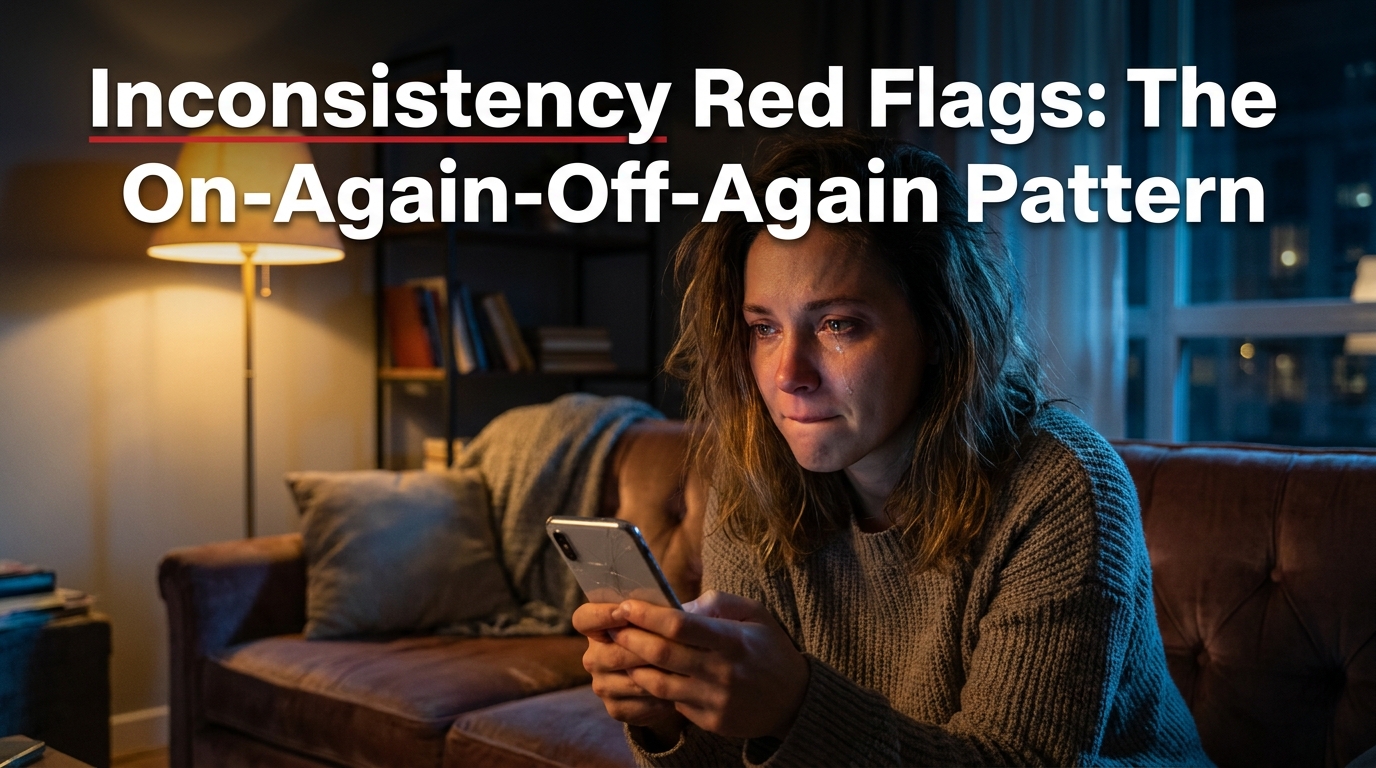
You love them. Then you don’t know where you stand. Then they come back, and everything feels magical again — until it doesn’t.
If that sentence just made your chest tighten, you already know exactly what inconsistency red flags feel like. And you’re not alone. Research published in the Journal of Social and Personal Relationships found that on-again-off-again relationships affect nearly 60% of adults at some point in their lives — and those relationships are consistently linked to higher rates of anxiety, depression, and emotional instability than relationships that simply end cleanly.
This is not a love story. This is a pattern. And patterns, unlike feelings, don’t lie.

What Does Inconsistency in a Relationship Actually Mean?
Inconsistency red flags are not just about someone canceling plans or being a bad texter occasionally. Life gets busy. People have off days. That is normal, and that is human.
What we are talking about here is a sustained pattern — a cycle that repeats itself in a way that leaves you emotionally exhausted, second-guessing your worth, and constantly trying to decode what is real.
An inconsistent partner might shower you with affection and attention for days or even weeks, making you feel like the most important person in their world. Then, with little or no explanation, they pull back. They go quiet. They become distant. You wonder what you did wrong. You replay conversations. You shrink yourself trying to figure out how to bring them back.
And then — just when you have almost made peace with the idea of letting go — they return. Warm, loving, attentive. The cycle resets.
This is not passion. This is not a “complicated” relationship. This is one of the clearest inconsistency red flags that psychology has documented, and it has a name.
The Psychology Behind the On-Again-Off-Again Cycle
Understanding why this pattern happens — and why it feels so impossible to leave — starts with one critical concept: intermittent reinforcement.
Intermittent reinforcement is a behavioral psychology principle first studied by B.F. Skinner. In his famous experiments, Skinner found that unpredictable rewards created far stronger behavioral responses than consistent rewards. Slot machines work the same way. So do inconsistent partners.
When someone rewards you with love and attention unpredictably — sometimes responding to your affection warmly, sometimes pulling away without reason — your brain does not learn to feel safe. Instead, it becomes hypervigilant. It becomes addicted to chasing the next moment of connection. The dopamine spike you feel when they come back is actually amplified by the pain of the withdrawal period that preceded it.
This is why leaving an inconsistent relationship often feels harder than leaving one defined by outright abuse. At least in a clearly toxic relationship, the answer feels clear. With intermittent reinforcement, your brain is hooked on the possibility of the good version of this person returning permanently.
Neuroscience backs this up. A 2010 study published in the Journal of Neurophysiology found that uncertainty in romantic relationships activates the same neural reward pathways as addictive substances. You are not weak for staying. You are neurologically hooked.
“Intermittent reinforcement creates a stronger emotional bond than consistent love — not because it is better, but because your brain cannot stop waiting for the next reward.”

10 Powerful Inconsistency Red Flags You Should Never Ignore
Recognizing the signs is the first step toward protecting yourself. These are not isolated incidents — they are patterns. And patterns are the truth of who someone is.
1. They Are Intensely Present, Then Completely Absent
One week they are texting you good morning every day, making plans, telling you how much you mean to them. The next week they are barely responding. No explanation. No apology. Just silence. And when they return, they act as if nothing happened.
2. They Avoid Defining the Relationship
Every time the subject of “what are we” comes up, they deflect, joke, change the subject, or make you feel like you are asking for too much. They want the emotional and physical intimacy of a relationship without the accountability that comes with one.
3. Their Effort Is Triggered by Your Distance
Have you noticed they only become attentive when you pull back? The moment you stop reaching out, suddenly they are calling, texting, showing up. The moment you re-engage, they retreat again. This is a classic push-pull dynamic, and it is one of the most damaging inconsistency red flags in any relationship.
4. They Use the Future as a Placeholder
“I just need more time.” “Things will be different when things settle down.” “I see a future with you, I just need to get myself together first.” Promises about a future that never arrives are not hope — they are a holding mechanism to keep you engaged without requiring them to change today.
5. Their Apologies Reset the Cycle, Not the Behavior
They apologize beautifully. They may even cry. They say all the right things. And you believe them — because in that moment, they believe themselves too. But the behavior does not change. The apology exists to bring you back into the cycle, not to mark a genuine turning point.
6. You Feel Emotionally Responsible for Their Moods
You walk on eggshells. You edit yourself. You monitor their energy before deciding what to say. When they are happy and warm, you feel relief — not joy. Because somewhere in your nervous system, you know it will not last, and you are already bracing for the shift.
7. The Relationship Exists Only in Private
They are warm and loving when it is just the two of you, but in public or around others, they are distant or evasive. They have never introduced you clearly. They keep the relationship in a comfortable gray zone where they have connection without visibility.
8. They Minimize Your Feelings Consistently
When you try to talk about how their inconsistency affects you, you are told you are “too sensitive,” “overanalyzing,” or “creating drama.” Your legitimate emotional responses are framed as the problem. This is a form of gaslighting that keeps you questioning your own reality.
9. Your Happiness Depends on Their Behavior That Day
You check your phone constantly. A good morning text makes your day. Silence destroys your focus. Your emotional regulation has become entirely dependent on their behavior — a sign that the relationship has created an anxious attachment pattern.
10. You Have Had This Exact Conversation Before
The clearest sign of all: you have sat down, expressed your needs, received what felt like genuine understanding — and ended up back in the same place months later. History in an on-again-off-again relationship is not the past. It is a preview.

Why People Stay in On-Again-Off-Again Relationships
Understanding why someone stays is not about judging them. It is about extending them — and yourself — the compassion that comes from the truth.
Attachment Wounding
Many people who find themselves trapped in on-again-off-again relationships have an anxious attachment style, often formed in childhood. If love felt unpredictable growing up — if affection was conditional, or if caregivers were inconsistent — unpredictable love in adulthood can feel familiar. Not healthy. Familiar. And the brain often mistakes familiarity for safety.
The Sunk Cost Fallacy
“We have been through so much together.” “I have invested so much time.” “It would all be for nothing if I leave now.” These are the thoughts that keep people in cycles long after the patterns have become clear. But time already spent is not a reason to continue spending more. The sunk cost of pain does not obligate you to accept more pain.
Hope as a Trap
Hope is a beautiful thing in the right context. In an on-again-off-again relationship, hope is often used against you — by the other person, and by your own mind. You are not hoping for who they are. You are hoping for who they sometimes are, who they say they could be, who they briefly become before the cycle resets.
“You cannot love someone into consistency. Either they are consistent, or they are not. Choosing you is not something that comes and goes.”
Fear of Starting Over
After months or years in a cycle, the idea of starting completely over can feel terrifying. Especially when the good moments have been genuinely good. The familiar pain of the cycle can feel safer than the unknown of healing and beginning again.

What This Pattern Does to Your Mental Health
The long-term psychological consequences of on-again-off-again relationships are well documented and deeply serious.
A 2013 study in the Journal of Family Psychology found that people in cyclical relationships reported significantly lower relationship quality, more uncertainty, and poorer communication — even compared to people in stable but unhappy relationships.
Living in a state of emotional unpredictability keeps your nervous system in a chronic state of low-grade stress. Your cortisol levels remain elevated. Your body stays in a mild but persistent fight-or-flight response. Over time, this contributes to anxiety disorders, depression, lowered self-esteem, and in some cases, symptoms that closely mirror those of complex PTSD.
You may begin to notice changes in yourself outside the relationship too. You become less trusting of your own judgment. You feel less confident. You apologize more. You ask for less. You shrink.
This is what sustained exposure to inconsistency red flags does to a person who is wired for love and connection. It does not break you all at once. It erodes you slowly, quietly, in the spaces between the good moments.
How to Break the Cycle: Practical Steps
Knowing the pattern is not enough. The mind that has been conditioned by intermittent reinforcement needs a structured approach to healing and clarity.
Step 1: Name It Out Loud
Write it down. Say it to a trusted friend. “This is an on-again-off-again relationship, and it is hurting me.” Naming the pattern removes the romantic fog that keeps it alive. You cannot heal what you will not name.
Step 2: Document the Pattern
Start a simple journal — not to obsess, but to see clearly. Write down the dates of connection and withdrawal. Write down what was promised and what actually changed. Patterns are much harder to romanticize when they are written in ink in front of you.
Step 3: Establish Non-Negotiable Standards
Not preferences. Not wishes. Standards. Decide what consistency looks like for you in concrete, behavioral terms. “I need someone who communicates regularly.” “I need to know where I stand in a relationship.” Then hold those standards, even when it is hard.
Step 4: Limit Contact With Intention
This is different from ghosting or punishment. It is creating space for clarity. When you are in constant contact with someone who is inconsistent, you are always in reaction mode. Distance gives you access to your own thoughts, your own feelings, and your own truth.
Step 5: Seek Professional Support
Therapy, particularly approaches like Cognitive Behavioral Therapy (CBT) or Emotionally Focused Therapy (EFT), can be profoundly helpful in unpacking the attachment patterns and neural conditioning that keep you in cycles. You do not have to figure this out alone.
Step 6: Reconnect With Your Own Life
One of the quieter damages of an on-again-off-again relationship is how much of your life it consumes. Your energy. Your attention. Your conversations. Rebuilding your identity outside of the relationship — through friendships, interests, goals — is not distraction. It is recovery.

When Someone Says “I’m Trying to Change”
This is where it gets complicated. Because sometimes people do change. Growth is real. People are capable of it.
The question is not whether they are trying. The question is whether the behavior has actually, consistently, changed over a meaningful period of time.
Words are not evidence of change. Repeated consistent behavior over time is evidence of change. If someone is genuinely growing, you will not have to wonder. Consistency will speak for itself.
Give yourself permission to require proof that is behavioral, not verbal. And give yourself permission to walk away if the proof never arrives — no matter how convincing the words are.
You Deserve Consistency, Not Potential
Here is a truth that gets buried under longing and hope and the very human desire to love and be loved:
You do not deserve someone who loves you most of the time. You do not deserve someone who treats you well when it is convenient. You do not deserve potential — the idea of who they could be if circumstances changed, if they healed, if they decided to finally choose you fully.
You deserve someone for whom choosing you is not an event. It is just what they do. Quietly, consistently, without drama.
Inconsistency red flags are not just warning signs about the other person. They are invitations — to look at what you have been accepting, at what you have been telling yourself love feels like, and at what you are willing to require going forward.
The on-again-off-again pattern is not a love story you can fix with more patience or more understanding or more love. It is a pattern that ends only when someone decides to end it.
Let it be you.
Frequently Asked Questions
Q1: Can an on-again-off-again relationship ever become healthy and stable?
It is possible, but statistically uncommon without significant individual work — particularly therapy — from the inconsistent partner. Research consistently shows that cyclical relationship patterns tend to repeat unless both people actively address the root causes, including attachment issues, communication patterns, and personal accountability. If genuine, sustained behavioral change occurs over a long period of time, the relationship can shift. But that change must be demonstrated through actions, not promised through words.
Q2: How do I know if someone is genuinely inconsistent or just going through a hard time?
The key distinction is pattern versus circumstance. Everyone has difficult seasons where they are less emotionally available. The difference is that a person going through a hard time will communicate about it, show genuine remorse for the impact on you, and return to consistent behavior when the circumstance resolves. An inconsistent partner’s behavior is not tied to external circumstances — it cycles regardless of what is happening in their life or yours.
Q3: Is it normal to feel addicted to an inconsistent partner?
Yes — and it is neurologically explainable. Intermittent reinforcement creates a dopamine-based attachment that can closely mimic addiction. The unpredictability of the relationship keeps your brain in a heightened state of anticipation, making the connection feel more intense than it may actually be. Recognizing this does not mean your feelings are not real. It means the intensity of your feelings may be amplified by the psychological mechanism, not the actual quality of the connection.
Q4: What should I say to someone when I decide to end an on-again-off-again relationship?
Keep it simple and clear. You do not owe a lengthy explanation, and lengthy conversations with an inconsistent partner often become another opportunity for the cycle to reset. Something like: “I’ve realized this pattern isn’t working for me, and I need to step away for my own well-being” is complete. You do not need their agreement or understanding. You need your own.
Q5: How long does it take to heal from an on-again-off-again relationship?
Healing timelines vary significantly depending on the length of the relationship, the intensity of the attachment, and the support available. Because these relationships involve intermittent reinforcement, healing can actually take longer than recovering from a clearly defined breakup. Expect a period of withdrawal that can feel genuinely physical. Be patient with yourself. With support — therapy, community, honest self-reflection — most people begin to feel significantly clearer within three to six months of consistent no or low contact.
Save This. Share This. Follow For More.
💾 Save this article — the next time the cycle pulls you back, come back and read it again.
📤 Share this with someone who needs to hear it. You might be giving them the clarity they have been searching for.
👉 Follow Truthsinside.com for more honest, research-backed content on relationships, psychology, and emotional health.
📃 Related article: 15 Subtle Red Flags in a New Relationship Most People Miss
Because the truth is always worth knowing — even when it is hard.
🎵 Music
Maren Lull is a singer-songwriter who writes from the places most people don’t talk about out loud.
Not the dramatic grief. Not the obvious heartbreak. The quiet kind — the ordinary Tuesday emptiness, the habit of reaching for someone who isn’t there anymore, the particular exhaustion of being strong for so long that the strength itself wears thin.
Her music lives at the intersection of emotional honesty and soft beauty — breathy vocals over gentle piano, slow tempos, lyrics that feel less like songs and more like something you wrote in a private notebook at two in the morning and never showed anyone.
Maren Lull writes for the people who feel everything deeply and say very little about it. For the ones who listen to sad music not because they want to feel worse — but because being understood, even by a song, makes the feeling easier to carry.
📱 Follow Maren Lull:
→ Spotify
→ Apple Music
→ Youtube
→ Audiomack