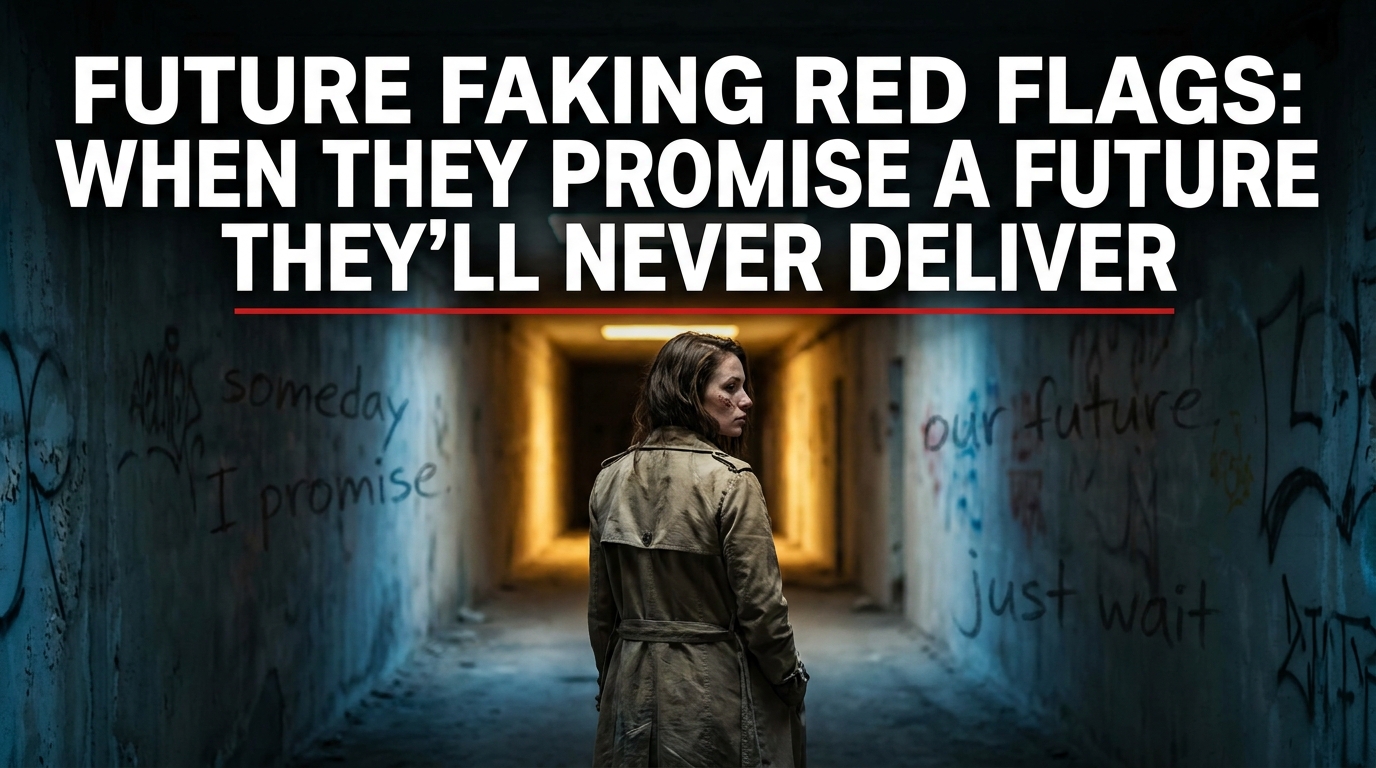
Future faking red flags are among the most emotionally destructive patterns in modern relationships — not because they are loud, but because they are beautiful.
Nobody stays for cruelty. People stay for promises. They stay because someone looked them in the eyes and described a future so specific, so warm, so exactly what they had always hoped for, that walking away felt impossible. They stay because every time doubt crept in, another promise arrived — a little more detailed, a little more convincing, just enough to reset the hope that had started to run out.
And then one day, they look up and realize: none of it ever happened. None of it was ever going to.
According to a survey conducted by relationship psychologists at the University of Texas, emotional manipulation involving false future promises was identified as one of the top three most psychologically damaging patterns reported by survivors of toxic relationships — ranking alongside gaslighting and intermittent reinforcement in terms of long-term damage to self-trust and the capacity for healthy love.
Future faking red flags do not just waste your time. They restructure the way you trust — yourself, other people, and the very idea of love having a future.

What Is Future Faking?
Future faking is a pattern of behavior — most commonly associated with narcissistic personality traits, avoidant attachment, and manipulative relationship dynamics — in which a person makes detailed, emotionally compelling promises about a shared future that they have no genuine intention, or capacity, to fulfill.
The term was coined in psychological discussions of narcissistic abuse, but future faking does not occur exclusively in relationships with clinically diagnosed narcissists. It occurs wherever one person uses the promise of a future to manage and retain another person’s emotional investment — consciously or, in some cases, entirely unconsciously.
That distinction matters.
Some future fakers are deliberate manipulators. They know exactly what they are doing — they are using your hope, your longing, and your love as leverage to keep you compliant, committed, and emotionally available to them on their own terms. They have no intention of delivering on any promise. The promise itself is the point — it is the mechanism of control.
Others are unconscious future fakers. They genuinely believe the promises they make in the moment of making them. In moments of emotional closeness or when they sense a partner pulling away, they reach instinctively for the most powerful retention tool available: the future. They paint it vividly, they feel it sincerely in the moment — and then the moment passes, and with it, the sincerity.
Whether deliberate or unconscious, the impact on the person receiving those promises is the same: hope extended past its expiration date, time given to something that was never going to become real, and a slow erosion of the ability to trust your own instincts about what is real and what is performance.
The Psychology Behind Future Faking
Understanding why future faking happens — what drives it psychologically — is essential for recognizing it clearly and protecting yourself from it.
The Narcissistic Supply Connection
In individuals with narcissistic traits, future faking serves a specific function within the broader pattern of narcissistic supply management. Narcissistic supply refers to the attention, admiration, and emotional energy that narcissistic individuals require from others to regulate their own fragile self-esteem.
When a partner begins to pull away — when their attention or admiration starts to diminish — the narcissistic individual deploys future promises as a powerful supply-retention mechanism. The promises are not expressions of genuine intention. They are emotional currency — offered at the exact moment they are most needed to reestablish the partner’s investment and re-secure the supply.
Research published in the Journal of Personality found that individuals scoring high on measures of narcissism showed significantly reduced follow-through on interpersonal commitments over time, while showing significantly elevated promise-making behavior during periods when relationships felt threatened. The pattern is clear: promises increase when the relationship is at risk, and decrease when it is stable — the inverse of what would occur if the promises were genuine.
The Avoidant Attachment Dynamic
Future faking also appears frequently in individuals with avoidant attachment styles — those who desire connection but fear the vulnerability and constraint that genuine commitment requires. For an avoidantly attached person, making promises about a future serves a specific emotional function: it allows them to maintain the emotional closeness of the present relationship without having to actually confront the intimacy and accountability that a real future together would require.
The promise of “someday” is a masterful piece of emotional engineering for an avoidant person — it keeps the partner hopeful and present while keeping the avoidant person’s genuine commitment safely deferred to an indefinite future that never actually arrives.
The Self-Deception Dimension
A third psychological pathway into future faking is what researchers describe as motivated self-deception — the capacity human beings have to genuinely believe things that serve their immediate emotional needs, regardless of whether those things are consistent with their actual behavior over time.
A person engaged in this form of future faking is not consciously lying. In the moment of making the promise, they feel it. They see the future they are describing. The emotion is real — but it is not connected to a genuine, considered intention to take the actions that would be required to make that future real.
The distinction between feeling something and committing to act on it is one that this type of future faker has never fully reckoned with. And the consequence for their partner is indistinguishable from deliberate deception: the promises do not come true.
“Future faking does not steal your present. It steals your future — the one you could have been building with someone who actually meant what they said.”

12 Future Faking Red Flags You Must Never Ignore
These are not isolated behaviors. They are a pattern — and patterns are the truth of who someone is and what they actually intend.
1. They Talk About the Future Constantly, But Take No Action in the Present
This is the foundational red flag of future faking. The person who genuinely intends to build a future with you does not just talk about it — they take concrete, visible steps toward it in the present. They make plans. They follow through on small commitments. They demonstrate, through daily action, that the future they describe is something they are actively working toward.
The future faker talks about the future lavishly and does nothing in the present to bring it closer. The talking is not preparation. The talking is the substitute for preparation.
2. The Promises Get More Detailed When You’re About to Leave
Pay careful attention to when the promises arrive. If the most vivid, specific, emotionally compelling promises consistently appear at the exact moment you have expressed doubt, pulled back emotionally, or indicated you might leave — that timing is not coincidence. It is a pattern, and it is the clearest signal that the promises are functioning as retention tools rather than genuine expressions of intention.
3. They Speak in Perpetual Somedays
“Someday we’ll travel the world together.” “One day I’m going to introduce you to my family.” “Eventually I want to move in with you.” The language of future faking is almost always vague and temporal — anchored to someday, one day, eventually, when things settle down, once I figure things out.
Genuine future planning has specificity. It has timelines. It has next steps. Perpetual somedays are not a vision of the future — they are a holding pattern designed to keep you invested in a future that has no actual architecture.
4. Their Actions Consistently Contradict Their Words
Actions are the only reliable data about what a person genuinely intends. If someone tells you they want to build a life with you while simultaneously making every major life decision — where to live, how to spend their money, what to prioritize — without any reference to you or your shared future, their actions are giving you the real answer. The words are the performance. The actions are the truth.
5. They Resist Concrete Commitment While Maintaining Emotional Intimacy
Future fakers are often experts at emotional intimacy. They can be deeply warm, genuinely affectionate, and convincingly loving in the day-to-day texture of the relationship. But the moment a conversation moves toward concrete commitment — defining the relationship, setting a timeline for moving in together, discussing marriage — they deflect, become defensive, or reframe the request as pressure.
They want all the emotional benefits of commitment without any of its accountability. The future is the mechanism that lets them have both.
6. The Same Promises Repeat Without Progress
If you have heard the same promise more than twice with no visible movement toward fulfillment between the tellings, you are not receiving a plan. You are receiving a script. The promise has been repeated not because progress has been made and momentum is building, but because the promise worked before — it kept you in place — and so it is being deployed again.
7. They Minimize Your Concerns About the Lack of Progress
When you raise the fact that the promised future has not materialized, a future faker will typically respond in one of several characteristic ways: they minimize (“you’re being impatient”), they redirect (“I thought you trusted me”), they guilt (“I can’t believe you don’t believe in us”), or they generate a new, even more elaborate promise to replace the one that failed to come true.
What they will almost never do is provide a genuine, accountable explanation for why the promised progress has not occurred — and a concrete, specific plan for how it will occur going forward.
8. You Feel More Connected to the Imagined Future Than the Actual Relationship
This is one of the most psychologically revealing signs of future faking’s impact on the person receiving it. When you find yourself sustaining the relationship primarily on the basis of the future that has been promised — when the imagined version of what you will have together feels more real and more nourishing than what you actually have right now — the future faking is working exactly as intended.
You are not in a relationship with who this person is. You are in a relationship with who they have promised to become.
9. They Use the Future to Resolve Present Problems
Every time there is a significant problem in the relationship — a breach of trust, a broken commitment, a period of emotional neglect — the future faker reaches for the future as the resolution. “Things will be different when we move in together.” “Once we get through this busy season, I’m going to be so much more present.” The future becomes a perpetual promissory note on which no payment is ever made — but which keeps the relationship’s emotional debt from being called in.
10. Their Vision of the Future Is Always About What You Will Have, Not What You Will Both Build
Listen carefully to how they describe the future they are promising. Is it a future you will receive — things that will happen to you, circumstances you will eventually find yourself in? Or is it a future you will actively build together — choices you will make, steps you will take, commitments you will both show up for?
Future faking tends to be passive and recipient-focused. Genuine future planning is active and collaborative.
11. They Have a History of Unfulfilled Promises in Other Areas
Future faking rarely exists in isolation. A person who consistently fails to follow through on promises in other areas of their life — professional commitments, friendships, financial obligations — is showing you the full pattern of their relationship with their own word. The future they are promising you is not an exception to this pattern. It is the most consequential expression of it.
12. Your Gut Has Been Trying to Tell You Something for a Long Time
The intuition that something is off — the recurring sense that the beautiful future being described does not quite match the reality you are actually living — is not paranoia. It is pattern recognition. Your nervous system is processing the discrepancy between words and actions faster than your conscious mind can articulate it. Trust that signal. It has been trying to protect you.

The Emotional Damage of Future Faking
Understanding the impact of future faking goes beyond recognizing it as a relationship problem. It is a form of psychological harm — one that leaves specific, documented damage in its wake.
Erosion of Self-Trust
Perhaps the most lasting consequence of future faking is what it does to your ability to trust your own perception. You believed. You invested. You built your decisions — where to live, whether to take opportunities, how to spend your emotional energy — around a future that was being described to you as real.
When that future fails to materialize, the mind does not always correctly attribute the failure to the future faker’s dishonesty. It often turns inward. What did I miss? How did I not see this? How could I have been so wrong? This internalized doubt — this collapse of confidence in your own judgment — is one of the most psychologically damaging inheritances of a future faking relationship.
Complicated Grief
Leaving a future faking relationship involves a specific and particularly painful form of grief — because you are grieving not just the relationship that was, but the future that was promised. The wedding that was described in vivid detail. The house you were going to live in. The life you were building toward.
That future felt real. You held it, planned around it, told people about it. Grieving something that never existed but felt completely real is a uniquely disorienting form of loss — and it deserves to be recognized as such.
Recalibrated Expectations
Extended exposure to future faking can gradually recalibrate a person’s expectations downward. If you have been repeatedly given promises that never came true, you may begin to unconsciously lower your standards — accepting less action in exchange for more words, tolerating an increasingly large gap between what is promised and what is delivered.
This recalibration does not happen all at once. It happens slowly, incrementally, in the same way that the future faking itself unfolds — gradually enough that each individual shift feels manageable, even as the cumulative distance from where you started becomes enormous.
Difficulty Trusting Future Partners
When someone eventually leaves a future faking relationship and begins a new one, they often bring with them a hypervigilance about promises that can make it difficult to receive genuine expressions of future intention without anxiety. A new partner who sincerely talks about the future may trigger the same fear response that the future faking created — because the brain has learned to associate future talk with eventual disappointment.
This is not a personal failing. It is a trauma response. And it is one that deserves compassionate attention — ideally in therapy — rather than shame.
“You did not fail to see clearly. You were shown something beautiful and chose to believe in it. That is not your weakness. That is your humanity — and it was used against you.”

How to Protect Yourself From Future Faking
Recognizing the pattern is the first line of defense. But protection requires more than awareness — it requires a shift in how you evaluate the people in your life.
Require Action, Not Just Words
The simplest and most effective protection against future faking is the commitment to evaluate people on the basis of what they consistently do rather than what they consistently say. Words are effortless. Action requires genuine intention. Make action your primary evidence.
This does not mean ignoring words. It means refusing to let words substitute for action when action is what the situation requires.
Set Timelines and Observe the Response
When someone makes a significant promise about the future, it is entirely reasonable to gently establish a timeline. “I really want that too — what do you think a realistic timeline for that looks like?” Pay careful attention not just to the answer, but to the emotional response to the question itself.
A person with genuine intention will engage with the timeline question thoughtfully and specifically. A future faker will typically deflect, become vague, reframe the question as pressure, or generate an even more elaborate promise to replace the need to answer it.
Stop Sustaining the Relationship on Future Credit
Be honest with yourself about what you actually have right now — in this relationship, as it currently exists, without any of the promised future factored in. Is what you have right now meeting your genuine needs? Is the present relationship — separate from what it might eventually become — worth being in?
If the primary reason you are staying is the future that has been promised rather than the present that is being delivered, that imbalance is important information.
Discuss Patterns With a Therapist
A therapist can help you identify whether what you are experiencing is future faking, help you understand the attachment and self-worth patterns that may be making you particularly vulnerable to it, and support you in building the internal standards and self-trust required to protect yourself going forward.
Trust the Timeline You Have Already Lived
You do not need to wait for new evidence. The timeline you have already lived — the promises that were made and the actions that did not follow — is itself evidence. History in a relationship is not the past. It is data about the present and a preview of the future.

What Genuine Future Planning Actually Looks Like
Because it is just as important to recognize what is real as it is to recognize what is not, here is what genuine future planning — from a partner who actually means what they say — tends to look like in practice.
Genuine future planning is action-oriented. It involves taking concrete steps, not just describing destinations. Genuine planning involves specificity — not “someday” but “by the end of the year.” It involves follow-through on smaller commitments as evidence of the capacity to follow through on larger ones.
A partner with real intentions invites accountability. They welcome conversations about timelines. They do not experience your reasonable expectations as pressure — they experience them as the natural architecture of building something real together.
Genuine love plans with you, not for you. It is collaborative and present-tense as well as future-oriented. It shows up in the choices being made today, not only in the vision being described for tomorrow.
And perhaps most importantly: genuine love does not require you to defer your needs indefinitely in exchange for the promise that they will eventually be met. It meets them — imperfectly, progressively, but genuinely — in the present.
You Deserved Someone Who Meant It
If you have been the recipient of future faking, there is something important that needs to be said clearly and without qualification:
You deserved someone who meant what they said.
Not someone who loved you when it was convenient, promised when they felt threatened, and disappeared from the future they described the moment they felt secure enough to stop performing it.
You deserved someone for whom the future was not a tool. Someone who talked about tomorrow because they were genuinely, actively building toward it — with you, for you, because you matter enough to make real plans for.
The future faking red flags were not your failure to notice. They were deliberately or unconsciously obscured by someone who needed you to stay. And the hope you held — the genuine, open-hearted hope you invested in that future — is not evidence of your weakness.
It is evidence of your capacity for love.
Carry that capacity forward. But this time, require that the people you offer it to show you, in consistent and visible action, that they deserve to receive it.
The future you deserve is not a promise someone makes. It is something you build — with someone who shows up to build it with you. Every. Single. Day.
Frequently Asked Questions
Q1: How is future faking different from someone who genuinely intends to follow through but struggles with commitment?
The most reliable distinguishing factor is the pattern of behavior over time paired with the response to accountability. Someone who genuinely wants to follow through but struggles with commitment will typically show genuine remorse when they fail to do so, engage honestly with timelines and expectations, and demonstrate visible effort toward the commitment even if progress is slow. A future faker, by contrast, tends to deflect accountability, generate new promises when old ones are called out, and show little genuine distress about the gap between their words and their actions — because the gap was never unintentional.
Q2: Can future faking happen unconsciously, and does that make it less harmful?
Yes, future faking can and does happen unconsciously — particularly in individuals with avoidant attachment styles or patterns of motivated self-deception. The unconscious future faker genuinely feels the promises in the moment of making them. However, unconscious origin does not reduce the harm caused to the person receiving the promises. The impact — eroded self-trust, wasted time, complicated grief, difficulty trusting future partners — is identical regardless of the future faker’s level of conscious intention. Understanding the unconscious dimension may support compassion for the person, but it does not reduce the validity of protecting yourself from the pattern.
Q3: Is it possible to have a real future with someone who has future faked in the past?
It is possible, but it requires genuine, sustained, and therapist-supported change on the part of the person who future faked — not more promises, but demonstrated behavioral change over a meaningful period of time. The specific changes required include follow-through on smaller commitments, accountability when commitments are not met, honest engagement with timelines, and the cessation of promise-making as a retention or conflict-resolution tool. If those behavioral changes are not occurring consistently and verifiably, more promises about the future are not evidence of change. They are evidence of the pattern continuing.
Q4: How do I rebuild trust in my own judgment after being future faked?
Rebuilding self-trust after future faking is a gradual process best supported by therapy — specifically approaches that address the internalized self-doubt and hypervigilance that future faking tends to create. Practically, it involves returning to the principle of evaluating people by their actions rather than their words, beginning with smaller relationships and lower-stakes commitments where you can practice calibrating your trust assessment in real time. Journaling about the patterns you observe in new relationships — writing down what is said versus what is done — can also help rebuild the capacity to see clearly that the future faking temporarily disrupted.
Q5: What should I say when I decide to leave a future faking relationship?
Keep it clear, grounded, and brief. You do not owe an extended explanation that becomes another opportunity for the future faker to generate new promises. Something like: “I have realized that the future you describe and the actions I observe are consistently different, and I need to make decisions based on what I can actually see rather than what I’ve been promised” is complete, honest, and non-negotiable in tone. Expect the future faker to respond with their most elaborate promise yet — the one that arrives at the exact moment you have made the clearest move toward leaving. That response is not evidence of change. It is the final, clearest evidence of the pattern you identified.
Save This. Share This. Follow For More.
💾 Save this article — the next time someone’s promises feel too beautiful to question, come back here and read it again.
📤 Share this with someone you love who has been waiting on a future that keeps getting deferred. You might be giving them the clarity that changes everything.
👉 Follow Truthsinside.com for more honest, research-backed content on relationship red flags, psychology, emotional health, and the truth about love that nobody else is saying out loud.
📃 Related article: Gaslighting in Relationships: How to Recognize, Name, and Leave It
Because the future you deserve is not a promise. It is something real — and you deserve to stop waiting and start living it.
🎵 Music
Maren Lull is a singer-songwriter who writes from the places most people don’t talk about out loud.
Not the dramatic grief. Not the obvious heartbreak. The quiet kind — the ordinary Tuesday emptiness, the habit of reaching for someone who isn’t there anymore, the particular exhaustion of being strong for so long that the strength itself wears thin.
Her music lives at the intersection of emotional honesty and soft beauty — breathy vocals over gentle piano, slow tempos, lyrics that feel less like songs and more like something you wrote in a private notebook at two in the morning and never showed anyone.
Maren Lull writes for the people who feel everything deeply and say very little about it. For the ones who listen to sad music not because they want to feel worse — but because being understood, even by a song, makes the feeling easier to carry.
📱 Follow Maren Lull:
→ Spotify
→ Apple Music
→ Youtube
→ Audiomack