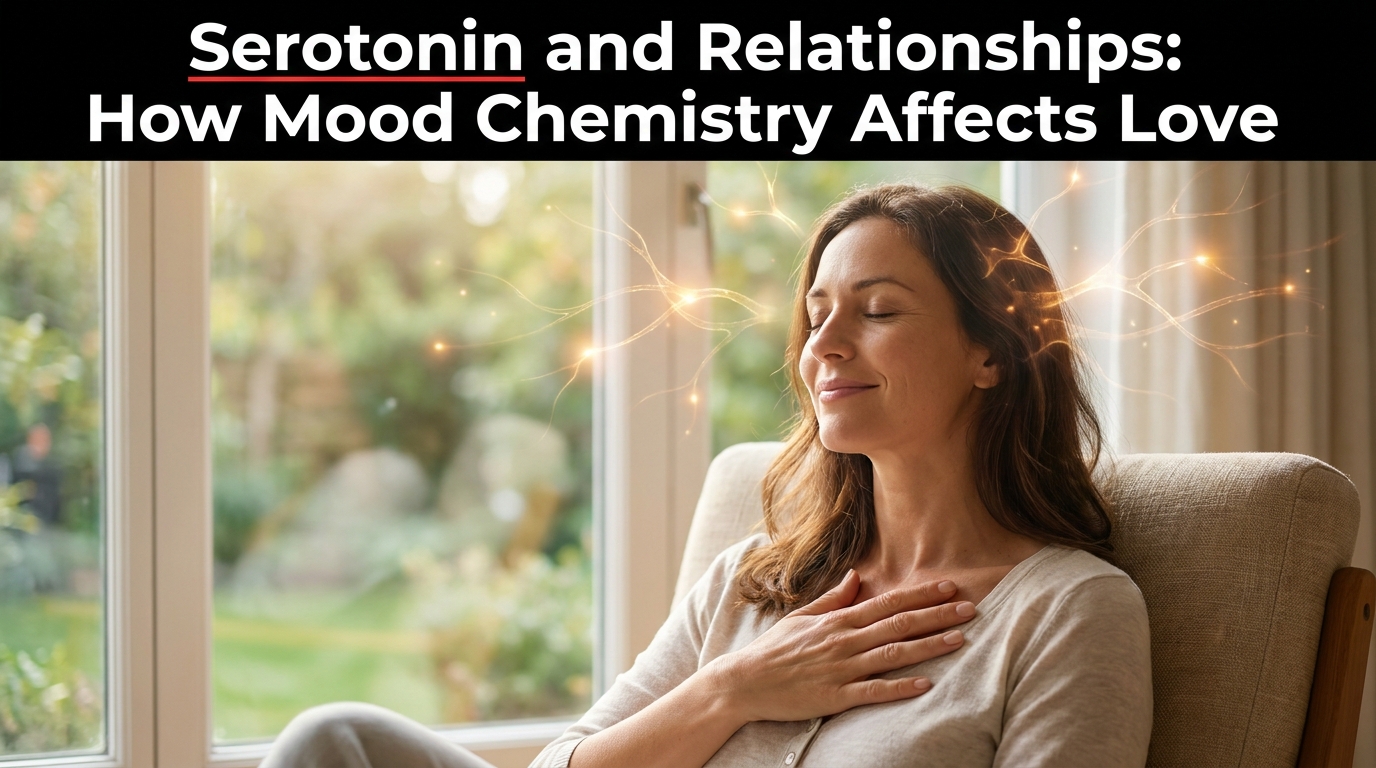
Serotonin and relationships are more deeply intertwined than most people ever realize — and understanding that connection might be the most important thing you can do for your love life.
Think about the last time you felt genuinely secure, warm, and emotionally open in a relationship. Now think about the last time you felt anxious, reactive, withdrawn, or irrationally jealous. Chances are, you attributed those differences entirely to the relationship — to your partner’s behavior, to the circumstances you were navigating, to how well things were going between you.
But what if the answer was also inside your own brain?
Research published in the Journal of Neuroscience found that serotonin — the neurotransmitter most commonly associated with mood regulation — plays a direct and measurable role in how we process social bonding, emotional security, and romantic attachment. Low serotonin levels are not just associated with depression and anxiety in isolation. They are associated with specific, documented changes in how people experience and behave within their closest relationships.
This is not a reason to feel less responsible for your behavior. It is a reason to understand yourself — and the people you love — with far greater depth and compassion.

What Is Serotonin and Why Does It Matter in Love?
Before exploring the specific ways serotonin and relationships intersect, it is important to understand what serotonin actually is — and what it is not.
Serotonin is a monoamine neurotransmitter produced primarily in the gut — approximately 90 to 95 percent of the body’s serotonin is synthesized in the gastrointestinal tract — with the remaining percentage produced in the brain’s raphe nuclei. It functions as a chemical messenger, transmitting signals between nerve cells and regulating a remarkably wide range of physiological and psychological processes.
These include mood, appetite, sleep, memory, cognitive function, and critically for our purposes — social behavior and emotional regulation.
Serotonin is often called the “feel-good” neurotransmitter, but that label undersells its complexity. It is more accurate to describe serotonin as a stabilizing neurotransmitter — one that does not so much create happiness as it creates the neurological conditions in which emotional equilibrium, patience, and social connection become possible.
When serotonin levels are adequate and balanced, people tend to feel calmer, more emotionally resilient, more capable of tolerating uncertainty, and more open to genuine intimacy. When serotonin is depleted or dysregulated, the opposite tends to occur — and the effects ripple outward into every significant relationship a person maintains.
Understanding this distinction is the foundation of understanding how mood chemistry shapes love.
The Neuroscience of Love: Where Serotonin Fits In
The neuroscience of romantic love involves a complex choreography of neurochemicals — each playing a distinct role in different dimensions of the love experience.
Dopamine drives the reward and craving dimension of early romantic love — the obsessive thinking, the euphoria, the urgent desire to be near the person. Oxytocin governs attachment and bonding — the deep sense of safety and belonging that develops over time with a trusted partner. Norepinephrine contributes to the racing heart and heightened alertness of new love.
And serotonin — interestingly — tends to decrease in the early stages of romantic love.
This finding, published in a landmark study by Dr. Donatella Marazziti of the University of Pisa, found that people who had recently fallen in love showed serotonin levels comparable to those observed in individuals diagnosed with obsessive-compulsive disorder. The obsessive, all-consuming nature of new romantic love — the inability to stop thinking about the person, the intrusive thoughts, the emotional volatility — is, at least in part, a serotonin story.
As relationships mature and stabilize, serotonin levels typically normalize — contributing to the shift from the passionate intensity of early love to the calmer, more stable warmth of long-term attachment. This neurochemical transition is not a loss of love. It is love evolving into a form that is actually sustainable.
But when serotonin dysregulation persists — due to genetics, chronic stress, lifestyle factors, or untreated mental health conditions — the effects on a relationship can be significant and far-reaching.
“Serotonin does not create love. But it creates the internal climate in which love can grow without constantly burning itself down.”

How Low Serotonin Specifically Affects Relationships
When serotonin levels are consistently low — whether due to genetics, chronic stress, poor sleep, nutritional deficiencies, or untreated depression — the effects manifest in a person’s relationships in ways that are both predictable and deeply disruptive.
Increased Emotional Reactivity
One of the most well-documented consequences of low serotonin is a reduced threshold for emotional reactivity. The brain’s prefrontal cortex — responsible for emotional regulation, rational decision-making, and impulse control — relies heavily on adequate serotonin signaling to function optimally.
When serotonin is depleted, the prefrontal cortex’s regulatory capacity diminishes, leaving the amygdala — the brain’s threat-detection and emotional response center — operating with less restraint. The result is a person who is faster to feel threatened, faster to anger, faster to perceive criticism or rejection where none was intended.
In a relationship, this manifests as disproportionate reactions to small conflicts, difficulty de-escalating once triggered, and a persistent sense that the relationship feels emotionally unsafe — even when a partner is doing nothing wrong.
Heightened Jealousy and Insecurity
Research published in Psychopharmacology found a direct relationship between serotonin transporter gene variations — which affect how efficiently the brain processes serotonin — and levels of jealousy in romantic relationships. Individuals with lower serotonergic functioning showed significantly higher levels of jealousy, possessiveness, and relationship anxiety.
This does not mean jealousy is purely a chemical issue. But it does mean that for some people, the intensity of jealousy they experience in relationships has a genuine neurobiological component — and addressing that component is part of addressing the jealousy itself.
Withdrawal and Emotional Unavailability
Low serotonin is a central feature of depression — and depression’s most relentless relationship consequence is the withdrawal it creates. A person experiencing depleted serotonin may genuinely want connection, intimacy, and closeness, while simultaneously finding themselves unable to access the emotional energy required to initiate or sustain it.
This withdrawal is often misread by partners as disinterest, rejection, or emotional coldness. It is rarely any of those things. It is, more often, the exhaustion of a nervous system running on insufficient neurochemical fuel — and it requires understanding, not accusation.
Obsessive Thinking and Relationship Anxiety
Because low serotonin is associated with the kind of intrusive, repetitive thought patterns seen in OCD, it also contributes to the obsessive quality of relationship anxiety. The person who cannot stop replaying a conversation for signs that their partner is losing interest. The person who checks their phone compulsively for a response. The person who rehearses worst-case scenarios in their relationship with exhausting frequency.
These patterns are not just psychological habits. They are neurochemical events — and they respond, at least in part, to neurochemical intervention.
Reduced Patience and Tolerance
Serotonin plays a significant role in the brain’s capacity for behavioral inhibition — the ability to pause before reacting, to tolerate frustration without immediately acting on it, to extend patience in difficult interpersonal moments. When serotonin is low, this capacity is measurably reduced.
In practice, this means a shorter fuse, less tolerance for ambiguity or imperfection in a relationship, and a reduced ability to navigate the ordinary friction of long-term partnership without it feeling catastrophic.

How High Serotonin Supports Healthier Relationships
Just as low serotonin creates specific relational challenges, adequate and balanced serotonin levels create specific relational strengths — ones that significantly contribute to relationship satisfaction, communication quality, and long-term partnership health.
Greater Emotional Regulation
People with well-regulated serotonin systems demonstrate a measurably greater capacity for emotional regulation — the ability to feel intense emotions without being completely overtaken by them. In a relationship, this translates to the ability to have difficult conversations without escalating, to hear critical feedback without immediately becoming defensive, and to tolerate the natural uncertainties of love without spiraling into anxiety.
Emotional regulation is one of the strongest predictors of relationship satisfaction identified in decades of relationship research. And serotonin is one of its primary neurobiological supports.
Increased Empathy and Social Sensitivity
Research from the University of Cambridge found that serotonin enhancement measurably increased participants’ ability to avoid harming others and to process social information with greater nuance and empathy. A well-functioning serotonin system appears to support the kind of social attunement — the ability to read emotional cues accurately, to respond to a partner’s needs with sensitivity — that is foundational to intimacy.
Greater Resilience in Conflict
Conflict is inevitable in any long-term relationship. What distinguishes healthy relationships from harmful ones is not the absence of conflict but the ability to navigate it without causing lasting damage. Serotonin’s role in impulse control and emotional regulation directly supports this capacity — allowing partners to engage with disagreement from a place of relative groundedness rather than reactive escalation.
More Secure Attachment
Attachment security — the ability to trust that a partner is available, responsive, and genuinely caring — is partly a learned psychological pattern and partly a neurobiological state. Adequate serotonin supports the neurological conditions associated with secure attachment: a calm nervous system, a reduced threat response, and the capacity to experience closeness without anxiety or avoidance.
Serotonin, Attachment Styles, and the Patterns We Repeat
One of the most illuminating intersections of neuroscience and relationship psychology is the connection between serotonin functioning and attachment styles.
Attachment theory, developed by John Bowlby and later expanded by researchers including Mary Ainsworth and Sue Johnson, identifies three primary adult attachment styles: secure, anxious, and avoidant. These styles are formed in early childhood through the nature of our caregiving experiences — but they are also, research increasingly suggests, supported or challenged by our neurobiological makeup.
People with anxious attachment styles — characterized by hypervigilance to signs of rejection, intense fear of abandonment, and a tendency toward emotional reactivity in relationships — often show patterns of serotonin dysregulation consistent with heightened amygdala activity and reduced prefrontal regulation.
People with avoidant attachment styles — characterized by emotional withdrawal, discomfort with intimacy, and a tendency to suppress or minimize emotional needs — may show different patterns of serotonin functioning that support emotional numbing as a regulatory strategy.
This does not mean attachment styles are purely biological destinies. They are not. But it does mean that for people working to shift from an insecure to a more secure attachment style — through therapy, intentional relationship work, and personal growth — supporting serotonin health is a legitimate and meaningful part of that work.
The neurobiological and the psychological are not separate systems. They are the same system, described in different languages.
“Your attachment style is not just a story from your childhood. It is a living pattern in your nervous system — and your nervous system is something you can actively support and gradually change.”

Practical Ways to Support Serotonin for Healthier Relationships
Here is where the science becomes actionable. Supporting your serotonin system is not just about mental health in the abstract — it is about showing up more fully, more patiently, and more lovingly in your most important relationships.
1. Prioritize Sunlight Exposure Daily
Sunlight is one of the most powerful natural serotonin boosters available. Exposure to bright natural light — particularly in the morning — stimulates serotonin production through a pathway involving the eyes and the brain’s raphe nuclei. Research consistently shows that even 20 to 30 minutes of morning sunlight exposure has a measurable positive impact on serotonin levels and mood stability throughout the day.
In practical relationship terms, a morning walk — ideally with your partner — offers both serotonin support and shared physical activity, which has its own relational benefits.
2. Exercise Regularly, Especially Aerobic Activity
Physical exercise — particularly aerobic activity like running, cycling, swimming, or brisk walking — is one of the most robustly documented natural serotonin-boosting interventions available. A 2016 meta-analysis published in Neuropsychiatric Disease and Treatment found that regular aerobic exercise produced serotonin effects comparable to antidepressant medication in individuals with mild to moderate depression.
Exercise does not just support serotonin production. It also reduces cortisol — the stress hormone that directly competes with serotonin’s regulatory functions — creating a neurochemical environment more conducive to patience, emotional openness, and relational generosity.
3. Nourish Tryptophan Intake Through Diet
Serotonin is synthesized from tryptophan — an essential amino acid that must be obtained through diet. Foods rich in tryptophan include turkey, eggs, salmon, tofu, walnuts, seeds, and dairy products.
Critically, tryptophan requires carbohydrates to cross the blood-brain barrier effectively — which is one reason why very low-carbohydrate diets are sometimes associated with mood dysregulation. A balanced diet that includes adequate tryptophan sources alongside complex carbohydrates supports serotonin production from the ground up.
4. Protect Sleep Quality
Serotonin and melatonin — the hormone that regulates sleep — are directly linked. The brain converts serotonin into melatonin in the evening as part of the natural sleep preparation process. This means that poor sleep quality both reflects and contributes to serotonin dysregulation in a reinforcing cycle.
Consistent, high-quality sleep — seven to nine hours for most adults, at consistent times — is one of the most fundamental supports for a healthy serotonin system. And a person who is sleeping well is, neurochemically, a significantly more patient, emotionally available, and relationally generous partner.
5. Cultivate Social Connection Intentionally
Here is where serotonin and relationships become genuinely reciprocal: positive social interaction itself supports serotonin production. Research shows that experiences of social belonging, being valued, and feeling respected and recognized by others trigger serotonin release — creating a reinforcing loop where healthy relationships support the neurochemistry that supports healthy relationships.
This means that investing in your relationships — showing up with warmth, expressing appreciation, spending quality time with people who matter to you — is not just emotionally good for your relationship. It is neurochemically good for your brain.
6. Consider Therapy and Professional Support
For people whose serotonin dysregulation is clinically significant — manifesting as depression, anxiety disorders, OCD, or severe relationship distress — professional support is not optional. It is essential.
Cognitive Behavioral Therapy has demonstrated efficacy in addressing the thought patterns associated with serotonin dysregulation. Selective Serotonin Reuptake Inhibitors — SSRIs, the most commonly prescribed class of antidepressants — work specifically by increasing the availability of serotonin in the brain’s synapses, and they have a documented positive impact not just on individual mood but on relationship functioning for people with clinical serotonin dysregulation.
Seeking that support is not weakness. It is one of the most loving things you can do — for yourself, and for the people who love you.
7. Practice Mindfulness and Meditation
A growing body of research links regular mindfulness meditation practice to measurable changes in serotonin-related brain functioning. A 2010 study published in Psychosomatic Medicine found that mindfulness practice increased activity in brain regions associated with serotonin processing and emotional regulation.
In relational terms, mindfulness practice builds the capacity to pause between stimulus and response — to notice a feeling without immediately acting from it. That pause is one of the most valuable skills a person can bring to a relationship.

When Your Partner’s Serotonin Struggles Affect Your Relationship
It is equally important to address what happens when it is not your serotonin that is struggling — but your partner’s.
Living and loving someone whose mood chemistry is dysregulated is genuinely difficult. It can mean navigating emotional volatility, withdrawal, jealousy, or reactivity that feels personal even when it is neurological. It can mean feeling responsible for someone else’s emotional state in ways that gradually become unsustainable.
The most important thing to understand is this: your partner’s serotonin dysregulation is not your fault, and it is not yours to fix. But it is yours to understand, to navigate with compassion, and — if it is causing consistent harm — to address honestly and directly.
Encouraging a partner to seek professional support — gently, without shame or ultimatum framing — is an act of love. So is maintaining your own emotional boundaries during periods of their dysregulation, recognizing that absorbing someone else’s neurochemical storm is not the same as supporting them through it.
Compassion and boundaries are not opposites. In the context of a relationship affected by mood chemistry challenges, they are partners.
The most loving response to a partner’s neurochemical struggles is one that holds space for their humanity while refusing to sacrifice your own.
The Bigger Picture: Chemistry Is Not Destiny
Perhaps the most important thing to take away from everything in this article is this: serotonin matters enormously in relationships — but it is not the whole story, and it is not a fixed fate.
Neuroplasticity — the brain’s lifelong capacity to change and reorganize itself — means that the neurochemical patterns that currently shape your relationship experiences are not permanent. With the right support, the right lifestyle choices, and the right therapeutic interventions, serotonin functioning can improve. Attachment patterns can shift. Emotional regulation can be learned and strengthened.
The brain that struggles to feel safe in love today is not the brain you are permanently assigned to. It is the brain you are currently working with — and working on.
Understanding serotonin’s role in your relationships does not excuse behavior. It does not remove accountability. What it does is add a layer of self-knowledge that makes change more possible — because change built on genuine understanding is always more sustainable than change built on willpower alone.
Know your chemistry. Support your chemistry. And then show up in your relationships with the full, compassionate, accountable self that that knowledge makes possible.
Frequently Asked Questions
Q1: Can low serotonin actually cause relationship problems, or is that an oversimplification?
It is both accurate and incomplete. Low serotonin is a genuine contributing factor to a range of emotional and behavioral patterns — including emotional reactivity, jealousy, anxiety, and withdrawal — that create real challenges in relationships. However, relationships are complex systems influenced by many factors: communication patterns, attachment history, shared values, life circumstances, and individual psychology. Serotonin is one important piece of the picture, not the entire canvas. The most accurate understanding treats neurochemistry as a significant contributor — one that deserves attention and support — rather than as a singular cause or a complete explanation.
Q2: Can improving serotonin levels actually improve my relationship?
Research supports a yes — with important nuance. Studies on individuals undergoing serotonin-enhancing treatments, including SSRIs and evidence-based lifestyle interventions, consistently show improvements in emotional regulation, social functioning, and interpersonal sensitivity. These neurological improvements translate into relational improvements for many people. However, neurochemical support works best when combined with genuine relationship work — improved communication, honest conversation, couples therapy where appropriate, and the ongoing daily choice to show up with intention and care.
Q3: Is it possible to love someone more deeply when your serotonin is balanced?
In a meaningful sense, yes. Serotonin balance does not create love — but it creates the neurological conditions in which love can be experienced and expressed most fully. When the brain is not consumed by threat-detection, anxiety, and emotional reactivity, it has significantly more capacity for the qualities that make love feel genuinely loving: patience, empathy, curiosity, generosity, and genuine presence. Many people who have treated serotonin dysregulation report not just feeling better themselves, but feeling more capable of love — and more receptive to receiving it.
Q4: How do I know if my relationship problems are psychological or neurochemical?
In most cases, they are both — and the distinction matters less than the comprehensive approach to addressing them. If you experience persistent patterns of emotional reactivity, anxiety, jealousy, withdrawal, or obsessive thinking in relationships — particularly if these patterns appear across multiple relationships and have been present most of your adult life — it is worth exploring both the psychological roots and the neurobiological dimensions with a qualified mental health professional. A good therapist will address both, often simultaneously.
Q5: Do SSRIs affect romantic feelings or reduce emotional capacity in relationships?
This is a legitimate and commonly reported concern. Some people on SSRIs report a reduction in emotional intensity — including in romantic feelings — particularly at higher doses. This effect, sometimes called “emotional blunting,” is not universal and often resolves with dosage adjustment. It is essential to discuss this openly with your prescribing physician. Many people find that the emotional regulation benefits of appropriate SSRI use significantly outweigh the initial emotional adjustment period — and that their capacity for genuine intimacy actually improves as anxiety and reactivity reduce. This is a highly individual experience that warrants ongoing, honest communication with your healthcare provider.
Save This. Share This. Follow For More.
💾 Save this article — come back to it whenever you need a reminder that understanding yourself is the first step to loving better.
📤 Share this with someone who has ever felt like their own brain was working against them in love. You might give them something genuinely life-changing.
👉 Follow Truthsinside.com for more deeply researched, compassionately written content on psychology, relationships, and the science of human connection.
📃 Related article: 15 Signs She Is Testing You: Why Women Test Men and What to Do
Because understanding your mind is not just about mental health. It is about every relationship you will ever have.
🎵 Music
Maren Lull is a singer-songwriter who writes from the places most people don’t talk about out loud.
Not the dramatic grief. Not the obvious heartbreak. The quiet kind — the ordinary Tuesday emptiness, the habit of reaching for someone who isn’t there anymore, the particular exhaustion of being strong for so long that the strength itself wears thin.
Her music lives at the intersection of emotional honesty and soft beauty — breathy vocals over gentle piano, slow tempos, lyrics that feel less like songs and more like something you wrote in a private notebook at two in the morning and never showed anyone.
Maren Lull writes for the people who feel everything deeply and say very little about it. For the ones who listen to sad music not because they want to feel worse — but because being understood, even by a song, makes the feeling easier to carry.
📱 Follow Maren Lull:
→ Spotify
→ Apple Music
→ Youtube
→ Audiomack