
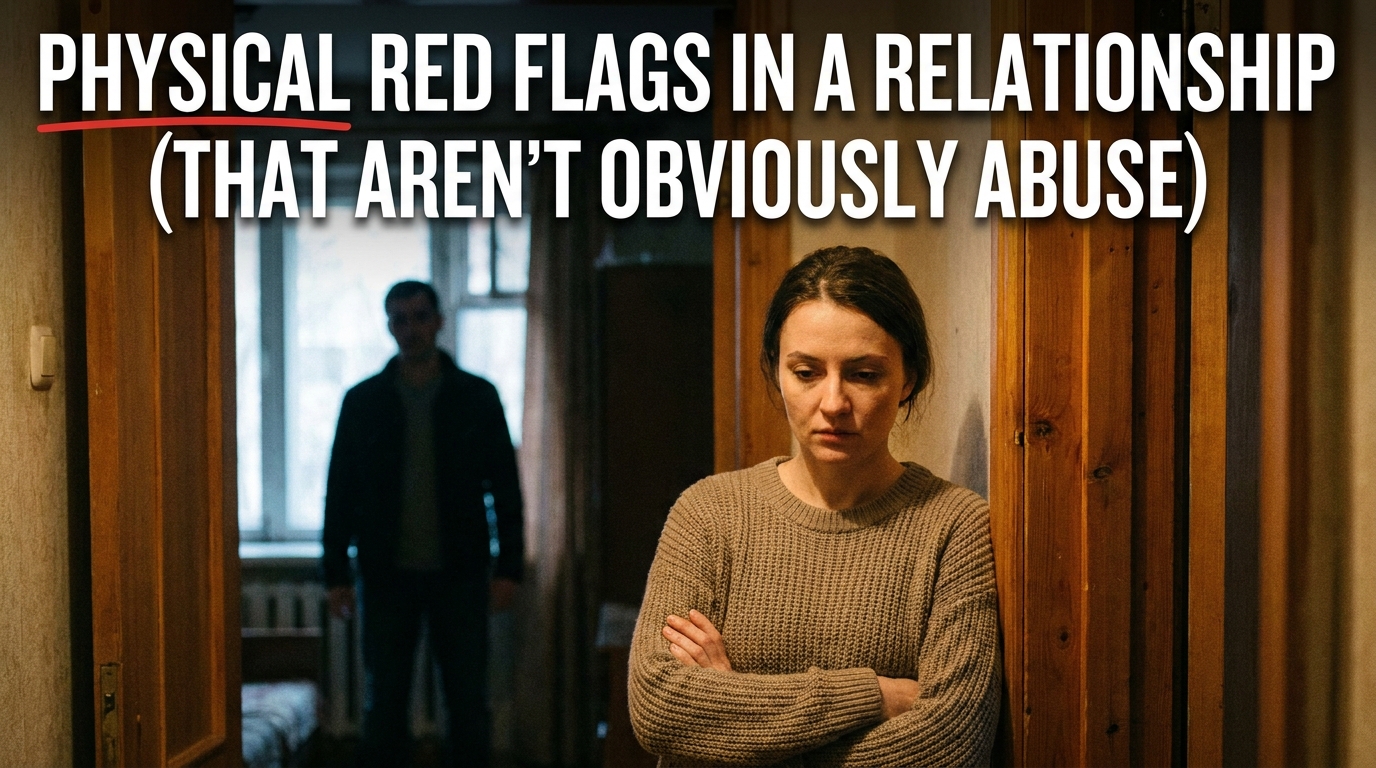
Physical red flags in a relationship are not always what people expect them to look like.
Most people carry a fairly clear internal image of what physical abuse in a relationship looks like. It looks like violence. It looks like visible injury. It looks like the kind of incident that someone else could witness, understand, and identify without ambiguity. And because that image is so dominant in cultural conversations about relationship danger, the physical warning signs that exist below that threshold — the ones that are subtler, more ambiguous, and far easier to explain away — are systematically overlooked, minimized, and dismissed.
Both by the people outside the relationship observing it. And by the person inside it experiencing it.
This is where the danger lives. Not only in the obvious, unambiguous expressions of physical harm — but in the accumulation of smaller physical signals that most people never learn to read, that are almost never discussed in mainstream relationship advice, and that research consistently identifies as early warning indicators of patterns that, without intervention, tend to escalate.
Research published in the Journal of Family Violence found that in the vast majority of documented cases of intimate partner violence, the physical abuse was preceded by a sustained period of subtler physical control behaviors — behaviors that the affected partner had noticed, felt, and frequently dismissed as oversensitivity or misreading of innocent actions. The average time between the emergence of these early physical control behaviors and the first incident of recognized physical abuse was eighteen months.
Eighteen months of signals that were not seen as signals.
This article is about learning to see them. About giving specific language to the physical experiences that your nervous system has been accurately registering as wrong, even when your conscious mind has been working to explain them away. About understanding the difference between affectionate physical engagement and physical behavior that is — however subtly — about control, dominance, or intimidation.
Not because naming these things is sufficient protection. But because naming them is always the beginning of it.

Why Physical Red Flags That Aren’t Obviously Abuse Are So Difficult to Name
Before mapping the specific physical red flags, it is worth understanding why this particular category of warning sign is so consistently missed — because the difficulty of naming them is not a personal failure of perception. It is a structural feature of how these behaviors operate.
The Plausible Deniability Architecture
Physical red flags that are not obviously abusive share a defining structural feature: plausible deniability. Each individual behavior has a readily available innocent interpretation. A hand that holds your arm too firmly — they were just being affectionate. A body positioned between you and a door — they were just standing there. A touch that made you flinch — you are just sensitive. A grip that was too tight — it was just an accident.
The plausible innocent interpretation is not merely convenient for the person engaging in the behavior. It becomes the primary framework through which the targeted person processes their own experience. Because the alternative — accepting that the person they love is physically intimidating or controlling them — is so psychologically costly that the brain defaults to the innocent interpretation as an act of self-protection.
This is not weakness. It is how the human mind manages the cognitive dissonance between loving someone and accurately perceiving that they are dangerous. And it is precisely the mechanism that allows early physical red flags to accumulate unaddressed until the pattern has escalated to a point where the plausible deniability becomes untenable.
The Absence of a Felt Framework
Most people are not taught what healthy physical engagement in a relationship feels like with any specificity — which means they lack a clear reference point against which to compare physical experiences that do not feel right. They know what obvious violence looks like. They do not know what to make of a physical presence that feels dominating without a single identifiable aggressive act, or a touch that feels controlling rather than affectionate without being able to articulate the difference.
Without a felt framework for what the difference actually is — without language for the specific physical experiences that register as wrong in the body before they register as dangerous in the mind — people are left with a vague, persistent unease that they frequently attribute to their own psychology rather than to the external reality generating it.
The Normalization of Discomfort
In relationships where subtle physical control behaviors are present from early on, those behaviors often become normalized before the affected partner has had the opportunity to evaluate them clearly. The relationship’s baseline — the ordinary texture of daily physical interaction — is established in a way that includes the controlling behavior as part of the normal pattern.
When your nervous system has adapted to a level of physical discomfort as the relationship’s normal, the absence of obviously abusive behavior feels like safety — even when the baseline itself represents a significant departure from what physical safety in an intimate relationship actually requires.
The Physical Red Flags: Specific, Named, and Explained
These are not abstract categories. They are specific, observable, physically experienced behaviors that research and clinical practice consistently identify as warning signs — not because each one is definitively abusive in isolation, but because their presence, particularly in combination and as a sustained pattern, is clinically significant.
1. Touch That Feels Possessive Rather Than Affectionate
Affectionate touch in a healthy relationship is characterized by a specific quality: it is oriented toward the other person’s experience and wellbeing. It asks, implicitly, “does this feel good for you?” It responds to your body’s signals. It is warm without being claiming.
Possessive touch has a different quality — one that your body registers before your mind has processed it. It is oriented toward marking, claiming, or demonstrating ownership rather than toward the other person’s experience of comfort and pleasure. It is a hand on the back of your neck at a social event that steers you rather than welcomes you. It is an arm around your shoulder in public that pulls you slightly toward the person rather than simply resting beside you. It is physical contact that functions as a statement to the environment — this person is mine — more than as a gesture of genuine affection toward you.
The distinction is subtle but bodily felt. Affectionate touch makes you feel warm and safe. Possessive touch makes you feel like property — and your nervous system knows the difference even when your mind is still negotiating.
2. Physical Blocking and Spatial Dominance
Physical blocking is one of the most consistently documented early physical control behaviors in the research literature on intimate partner violence — and one of the most consistently normalized by affected partners as innocent or accidental.
Blocking occurs when one partner uses their physical presence to limit the other partner’s freedom of movement — positioning their body between the other person and a door, standing in the exit of a room in a way that requires the other person to physically ask to leave, placing themselves between the partner and other people at social events in a way that limits the partner’s independent movement and interaction.
Each individual instance can be explained as innocent — they were just standing there, the room was small, they happened to be in that position. The pattern of instances — the consistency with which the blocking occurs, particularly during or after conflict — is what carries the diagnostic weight.
A related behavior is the use of physical size and spatial presence to dominate — standing very close during disagreements in a way that uses physical stature as implicit pressure, towering over a seated partner during a conflict, physically positioning themselves in ways that make the other person feel physically smaller regardless of whether any threatening gesture is made.
3. Gripping, Grabbing, or Restraining — Even Briefly
Any physical contact that restricts another person’s movement — even briefly, even gently, even in a context that is presented as protective or affectionate — falls into a category that deserves serious attention.
This includes a hand on the arm that holds rather than touches, a grip on the wrist that prevents the person from moving away, a physical restraint during a conflict that is framed as “I just need you to listen to me” or “I don’t want you to leave until we finish this,” and the physical positioning of a body against a door or wall in a way that implicitly prevents exit.
The framing matters less than the physical reality. Whether the restraint is presented as protective, affectionate, or necessary for the conversation — the physical experience of being prevented from moving freely in an intimate relationship is a red flag that does not require an additional qualifier to be taken seriously.
4. Rough Physical Contact Framed as Play
One of the most difficult physical red flags to name is the pattern of rough physical contact — grabbing too hard, play-fighting that escalates or that one party clearly does not enjoy, tickling or physical teasing that continues past the point of comfort, roughhousing that leaves marks or bruises that are explained as accidents of play.
The framing of these behaviors as playful is the source of the difficulty — because playful physical contact is a normal and positive feature of intimate relationships. The line between genuine play and the introduction of physical roughness under a playful guise is the other person’s genuine comfort and willingness, which is expressed through both verbal and bodily signals.
When physical contact is rough in a way that one partner consistently signals discomfort about — through body language, verbal requests to stop, or physical attempts to disengage — and the rough contact continues regardless of those signals, the “play” framing has ceased to be accurate. What is present instead is the practice of overriding a partner’s physical signals — a practice that, in a more serious context, constitutes the essence of physical violation.
5. Flinching Responses in Your Own Body
This red flag is unusual because it is located not in the other person’s behavior but in your own — and it is one of the most diagnostically significant signals available.
A flinch is an involuntary physical response. It cannot be manufactured or suppressed through simple intention. When you flinch at a sudden movement from your partner — a hand raised quickly for a harmless reason, a raised voice that comes unexpectedly, a rapid approach across a room — your nervous system is reporting something. It is reporting that at some level of its processing, it has assessed your partner’s sudden physical movements as potentially threatening.
People do not flinch at the movements of people they feel genuinely physically safe with. The flinch response develops in the presence of previous experiences of sudden physical threat — and when it becomes present in response to a specific person, it is the most honest physical signal your body can produce about your felt sense of safety in their presence.
If you have noticed yourself flinching at your partner’s movements — even movements that were entirely innocent, even if they have never physically harmed you — that response deserves your full, honest attention. It is not oversensitivity. It is your nervous system telling you what it knows.
“Your body is not dramatic. It does not invent threats. When it registers a person’s physical presence as dangerous, it is working with information — information that your mind may not yet be ready to accept, but that your body has already accurately processed.”

6. Controlling Physical Contact in Public
The quality of physical contact in public is a distinct and specifically informative category of physical red flag — because public context removes the privacy that makes other forms of controlling behavior easier to normalize.
Controlling physical contact in public includes steering behaviors — a hand on the lower back that directs rather than accompanies, an arm around the shoulder that guides movement rather than expressing affection. It includes physical positioning that consistently places the partner in a location that limits their interaction with others — facing away from the group, positioned between the partner and other people in a way that reduces their independent social engagement. It includes touch that is performed for the observation of others — particularly other men — in a way that functions as territorial marking rather than genuine affection.
It also includes the specifically uncomfortable experience of public physical contact that cannot be gracefully declined — the partner who insists on physical closeness at social events in a way that makes declining awkward or impossible, who uses the social context as a reason why the partner cannot express discomfort without creating a scene.
In a healthy relationship, public physical affection is a genuine, mutual expression of warmth and connection. When it becomes a mechanism for control, display, or limitation — the difference is felt, even when it cannot yet be fully articulated.
7. Physical Intimidation Without Physical Contact
Physical intimidation does not require physical contact to be real, impactful, or significant as a red flag. The use of physical presence, size, and proximity as a tool of intimidation — without any actual physical touch — is one of the most commonly overlooked physical red flags in relationship dynamics.
This includes standing very close during disagreements in a way that uses physical size to create implicit pressure. It includes throwing or hitting objects in the partner’s proximity — not at them, but close enough to communicate both physical capability and the implication of what that capability could be directed toward. It includes aggressive physical gestures that stop short of contact — a hand slammed beside your head, a fist against a wall near you, an object thrown across the room during conflict.
Each of these behaviors communicates, at the physical and physiological level, a specific and deliberate message: I am capable of physical harm, and I am choosing, right now, not to direct it at you. That message is not accidental. It is the mechanism through which physical intimidation operates to control behavior without requiring actual physical assault.
Research from the National Domestic Violence Hotline identifies object-throwing, wall-hitting, and proximity intimidation as consistent precursors to physical violence in intimate relationships — with the overwhelming majority of physically abusive relationships having included a substantial period of this specific physical intimidation behavior before the first incident of direct physical assault.
8. Controlling Your Physical Appearance or Movement
Physical control in a relationship is not limited to direct physical contact. It also manifests in controlling behaviors directed at the partner’s physical presentation and physical freedom of movement.
This includes controlling what the partner wears — preferences and requests that have the quality of requirements rather than desires, responses to clothing choices that produce visible displeasure or conflict sufficient to effectively limit the partner’s choices. It includes controlling physical freedom of movement — needing to know exactly where the partner is at all times, requiring check-ins that are frequent enough to constitute surveillance, expressing displeasure or conflict in response to unannounced physical independence in ways that effectively train the partner to limit their own movement.
It includes controlling access to physical space — rooms in the shared home that feel off-limits without explicit permission, areas of physical life that the partner has learned to navigate with permission-seeking rather than natural independence.
These controlling behaviors are not always recognized as physical red flags because they do not involve physical contact. But they are the direct expression of a controlling dynamic operating in the physical domain of the relationship — limiting the partner’s physical autonomy, physical self-expression, and physical freedom in ways that are foundationally inconsistent with genuine intimate partnership.
9. Disregard for Physical Boundaries During Intimacy
Physical boundaries within intimate contexts are among the most fundamental and most consistently relevant indicators of physical respect in a relationship.
A partner who regularly disregards stated physical preferences — who continues physical contact after you have indicated discomfort, who initiates physical intimacy in ways that do not honor your communicated needs, who treats your physical boundaries as suggestions rather than requirements — is demonstrating something important about how they relate to your physical autonomy as a whole.
The specific red flag here is not the presence of any single incident of misread signals or awkward navigation of physical preferences — those are normal features of human intimacy. The red flag is the pattern of consistent disregard for clearly communicated physical preferences, and particularly the dismissal or minimization of expressed discomfort as oversensitivity, manipulation, or a problem with your psychology rather than as information that requires responsive adjustment of their behavior.
10. The Physical Aftermath of Conflict
How a partner’s body behaves in the immediate aftermath of conflict is one of the most informative physical indicators available in a relationship — and one of the most consistently overlooked.
Physical red flags in the aftermath of conflict include: continuing to physically impose presence when the other person has clearly communicated a need for space — following them from room to room during an argument, standing in the doorway when they have retreated to another room, physically preventing the cessation of the conflict by maintaining proximity when the other person is attempting to disengage.
They also include the specific physical tension that persists in the shared space after a conflict — a quality of presence that communicates ongoing threat even when verbal conflict has nominally ended. A partner whose physical presence in the aftermath of conflict makes you feel unsafe — even when they are not doing anything specific — is communicating something through their physical energy that your nervous system is accurately registering.
And they include the physical reversal — the sudden shift from intimidating physical presence during conflict to physical affection immediately afterward, a reversal that is used to manage the partner’s emotional response to the conflict and to prevent the natural processing of the discomfort the conflict generated.

11. Using Physical Size or Strength Asymmetrically
Physical size and strength differentials are a natural feature of many intimate relationships. The red flag is not the existence of that differential — it is the way the larger or stronger partner relates to it.
A partner who is aware of the physical asymmetry and navigates it with care — who is consciously gentle, who is mindful of how their physical presence affects the other person’s felt sense of safety, who never leverages their size or strength in the service of anything other than genuine care — is demonstrating physical respect.
A partner who uses their size or strength asymmetrically — who leverages it during conflict, who invokes it implicitly through physical positioning, who handles the other person’s body during moments of any kind of tension with a forcefulness that is disproportionate to the context — is demonstrating something fundamentally different. Not necessarily violence. But the deployment of a physical advantage in ways that produce asymmetry of power and safety in the relationship.
The question is not whether the physical difference exists. It is whether the person with more physical power uses that power in the service of your safety — or in the service of something else.
12. Monitoring Your Physical State and Using It Strategically
A specific and sophisticated form of physical control involves the close monitoring of your physical state — your tiredness, your hunger, your physical vulnerability — and the strategic timing of difficult conversations, conflicts, or demands around periods when you are most physically depleted.
This is a pattern that is almost never recognized as a physical red flag because it does not involve any direct physical behavior. But it is the use of physical vulnerability as a tactical advantage in relational dynamics — a pattern that research on coercive control consistently identifies as a significant indicator of a controlling relational dynamic operating across physical and psychological dimensions simultaneously.
If you notice that difficult conversations, criticisms, or demands from your partner consistently cluster around periods of physical vulnerability — late at night, when you are unwell, after periods of strenuous activity, in the morning before you have fully oriented yourself — that pattern is worth examining with genuine honesty.
“Physical safety in a relationship is not only about what happens to your body. It is about how your body is allowed to exist in the relationship — freely, autonomously, without having to earn its space through compliance.”

The Physiology of Living With These Red Flags
Understanding the physical red flags themselves is important. Understanding what sustained exposure to them does to the body is equally important — both for the person experiencing them and for anyone trying to understand why leaving feels so difficult.
Chronic Hypervigilance
The human nervous system responds to perceived physical threat by activating the sympathetic nervous system — the fight, flight, or freeze response — which mobilizes the body’s resources for survival. In a relationship where subtle physical threat is chronic and unpredictable, the nervous system does not return to baseline between activations. It remains in a state of low-grade, persistent hypervigilance — continuously scanning the environment for threat signals, continuously monitoring the partner’s physical behavior for indications of what is coming next.
This chronic hypervigilance is physiologically costly. It maintains elevated cortisol levels, disrupts sleep, impairs immune function, and produces the specific, persistent exhaustion of a body that has been running its threat-response system continuously. It also, critically, narrows the field of attention — making it genuinely harder to see the larger relational pattern clearly, because the nervous system is consuming so much of its processing capacity on moment-to-moment threat assessment.
Research from the field of interpersonal neurobiology consistently documents this physiological profile in individuals in relationships with physical control dynamics — and understanding it as a physiological reality rather than an emotional weakness is both clinically important and personally liberating.
The Freeze Response and Why It Is Not Consent
One of the most important physiological realities to understand in the context of physical red flags is the freeze response — the third option in the fight-flight-freeze survival response — and what it means in the context of intimate relationships.
The freeze response is an involuntary physiological state in which the body becomes immobile, the voice becomes quiet, and the typical behavioral signals of distress are suppressed — not by choice, but by the nervous system’s assessment that fighting or fleeing would be more dangerous than stillness. It is the same response that animals display when caught by a predator they cannot outrun.
In the context of physical control behaviors in intimate relationships, the freeze response frequently looks, from the outside, like compliance. The partner does not resist. They do not protest loudly. They become quiet and still. This is not agreement. It is a survival response — and it is consistently misread both by the person displaying it (who may feel shame about their own apparent passivity) and by the person eliciting it (who may interpret it as evidence of consent or acceptance).
Understanding the freeze response is not an academic matter. It is one of the most practically important pieces of physiological knowledge available to anyone navigating or recovering from a relationship with physical control dynamics.
The Body’s Memory
Trauma — including the accumulated, chronic, low-grade trauma of sustained exposure to physical control behaviors — is stored in the body as well as in the mind. This is the finding that underlies somatic approaches to trauma therapy, including Somatic Experiencing, EMDR, and Sensorimotor Psychotherapy.
The body remembers what the mind sometimes softens, rationalizes, or forgets. It remembers through the flinch that appears months or years after the relationship has ended. Through the specific tension that arises in certain body positions. Through the physiological responses to sounds, smells, or physical sensations that were associated with the threatening context.
This bodily memory is not malfunction. It is the nervous system’s accurate archival of what it survived — and it is one of the reasons why healing from physical control dynamics in a relationship requires approaches that address the body as well as the mind.
What to Do When You Recognize These Red Flags
Trust Your Body’s Response
Your body is the most honest instrument you have access to in assessing physical safety in a relationship. The flinch. The tightening in your chest when they approach. The specific relaxation that happens when they leave the room. The way your shoulders drop when you are alone. These are not dramatic signals — they are the quiet, continuous truth-telling of a nervous system that is working with accurate information.
Trust those signals. Not as definitive proof that requires immediate action, but as data that deserves to be taken seriously and examined honestly — in your own private assessment, and ideally in conversation with a professional who can help you contextualize what you are experiencing.
Name the Pattern, Not Just the Incident
Physical red flags that are not obviously abusive derive most of their power from their individual deniability. The pattern is where the truth lives. Keep a private record — a journal, notes in a secure app — of specific incidents: what happened, when, what was said about it, and how it felt in your body. Seeing the pattern written down removes the narrative fog that individual incidents, spaced across time, are easy to disappear into.
Seek Professional Support
Individual therapy — particularly with a therapist who has experience with relationship trauma, coercive control, or intimate partner dynamics — provides the most structured and protected space available for examining what you are experiencing, developing an accurate assessment of its significance, and making decisions from a position of genuine clarity and support.
The National Domestic Violence Hotline (1-800-799-7233 in the United States) is available around the clock and provides support, assessment, and safety planning resources that are specifically adapted to the ambiguous, pre-crisis situations this article describes — situations where something is clearly wrong but nothing is clearly abusive in the obvious sense.
Create a Safety Plan
Safety planning is not only for situations of recognized physical abuse. It is for any situation in which the physical dynamics of a relationship create concern about your physical safety. A safety plan includes knowing who you would contact and where you would go if a situation escalated, having access to important documents and resources independently of your partner, and having a trusted person outside the relationship who knows what is happening and who can be a point of contact if needed.
Creating a safety plan does not mean you have decided the relationship is abusive. It means you are taking your own wellbeing seriously enough to prepare for possibilities you hope never materialize. That is not catastrophizing. That is self-protection.

You Are Allowed to Name What Did Not Leave a Mark
Here is the truth that this entire article has been building toward, and that deserves to be stated as clearly as possible:
You do not need a bruise to have a case.
You do not need to have been obviously, unambiguously harmed to be allowed to say that something in your relationship is not safe. You do not need to wait for the pattern to escalate to something that everyone else would immediately recognize as abuse before you are permitted to take your own discomfort seriously.
The physical red flags described in this article — the possessive touch, the blocking, the flinch response, the objects thrown near but not at you, the controlling presence, the physical intimidation that never technically crossed the line — are real. They cause real harm. They produce real physiological responses. They leave real marks — just not the visible kind.
Your body’s knowledge of your own safety is valid. The signals your nervous system has been sending are accurate. The persistent, quiet, unnameable sense that something is physically not right in your relationship is not a character flaw, not oversensitivity, not the product of an overactive imagination.
It is information. Specific, serious, and worth acting on — before the eighteen months that the research tells us typically pass between these early signals and something that leaves the kind of marks everyone else can see.
You are allowed to trust your body. You are allowed to name what it knows. And you are allowed to take that knowledge seriously enough to do something with it — now, before the pattern asks you to pay a higher price for having recognized it too late.
Frequently Asked Questions
Q1: How do I know if physical behaviors in my relationship are red flags or just personality differences in how people express affection?
The most reliable distinguishing factor is your own bodily experience of the contact — specifically, whether the physical behavior consistently leaves you feeling safe, warm, and respected, or whether it consistently leaves you feeling uncomfortable, reduced, or controlled. Genuine affectionate contact in a healthy relationship is responsive — it adjusts to your signals, honors your communicated preferences, and prioritizes your comfort and wellbeing. Physical behavior that is a red flag is characteristically unresponsive — it continues regardless of your signals, dismisses your expressed discomfort, and prioritizes the other person’s expression or control over your comfort. The content of the behavior matters less than its responsiveness to you.
Q2: Is it possible that I am overreacting to physical behaviors that are actually innocent?
It is possible that a specific individual incident has an innocent explanation. It is significantly less likely that a sustained, multi-incident pattern across different contexts and different behavioral categories is entirely accounted for by innocent explanations. The most useful frame is not “am I overreacting to this incident” but “what does the pattern of my physical experience in this relationship tell me?” If the pattern of your physical experience is one of persistent discomfort, hypervigilance, and felt unsafety, that pattern is significant regardless of whether any individual incident within it has an innocent explanation.
Q3: My partner has never hit me. Does that mean these physical behaviors are not serious?
No — and this is one of the most important messages of this article. Research on intimate partner violence consistently shows that the absence of physical assault does not indicate the absence of physical control or the absence of risk. Coercive control dynamics — which include physical control behaviors that fall short of assault — are associated with significant psychological harm, are strongly predictive of future physical violence escalation, and are recognized by the legal systems of a growing number of countries as a form of domestic abuse in their own right, independent of physical assault.
The absence of hitting is not the relevant threshold. The presence of behaviors that undermine your physical autonomy, produce felt physical unsafety, and use physical means for control is the relevant threshold.
Q4: How do I bring up these physical concerns with my partner without seeming paranoid or accusatory?
This is a genuinely complex question with no single right answer — because the appropriate approach depends significantly on the severity of the pattern and the specific dynamics of the relationship. For behaviors that may reflect a lack of awareness rather than deliberate control, a calm, specific, non-accusatory conversation from your own experience — “When you [specific behavior], I feel [specific physical experience], and I need [specific change]” — provides an opportunity to observe whether the behavior changes in response to clear communication. The response to this conversation is itself important information: a partner who is not deliberately controlling will typically respond with genuine concern and behavioral adjustment.
A partner who is, will typically respond with denial, minimization, or counter-accusation. If the pattern is severe or if you have safety concerns about having this conversation, please seek professional support before initiating it.
Q5: What resources are available if I am recognizing these physical red flags in my relationship?
Several resources are specifically designed for situations where something is clearly not right but does not fit the obvious profile of recognized physical abuse. The National Domestic Violence Hotline (1-800-799-7233, or text START to 88788) provides 24/7 support for any situation of concern — not only recognized physical abuse. The hotline’s advocates are trained to help callers assess situations that are ambiguous, develop safety plans appropriate to their specific circumstances, and identify local resources.
Individual therapy with a trauma-informed therapist is also a critical resource — both for accurate assessment of the situation and for the support needed to make decisions from a position of genuine clarity and self-knowledge rather than from fear, confusion, or the distorted self-perception that these dynamics tend to produce over time.
Save This. Share This. Follow For More.
💾 Save this article — because the next time something in your relationship feels physically wrong without a clear reason you can point to, you deserve to have the language for what your body is telling you.
📤 Share this with someone you love who has ever said “I don’t know, something just doesn’t feel right” about their relationship — and who deserves to have their nervous system’s honest report taken seriously.
👉 Follow Truthsinside.com for more honest, research-backed content on relationship red flags, psychology, emotional and physical safety, and every truth about love and harm that deserves to be named clearly and without apology.
📃 Related article: Gaslighting in Relationships: How to Recognize, Name, and Leave It
Because your physical safety in a relationship is not negotiable. And it begins with learning to name what does not feel safe — long before it becomes something everyone else can see.
🎵 Music
Maren Lull is a singer-songwriter who writes from the places most people don’t talk about out loud.
Not the dramatic grief. Not the obvious heartbreak. The quiet kind — the ordinary Tuesday emptiness, the habit of reaching for someone who isn’t there anymore, the particular exhaustion of being strong for so long that the strength itself wears thin.
Her music lives at the intersection of emotional honesty and soft beauty — breathy vocals over gentle piano, slow tempos, lyrics that feel less like songs and more like something you wrote in a private notebook at two in the morning and never showed anyone.
Maren Lull writes for the people who feel everything deeply and say very little about it. For the ones who listen to sad music not because they want to feel worse — but because being understood, even by a song, makes the feeling easier to carry.
📱 Follow Maren Lull:
→ Spotify
→ Apple Music
→ Youtube
→ Audiomack