
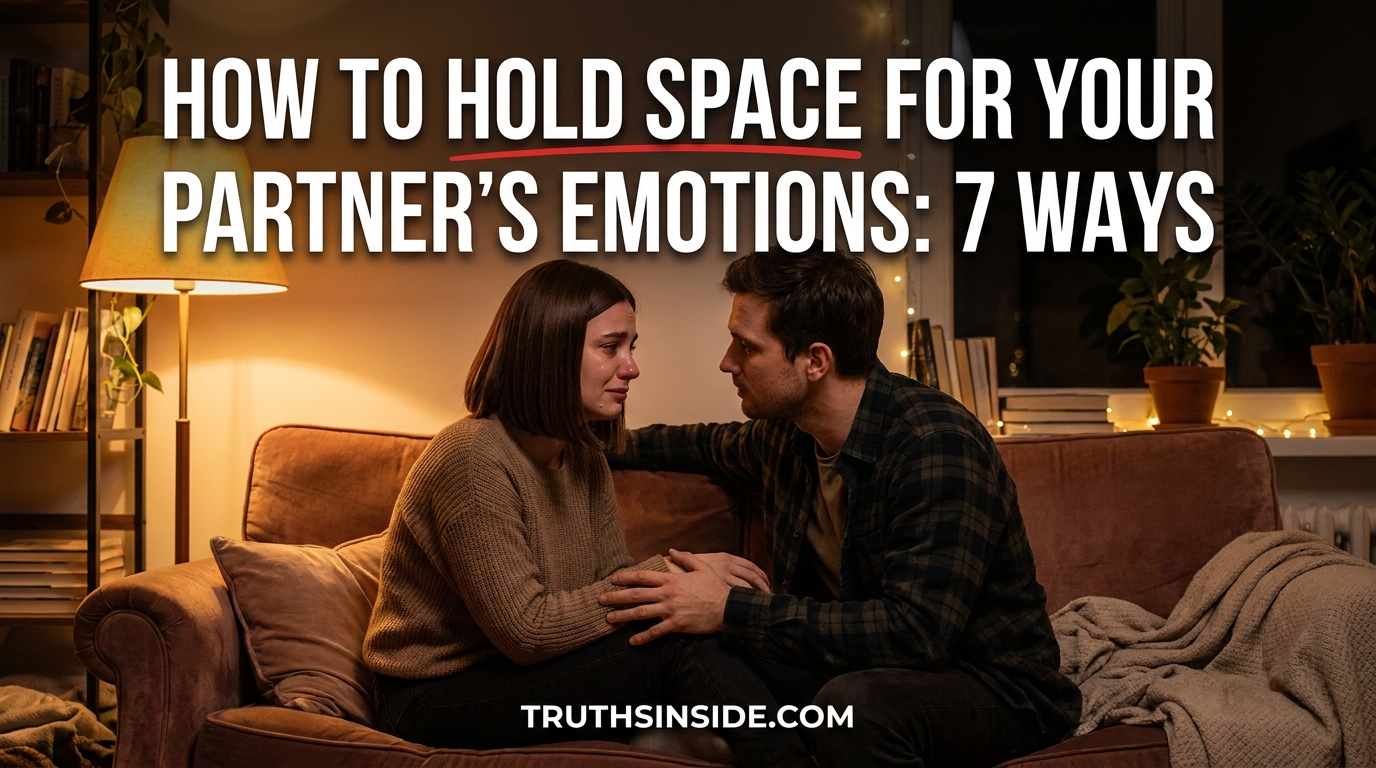
Have you ever watched someone you love fall apart — and felt completely powerless? That gut-wrenching feeling of wanting to fix everything but not knowing how is one of the most emotionally exhausting experiences in a relationship. Hold space for your partner’s emotions is not just a trendy phrase — it is a deeply meaningful act of love that can transform the foundation of any relationship. According to a study published in the Journal of Personality and Social Psychology, emotional validation from a romantic partner is one of the strongest predictors of relationship satisfaction and long-term emotional bonding.
Yet, most of us were never taught how to do this. We were raised in homes where emotions were either dismissed, minimized, or avoided entirely. So when our partner breaks down, we either try to problem-solve too quickly, go silent out of discomfort, or worse — we make the moment about ourselves. None of these responses create the safety our partner truly needs.
The good news? Holding space is a learnable skill. It is not about having the perfect words or erasing your partner’s pain. It is about being fully present, suspending judgment, and creating an emotional environment so safe that your partner feels free to feel everything without fear. This article will walk you through exactly how to do that — practically, compassionately, and without losing yourself in the process.
What Does It Really Mean to Hold Space for Your Partner’s Emotions?
Before we dive into the how, let us get crystal clear on the what. The phrase “hold space” was popularized in therapeutic circles and refers to the practice of being emotionally present for another person without judgment, without rushing to fix things, and without making their experience about you.
When you hold space for your partner’s emotions, you are essentially saying: “Your feelings are valid. I am here. You do not have to go through this alone.”
It sounds simple. But in practice, it is profoundly difficult — especially if you were raised in an environment where emotional expression was seen as weakness, or if you tend to be a natural problem-solver.
Psychologist Dr. John Gottman, one of the world’s leading relationship researchers, found through decades of study that couples who respond to each other’s emotional bids with presence and empathy rather than dismissal are significantly more likely to maintain loving, stable relationships. His research showed that emotional attunement — the ability to tune into your partner’s feelings and respond with care — is one of the most critical components of lasting love.
Holding space does not mean:
- You have to have all the answers
- You must agree with everything your partner feels
- You should abandon your own emotional needs indefinitely
- You are responsible for fixing their pain
Holding space does mean:
- You show up fully, without distraction
- You listen to understand, not to respond
- You resist the urge to minimize or compare
- You make them feel seen, heard, and safe
This distinction matters enormously. Many people confuse holding space with people-pleasing or emotional martyrdom. True space-holding is a balanced, boundaried act of love — not self-erasure.

The Psychology Behind Why This Is So Hard to Do
Here is something most people do not realize: the reason holding space feels so difficult is neurological, not personal.
When we see someone we love in pain, our brains trigger a threat response. The mirror neurons in our brain — the same neurons responsible for empathy — cause us to feel some of what our partner feels. And when that discomfort rises in us, our nervous system instinctively wants to make it stop.
This is why we rush to say things like:
- “It will be fine, don’t worry.”
- “At least it’s not as bad as…”
- “What you should do is…”
These responses are not born out of cruelty. They come from our own discomfort with pain — both theirs and the reflected pain we feel inside ourselves.
Dr. Brené Brown, a research professor and bestselling author known for her work on vulnerability, explains this beautifully: “Empathy has no script. There is no right way or wrong way to do it. It’s simply listening, holding space, withholding judgment, emotionally connecting, and communicating that incredibly healing message of ‘You are not alone.'”
The problem is further compounded by attachment styles. If you grew up with an avoidant attachment style, emotional closeness may genuinely feel threatening. If you have an anxious attachment style, your partner’s pain may trigger your own deep fears of abandonment or inadequacy. Understanding your own emotional wiring is the first step to becoming a better space-holder.
Research published in Emotion journal shows that people who have greater emotional regulation skills — the ability to manage their own emotional responses — are significantly better at providing support to their partners without becoming overwhelmed or reactive. In other words: your emotional work directly impacts your capacity to show up for someone else.
“The greatest gift you can give someone is your full, undivided, non-judgmental presence. Not advice. Not solutions. Just you — fully there.”
7 Powerful Ways to Hold Space for Your Partner’s Emotions
Now let us get into the practical, actionable heart of this article. These strategies are grounded in psychology, relationship science, and real-world experience.
1. Put Down Everything and Be Fully Present
This sounds obvious but it is rarely practiced. Holding space begins with physical and mental presence. When your partner comes to you emotionally charged, the most powerful thing you can do first is stop what you are doing. Put your phone face-down. Mute the television. Turn your body toward them.
Research from the University of Essex found that the mere presence of a smartphone on a table — even if not being used — significantly reduced the quality of conversation and feelings of connection between two people. Your physical presence communicates safety before a single word is spoken.
2. Lead With Curiosity, Not Conclusions
One of the most common mistakes well-meaning partners make is jumping to conclusions about what their partner is feeling or why. Instead of projecting, ask open-ended questions that invite your partner to unfold at their own pace.
Try phrases like:
- “Tell me more about what happened.”
- “What was that like for you?”
- “How are you feeling about everything right now?”
These questions send a powerful message: I want to understand your world, not impose my interpretation onto it. Curiosity is one of the most underrated forms of love.
3. Validate Before You Advise
Emotional validation is the cornerstone of holding space. It does not mean you agree with your partner’s perspective or think their reaction is perfectly rational. It means you acknowledge that their emotional experience is real and makes sense from their point of view.
Powerful validation phrases include:
- “That makes complete sense that you’d feel that way.”
- “I can see why that would hurt so much.”
- “Your feelings are completely valid.”
According to a study in the Journal of Family Psychology, couples who practice emotional validation during conflicts experience less escalation, faster emotional recovery, and significantly higher relationship satisfaction than couples who skip validation and move straight to problem-solving.

4. Resist the Urge to Fix
This is the big one — especially for those of us who are natural problem-solvers. When someone we love is in pain, the desire to fix it is overwhelming. But here is what the research tells us: most of the time, people do not want solutions. They want connection.
A landmark study from Personal Relationships journal found that unsolicited advice during emotional moments is one of the most common sources of conflict in romantic relationships. Partners who received empathy first — before any advice was offered — reported feeling significantly more understood, more loved, and more willing to eventually hear suggestions.
Ask your partner directly: “Would you like me to just listen, or would you find it helpful if I offered some thoughts?” This simple question respects their agency and removes all guesswork.
5. Mind Your Body Language
Communication research consistently shows that more than half of what we communicate is nonverbal. When you are holding space for your partner, your body language speaks volumes.
Supportive body language includes:
- Maintaining soft, gentle eye contact
- Leaning slightly toward your partner
- Nodding slowly to show you are tracking
- Keeping your arms open rather than crossed
- Allowing comfortable silence without fidgeting
These micro-signals tell your partner’s nervous system: “You are safe here. I am not going anywhere.”
6. Tolerate the Silence
Silence in emotional conversations often feels unbearable — so we fill it. We rush to speak, to comfort, to redirect. But silence can be one of the most powerful gifts you offer. It communicates that you are not in a hurry. That you are not uncomfortable with the weight of what is being shared.
Psychotherapist and author Esther Perel reminds us that one of the most profound acts of love is allowing your partner to sit in their experience without immediately trying to lift them out of it. Sometimes, what heals is not a word — it is the quiet, steady presence of someone who is not afraid of your feelings.
7. Check In After the Storm
Holding space does not end when the tears stop or the conversation winds down. One of the most meaningful things you can do is follow up. A simple “Hey, I’ve been thinking about what you shared with me earlier — how are you feeling now?” communicates that what your partner shared mattered to you beyond the moment itself.
This follow-through builds what psychologists call relational trust — the deep-seated confidence that you can bring your whole self to a relationship and be received with care, consistently over time.
“Holding space is not about making the pain go away. It is about being brave enough to sit in it with someone you love.”

How to Hold Space Without Losing Yourself
Here is the part that does not get talked about enough: you matter too.
Holding space is a profound act of love — but it can also become emotionally draining if you do not protect your own emotional well-being in the process. There is a critical difference between being supportive and becoming a vessel for your partner’s every unprocessed emotion at the expense of your own mental health.
Here is how to remain a loving, present partner without emotional burnout:
Set compassionate limits. It is okay to say: “I want to be here for you completely. Can we have 20 minutes? I need to get to a good stopping point first.” This is not rejection — it is honesty that serves the relationship.
Debrief with yourself after intense emotional conversations. Journal, meditate, take a walk. Emotional labor is real labor. Your body and mind need recovery time.
Maintain your own emotional support system. Your partner cannot and should not be your only source of emotional processing. Trusted friends, a therapist, or a support community allow you to process your own emotions elsewhere so you arrive to your partner less depleted.
Know the difference between empathy and enmeshment. Empathy means you feel with your partner. Enmeshment means you lose yourself in their emotions. The first deepens connection. The second erodes your individual identity and ultimately harms the relationship.
Communicate your needs too. Healthy relationships are not one-directional. After a period of supporting your partner, it is both valid and necessary to eventually share your own emotional experiences and expect the same quality of presence in return.
Common Mistakes That Shut Your Partner Down
Even the most well-intentioned partners make these missteps. Recognizing them is the first step to correcting them.
Turning it into a debate. When your partner shares a feeling, responding with “Well, technically…” or “But you have to admit…” signals that being right matters more to you than their emotional experience.
Bringing up your own similar experience too quickly. Saying “I know exactly how you feel — when that happened to me…” can unintentionally shift the spotlight away from your partner right when they need it most.
Giving toxic positivity. Phrases like “Look on the bright side!” or “Everything happens for a reason!” feel dismissive, even when they come from a loving place. They communicate that your partner’s pain is an inconvenience to be dissolved rather than an experience to be honored.
Minimizing their feelings. “You’re overreacting,” or “It’s not that big of a deal” are some of the most emotionally damaging things you can say to someone in a vulnerable moment.
Checking your phone. Even a glance at your screen during an emotional conversation sends the message that something else is more important than what your partner is sharing with you right now.
Building a Relationship Where Both Partners Feel Emotionally Safe
Ultimately, learning how to hold space for your partner’s emotions is not just about individual moments of support. It is about building a relationship culture — a shared emotional environment where both of you know, without question, that you are safe to feel everything.
This kind of relationship does not happen by accident. It is built intentionally, conversation by conversation, moment by moment, over years of showing up with consistency and care.
When both partners feel emotionally safe with each other, the entire dynamic of the relationship shifts. Conflicts become less catastrophic. Vulnerability becomes less terrifying. Love becomes less conditional.
Couples who cultivate this kind of emotional safety report not only higher relationship satisfaction but also better individual mental health outcomes, greater resilience during life stressors, and a significantly deeper sense of meaning and joy in their shared life.
You do not have to be a therapist to build this. You just have to be willing to keep showing up — imperfectly, bravely, and with an open heart.
CTA — Save, Share & Follow
💾 Save this article so you can come back to it the next time your partner needs your full presence.
📤 Share it with someone who is learning how to show up better in their relationship — sometimes the most loving thing we can do is grow together.
👉 Follow Truthsinside.com for more deeply researched, psychology-backed content on love, relationships, and the emotional truths that connect us all.
📃 Related article: What Does It Actually Feel Like to Fall in Love? Science + Real Stories
FAQ — Frequently Asked Questions
Q1: What does it mean to hold space for someone emotionally?
Holding space means being fully present with someone during a difficult emotional experience — without judgment, without rushing to fix things, and without making it about yourself. It is the practice of creating emotional safety so the other person feels free to feel and express without fear.
Q2: Can I hold space for my partner if I am also struggling emotionally?
Yes, but with care and honest communication. It is okay to acknowledge your own emotional state and set a compassionate limit — such as asking for a short window of time before the conversation — so you can arrive to the conversation with greater presence. Depleted support is often less effective and can lead to resentment if practiced consistently.
Q3: What is the difference between holding space and enabling?
Holding space is about emotional presence and validation — it does not mean endorsing harmful behavior or decisions. Enabling occurs when your support actively allows self-destructive patterns to continue unchallenged. You can validate how your partner feels while still, at an appropriate time, gently reflecting on the impact of certain choices.
Q4: How do I hold space if I tend to be an emotionally avoidant person?
Start small. You do not have to transform overnight. Begin by simply staying in the room, maintaining eye contact, and resisting the urge to exit the conversation. Over time, practice tolerating the discomfort of emotional closeness. Working with a therapist individually or as a couple can accelerate this growth significantly.
Q5: How often should couples practice emotionally holding space for each other?
Emotional support is not a scheduled event — it is a daily relational practice. However, creating intentional check-in moments — even a 10-minute daily conversation where each partner shares what they are feeling — can dramatically increase the baseline emotional safety in a relationship over time.
🎵 Music
Maren Lull is a singer-songwriter who writes from the places most people don’t talk about out loud.
Not the dramatic grief. Not the obvious heartbreak. The quiet kind — the ordinary Tuesday emptiness, the habit of reaching for someone who isn’t there anymore, the particular exhaustion of being strong for so long that the strength itself wears thin.
Her music lives at the intersection of emotional honesty and soft beauty — breathy vocals over gentle piano, slow tempos, lyrics that feel less like songs and more like something you wrote in a private notebook at two in the morning and never showed anyone.
Maren Lull writes for the people who feel everything deeply and say very little about it. For the ones who listen to sad music not because they want to feel worse — but because being understood, even by a song, makes the feeling easier to carry.
📱 Follow Maren Lull:
→ Spotify
→ Apple Music
→ Youtube
→ Audiomack