Have you ever found yourself texting someone every single day, staying up past midnight just to talk — and yet you still have absolutely no idea what you two actually are? You are not alone. Research published in the Journal of Social and Personal Relationships found that ambiguity in early romantic connections is one of the leading causes of anxiety and emotional distress among young adults. In fact, over 60% of millennials and Gen Z daters report experiencing significant confusion during what is now widely known as the talking stage — that undefined, nerve-wracking space between “just met” and “officially dating.”
It is the era of situationships, slow fades, and digital romance — and the talking stage sits right in the middle of all of it. It can be exciting, thrilling even. But it can also leave you emotionally exhausted, overthinking every text, every emoji, every response time. The rules feel invisible. The signs feel mixed. And the destination? Completely unclear.
This article is your complete guide to understanding the talking stage — what it really means, the unspoken rules that protect your emotional health, the signs it is actually going somewhere, and the exact moment it crosses the line into a real, committed relationship. Whether you are in one right now or preparing for one, knowing the truth can save your heart.

What Exactly Is the Talking Stage?
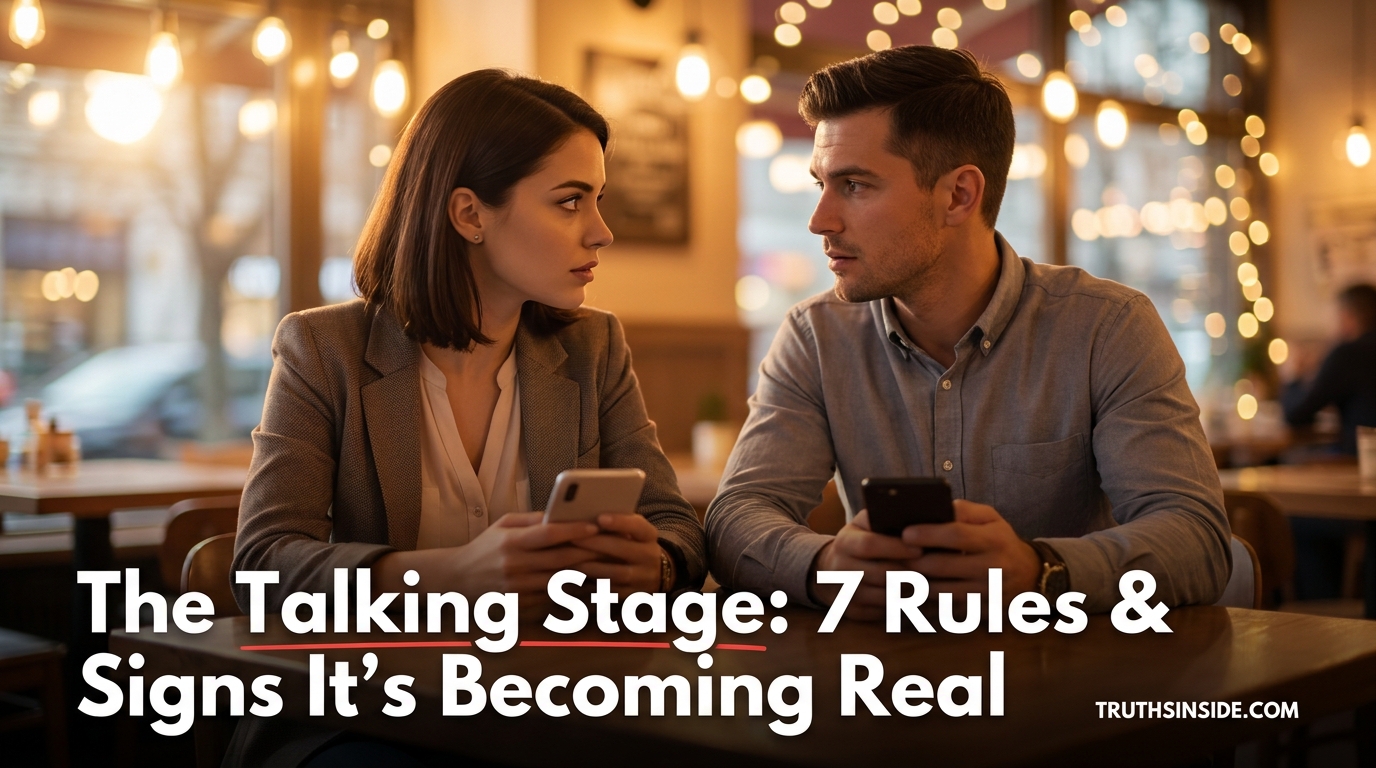
The talking stage is the pre-relationship phase where two people communicate regularly — through text, social media, phone calls, or occasional meetups — with a mutual but often unspoken romantic interest. It is the period before any official label has been placed on the connection.
It is not friendship. It is not dating in the traditional sense. It exists in a gray zone that modern dating culture created — partly out of a desire to “test the waters” before full emotional commitment, and partly because defining things too early can feel risky or vulnerable.
The talking stage can last anywhere from a few weeks to several months. And during that time, both people are essentially auditioning for each other’s life — learning personalities, values, humor, and compatibility — all without the safety net of a real commitment.
What makes the talking stage unique in modern dating is how heavily it relies on digital communication. Unlike previous generations who picked up a telephone or showed up in person, today’s talking stage often begins entirely online — a match on an app, a slide into DMs, or a back-and-forth on social media. The emotional connection builds through screens first, and real-life chemistry comes later — sometimes much later.
Understanding this phase is not just about romance. It is about emotional intelligence, self-awareness, and protecting your own heart while remaining open to love.
The Unspoken Rules of the Talking Stage
Every relationship phase has its own set of expectations. The talking stage is no different — except that nobody hands you a rulebook. Here are the most important rules that will keep your emotional health intact and give the connection its best possible chance.
Rule 1 — Be Honest About Your Intentions Early
One of the most painful outcomes of a talking stage is when two people discover — weeks or months in — that they wanted completely different things. One wanted a relationship. The other was just passing time. It does not mean anyone is a villain, but the emotional damage is real.
Being honest early does not mean proposing commitment on day one. It simply means being open about the fact that you are looking for something real, or that you are taking things slowly to see where it goes. Clarity saves everyone involved from unnecessary heartbreak.
Rule 2 — Maintain Your Own Identity and Life
One of the most common mistakes people make during the talking stage is emotionally investing so deeply that they begin to reshape their entire world around this new person — before anything has even been officially established.
Keep your friendships alive. Keep your hobbies. Keep your routines. The talking stage is not a relationship yet, and treating it like one before the other person has committed to that same level can lead to serious emotional imbalance. You want to bring your best self to this connection — and that requires keeping yourself whole.
Rule 3 — Do Not Over-Isolate From Other Possibilities
Unless there has been an explicit conversation about exclusivity, you are technically not in a committed relationship during the talking stage. That can feel uncomfortable to say out loud, but it is the honest truth.
This does not mean you must date multiple people. It simply means you should not put all of your emotional eggs into one basket before you know the basket is yours. Continue living your life. If this person is right for you, the connection will naturally move toward exclusivity on its own.
Rule 4 — Set Emotional Boundaries
Protect your emotional energy. The talking stage can mimic the feelings of a full relationship — the daily check-ins, the deep conversations, the vulnerability — without actually being one. This creates what psychology calls a “phantom relationship” effect, where your brain experiences attachment and bonding without the security of true commitment.
Know what you are comfortable sharing. Know how much emotional labor you are willing to give at this stage. And be willing to step back if you notice the investment becoming dangerously one-sided.
Rule 5 — Have the Conversation — Do Not Wait Forever
There is a moment in every talking stage where you feel it — that quiet pressure, that growing need to know where this is going. Do not suppress it indefinitely. The “what are we?” conversation is uncomfortable, yes. But it is also one of the most important conversations you can have for your own emotional clarity.
If someone genuinely wants to be with you, they will not run from that conversation. They may be nervous. They may need a moment. But they will not disappear or suddenly become cold. The way someone responds to that conversation tells you everything.
“The talking stage does not need to be a maze. With honesty, boundaries, and self-respect, it can be the most exciting and revealing season of any love story.”

Clear Signs the Talking Stage Is Going Somewhere Real
Not every talking stage leads to a relationship. Some drift into the dreaded “situationship” — a connection that feels like a relationship but never quite becomes one. Knowing the signs that yours is actually progressing toward something real can give you both clarity and confidence.
They make consistent effort — not just when it is convenient.
Anyone can text you when they are bored at midnight. But someone who is genuinely interested will reach out during the day, check in when life gets busy, and prioritize your conversations even when their schedule does not demand it. Consistency, not intensity, is the real indicator of interest.
They talk about the future — and include you in it.
When someone casually mentions a concert next month and says “we should go,” or references a trip they want to take and says “you would love it there” — they are picturing you in their future. This kind of future-orientation is one of the strongest signals that the talking stage is building toward something real.
They introduce you to their world — even digitally.
They tag you in something funny. They mention you to their friends. They start engaging with your social media in a way that feels intentional and public. These small gestures are a person’s way of saying: “I want people to know you exist in my life.”
They show up during difficult moments.
Anyone can be charming when things are fun and light. But someone who checks in when you mention you had a hard day, who remembers that you had an important meeting and asks how it went, who stays on the phone when you need to talk — that person is emotionally investing in you. That is a profound signal.
They bring up the future of “us” naturally.
Whether it is a comment about what kind of relationship they are looking for or a direct question about what you want — when someone starts steering the conversation toward clarity and labels, they are telling you they are ready to move forward. They are not afraid of the conversation because they already know what answer they want to give.
Signs the Talking Stage Is Going Nowhere
Equally important — and arguably more emotionally critical — is recognizing when the talking stage has stalled or is heading nowhere at all.
Hot and cold behavior. One day they are deeply engaged, the next they are distant and short with replies. Emotional inconsistency is not a sign of “playing it cool.” It is a red flag that something is off — whether they are unsure about you, managing multiple people, or simply not in a place for something real.
They never suggest real plans. Talking online is easy. But if weeks or months go by and there has been no genuine effort to spend time together in real life, the connection exists primarily in their comfort zone — not their heart.
They avoid any conversation about where this is going. Someone who genuinely wants a future with you will not panic or go cold when you ask a direct question about your dynamic. Deflection, humor used to sidestep the conversation, or sudden unavailability after you bring it up — these are signs you are not on the same page.
You feel anxious more than you feel excited. In a healthy talking stage, there is excitement, anticipation, and some nerves — but it should feel mostly good. If you spend the majority of your time anxious, second-guessing, and overanalyzing, your emotions are already telling you something important. Listen to them.

When Does the Talking Stage Officially Become a Relationship?
This is the question that keeps people awake at night. When does it cross the line? When does the talking stage end and a real relationship begin?
The honest answer is: it becomes a relationship when both people explicitly agree that it is.
Not when you have been talking for three months. Not when the texting has become daily. Not when you have met their friends or spent the weekend together. It becomes a real relationship when there is a clear, mutual, verbal agreement — or at minimum a deeply understood, unambiguous acknowledgment — that you are committed to each other and exclusively so.
This moment can arrive naturally. It can come from a soft, casual conversation over coffee where one of you simply says “I really like what we have — I want this to be real.” It can come from the classic “what are we?” conversation. It can come from someone simply asking, “Will you be my girlfriend/boyfriend?” with warmth and sincerity.
What it cannot come from is assumption. One of the most heartbreaking experiences in modern dating is two people who assumed they were in a relationship — only to discover one of them never considered it official. The talking stage ends with clarity, not time.
There are a few clear indicators that the transition has happened or is imminent. You have met each other’s close friends and family in a meaningful context. You have stopped using dating apps — and acknowledged that you have. You refer to each other in ways that imply ownership or partnership. And most powerfully — you have both said, out loud, that you are together.
Do not be afraid of that moment. Ask for it if you need to. A person who truly wants you will never punish you for needing clarity.
“You deserve to know where you stand. Love that is worth having is love that is willing to be named.”
How to Transition Out of the Talking Stage Gracefully
Whether it leads to a relationship or not, how you exit the talking stage says a great deal about your character and emotional maturity.
If it is becoming a relationship: Have the conversation with warmth and confidence. Express what you feel without ultimatums. Make it clear that you are excited about them and that you want something real. Let it be a moment you both choose — not a moment one person forces on the other.
If it is not working out: Be honest and kind. One of the most respectful things you can do for someone you have spent weeks building a connection with is to tell them directly that it is not going to move forward — rather than simply fading away. Ghosting someone after a talking stage is an emotionally careless act that leaves the other person with no closure and a deep sense of self-doubt.
If you are unsure: It is okay to say that too. “I really like you but I need a little more time to understand what I want” is a legitimate and honest thing to say — as long as you are not using it indefinitely as a shield against vulnerability.

FAQ: The Talking Stage — Your Top Questions Answered
Q1: How long should the talking stage last?
There is no universal timeline, but most relationship experts suggest that if you are genuinely compatible and both interested, the talking stage should naturally progress within one to three months. Beyond that, especially if you have been spending real time together, a lack of clarity may indicate that one or both people are avoiding commitment.
Q2: Can you be exclusive during the talking stage?
Absolutely. Exclusivity and official commitment are two different things. You can mutually agree to stop seeing other people while you continue getting to know each other before putting a formal label on the relationship. The key is that this agreement must be talked about openly — not just assumed.
Q3: Is it okay to ask “what are we?” during the talking stage?
Not only is it okay — it is healthy and mature. Needing clarity about where a connection is headed is a completely reasonable emotional need. Anyone who makes you feel “crazy” or “too much” for asking that question after a reasonable amount of time is not someone who respects your emotional needs.
Q4: What is the difference between a talking stage and a situationship?
A talking stage is a pre-relationship phase with the potential to become something real. A situationship is when the talking stage never progresses — it stays in that gray zone indefinitely, often because one person is using the ambiguity to avoid full commitment while still receiving the emotional benefits of a relationship.
Q5: How do I know if I am being strung along during the talking stage?
If the person you are talking to consistently avoids conversations about where things are going, makes no real-world effort to spend time with you, goes hot and cold emotionally, and the months are passing without any growth in the connection — you are likely being strung along. Your feelings and time deserve more than a permanent “maybe.”
Final Thoughts
The talking stage is one of the most emotionally complex phases of modern dating — but it does not have to be one of the most painful. When you understand the rules, read the signs clearly, and have the courage to ask for what you deserve, you transform the talking stage from a confusing maze into a meaningful path.
Whether it leads to a beautiful relationship or a respectful goodbye, you will walk away with your dignity, your self-awareness, and a deeper understanding of what you truly want in love.
The right person will not leave you wondering. The right connection will not require you to shrink your needs into silence. And the right relationship will begin with two people who choose each other — clearly, deliberately, and without fear.
Save this article if you are in a talking stage right now and need clarity.
Share it with a friend who has been stuck in the gray zone for too long.
Follow Truthsinside.com for more honest, deeply researched content on relationships, psychology, and love.
Related article: The 5 Love Languages Explained: Which One Are You?
🎵 Music
Maren Lull is a singer-songwriter who writes from the places most people don’t talk about out loud.
Not the dramatic grief. Not the obvious heartbreak. The quiet kind — the ordinary Tuesday emptiness, the habit of reaching for someone who isn’t there anymore, the particular exhaustion of being strong for so long that the strength itself wears thin.
Her music lives at the intersection of emotional honesty and soft beauty — breathy vocals over gentle piano, slow tempos, lyrics that feel less like songs and more like something you wrote in a private notebook at two in the morning and never showed anyone.
Maren Lull writes for the people who feel everything deeply and say very little about it. For the ones who listen to sad music not because they want to feel worse — but because being understood, even by a song, makes the feeling easier to carry.
📱 Follow Maren Lull:
→ Spotify
→ Apple Music
→ Youtube
→ Audiomack