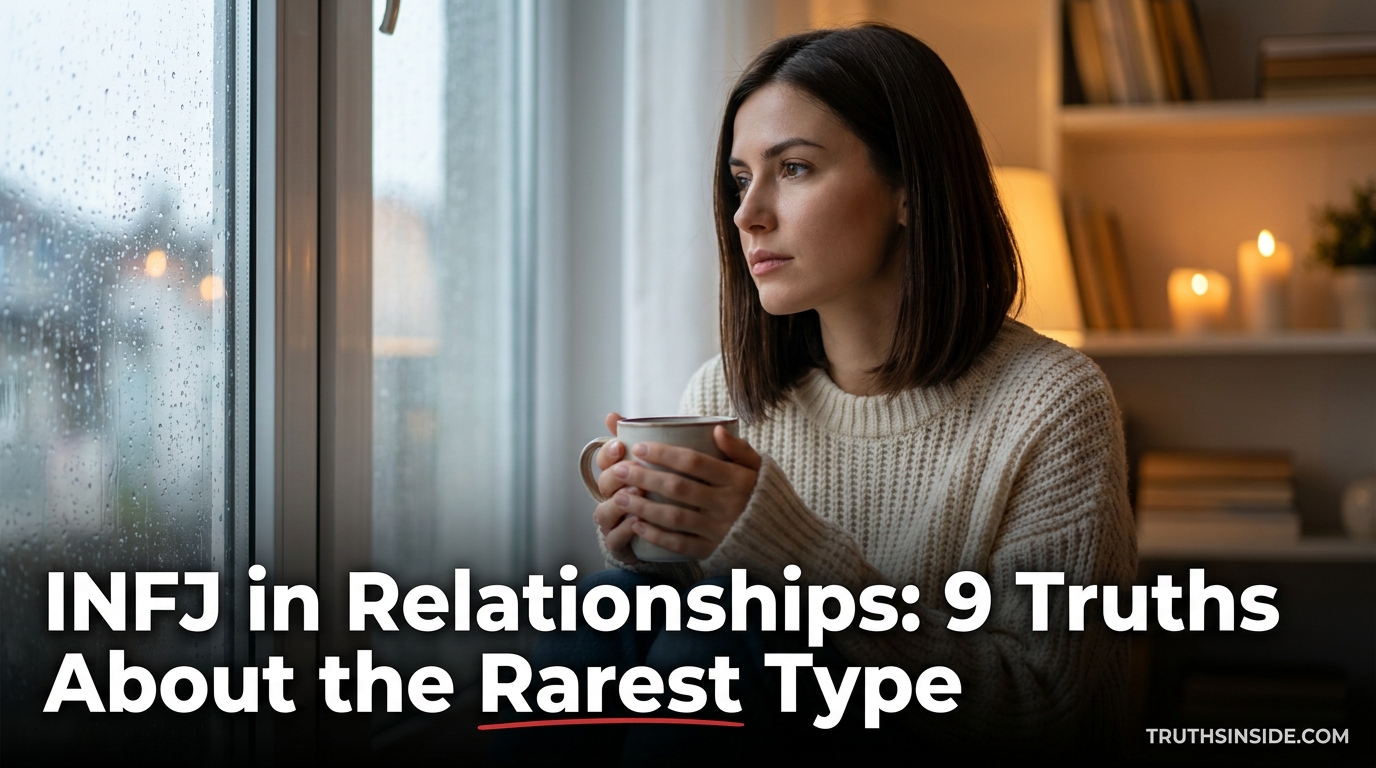
Have you ever loved someone who seemed to understand you on a level no one else ever had — someone who saw through every wall you built and somehow knew exactly what you needed before you said a word? If so, there is a powerful chance you were loved by an INFJ. According to the Myers-Briggs Type Indicator, INFJ in relationships represents one of the most profound and complex partnership experiences a person can have. INFJs make up only 1–3% of the global population, making them the rarest of all 16 personality types — and their approach to love is just as rare.
Research in personality psychology consistently shows that INFJs experience emotions at extraordinary depth. They do not enter relationships casually. They do not love halfway. When an INFJ chooses to open their heart to someone, it is a deeply deliberate, all-encompassing act — one that comes with extraordinary gifts and extraordinary challenges. A study published in the Journal of Psychological Type found that INFJs report some of the highest levels of empathy and emotional attunement of any personality type, often sensing their partner’s emotional state before it is verbally expressed.
Yet for all their depth, INFJs are widely misunderstood — even by the people who love them most. They are simultaneously the most giving and the most guarded. The most emotionally present and the most likely to disappear into solitude. The most visionary in love and the most prone to silent suffering. This article pulls back the curtain on what it truly means to be in a relationship with the rarest personality type — and what it means to be one.

What Makes INFJ in Relationships So Uniquely Powerful
To understand INFJ in relationships, you must first understand what drives the INFJ at their core. INFJ stands for Introverted, Intuitive, Feeling, and Judging — and each of those four letters plays a defining role in how they love.
The Introverted nature of the INFJ means they recharge in solitude and process the world internally. Unlike extroverted personality types who seek stimulation through social interaction, the INFJ finds energy in quiet reflection, deep one-on-one conversations, and meaningful connection. In a relationship, this translates to a partner who truly listens — not just to your words, but to the emotion and intention behind them.
The Intuitive function gives the INFJ an almost uncanny ability to read people. They pick up on microexpressions, tonal shifts, behavioral patterns, and emotional undercurrents that most people would never notice. In relationships, this means your INFJ partner will often know something is wrong before you do. They will sense the shift in your energy. They will feel the distance before you have said a word.
The Feeling function means that INFJs make decisions based on values and emotions rather than cold logic. They lead with empathy. They are profoundly attuned to fairness, kindness, and the emotional well-being of those they love. And the Judging function means they crave structure and meaning — they do not want a love that drifts aimlessly. They want a relationship with purpose, direction, and depth.
Together, these four qualities create a partner who is deeply committed, extraordinarily perceptive, passionately empathetic, and quietly visionary about the future they want to build with you.
9 Truths About Loving an INFJ
Truth 1 — They Will See Through You — Completely
One of the most disorienting and beautiful experiences of being loved by an INFJ is the feeling of being truly seen. INFJs have an almost supernatural ability to perceive who a person really is beneath their social mask. They see your fears, your patterns, your unspoken needs, and your deepest motivations — often before you have articulated them yourself.
This can feel like a relief after years of feeling unseen. But it can also feel deeply exposing. For people who are used to controlling their image and keeping emotional distance, being with an INFJ can feel vulnerable in ways they are not prepared for. The INFJ does not do surface-level. If you are with one, you will be known — fully and deeply.
Truth 2 — They Love With Extraordinary Depth and Intentionality
INFJs do not fall into relationships by accident. They observe. They assess. They think deeply about whether a person aligns with their values, their vision, and their emotional needs. When an INFJ finally decides to be with someone, it is not a casual choice — it is a profound commitment.
This means their love is not fleeting or impulsive. It is steady, intentional, and layered. They think about your happiness in quiet moments. They remember the small things you mentioned weeks ago. They show love not always through grand gestures but through a thousand small, deliberate acts of care that tell you: I was paying attention. I always was.
Truth 3 — They Need Deep Emotional Intimacy to Thrive
For an INFJ, physical presence alone is not enough to sustain a relationship. They need emotional intimacy — genuine, honest, vulnerable conversation that goes beneath the surface. Small talk exhausts them. Surface-level connection leaves them feeling empty and disconnected even when they are physically surrounded by people.
In a relationship, this means they need a partner who is willing to go deep. To talk about real things — fears, dreams, wounds, beliefs, the kind of conversations most people avoid because they require too much honesty. When an INFJ finds a partner who can meet them at that level, the connection that forms is unlike anything either person has ever experienced.
Truth 4 — They Are Deeply Private Despite Being Emotionally Open
Here is one of the most fascinating contradictions of the INFJ personality: they are simultaneously open and deeply private. They can hold space for your vulnerability with extraordinary grace, and yet they reveal their own inner world very slowly, very selectively, and only to those they have decided to fully trust.
This means that even in a committed relationship, your INFJ partner may have emotional layers they have not yet shared with you — not out of deception, but out of a deep need to feel completely safe before exposing their most vulnerable self. Patience, consistency, and safety are what unlock an INFJ’s deepest interior.
Truth 5 — They Absorb Your Emotions Like a Sponge
INFJs are empaths in the truest psychological sense. They do not just intellectually understand your emotional state — they physically and energetically absorb it. When you are in pain, they feel it. When you are joyful, they glow. When you are anxious, their body registers a version of that anxiety as their own.
This is both a gift and a significant vulnerability. In relationships, it means the emotional climate you create matters enormously to your INFJ partner. A chronically hostile, dismissive, or emotionally chaotic environment will not just hurt an INFJ — it will slowly deplete them at a cellular level. Their emotional health is intimately tied to the health of their most important relationships.
Truth 6 — They Have a “Door Slam” — and It Is Final
Perhaps the most widely discussed and most misunderstood aspect of INFJ relationships is the infamous “INFJ door slam.” This is the phenomenon where an INFJ — after enduring repeated mistreatment, emotional dismissal, or a profound betrayal of trust — completely and permanently closes the door on a relationship.
There is no dramatic confrontation. No long argument. No last-chance ultimatum. One day, the INFJ simply steps back — emotionally, energetically, and often physically — and the warmth that once defined their love is simply gone. What makes this particularly striking is that it does not come from cruelty. It comes from self-preservation. INFJs give so deeply and endure so quietly that by the time they door-slam, they have already processed the grief and moved on internally. The door slam is not the beginning of the end. It is the acknowledgment that the end already happened — quietly, and long ago.
Truth 7 — They Are Idealistic About Love — Sometimes Dangerously So
INFJs carry a vision of love that is profoundly beautiful and sometimes heartbreakingly idealistic. They believe in deep soul-level connection. They believe in a love that is transformative, growth-oriented, and spiritually meaningful. And while this idealism is one of their most beautiful qualities, it can also set them up for disappointment.
When reality falls short of their vision — as it inevitably does in any human relationship — INFJs can struggle with disillusionment. They may stay in relationships longer than they should, hoping their partner will eventually evolve into the person they believe they can be. Learning to love real people rather than potential is one of the INFJ’s most important and difficult growth edges.
Truth 8 — They Need Regular Solitude — Even From People They Love
An INFJ’s need for solitude is not a reflection of how much they love you. It is a biological and psychological necessity. After extended social interaction — even with a beloved partner — INFJs need time alone to decompress, recharge, and return to themselves.
For partners who are more extroverted or who interpret alone-time as rejection, this can be a significant source of conflict. Understanding that your INFJ partner’s need for solitude is not about you — and never was — is one of the most important things you can do for the health of the relationship. When they return from that solitude, they will love you with renewed presence and depth.
Truth 9 — They Will Grow With You If You Give Them Reason To
INFJs are deeply committed to personal growth — their own and their partner’s. In a relationship, they are not interested in stagnation. They want to evolve together, to challenge each other, to become better humans through the experience of loving each other deeply.
A partner who is open to growth, who values self-awareness, and who approaches the relationship as a living, evolving connection rather than a static arrangement will bring out the most extraordinary version of an INFJ’s love. When an INFJ feels safe, challenged in the right ways, and genuinely met — they become one of the most loyal, insightful, and profoundly loving partners a person will ever know.
“An INFJ does not love you with half of their heart. They love you with the whole of who they are — their intuition, their empathy, their vision, and their silence. To be chosen by one is to be truly, completely seen.”

The INFJ’s Biggest Relationship Challenges
Understanding the gifts of an INFJ partner is only half the picture. The challenges they face — and create — in relationships are just as important to understand.
The Perfectionism Trap
INFJs hold high standards — for themselves, for their relationships, and sometimes for their partners. This perfectionism, while rooted in genuine care and vision, can create an environment where their partner feels they can never quite measure up. Learning to embrace imperfection — in themselves and in the people they love — is one of the INFJ’s most important relational lessons.
The Chronic Over-Giver
INFJs are natural givers. They give their time, their energy, their emotional labor, and their insight — often without being asked and often without limit. In relationships, this can create a dangerous imbalance where the INFJ is perpetually depleted while their partner unconsciously takes without reciprocating.
Over time, this imbalance breeds resentment — even in an INFJ who would never voice it directly. The healthiest thing an INFJ can do for their relationships is learn to receive as generously as they give, and to communicate their needs before they reach a breaking point.
The Communication Paradox
INFJs are gifted communicators — in writing, in deep conversation, in emotional processing. And yet they often struggle to communicate their own needs and pain in real time. They tend to internalize, to process alone, to hope their partner will intuit what is wrong rather than asking them to bear the discomfort of direct disclosure.
This creates a painful paradox: the INFJ suffers quietly, their partner remains unaware, and the emotional distance grows until it becomes a chasm. Learning to speak up — to say “I am hurting” or “I need this from you” before it becomes a crisis — is a relationship skill that transforms the INFJ’s love life.

What INFJs Need Most From a Partner
If you love an INFJ — or want to — understanding what they genuinely need in a relationship will make all the difference.
Consistency and reliability. INFJs have often spent their lives feeling misunderstood and emotionally unsupported. What they need more than passion or excitement is the quiet, steady reassurance that you are trustworthy. Show up when you say you will. Mean what you say. Be the person whose word means something.
Intellectual and emotional depth. Stimulate their mind and their heart equally. Engage them in conversations that matter. Share your real thoughts, your real fears, your real dreams. An INFJ falls in love with someone’s interior world — their character, their values, their perspective. Give them something real to fall in love with.
Patience with their process. INFJs need time — to open up, to trust, to fully let someone in. Do not rush them. Do not interpret their guardedness as rejection. Understand that every layer they reveal to you is a gift that cost them something — and treat it accordingly.
Space without abandonment. Honor their need for solitude without making them feel guilty for needing it. Understand that the most loving thing you can do sometimes is give them room to be alone — and be warmly present when they return.
Reciprocal emotional investment. An INFJ will pour everything into you. They ask, in return, that you pour something back. Not equally, perhaps — but meaningfully. Show them that their emotional labor is noticed, valued, and returned with genuine care.
“The INFJ will love you in ways you did not know you needed — but they will only fully open if you give them the one thing they have always searched for: a love that is safe enough to be real.”
INFJ Compatibility — Who Loves Them Best
While any two mature, self-aware individuals can build a great relationship regardless of personality type, certain types tend to create particularly resonant connections with INFJs.
ENFP — The Campaigner is widely considered one of the INFJ’s most natural partners. Their warmth, creativity, and genuine curiosity about human nature complements the INFJ’s depth and vision beautifully. ENFPs help INFJs come alive socially and feel less alone in their idealism.
ENTP — The Debater challenges the INFJ’s thinking in ways that stimulate and excite rather than overwhelm. The intellectual chemistry between these two types can be extraordinary — though both must work on emotional communication.
INTJ — Two introverted intuitives who both value depth, vision, and meaning. This pairing creates an intensely intellectual and emotionally private connection. The mutual respect for each other’s inner world creates a relationship built on quiet strength.
INFP — A deeply values-driven pairing. Both types lead with feeling and intuition, creating a relationship of profound emotional understanding. The challenge here is that both types can struggle with direct conflict resolution, requiring intentional communication.
Regardless of type compatibility, what an INFJ needs most is a partner who is emotionally available, genuinely curious about them, and willing to do the internal work that real intimacy requires.

Final Thoughts
Being in a relationship with an INFJ — or being one — is not a simple experience. It is one of the most profound, layered, and transformative experiences the human heart can have. The INFJ brings a quality of love that is extraordinarily rare: perceptive without being invasive, deep without being dramatic, committed without being possessive, visionary without being detached from the present moment.
They will challenge you to grow. They will love you in ways that feel almost unfair in their tenderness and precision. They will remember your stories and hold your pain as carefully as if it were their own. And when they fully trust you — when the last wall comes down and they let you see everything they are — you will understand why the world calls them rare.
Not because there are few of them. But because love like theirs does not happen twice.
Save this article if you are an INFJ or love one — you will want to come back to this.
Share it with the person in your life who finally needs to understand you.
Follow Truthsinside.com for more deeply researched psychology and relationship content that actually matters.
Related article: Anxious Attachment: Signs, Causes, and How to Heal
FAQ: INFJ in Relationships
Q1: Are INFJs good romantic partners?
INFJs are considered among the most devoted, empathetic, and emotionally intelligent partners of all personality types. Their depth of commitment, perceptiveness, and genuine care for their partner’s well-being makes them extraordinary in love — though they require a partner who can meet their emotional depth and respect their need for authenticity.
Q2: Why do INFJs struggle in relationships?
Despite their emotional gifts, INFJs often struggle with communicating their own needs, maintaining healthy boundaries, and avoiding the tendency to over-give until they are emotionally depleted. Their idealism can also create expectations that are difficult for real-world relationships to meet consistently.
Q3: What type of person is best for an INFJ?
INFJs thrive with partners who value emotional depth, intellectual connection, and genuine vulnerability. They tend to connect most naturally with intuitive personality types — particularly ENFPs, INTJs, and ENTPs — though emotional maturity and self-awareness matter far more than any specific type designation.
Q4: How do you know if an INFJ loves you?
An INFJ in love is deeply attentive, remembers everything you share, goes out of their way to support your emotional well-being, and gradually opens layers of themselves to you that they share with almost no one else. When an INFJ chooses you, you will feel it — not in grand gestures, but in the quality of their presence and the precision of their care.
Q5: What is the INFJ door slam and should I be worried?
The door slam is an INFJ’s ultimate self-protective mechanism — a complete emotional withdrawal from someone who has caused repeated harm or violated their trust in a fundamental way. It is not impulsive. It is the result of long, quiet suffering finally reaching its limit. The best way to never experience an INFJ’s door slam is to treat them with consistent honesty, respect, and emotional reciprocity.
🎵 Music
Maren Lull is a singer-songwriter who writes from the places most people don’t talk about out loud.
Not the dramatic grief. Not the obvious heartbreak. The quiet kind — the ordinary Tuesday emptiness, the habit of reaching for someone who isn’t there anymore, the particular exhaustion of being strong for so long that the strength itself wears thin.
Her music lives at the intersection of emotional honesty and soft beauty — breathy vocals over gentle piano, slow tempos, lyrics that feel less like songs and more like something you wrote in a private notebook at two in the morning and never showed anyone.
Maren Lull writes for the people who feel everything deeply and say very little about it. For the ones who listen to sad music not because they want to feel worse — but because being understood, even by a song, makes the feeling easier to carry.
📱 Follow Maren Lull:
→ Spotify
→ Apple Music
→ Youtube
→ Audiomack