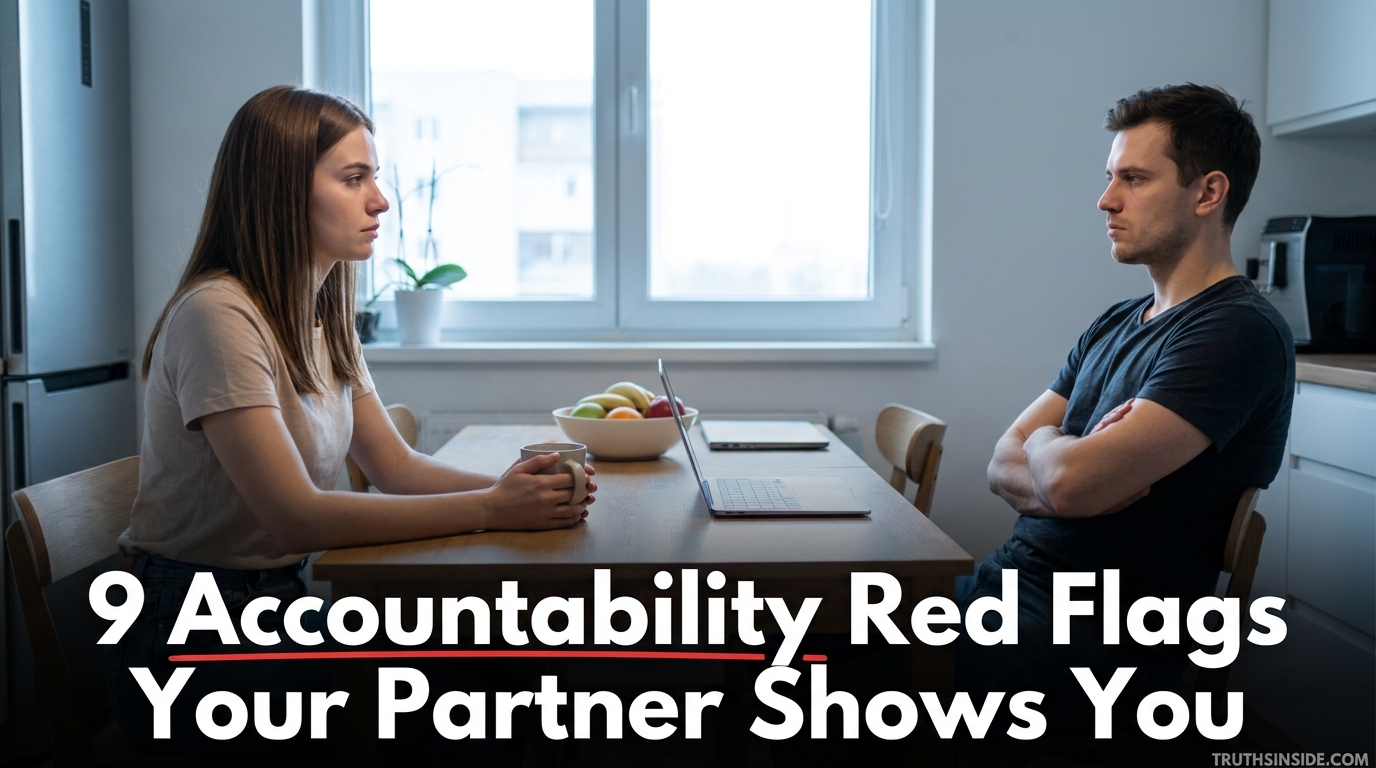
Have you ever tried to have a calm, honest conversation about something that hurt you — only to find yourself somehow apologizing by the end of it? If that sounds painfully familiar, you may be living with one of the most damaging accountability red flags in modern relationships. Research from the Journal of Social and Clinical Psychology found that chronic blame-shifting in romantic partnerships is one of the strongest predictors of long-term relationship dissatisfaction and emotional harm. In fact, studies show that individuals in relationships with partners who consistently avoid accountability report significantly higher levels of anxiety, self-doubt, and emotional exhaustion than those in mutually accountable partnerships.
Accountability — the ability to own your actions, acknowledge your impact on others, and make genuine efforts to change — is not just a desirable trait in a partner. It is a foundational requirement for any healthy, lasting relationship. Without it, conflicts never truly resolve. Trust erodes slowly but surely. And the partner who keeps trying to work through issues begins to feel more like a therapist, a parent, or a punching bag than an equal.
The most insidious aspect of accountability red flags is how easy they are to rationalize away in the early stages of love. A person who never takes responsibility is rarely obvious about it. They do not announce their avoidance. Instead, it hides behind charm, defensiveness, victimhood, and just enough occasional remorse to keep you doubting your own perception. This article will make those patterns impossible to ignore — because you deserve a partner who can look you in the eye and say “I was wrong, and I am sorry” without making you pay for asking.

Why Accountability Is the Foundation of a Healthy Relationship
Before identifying the accountability red flags, it is worth understanding why accountability matters so deeply in a romantic partnership — and what its absence actually does to a relationship over time.
Accountability is not about keeping score or demanding perfection. Every human being makes mistakes. Every person in a relationship will occasionally say something hurtful, act selfishly, or fall short of their partner’s needs. That is not the problem. The problem is what happens after.
When a partner takes genuine accountability, they validate your experience. They confirm that what you felt was real and that your pain was not an overreaction. They communicate respect — the message that your emotional well-being matters enough for them to sit in discomfort and own their part in causing harm.
When a partner consistently refuses accountability, the opposite happens. Your experiences are invalidated. Your pain is minimized, redirected, or turned back on you. Over time, you begin to question your own perception of reality — a psychological phenomenon known as gaslighting. You start to feel that bringing up anything difficult is more trouble than it is worth. You learn to manage your own emotions silently rather than risk the exhausting cycle of a conversation that ends with you feeling worse than when it started.
Psychologist Harriet Lerner, author of Why Won’t You Apologize?, found through decades of research that genuine apologies and accountability are among the most powerful acts of emotional repair available to human beings. Their consistent absence in a relationship is not a minor flaw. It is a structural crack that, left unaddressed, will eventually cause the entire foundation to collapse.
9 Accountability Red Flags to Watch For in Your Partner
Red Flag 1 — They Always Have an Excuse
No matter what the situation, your partner has a reason why what happened was not really their fault. They were stressed. They were tired. You caught them at a bad moment. Someone else had wound them up before you spoke. The context is always there to dilute their responsibility — and it is always just convincing enough to make you question whether you are being too hard on them.
The occasional explanation is human and reasonable. But when every single mistake or harmful behavior comes packaged with an automatic justification — when accountability is never offered without a “but” attached — the excuse has become a shield. A mature person can acknowledge that circumstances exist while still owning their behavior within those circumstances. The two are not mutually exclusive.
Red Flag 2 — They Turn Every Conflict Back on You
You bring up something they did that hurt you. Within minutes — sometimes within seconds — the conversation has shifted. Now you are talking about something you did three weeks ago. Now your tone is the problem. Now your timing was wrong. Now you are “always bringing up the past.” The original issue has evaporated, and you are on the defensive.
This is called DARVO — Deny, Attack, Reverse Victim and Offender — a term coined by psychologist Jennifer Freyd to describe a specific manipulation pattern used to avoid accountability. It is one of the most disorienting experiences in a relationship because it happens so quickly and so smoothly that many people do not realize what occurred until they are already apologizing for the thing they raised.
Red Flag 3 — Their Apologies Are Weaponized
Not all apologies are created equal. A genuine apology acknowledges the specific harm caused, expresses empathy for the impact on the other person, and comes with a sincere intention to change the behavior. A weaponized apology does none of those things.
Watch for phrases like: “I’m sorry you feel that way.” “I’m sorry, but you have to understand—” “Fine. I’m sorry. Are you happy now?” These are not apologies. They are performance. They are designed to end the conversation and relieve the pressure — not to repair the damage. A partner who consistently offers apologies of this quality is not practicing accountability. They are practicing conflict termination.
Red Flag 4 — They Play the Victim in Every Situation
When confronted with their behavior, a partner who avoids accountability will often reframe the entire narrative so that they become the wronged party. You expressing hurt becomes you attacking them. You setting a boundary becomes you being controlling. You needing space becomes you abandoning them.
This victim inversion is particularly insidious because it exploits a caring partner’s empathy. If you are a genuinely compassionate person, your instinct when someone expresses pain is to comfort them — even if you were the one who was originally hurting. Over time, this dynamic creates a relationship where one person’s pain is always centered and the other person’s needs are perpetually sidelined.
Red Flag 5 — They Never Change After Apologies
Perhaps the most telling of all accountability red flags is the pattern of repeated apology without repeated change. They express remorse. They may even cry. They say the right words. And then — slowly or quickly — the same behavior returns, and the cycle begins again.
This is critically important: remorse without behavioral change is not accountability. Accountability is demonstrated through action over time, not through emotional expression in the moment. If you find yourself having the same conversation about the same issues with the same partner over and over, what you are witnessing is not a person struggling to change — it is a person who has learned that expressing remorse is enough to reset your expectations without requiring actual growth.
“You are not too sensitive for needing accountability. You are not too demanding for expecting change. A partner who cannot own their actions is not a safe person to build a life with.”

Red Flag 6 — They Gaslight Your Memory of Events
Gaslighting is one of the most psychologically damaging forms of accountability avoidance. It occurs when a partner consistently denies, distorts, or rewrites the reality of events in ways that make you question your own memory, perception, and sanity.
“That never happened.” “You are imagining things.” “You are way too sensitive — it was not that big of a deal.” “I never said that.” “You always twist everything I say.”
Over time, gaslighting erodes your confidence in your own perceptions. You begin to defer to your partner’s version of reality not because it is accurate but because the psychological cost of disagreeing has become too high. This is not a communication style difference. This is emotional abuse — and it thrives in the absence of accountability.
Red Flag 7 — They Make You Feel Guilty for Having Needs
A partner who avoids accountability will often preemptively strike against your needs by making you feel that having them is itself a problem. Needing an apology becomes “being dramatic.” Wanting to discuss an issue becomes “starting fights.” Expecting follow-through on a promise becomes “not trusting them.”
If you regularly feel embarrassed, burdensome, or unreasonable for needing the basic elements of a healthy relationship — honest communication, emotional repair after conflict, consistent behavior — examine whether that shame is coming from inside you or whether it is being carefully cultivated by a partner who benefits from your silence.
Red Flag 8 — They Use Your Vulnerabilities Against You
In moments of genuine conflict, a partner who avoids accountability will sometimes reach for the most powerful weapons available — the personal information you trusted them with during your most vulnerable moments. Your insecurities. Your past traumas. Your fears.
This is a form of emotional manipulation designed to derail the conversation and put you so far on the defensive that the original issue becomes impossible to address. It is a deeply damaging breach of trust — because the very intimacy of the relationship is being weaponized against you. A partner who genuinely respects you will never use what you shared in love as ammunition in conflict.
Red Flag 9 — They Dismiss Your Feelings as Overreactions
“You are being too sensitive.” “You always make a big deal out of nothing.” “I cannot say anything without you getting upset.” These phrases — delivered repeatedly and consistently — are not honest feedback. They are a systematic campaign to delegitimize your emotional responses so that you stop bringing them up altogether.
Emotional dismissal is a quiet but profoundly damaging form of accountability avoidance. When a partner consistently frames your feelings as disproportionate, they are not helping you gain perspective — they are training you to distrust yourself. And a person who has been trained to distrust their own emotions is much easier to avoid accountability with.

The Psychological Impact of Living With These Red Flags
Understanding the accountability red flags is one thing. Understanding what they do to you over time is another — and it is arguably more important for your long-term well-being.
Living with a partner who consistently refuses accountability does not just damage the relationship. It damages you. Research in clinical psychology has shown that chronic exposure to blame-shifting, gaslighting, and emotional dismissal produces measurable changes in a person’s psychological functioning.
You begin to second-guess yourself constantly — not just in the relationship, but in every area of your life. Your self-esteem erodes quietly, the way paint peels in a damp room: slowly, invisibly, until one day you notice entire sections are gone. Your nervous system begins to operate in a low-level state of alert, anticipating the next conflict, the next dismissal, the next rewrite of reality.
Many people in these relationships develop symptoms consistent with anxiety disorders and complex trauma — hypervigilance, difficulty trusting their own judgment, a persistent sense of walking on eggshells. They may not identify these symptoms as relationship-induced because the damage has been so gradual and so expertly normalized.
Perhaps most heartbreaking of all — many people who have been in these relationships for extended periods lose their ability to clearly articulate what they need, because they have spent so long being told that their needs are unreasonable. Reclaiming that voice — and trusting it — becomes one of the most important acts of healing they will ever undertake.
“When someone consistently refuses to take responsibility, they are not just failing you in the moment — they are teaching you to make yourself smaller to survive the relationship. That is not love. That is erosion.”
What Genuine Accountability Looks Like
Because it is easy to become so focused on what is wrong that we lose sight of what right looks like, it is worth being explicit about what genuine accountability in a relationship actually sounds like and feels like.
A genuinely accountable partner says: “You are right. I should not have said that. I understand why it hurt you.” Not once — but as a consistent pattern across the relationship.
They do not require you to present a flawless argument before they will acknowledge your pain. They do not weaponize your emotional delivery as a reason to ignore the content of what you are saying. They sit with discomfort rather than deflecting it back onto you.
They follow through. The apology is accompanied by visible, sustained effort to change the behavior. Not immediately and not perfectly — but genuinely and progressively. You can see the work happening.
They create an environment where you feel safe to raise issues because you know that doing so will not result in punishment, manipulation, or days of emotional coldness. Conflict feels like something you navigate together — not something you survive alone.
This is the standard. Not perfection. Not immunity from mistakes. But consistent, genuine willingness to own their impact on you and do something meaningful about it.

What to Do If You Recognize These Red Flags
Recognizing accountability red flags in your relationship is not the end of the story. It is the beginning of a decision — and that decision belongs entirely to you.
Name what you are seeing — to yourself first. Stop minimizing, rationalizing, or explaining away what you have been experiencing. Call it what it is, clearly and without softening. Journaling can be a powerful tool here — writing down specific incidents as they happen creates an objective record that is much harder to gaslight than memory alone.
Have a direct conversation — and observe the response carefully. Tell your partner, calmly and specifically, that you need them to take more accountability in the relationship. Be clear about what that means and what you need it to look like. Then watch what happens. Not just in the conversation — but in the days and weeks that follow. The response to this conversation will tell you more than any previous argument has.
Seek support outside the relationship. Talk to a trusted friend, family member, or therapist. One of the most damaging effects of living with these patterns is the isolation they create — the sense that your experience is either too complicated to explain or too embarrassing to share. Breaking that isolation is one of the most important things you can do for your own clarity and healing.
Establish and hold your boundaries. Decide what you are and are not willing to continue accepting — and hold that line, not as punishment, but as self-respect. Boundaries without follow-through are not boundaries. They are requests that your partner has learned they can ignore.
Know when it is time to leave. If you have communicated clearly, if you have given genuine opportunity for change, and if the patterns have not shifted — know that staying is a choice with consequences. You deserve a relationship where your feelings are taken seriously, your needs are treated as legitimate, and your partner’s first instinct when they hurt you is to repair — not to defend.
FAQ: Accountability Red Flags
Q1: Is it normal for partners to occasionally avoid accountability?
All people struggle with accountability at times — it is a deeply human challenge tied to ego, shame, and fear of conflict. The red flag is not an occasional lapse. It is a consistent, entrenched pattern where accountability is never genuinely offered, where the same harmful behaviors repeat without change, and where the partner who raises issues consistently ends up feeling worse for having done so.
Q2: Can a partner who avoids accountability change?
Change is possible — but only when the person genuinely recognizes and wants to address the pattern. This typically requires significant self-awareness and often professional support such as individual therapy. The critical question is not whether change is theoretically possible, but whether your specific partner is actively choosing to pursue it. Wanting them to change is not the same as them wanting to change.
Q3: How do I tell the difference between accountability avoidance and someone who just communicates differently?
Communication style differences are real and valid. But they do not explain why your pain is never acknowledged, why conflicts always end with you apologizing, or why raising an issue consistently results in the conversation being turned against you. Accountability is not a communication style. It is an emotional and moral orientation toward the people you love. Genuine communication differences can be worked through together. Accountability avoidance is a pattern that only the person practicing it can choose to break.
Q4: What does DARVO mean and how do I recognize it?
DARVO stands for Deny, Attack, Reverse Victim and Offender. It is a specific manipulation pattern identified by psychologist Jennifer Freyd. You can recognize it when: the person you confronted suddenly claims to be the one being wronged, when they attack your character or past behavior in response to your concern, and when the conversation ends with you defending yourself rather than the original issue being addressed. It is disorienting precisely because it happens quickly and feels almost logical in the moment.
Q5: Is a partner who never takes responsibility emotionally abusive?
Chronic accountability avoidance — particularly when paired with gaslighting, emotional dismissal, and the use of vulnerabilities as weapons — falls within the clinical definition of emotional abuse. It does not require physical harm to cause deep and lasting psychological damage. If you recognize multiple patterns from this article in your relationship, speaking with a licensed therapist or counselor is strongly encouraged.
Final Thoughts
Accountability red flags do not announce themselves loudly. They do not arrive wearing warning signs. They settle in quietly — through a hundred small moments where your pain was minimized, your reality was rewritten, and your needs were made to feel like the problem.
But now you see them.
And seeing them clearly is the most powerful thing you can do — not just for your relationship, but for yourself. Because at the core of every accountability red flag is the same message: your experience does not matter as much as my comfort. And at the core of your healing is the decision that it does.
You are not asking for too much when you ask for a partner who owns their mistakes. You are asking for the bare minimum of what love requires. Do not let anyone convince you otherwise.
Save this article — you may need to come back to it when doubt starts to creep back in.
Share it with someone who keeps apologizing for things that were never their fault.
Follow Truthsinside.com for more honest, research-backed content on relationships, red flags, and emotional well-being.
Related article: The 5 Love Languages Explained: Which One Are You?
🎵 Music
Maren Lull is a singer-songwriter who writes from the places most people don’t talk about out loud.
Not the dramatic grief. Not the obvious heartbreak. The quiet kind — the ordinary Tuesday emptiness, the habit of reaching for someone who isn’t there anymore, the particular exhaustion of being strong for so long that the strength itself wears thin.
Her music lives at the intersection of emotional honesty and soft beauty — breathy vocals over gentle piano, slow tempos, lyrics that feel less like songs and more like something you wrote in a private notebook at two in the morning and never showed anyone.
Maren Lull writes for the people who feel everything deeply and say very little about it. For the ones who listen to sad music not because they want to feel worse — but because being understood, even by a song, makes the feeling easier to carry.
📱 Follow Maren Lull:
→ Spotify
→ Apple Music
→ Youtube
→ Audiomack