
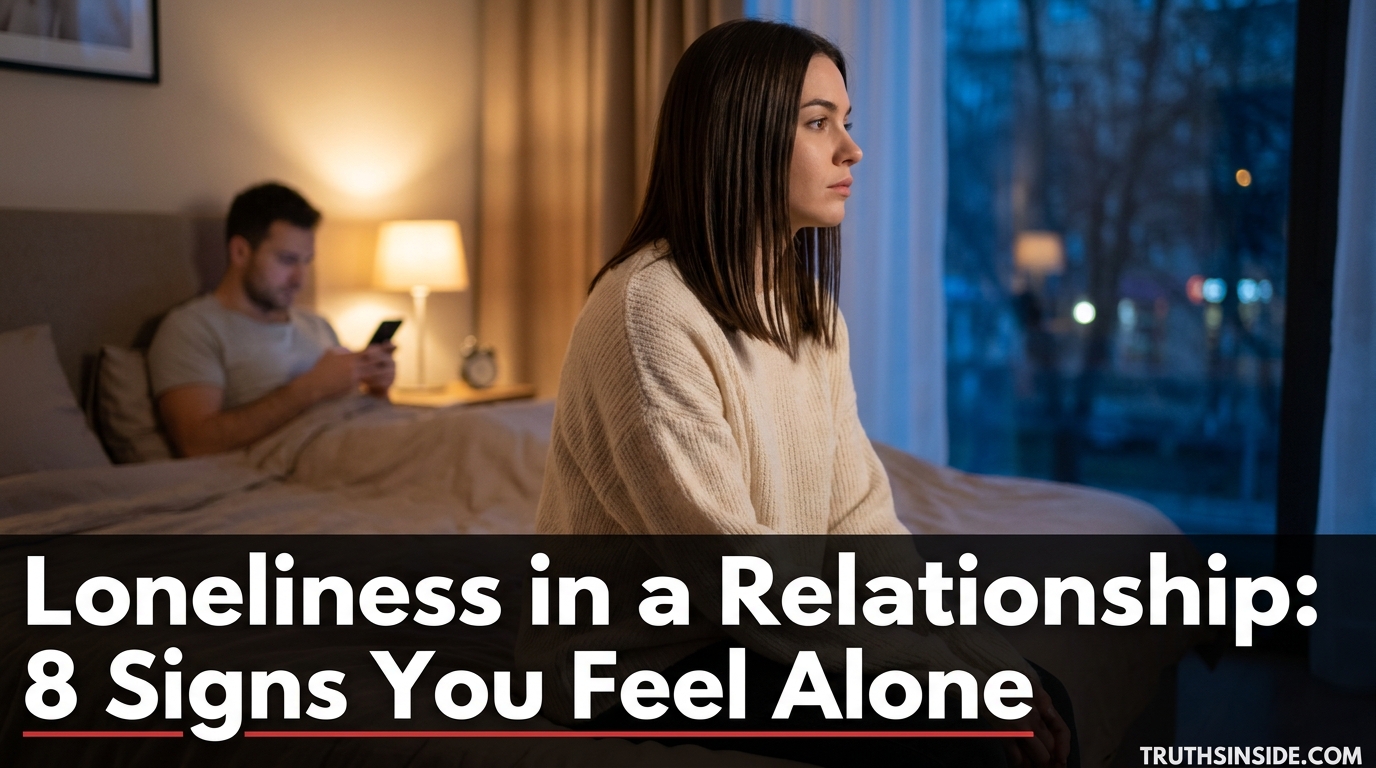
There is a particular kind of loneliness that no one really prepares you for — the kind that wraps around you not in an empty apartment, but in a bed you share with someone you love. Loneliness in a relationship is not just possible. According to a landmark study published in the American Journal of Health Promotion, it is alarmingly common — with over 62% of married and partnered adults reporting feeling lonely within their relationship at some point.
Even more striking, researchers at the University of Chicago found that the health consequences of loneliness within a committed relationship can be just as severe as those experienced by people who are completely alone — including elevated cortisol levels, disrupted sleep, and a measurably weakened immune system.
What makes this particular loneliness so devastating is its invisibility. From the outside, everything looks intact. There is a relationship. There is a partner. There is a shared life with shared spaces and shared routines. And yet something essential is missing — the feeling of being truly seen, genuinely heard, and emotionally held by the person who is supposed to know you best. That gap between physical presence and emotional connection is one of the most quietly painful experiences a human heart can endure.
This article is for everyone who has ever sat in the same room as their partner and felt utterly alone. For everyone who has wondered whether what they are feeling is real, whether they are expecting too much, or whether this quiet emptiness is simply what long-term love becomes. The answer to that last question is no — it is not. Emotional connection in a relationship is not a luxury. It is the entire point. And understanding why the loneliness appeared, what it is telling you, and what can be done about it may be the most important relationship work you ever do.

What Loneliness in a Relationship Actually Means
Before anything else, it is worth being precise about what loneliness in a relationship is — and what it is not — because the distinction matters enormously for how you understand and respond to it.
Loneliness in a relationship is not simply the absence of your partner. It is not missing them when they travel for work or feeling quiet on an evening when conversation does not flow. It is not the natural and healthy experience of two individuals who maintain their own inner lives within a shared partnership.
Loneliness in a relationship is the persistent, aching sense that despite your partner’s physical presence, you are not emotionally connected to them. It is the feeling that you could say something deeply true about yourself and not be genuinely received. It is reaching for emotional intimacy — real vulnerability, real understanding, real presence — and finding nothing substantial to hold onto.
Psychologist John Cacioppo, one of the world’s leading researchers on loneliness, described the experience not as physical isolation but as perceived social disconnection — the subjective sense that your need for meaningful connection is going unmet. Within a romantic relationship, this disconnection is uniquely painful precisely because the expectation of connection is highest there. Your partner is supposed to be your person. When the loneliness lives there — in that specific space — it carries a weight that solitude alone cannot fully replicate.
It is also worth saying clearly: feeling lonely in your relationship does not automatically mean the relationship is broken, that your partner is a bad person, or that love is gone. It means a disconnection has developed — and disconnections, when caught and addressed with honesty and care, can be repaired. The danger lies not in the loneliness itself but in the silence around it. In the decision to say nothing, to manage it alone, to wait and hope it resolves without intervention.
It rarely does.
8 Signs You Are Experiencing Loneliness in a Relationship
Sign 1 — You Stop Sharing the Important Things
There is a specific moment that relationship therapists point to as one of the earliest and most significant indicators of relational loneliness — the moment you stop instinctively reaching for your partner when something important happens in your life.
Something extraordinary occurs at work. Something difficult happens with a family member. You have a thought or a feeling that moves you deeply. And instead of turning to your partner first — your first instinct is to call a friend, sit with it alone, or simply not share it at all. Not because you are angry. Not because you are punishing them. But because somewhere along the way, you learned — quietly and without ceremony — that sharing with them does not feel worth it. That they will not quite get it. That the emotional return will not justify the vulnerability it costs you to offer it.
This withdrawal from emotional sharing is rarely dramatic. It creeps in slowly, one withheld story at a time, until one day you realize that the person you live with knows almost nothing about your inner life anymore.
Sign 2 — Conversations Stay Permanently on the Surface
Think about the last ten conversations you had with your partner. What were they about? Logistics. Schedules. What to eat. What needs to be fixed. What someone said at work. The kinds of conversations that keep a household running but do not keep a relationship alive.
When surface-level communication becomes the permanent setting of a relationship — when conversations never venture into feelings, fears, dreams, values, or genuine curiosity about each other’s inner world — a slow emotional famine sets in. The words are there. The exchange is there. But the nourishment that real connection provides is completely absent.
Deep conversation is not a luxury for couples who have time for it. It is the primary mechanism through which emotional intimacy is built and maintained. When it disappears, the loneliness moves in to fill the space it left.
Sign 3 — You Feel Unseen and Misunderstood
Being known — truly, accurately known — by your partner is one of the most fundamental emotional needs in a romantic relationship. When that knowing is absent, the loneliness that follows is profound.
You may feel unseen in small ways — your partner misremembers things that matter to you, misreads your emotional state consistently, or seems to engage with a version of you that does not quite match who you actually are. Or it may be larger — the sense that your partner has never truly understood your values, your sensitivities, your deepest needs, and has never seemed particularly invested in doing so.
Being misunderstood occasionally is human and inevitable. Being chronically misunderstood by the person who is supposed to know you best is a form of relational loneliness that strikes at the very core of your identity and sense of worth.
Sign 4 — Physical Presence No Longer Feels Like Company
You are in the same room. You might even be touching. And yet you feel completely, utterly alone. This is one of the most disorienting and painful signs of loneliness in a relationship — the moment when proximity stops being comfort.
Physical presence without emotional attunement creates what psychologists call an experience of “crowded loneliness” — a state where the company of another person actually amplifies rather than alleviates the sense of disconnection. When being with your partner feels no more emotionally nourishing than being alone, something essential in the connection has been lost.
Sign 5 — You Have Stopped Fighting — but Not Because Things Are Better
Many people confuse the absence of conflict with the presence of peace. But in relationships where loneliness has settled in deeply, the absence of arguments often signals something far more troubling than unresolved tension — it signals withdrawal.
When a partner stops fighting, stops raising issues, stops reacting with passion even to things that matter, it is frequently because they have quietly given up on the possibility of being heard. The energy required to fight — to care enough to argue, to push, to expect better — has been exhausted. What remains is a kind of numb coexistence that looks like peace from the outside but feels like surrender from the inside.
Therapist Esther Perel calls this state “the long goodbye” — the gradual emotional departure that precedes the physical one, often by years.
Sign 6 — You Feel More Like Roommates Than Partners
The relationship functions. The bills get paid, the meals get made, the routines get maintained. But the romantic, emotional, and intimate dimensions of the partnership have quietly evaporated. You share a home. You share responsibilities. You may share children. But you do not share yourselves — not in the ways that make a relationship feel like love rather than logistics.
This roommate dynamic is one of the most commonly reported experiences among couples in long-term relationships who describe feeling lonely. It is not hostile. It is not dramatic. It is simply hollow — a structure without substance, a routine without resonance.
Sign 7 — Your Emotional Needs Are Consistently Unmet
You need reassurance and receive distraction. You need comfort and receive advice. You need to be heard and receive solutions. You need presence and receive absence. Over and over, the emotional frequencies you are broadcasting on do not match the ones your partner is tuned to — and the repeated experience of reaching out and coming back empty-handed carves a loneliness that is both specific and cumulative.
Unmet emotional needs do not always reflect a partner’s malice or indifference. Sometimes they reflect genuine incompatibility in emotional language. Sometimes they reflect a partner’s own emotional limitations or unprocessed wounds. But regardless of the cause, the impact is the same: a growing conviction that you are fundamentally alone in this relationship — that your interior life is something you carry alone.
Sign 8 — You Find More Emotional Nourishment Outside the Relationship
Your closest confidant is your best friend, not your partner. Your most meaningful conversations happen with a sibling, a colleague, or a therapist. The relationships that make you feel genuinely understood and valued are not the one you come home to.
This is not necessarily a betrayal of the relationship — but it is a significant signal. When the emotional center of gravity in your life has shifted decisively away from your partner, the loneliness inside the relationship has already become normalized. You have unconsciously constructed an emotional life that works around the relationship’s limitations rather than within it.
“The loneliest moment is not when you are by yourself in an empty room. It is when you are sitting beside the person you love most — and they do not even notice you are disappearing.”

Why Loneliness in a Relationship Develops
Understanding how the loneliness arrived is as important as recognizing that it is there. Relational loneliness rarely appears overnight. It develops gradually, through specific and often identifiable patterns and circumstances.
Life transitions that were never processed together. A new job, a move, the arrival of children, a health crisis, a loss — major life transitions place enormous pressure on a couple’s connection. When those transitions are navigated individually rather than together, when neither person has the bandwidth or emotional vocabulary to process the change as a unit, the distance they create can calcify into permanent disconnection.
Emotional avoidance in one or both partners. Some people were raised in environments where emotional expression was discouraged, punished, or simply never modeled. Bringing that emotional avoidance into a relationship creates a dynamic where genuine intimacy is perpetually just out of reach — not because the person does not care, but because they do not have access to the emotional tools that real connection requires.
Accumulated resentment that was never addressed. Loneliness in a relationship is often the end product of unresolved conflict. When hurts go unacknowledged, when apologies are never offered, when the same wounds are repeatedly reopened without repair — partners learn to protect themselves by withdrawing. And withdrawal, over time, becomes distance. And distance becomes loneliness.
The erosion of intentional connection. In the early stages of a relationship, couples naturally prioritize connection — time together, genuine conversation, physical intimacy, playful engagement. As life becomes more complex and demanding, these intentional acts of connection are often the first things to be quietly deprioritized. And once the habit of connection is broken, the distance that grows in its absence is surprisingly difficult to close without deliberate effort.
Incompatible emotional languages. Not all loneliness in a relationship is the result of conflict or neglect. Sometimes two genuinely good people simply speak different emotional languages — one craves verbal intimacy while the other expresses love through acts of service; one needs physical closeness while the other retreats inward when stressed. Without awareness and deliberate adjustment, these incompatibilities can create a persistent experience of reaching for each other and missing.

How Loneliness in a Relationship Affects Your Mental and Physical Health
The impact of relational loneliness extends far beyond emotional discomfort. The research on this is both extensive and sobering — and it is important to take seriously.
Psychologist John Cacioppo’s decades of research established that chronic loneliness — including the relational variety — activates the body’s stress response systems in ways that are measurably harmful over time. Elevated cortisol, the body’s primary stress hormone, disrupts sleep quality, suppresses immune function, increases inflammation, and raises the risk of cardiovascular disease. The body, it turns out, does not distinguish cleanly between being physically alone and feeling emotionally alone — the physiological stress response is remarkably similar in both cases.
Mentally, the consequences are equally significant. Chronic relational loneliness is strongly associated with increased rates of depression and anxiety. It tends to produce a particular cognitive pattern that psychologists call “hypervigilance to social threat” — a state where the brain becomes hypersensitive to perceived rejection or indifference, making even neutral interactions feel like confirmation of unworthiness.
Perhaps most insidiously, loneliness in a relationship tends to become self-reinforcing. The lonelier you feel, the more you withdraw to protect yourself. The more you withdraw, the less connection is possible. The less connection occurs, the lonelier you feel. Breaking this cycle requires intentional intervention — from both partners, ideally, but sometimes from one partner alone as an act of courageous initiation.
How to Heal From Loneliness in a Relationship
Recognizing the loneliness is the first act of courage. The second is deciding to do something about it — and doing so with honesty, vulnerability, and realistic expectations.
Name it out loud — to yourself and to your partner. The loneliness you have been carrying quietly needs to be spoken. Not as an accusation — “you make me feel lonely” — but as a genuine, vulnerable disclosure: “I have been feeling disconnected from us, and I miss you. I miss what we were.” This kind of language invites rather than defends, and it gives your partner the opportunity to respond rather than react.
Create intentional spaces for real connection. Connection does not happen accidentally in long-term relationships — it has to be built back deliberately. Designate time that belongs only to your relationship — not to screens, not to logistics, not to the demands of life outside the two of you. It does not need to be elaborate. It needs to be consistent and protected.
Learn each other’s emotional language. Gary Chapman’s framework of the Five Love Languages remains one of the most practically useful tools for couples experiencing disconnection. Understanding how your partner gives and receives love — and communicating your own language clearly — can close gaps that have been quietly growing for years.
Seek professional support. Couples therapy is not a last resort before separation. It is a skilled, structured space where two people who want to reconnect can learn to do so with the guidance of someone trained to help them hear each other differently. The research on the effectiveness of evidence-based couples therapy — particularly Emotionally Focused Therapy — is among the most compelling in all of clinical psychology. Couples who engage genuinely in the process show measurable, lasting improvements in emotional connection and relationship satisfaction.
Be honest about whether reconnection is possible. Not every relationship that reaches this level of disconnection can or should be repaired. Sometimes the loneliness in a relationship is the signal that two people have genuinely grown in incompatible directions — and that the most loving, honest thing they can do for each other is to acknowledge that. This is not failure. It is clarity. And clarity, even when it is painful, is always more humane than a lifetime of shared loneliness.
“You do not have to be physically alone to deserve connection. Loneliness inside a relationship is just as real, just as valid, and just as worthy of healing as any other kind.”

FAQ: Loneliness in a Relationship
Q1: Is it normal to feel lonely in a long-term relationship?
It is far more common than most people realize — research suggests the majority of people in long-term partnerships experience relational loneliness at some point. What matters is not whether it occurs but how quickly it is recognized and how honestly it is addressed. Loneliness in a relationship becomes truly damaging when it is left unacknowledged and allowed to deepen over months or years without any attempt at repair.
Q2: Can a relationship recover from deep loneliness?
Yes — many relationships have been transformed from states of profound disconnection into deeply fulfilling partnerships through intentional effort, honest communication, and often professional support. The key conditions for recovery are that both partners acknowledge the problem, both are genuinely willing to change their patterns, and both are committed to the uncomfortable work of rebuilding emotional intimacy. When only one partner is invested in the reconnection, recovery becomes significantly more difficult and the outcomes less certain.
Q3: How do I tell my partner I feel lonely without hurting them?
Lead with love and longing rather than blame. Instead of framing the conversation as a complaint about what your partner has failed to provide, frame it as an expression of how much the connection means to you and how much you miss it. “I miss feeling close to you” lands very differently than “You never make time for me.” The former is an invitation. The latter triggers defense. Choose language that opens a door rather than positions the other person as the villain.
Q4: What is the difference between healthy solitude and relational loneliness?
Healthy solitude within a relationship is the comfortable, self-chosen experience of spending time alone while knowing your connection with your partner remains intact and available. Relational loneliness is the involuntary, painful sense that genuine emotional connection with your partner is unavailable to you — even when they are physically present. The distinguishing factor is whether the aloneness feels peaceful or whether it feels like a symptom of something broken.
Q5: When is loneliness in a relationship a sign it should end?
When both partners have genuinely engaged with the problem — communicated honestly, sought support, made sustained effort — and the emotional disconnection has not meaningfully shifted, the loneliness may be communicating something more fundamental: that the relationship, in its current form, cannot provide what both people need. This is not a comfortable conclusion, but it is a loving one. Staying in a relationship where both people are chronically lonely is not devotion. It is a postponement of lives that could be fuller elsewhere.
Final Thoughts
Loneliness in a relationship is one of the most quietly devastating experiences the human heart encounters — precisely because it carries not just the pain of disconnection, but the confusion of not understanding why it hurts so much when someone is right there beside you.
But now you understand it. You can name it, trace its origins, recognize its signs, and — most importantly — you know it does not have to be permanent.
Whether this article leads you toward a brave conversation with your partner, toward a therapist’s office, toward a deeper understanding of your own emotional needs, or toward the clarity that it is time for a new chapter — all of those outcomes are more honest than silence. And honesty, even the painful kind, is where healing begins.
You are not too much for wanting to feel loved by the person you love. You are not dramatic for grieving a connection that used to exist. You are not alone in feeling alone — and you deserve a love that makes sure you never have to feel that way again.
Save this article — for the moments when the loneliness feels too quiet to explain.
Share it with someone who needs to know that what they are feeling has a name — and a way through.
Follow Truthsinside.com for more honest, deeply human content on love, emotions, and the relationships that shape us
Related article: 15 Subtle Red Flags in a New Relationship Most People Miss
🎵 Music
Maren Lull is a singer-songwriter who writes from the places most people don’t talk about out loud.
Not the dramatic grief. Not the obvious heartbreak. The quiet kind — the ordinary Tuesday emptiness, the habit of reaching for someone who isn’t there anymore, the particular exhaustion of being strong for so long that the strength itself wears thin.
Her music lives at the intersection of emotional honesty and soft beauty — breathy vocals over gentle piano, slow tempos, lyrics that feel less like songs and more like something you wrote in a private notebook at two in the morning and never showed anyone.
Maren Lull writes for the people who feel everything deeply and say very little about it. For the ones who listen to sad music not because they want to feel worse — but because being understood, even by a song, makes the feeling easier to carry.
📱 Follow Maren Lull:
→ Spotify
→ Apple Music
→ Youtube
→ Audiomack