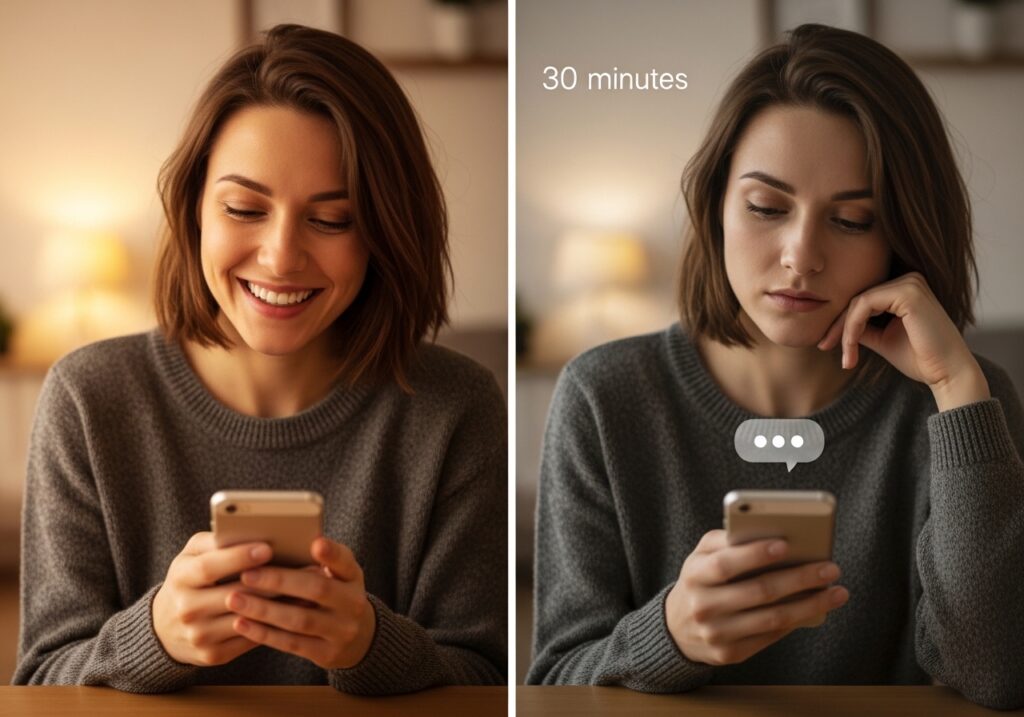
You check your phone for the fifth time in ten minutes. They haven’t replied. Your mind starts spiraling — did you say something wrong? Are they pulling away? Is this the beginning of the end? To everyone around you, the situation looks completely normal. But inside, your nervous system is in full alarm mode. If this feels painfully familiar, you may be living with anxious attachment — one of the most common and most misunderstood attachment styles in psychology. Studies suggest that roughly 20% of adults have an anxious attachment style, and many spend years in painful relationship cycles without ever understanding why. This article is for them. This article is for you.

What Is Anxious Attachment?
Anxious attachment — also called anxious-preoccupied attachment in adult attachment research — is a relational pattern in which a person craves deep intimacy and closeness but lives in near-constant fear of losing it. It is one of the four primary attachment styles identified through decades of psychological research, originating with John Bowlby’s attachment theory and expanded through Mary Ainsworth’s landmark studies.
At its core, anxious attachment is driven by a deeply held — and usually unconscious — belief: I am not enough, and the people I love will eventually leave me. Every behavior that stems from anxious attachment is, at its root, an attempt to prevent that feared outcome.
The cruel irony is that those very behaviors — the reassurance-seeking, the hypervigilance, the emotional intensity — often create the distance they were designed to prevent.
Understanding anxious attachment isn’t about labeling yourself or pathologizing your love. It’s about finally having a language for something you’ve felt your entire life — and a roadmap for changing it.
Signs You May Have Anxious Attachment
Anxious attachment shows up differently in different people, but the underlying emotional architecture is remarkably consistent. Here are the most common signs:
You need constant reassurance. A single “I love you” doesn’t land and stay — it fades quickly and needs to be replenished. You find yourself asking your partner variations of “Are we okay?” or “Do you still love me?” more often than feels comfortable to admit.
You overanalyze everything. A short text reply, a shift in tone, a slightly distant mood — your mind immediately scans for what it means about the relationship. You are a master at reading between the lines, even when there is nothing written there.
You fear abandonment intensely. Not just the normal sadness of a breakup, but a deep, primal terror of being left. This fear can make it difficult to set healthy boundaries, because saying no feels like risking rejection.
You lose yourself in relationships. Your partner’s mood becomes your mood. Their happiness becomes your project. You may neglect your own needs, friendships, and identity in service of keeping the relationship stable.
Conflict feels catastrophic. An argument doesn’t feel like a disagreement — it feels like evidence that the relationship is ending. You may escalate quickly, become emotional, or say things you don’t mean in a desperate attempt to resolve the tension immediately.
You struggle to be alone. Time alone can feel unsettling rather than restorative. Without the presence or contact of your partner, anxiety fills the space quickly.
You attract unavailable partners. There is an unconscious pull toward people who are emotionally distant or inconsistent — because the push-pull dynamic feels familiar, even when it’s painful.
You feel relief, not joy, when reassured. When your partner does reassure you, the feeling isn’t warm happiness — it’s a brief exhale of relief before the anxiety quietly begins building again.
The Art of Active Listening in Relationships: A Practical Guide
What Causes Anxious Attachment?
Anxious attachment doesn’t develop in a vacuum. It is almost always rooted in early childhood experiences — specifically in the nature of the bond between a child and their primary caregiver.
Inconsistent Caregiving
The most common origin of anxious attachment is inconsistent parenting. When a caregiver is sometimes warm, loving, and responsive — and other times distracted, emotionally unavailable, or unpredictable — the child cannot form a reliable internal model of what to expect. Sometimes reaching out for comfort works. Sometimes it doesn’t. The child learns to escalate their bids for connection — crying louder, clinging tighter, staying hypervigilant — because they never know when the next moment of warmth will come.
This hypervigilance becomes a survival strategy. And survival strategies, once wired into the nervous system, don’t simply switch off in adulthood.
Emotional Neglect
A caregiver doesn’t have to be abusive to create anxious attachment. Emotional neglect — being physically present but emotionally absent — is enough. Parents dealing with their own depression, anxiety, addiction, or emotional immaturity may love their child deeply yet consistently fail to attune to their emotional world. The child learns: my feelings are invisible, or they are too much. Neither conclusion is safe.
Early Loss or Separation
Significant early experiences of loss — the death of a parent, prolonged separation, illness, or divorce — can also lay the groundwork for anxious attachment. When a child’s primary source of security is suddenly gone or unreliable, the foundation of safe attachment cracks. The world learns to feel fundamentally unsafe.
Childhood Trauma
Traumatic experiences in childhood — including emotional, physical, or sexual abuse — can significantly contribute to anxious attachment patterns. When the people who are supposed to protect you become sources of pain, the relationship between love and suffering becomes entangled in ways that can take years to unravel.
Cultural and Generational Patterns
Attachment patterns are also passed down generationally. Parents who themselves had anxious or insecure childhoods often unconsciously recreate similar emotional environments — not out of malice, but because they never had the tools to do differently. Healing one generation has ripple effects through the next.

How Anxious Attachment Affects Your Relationships
Anxious attachment doesn’t stay in the past. It follows you into every significant relationship — romantic, platonic, and professional — shaping how you connect, what you fear, and how you behave when those fears are triggered.
The pursue-withdraw cycle. Anxiously attached people most commonly partner with avoidantly attached people — and the resulting dynamic is one of the most painful and well-documented in relationship psychology. The more the anxious partner pursues — texting, seeking reassurance, escalating emotional intensity — the more the avoidant partner withdraws. The more the avoidant withdraws, the more panicked the anxious partner becomes. Both are trapped in a cycle that neither fully understands.
Self-abandonment. In an effort to keep the relationship safe, anxiously attached people often suppress their own needs, opinions, and desires. They become whoever their partner needs them to be. Over time, this erodes self-worth and creates resentment beneath the surface of apparent harmony.
Emotional highs and lows. Relationships feel intensely alive — but also intensely unstable. The relief of reconnection after conflict can feel intoxicating, which sometimes keeps people in unhealthy relationships far longer than is good for them. The nervous system begins to associate love with emotional turbulence.
Difficulty ending relationships. Even when a relationship is clearly unhealthy, the fear of being alone — of abandonment — can make it nearly impossible to leave. Staying, even in pain, feels safer than the terrifying unknown of being without.
How to Heal Anxious Attachment
Here is the most important thing to know: anxious attachment is not a personality flaw. It is a learned response to an environment that felt unsafe. And what was learned can, with time and intention, be unlearned. Healing is not only possible — it is well-documented.
1. Build Self-Awareness First
You cannot change a pattern you cannot see. Start by learning to recognize when your anxious attachment is being triggered — not as a character defect, but as your nervous system doing what it was trained to do. When you notice the spiral beginning — the phone-checking, the catastrophizing, the urge to seek reassurance — try naming it internally: “This is my anxious attachment. This feeling is not the same as fact.”
Creating that small gap between trigger and reaction is where healing begins.
2. Develop a Relationship With Yourself
Anxious attachment is fundamentally about outsourcing your sense of safety to another person. Healing means gradually building that safety within yourself. This looks like:
- Spending intentional time alone — and learning to tolerate, then enjoy it
- Developing interests, friendships, and a sense of identity outside the relationship
- Practicing self-soothing when anxiety spikes, rather than immediately reaching for external reassurance
- Asking yourself regularly: what do I need right now — separate from what my partner thinks or feels?
3. Challenge Your Core Beliefs
Anxious attachment is sustained by deeply held beliefs: I am not enough. People always leave. I have to earn love. These beliefs feel like facts, but they are conclusions drawn by a child trying to make sense of an inconsistent world.
Cognitive Behavioral Therapy (CBT) is particularly effective at identifying and restructuring these core beliefs. Journaling can also be a powerful daily practice — asking yourself: what is the evidence for this fear? What would I say to a friend who believed this about themselves?
How to Communicate Better With Your Partner: 12 Proven Techniques

4. Learn to Self-Soothe
One of the most practical healing skills for anxious attachment is developing a personal toolkit for self-soothing — ways to calm your nervous system when anxiety spikes, without relying on external reassurance.
This might include:
- Deep breathing or box breathing exercises
- Grounding techniques — focusing on physical sensations in the present moment
- Physical movement — walking, yoga, or any exercise that brings you back into your body
- Calling a trusted friend rather than repeatedly texting your partner
- Reminding yourself of past evidence that you have survived uncertainty before
The goal isn’t to suppress emotion. It’s to build the internal resources to sit with discomfort long enough for it to pass on its own — without creating new relationship problems in the process.
5. Communicate Your Needs Directly
Anxiously attached people often communicate needs indirectly — through hinting, emotional escalation, or withdrawing to see if their partner will notice. This rarely works, and it leaves both people frustrated and confused.
Practice naming your needs clearly and calmly: “I’m feeling disconnected from you today and I’d really value some quality time together tonight. Can we make that happen?” Direct communication is vulnerable — but it is infinitely more effective than hoping your partner will decode your emotional signals correctly.
6. Work With a Therapist
Healing anxious attachment at its root — rather than just managing its surface behaviors — almost always benefits from professional support. Attachment-focused therapy, Emotionally Focused Therapy (EFT), Internal Family Systems (IFS), and trauma-informed approaches are all particularly effective.
A therapist can help you trace the pattern back to its origins, grieve what you didn’t receive in childhood, and build new internal working models of what safe, secure love actually feels like. This is deep work. It is also some of the most life-changing work a person can do.
7. Choose Relationships Wisely
Healing doesn’t happen in a vacuum — it happens in relationship. Choosing a partner who is emotionally consistent, communicative, and patient with your process is not settling. It is wisdom. A secure partner — someone who shows up reliably, communicates openly, and doesn’t use your vulnerability against you — provides a corrective emotional experience that literally helps rewire your nervous system over time.

A Note to Anyone Reading This
If you recognized yourself in these pages, please hear this: there is nothing wrong with you. You loved with everything you had in an environment that didn’t always love you back in the way you needed. You adapted. You survived. And that adaptation — however painful its consequences — was intelligent.
You are not too much. You are not broken. You are someone whose nervous system learned that love is uncertain — and you deserve the experience of discovering that it doesn’t have to be.
Healing is not about becoming someone who doesn’t feel deeply. It’s about learning to feel deeply without losing yourself in the process.
You don’t have to earn love. You never did. Healing is the slow, courageous process of learning to believe that.
💾 Save this — return to it on the hard days. 📤 Share it with someone who needs to know they’re not alone in this. 👣 Follow Truthsinside.com for more honest, psychology-backed content on love, healing, and the human mind.
Frequently Asked Questions
Q1: Can you have anxious attachment and not realize it? Absolutely — and it’s more common than you might think. Many people with anxious attachment simply believe they are “too sensitive,” “too emotional,” or “too needy” without ever understanding the deeper pattern at work. Because the behaviors feel so natural and so driven by genuine love and fear, they rarely appear as a pattern until someone points it out — or until the relationship pain becomes too great to ignore. Self-education and therapy are both powerful tools for developing this awareness.
Q2: Is anxious attachment a mental health disorder? No. Anxious attachment is not a diagnosis or a disorder — it is an attachment style, which is a relational pattern. However, it does overlap significantly with anxiety disorders, depression, borderline personality traits, and trauma responses in some individuals. If your anxious attachment is severely impacting your mental health, daily functioning, or relationship stability, it is worth exploring with a mental health professional who can assess the full picture.
Q3: Can an anxiously attached person be happy in a relationship? Yes — deeply so. Awareness is the turning point. Anxiously attached people who understand their pattern, communicate their needs directly, and choose emotionally available partners can build extraordinarily rich, loving relationships. The intensity of feeling that characterizes anxious attachment — when channeled healthily — can become one of the most beautiful qualities a partner could offer: depth, passion, and a profound capacity for love.
Q4: What is the best therapy for anxious attachment? Several therapeutic approaches are particularly effective. Emotionally Focused Therapy (EFT) — developed by Dr. Sue Johnson — is widely considered the gold standard for attachment healing in adults and couples. Internal Family Systems (IFS) is powerful for understanding the different “parts” that drive anxious behavior. Trauma-informed CBT can help restructure the core beliefs that sustain the pattern. The best therapy is ultimately the one you commit to consistently with a therapist you trust.
Q5: How long does it take to heal anxious attachment? There is no fixed timeline — healing is not linear, and it varies enormously depending on the depth of the original wound, the consistency of therapeutic support, and the quality of relationships in your life. Many people report meaningful shifts within months of beginning intentional work. Deeper healing — particularly when rooted in significant childhood trauma — may take years. What matters most is not the speed but the direction. Every step toward self-awareness and self-compassion is a step toward secure attachment.