There is a specific kind of confusion that settles into a relationship like a slow fog — not dramatic enough to name, not obvious enough to confront, but persistent enough to keep you awake at 2 a.m. staring at the ceiling wondering why something feels off. You haven’t caught your partner kissing anyone. There are no lipstick stains, no hotel receipts, no smoking gun. But something has shifted, and your gut — that ancient, brutally honest part of you — refuses to let it go. What you may be experiencing are micro-cheating red flags, and dismissing them could be the most expensive mistake you make in your relationship.
Research published in the Journal of Social and Personal Relationships found that emotional betrayal — the kind that doesn’t involve physical contact — registers as equally devastating to relationship trust as physical infidelity, and in many cases, more so. A separate study from the University of Michigan found that secretive digital communication with a person outside the relationship was among the top predictors of eventual infidelity escalation. Micro-cheating is not a harmless gray area. It is a pattern — and patterns have destinations.
The reason micro-cheating red flags are so dangerous is precisely because they are designed — consciously or not — to be deniable. Every individual behavior can be explained away. But when you step back and look at the full picture, the image that forms is one of divided loyalty, hidden intimacy, and a partner whose emotional energy is flowing somewhere it doesn’t belong. This article is going to show you exactly what that picture looks like — and what to do when you recognize it.
What Exactly Is Micro-Cheating?
Before diving into the red flags, it’s important to define the territory. Micro-cheating refers to a series of small, seemingly minor behaviors that, individually, might appear innocent — but collectively represent a significant emotional or romantic investment in someone outside the relationship.
It is not a single flirtatious comment or a harmless compliment. It is the pattern. It is the secrecy. It is the fact that your partner is consistently allocating emotional intimacy, attention, or romantic energy to another person while keeping that connection hidden from you.
Micro-cheating lives in the space between “technically nothing happened” and “but it still feels like a betrayal.” And that space? It is not nothing. It is where trust quietly bleeds out.
9 Micro-Cheating Red Flags You Need to Stop Dismissing
1. They Guard Their Phone Like It Holds State Secrets
Everyone values privacy. That is healthy and reasonable. But there is a meaningful difference between privacy and secrecy — and one of the clearest micro-cheating red flags is a sudden, dramatic shift in how your partner handles their phone.
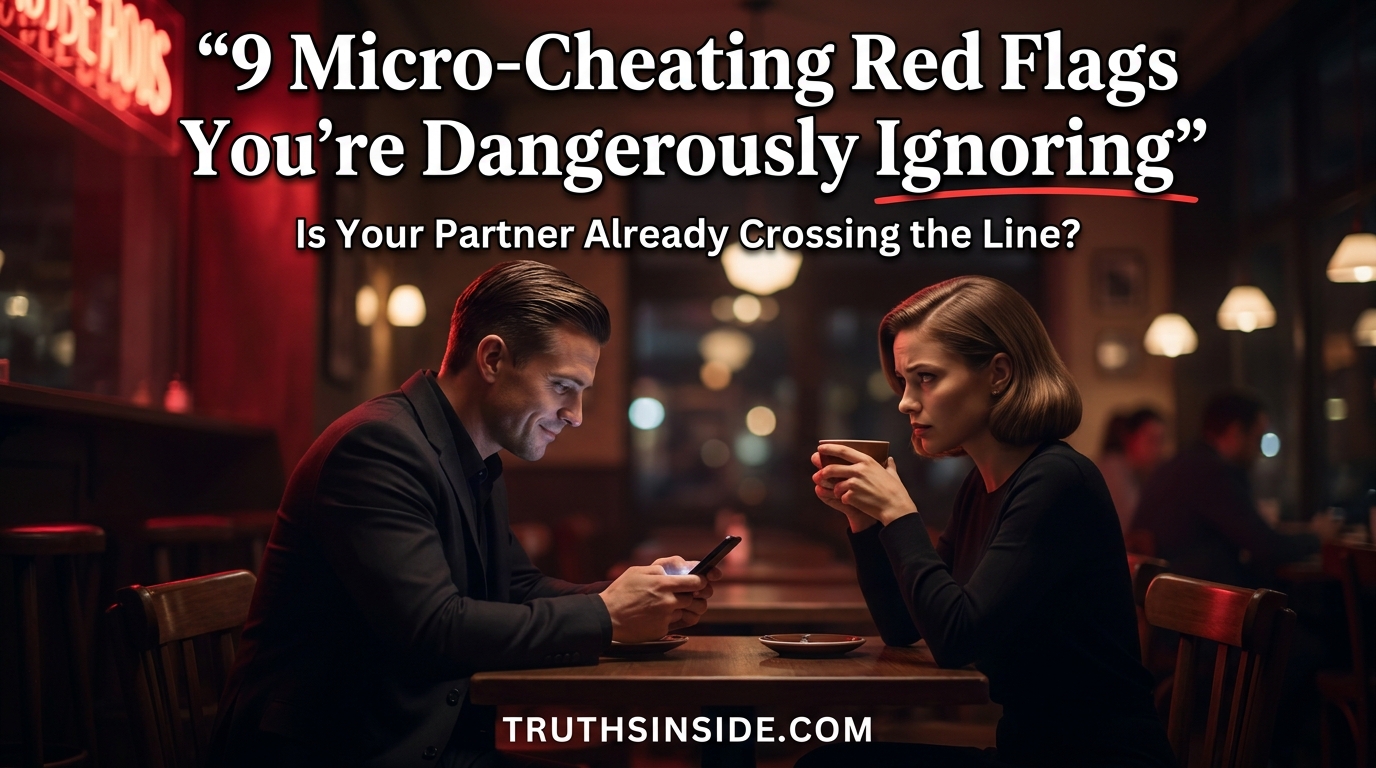
If the phone is always face-down, always taken into the bathroom, always angled away from you when a notification arrives — pay attention. If they used to leave their phone on the table without a second thought and now it never leaves their hand, something has changed. It is not the phone that has changed. It is what is on it.
The secrecy itself is the red flag. A person with nothing to hide does not hide everything.
2. There Is a Person They Mention Just a Little Too Often
Or perhaps more telling — a person they deliberately never mention, even though your instincts tell you this person is present in their daily life. Both patterns carry weight.
When someone is developing an emotional connection outside the relationship, that person tends to occupy mental real estate. They slip into conversations. They become a reference point. “Oh, Jamie would love this restaurant.” “That’s something Alex would say.”
On the flip side, if you discover through a notification or a passing comment that your partner has regular contact with someone they have never once mentioned to you — that deliberate omission is its own kind of message. People don’t hide what isn’t worth hiding.
3. They Are Emotionally Generous With Someone Else and Emotionally Absent With You
This is one of the most painful and most overlooked micro-cheating red flags. Your partner is funny, warm, attentive, and emotionally present — just not with you. You watch them light up during a phone call. You see the energy in their texts. You hear them laugh in a way you haven’t heard directed at you in months.
Emotional energy is not infinite. When a significant portion of your partner’s warmth, humor, and attentiveness is flowing toward someone else, what reaches you is the remainder — the leftover. You are not imagining the emotional distance. You are experiencing the math of divided loyalty.
“Micro-cheating doesn’t announce itself with dramatic betrayal. It arrives quietly — in the brightness of someone’s eyes when a particular name lights up their screen, and the dimness you feel standing right beside them.”
4. They Minimize or Mock Your Concern About This Person
You bring it up once — carefully, trying not to sound accusatory — and the response you receive is dismissal. Eye rolls. Sighs. “You’re being insecure.” “We’re just friends, I can’t believe you’re making this a thing.” “You’re so jealous.”
The issue is not whether the relationship with the other person is technically innocent. The issue is how your partner responds to your expressed concern. A partner who respects you and values your emotional safety will take your feelings seriously, even if they disagree. A partner who is invested in keeping a particular connection protected will make you feel irrational for noticing it.
Making you feel crazy for asking a reasonable question is not reassurance. It is a strategy.
5. They Present Themselves as Single in Online or Social Spaces
Does your partner’s social media presence reflect the fact that they are in a relationship? Do they post about your relationship at all, or are they carefully curating a persona that keeps their “availability” ambiguous?
This is one of the micro-cheating red flags that the digital age has made newly relevant. A partner who keeps their relationship status hidden, never references you in public posts, responds to flirtatious comments from others, or maintains a social presence that communicates singlehood is actively choosing to project a false image to potential romantic interests.
It does not matter if they claim they “just don’t like posting personal stuff.” Context is everything. If they post freely about other areas of their life but specifically omit you — that omission is a choice, and choices reveal priorities.

6. Conversations With This Person Happen in Secret or Get Deleted
Transparency is one of the foundational behaviors of a trustworthy partner. When communication with a specific person consistently happens out of your sight — late at night after you fall asleep, during bathroom breaks, in a separate messaging app — and when you happen to notice that conversation threads are regularly cleared or deleted, you are not looking at privacy. You are looking at concealment.
Healthy friendships do not require a deletion strategy. They do not require a partner to wait until you leave the room. The act of hiding a conversation is an acknowledgment — conscious or not — that the content of that conversation would not sit well with you. That awareness, and the choice to hide rather than be honest, is itself a form of betrayal.
7. They Compare You to This Person — Unfavorably
“She never makes a big deal about stuff like this.” “He’s so easy to talk to.” “You should be more like — never mind.”
When your partner begins using someone outside the relationship as a measuring stick against which you consistently fall short, it is one of the most corrosive micro-cheating red flags on this list. It signals not only that an emotional attachment exists, but that it has developed to the point where the other person has become idealized — and you have become the problem by comparison.
No one who is fully emotionally invested in their relationship reaches for comparisons like this. These comments leak from a mind that is building a case — justifying an emotional investment that it knows it shouldn’t have.
8. Physical and Emotional Intimacy With You Has Noticeably Declined
When someone is investing romantic or emotional energy elsewhere, that withdrawal shows up in the relationship they are in. Fewer spontaneous touches. Less meaningful conversation. Sex that feels mechanical or has become increasingly rare. The quiet disappearance of all those small moments of connection that once made the relationship feel alive.
This shift alone does not confirm micro-cheating — many factors affect intimacy. But combined with other signs on this list, a noticeable and unexplained decline in emotional and physical closeness is a significant data point. Emotional energy has a source and a destination. When the destination has changed, the source feels it.

9. Your Gut Has Been Trying to Tell You Something for a While
This one is last on the list but arguably the most important. Intuition is not superstition. It is pattern recognition operating below the level of conscious thought — your brain processing hundreds of micro-signals and arriving at a conclusion before your logical mind has caught up.
If you have felt, for weeks or months, that something is wrong without being able to fully name it — if you feel a low-grade anxiety around your partner’s phone, a tightening in your chest when a particular name comes up, a sense that you are being kept on the outside of something — trust that signal.
Gaslighting, whether from a partner or from your own desire to believe the best, cannot silence intuition permanently. It only delays the reckoning. Listen to what your body already knows.
Why People Dismiss Micro-Cheating Red Flags
Understanding why these signs get rationalized away is just as important as recognizing them. There are several powerful psychological mechanisms at play.
Fear of being wrong — The consequences of raising these concerns feel enormous. If you’re mistaken, you risk conflict, embarrassment, or damaging the relationship. So doing nothing feels safer.
Fear of being right — Even more paralyzing is the possibility that your instincts are accurate. If the red flags are real, the relationship is in serious trouble. Some part of the mind would rather live in comfortable uncertainty than face a painful truth.
The minimization trap — Each individual behavior, examined in isolation, seems small. “It’s just a text.” “They’re just friends.” “It’s nothing.” But you are not dealing with isolated incidents. You are dealing with a pattern — and patterns tell a different story than individual moments do.
Sunk cost reasoning — Years invested. A life built together. The idea of unraveling it all based on “feelings” feels disproportionate. So the feelings get buried instead. Until they can no longer be contained.
“The most dangerous red flag is not the one you see and ignore — it is the one you see, rationalize away, and then blame yourself for noticing in the first place.”
What To Do When You Recognize These Signs
Have the Honest Conversation
Not an accusation. Not a courtroom interrogation. An honest, vulnerable conversation rooted in your own experience. Use “I” language: “I’ve been feeling disconnected lately and I notice I feel anxious when you’re on your phone. Can we talk about that?” You are not presenting evidence. You are opening a door.
A partner who loves and respects you will walk through that door with you. A partner who is defensive, dismissive, or turns the conversation back on you as the problem — is showing you exactly what you need to see.
Trust Your Pattern Recognition, Not Just Individual Incidents
Stop evaluating each behavior in isolation and start looking at the constellation. One star is just a star. But when nine of them align in the same direction, you are looking at something. Step back from the individual trees and look at the forest.
Establish Clear Relational Agreements
Many couples have never explicitly defined what constitutes betrayal in their relationship. Have that conversation. Define your boundaries around digital communication, emotional intimacy with others, and social media. Not as a system of control — but as an act of mutual clarity and respect. You cannot enforce a boundary that was never spoken.

Know the Difference Between Working Through It and Accepting It
There is meaningful space between ending a relationship and tolerating behavior that erodes your self-respect. Couples therapy, honest communication, and genuine accountability can create real change — but only if both partners are willing participants. If your partner refuses to acknowledge the pattern, dismisses your experience, and continues the behavior without remorse — you are not in a repair process. You are in a slow erosion.
You are allowed to decide what you will and will not accept. That is not jealousy. That is self-knowledge.
FAQ Section
Q1: Is micro-cheating really as serious as physical cheating?
Research suggests yes — in many cases, emotional infidelity causes equal or greater psychological damage than physical cheating because it involves the deliberate redirection of intimacy, connection, and investment toward another person. The absence of physical contact does not neutralize the betrayal of trust.
Q2: What if my partner says I’m just being insecure and jealous?
There is an important distinction between insecurity that exists without evidence and concern that is rooted in observable behavioral changes. If you have noticed specific, consistent patterns — not just a general fear — your concern is valid. A partner who responds to genuine concern exclusively with dismissal and blame is not engaging with you honestly.
Q3: Can micro-cheating escalate into full infidelity?
Yes — and research supports this. Emotional connections that begin in the micro-cheating space frequently escalate when boundaries are not established and accountability is not introduced. The behavior follows a progression. Catching the pattern early gives both partners the opportunity to address it before that escalation occurs.
Q4: What if the person they’re texting is an old friend or ex?
The nature of the relationship matters less than the behavior around it. Secrecy, defensiveness, deletion of messages, and emotional withdrawal from you are the red flags — regardless of who is on the other end of the phone. Friends and exes can exist in someone’s life without any of those behaviors. When those behaviors are present, the relationship — whatever its label — warrants a conversation.
Q5: How do I bring this up without sounding paranoid?
Root the conversation in your own feelings rather than accusations. Say what you have noticed and how it has made you feel. Avoid ultimatums in the opening conversation. The goal of the first conversation is not a confession — it is an honest exchange. If your partner is genuinely invested in the relationship, they will receive your vulnerability with care, not contempt.
Final Thoughts
Micro-cheating red flags are not small just because they are subtle. They are small by design — small enough to be dismissed, rationalized, and buried until the damage is too deep to repair. The fact that you are reading this article means some part of you already knows that what you are experiencing deserves to be taken seriously. That instinct is not paranoia. It is self-respect in its earliest form.
You deserve a relationship built on full transparency, not deniable half-truths. You deserve a partner whose emotional energy lives inside your relationship, not outside it looking in. And you deserve the clarity to know the difference between what you are being told and what is actually true.
Save this article so you can come back to it when doubt starts to creep in again.
Share it with someone who needs permission to trust what they already feel.
Follow Truthsinside.com for more honest, research-backed content on red flags, relationships, and the psychology of love that actually tells you the truth.
Related article: Gaslighting in Relationships: How to Recognize, Name, and Leave It
🎵 Music
Maren Lull is a singer-songwriter who writes from the places most people don’t talk about out loud.
Not the dramatic grief. Not the obvious heartbreak. The quiet kind — the ordinary Tuesday emptiness, the habit of reaching for someone who isn’t there anymore, the particular exhaustion of being strong for so long that the strength itself wears thin.
Her music lives at the intersection of emotional honesty and soft beauty — breathy vocals over gentle piano, slow tempos, lyrics that feel less like songs and more like something you wrote in a private notebook at two in the morning and never showed anyone.
Maren Lull writes for the people who feel everything deeply and say very little about it. For the ones who listen to sad music not because they want to feel worse — but because being understood, even by a song, makes the feeling easier to carry.
📱 Follow Maren Lull:
→ Spotify
→ Apple Music
→ Youtube
→ Audiomack