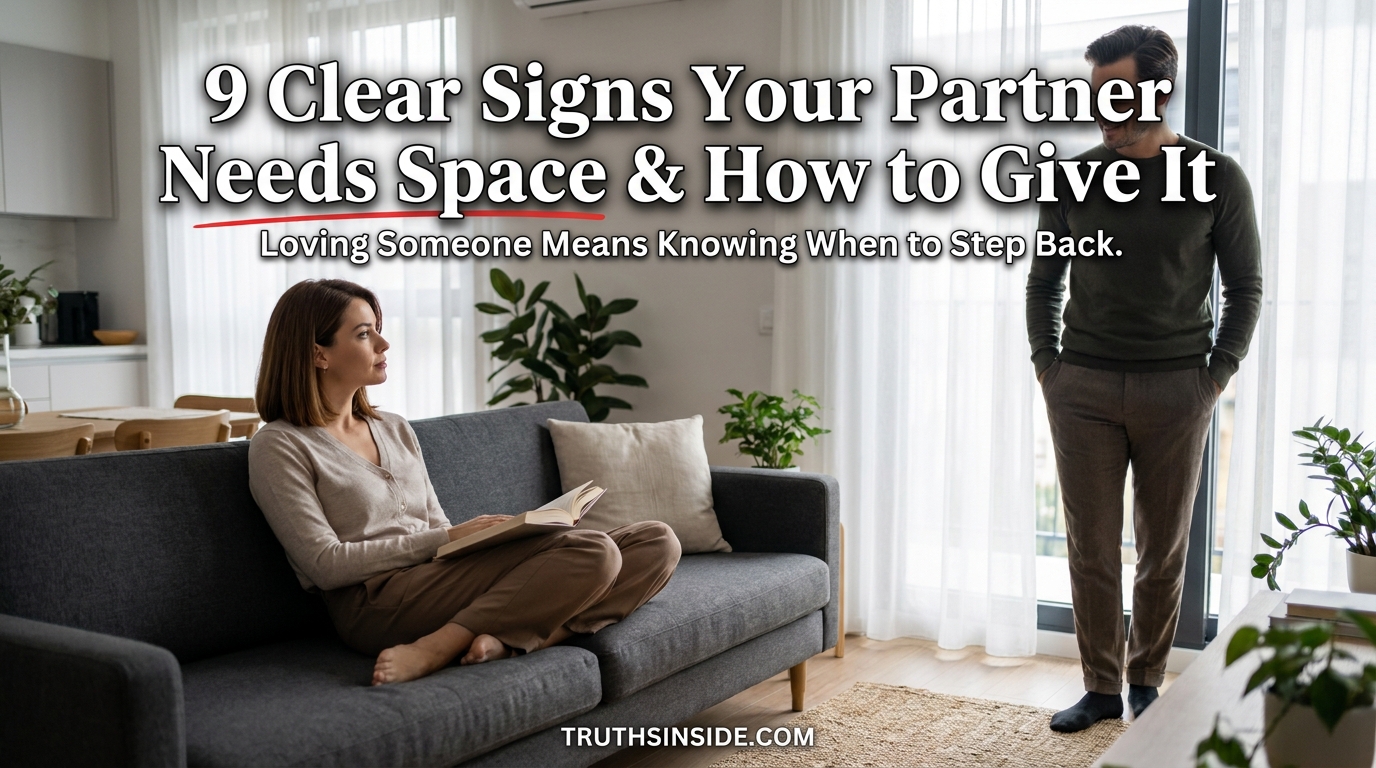
There is a specific anxiety that sets in when the person you love starts to feel a little further away than usual. They are still there — still in the same house, still sleeping in the same bed — but something has shifted. They are quieter. They are less responsive. They seem to need more time alone, more silence, more room to breathe. And the very human, very understandable response to that shift is to move closer — to ask more questions, to check in more frequently, to try to close the gap with presence and words.
But what if that instinct, however loving its source, is precisely the wrong move? Recognizing the signs your partner needs space — and knowing how to give it gracefully — is one of the most emotionally sophisticated skills a person in a relationship can develop.
According to research published in the Journal of Personality and Social Psychology, the need for autonomy within a relationship is not a sign of disengagement — it is a fundamental psychological need that, when honored, actually strengthens long-term relationship satisfaction and emotional intimacy. A separate study from the University of Michigan found that partners who felt their need for personal space was respected by their significant other reported 34% higher relationship satisfaction scores than those whose need for solitude was met with anxiety, pressure, or guilt. Space, in other words, is not the enemy of closeness. When given correctly, it is one of its most powerful builders.
The challenge is that needing space and pulling away look deceptively similar from the outside — and the difference between the two has enormous implications for how you respond. Misreading the signs your partner needs space as rejection, disinterest, or impending abandonment leads to exactly the kind of anxious pursuit that pushes a partner further into withdrawal. Understanding what is actually being communicated — and how to respond in a way that strengthens rather than strains the relationship — begins with learning to read the signals correctly.
Why Some People Need More Space Than Others
Before identifying the signs, it is worth understanding the psychology behind why individuals differ so significantly in their need for personal space and solitude.
Attachment theory — developed by psychologist John Bowlby and later expanded by Mary Ainsworth — identifies distinct attachment styles that form in early childhood and significantly influence how adults behave in intimate relationships. People with an avoidant attachment style are wired to value independence highly and can feel genuinely overwhelmed by too much closeness or emotional intensity. For them, space is not withdrawal — it is regulation. It is how they return to a stable emotional baseline so they can re-engage with connection.
Beyond attachment style, introversion plays a significant role. Introverts — roughly 30 to 50 percent of the population according to research by Susan Cain — are neurologically wired to find sustained social interaction, even with people they love deeply, energetically depleting. They recharge through solitude, not togetherness. This is not a personality flaw. It is a neurological reality that requires understanding and accommodation from their partner.
Additionally, life stressors — work pressure, grief, health challenges, family demands — can temporarily increase anyone’s need for psychological space, regardless of attachment style or personality type. Recognizing that a request for space is often about internal regulation rather than external rejection reframes the entire dynamic and makes it possible to respond with wisdom rather than fear.
9 Clear Signs Your Partner Needs Space
1. They Have Become Noticeably Quieter Than Usual
One of the most consistent and earliest signs your partner needs space is a shift in verbal communication. Not silence born of anger or punishment — but a quietness that feels more internal than interpersonal. They are not giving you the silent treatment. They simply seem to have retreated inward.
They may respond to questions with shorter answers. They may not initiate conversation the way they usually do. They may seem lost in thought during moments that would normally invite connection. This is often the nervous system’s way of signaling that it needs less input, less engagement, and more room to process whatever is happening internally.
The instinct in these moments is to fill the silence — to ask what’s wrong, to try to draw them out, to interpret the quiet as a problem to be solved. But silence that comes from a need for space is not a problem. It is a communication. And the most respectful response is to meet it with calm rather than urgency.
2. They Are Spending More Time on Solitary Activities
When a partner suddenly develops a stronger interest in solo activities — reading alone, going for walks without you, spending more time in a separate room, exercising alone when they used to invite you — this behavioral shift is one of the clearest signs your partner needs space.
They are not choosing the activity over you. They are choosing the solitude that the activity provides. There is a meaningful difference. These solitary pursuits are a form of self-restoration — a way of refilling emotional reserves that have become depleted.
Responding to this with hurt or guilt — “You never want to do anything with me anymore” — communicates that their need for restoration is a problem for you, which creates pressure and resentment. Responding with genuine support — “Enjoy your walk, I’ll be here when you get back” — communicates safety, and paradoxically draws your partner closer over time.
3. They Seem Overwhelmed by Small Decisions or Interactions
When someone is running low on emotional and psychological resources, even minor demands can feel disproportionately heavy. If your partner seems irritated by small questions, overwhelmed by minor decisions, or unusually fatigued by normal social interactions — this is frequently a sign that their internal reserves are depleted and they need space to recover.
This is not moodiness for its own sake. It is the behavioral expression of a nervous system that has reached its capacity. Every additional question, request, or demand — however small — lands on a system that is already at its limit. What looks like irritability is often exhaustion wearing a sharper edge.

4. Physical Affection Has Decreased Without Any Clear Conflict
A noticeable reduction in physical touch — fewer spontaneous hugs, less hand-holding, a pulled-back quality to intimacy — that happens without any preceding argument or identified issue is one of the subtler signs your partner needs space. The body often communicates what words have not yet said.
When someone is overwhelmed, overstimulated, or emotionally saturated, physical touch can feel like one more demand on a system that is already at capacity. It is not a withdrawal of love — it is the body drawing a temporary boundary around its sensory experience.
This is particularly important to understand because many partners interpret decreased physical affection as a sign that love is fading, leading to increased pursuit of touch, which creates the exact pressure that makes the need for space more acute. Giving breathing room at the physical level, without making it a source of anxiety or conversation, is often the fastest path back to natural, willing closeness.
5. They Are Less Emotionally Available for Deep Conversations
Your partner used to be able to sit with you through complex emotional conversations. Now they seem to check out, give surface-level responses, or actively redirect away from depth and vulnerability. This shift in emotional availability is a significant signal.
When internal resources are depleted, emotional processing becomes genuinely difficult. The capacity for empathy, for holding complexity, for engaging with vulnerability — all of these require psychological energy. When that energy is low, a person naturally retreats to shallower emotional waters not because they no longer care, but because deep water currently requires more than they have to give.
Forcing deep conversations during these periods tends to produce defensiveness, shutdown, or conflict — none of which move the relationship forward. Recognizing the signal and giving your partner permission to engage less deeply for a period, without withdrawing your own warmth, is the emotionally intelligent response.
6. They Become Easily Overstimulated in Social Situations
If your partner has started declining social invitations more frequently, seems drained after gatherings that used to energize them, or appears withdrawn during events rather than engaged — pay attention. This behavioral pattern often signals that their general tolerance for stimulation has decreased, and they are protecting their limited reserves by reducing input.
This is especially common during periods of high stress, major life transitions, or after sustained periods of emotional intensity within the relationship itself. The world, including the social world, becomes temporarily too loud — and home, solitude, and quiet become the primary sources of recovery.
“Giving your partner space is not the same as giving up on them. It is the practice of loving them in the language their nervous system is speaking — and trust, in any relationship, is built not just in closeness, but in the safety to step back.”
7. They Express Feeling Overwhelmed or Overstretched — Even About Unrelated Things
Listen carefully to what your partner says about their life outside the relationship. When someone begins expressing that they feel overwhelmed by work, by responsibilities, by the pace of life — this is a direct communication of their internal state that will inevitably affect the relationship dynamic.
A partner who feels overstretched in life will naturally have less to bring to the relationship — less patience, less presence, less emotional availability. This is not about you. It is about capacity. And the most supportive response is to temporarily reduce the relational demands you place on them — fewer expectations around togetherness, fewer emotional processing conversations, fewer requests for engagement — while maintaining your own warmth and stability.
This is one of the most loving things one partner can do for another: to accurately read the signals and say, without resentment, “I see you’re carrying a lot right now. I’ve got us. Take what you need.”
8. They Explicitly Ask for Time Alone — But Seem Uncomfortable Doing So
Some partners will actually voice their need for space — but do so hesitantly, apologetically, or with visible discomfort, as though the request itself is something to be ashamed of. This is one of the most direct signs your partner needs space, and also one of the most important to receive gracefully.
When a partner works up the courage to ask for space and is met with hurt, guilt, or interrogation — “Why do you need to be alone? Is something wrong with us? Did I do something?” — they receive the message that their needs are a burden. Over time, they learn not to ask. Instead, they begin to take space covertly — becoming more withdrawn, less communicative, more distant — because the direct request has been demonstrated to be unsafe.
How you receive this request matters enormously. “Of course — take all the time you need. I’ll be here” is not just generous. It is relationship-building in its most practical form.
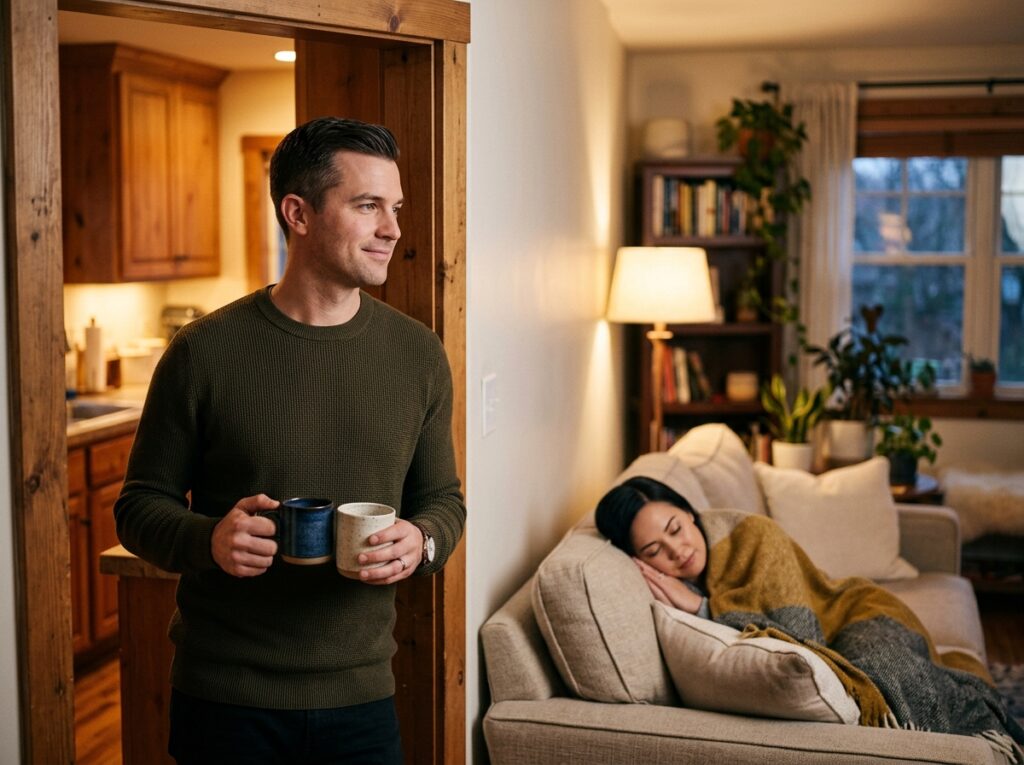
9. Your Gut Tells You They Need Room — Even If You Can’t Name Why
Relational intuition is a real and well-documented phenomenon. Research in interpersonal neurobiology suggests that long-term partners develop an extraordinary sensitivity to each other’s nervous system states — often registering shifts in their partner’s emotional needs before those needs are consciously articulated or behaviorally obvious.
If something tells you — quietly, persistently — that your partner needs room right now, trust that signal. Not as an excuse to withdraw your love or to make them feel abandoned, but as information that guides you toward a response of gentle, spacious presence rather than close pursuit.
Intuition in a relationship is not paranoia. It is attunement — and attunement, honored and acted upon, is one of the deepest forms of love a partner can offer.
How to Give Space Without Losing the Connection
Recognizing the signs your partner needs space is only half the equation. The other half — the part that actually determines whether space heals the relationship or creates dangerous distance — is how you give it.
Communicate Before You Create Distance
Before physically or emotionally pulling back, say something simple and reassuring. “I can see you need some time to yourself — I’m going to give you that space and I’ll be here when you’re ready.” This brief statement does something critically important: it reframes the upcoming distance as an act of love rather than abandonment, and it removes the anxiety your partner might feel about whether you are hurt or distant yourself.
Space given without communication can feel like punishment or withdrawal. Space given with a warm, explicit acknowledgment feels like understanding. The difference in how it is received is enormous.
Tend to Yourself During the Space
One of the most common mistakes people make when giving their partner space is waiting. Sitting by the phone. Monitoring signals of when they might be ready to reconnect. This places your entire emotional equilibrium in your partner’s hands and creates a pressure they can feel even from a distance.
Instead, use the time actively and genuinely. Reach out to your own friends. Pursue something you enjoy. Exercise. Create. Rest. When you fill your own time with genuine engagement, two things happen: you do not experience the space as loss, and you return to your partner as a fuller, more interesting, more grounded person — which is far more attractive and connecting than someone who has been sitting in anxious wait.
Resist the Urge to Check In Repeatedly
Giving space and then immediately undermining it with repeated check-ins — “Are you okay?” “Do you need anything?” “Just making sure you’re alright” — is not giving space. It is surveillance dressed in caring language. Your partner feels the monitoring even when it is gentle, and it defeats the entire purpose of the distance.
Set an internal agreement with yourself about when you will next reach out, and then honor it. One check-in, warm and brief, and then genuine trust in the space you have given. That trust is the actual gift.
“The partner who can give space without making it feel like abandonment — who can step back with love rather than hurt, and wait with trust rather than anxiety — is the partner whose presence becomes something the other person cannot imagine losing.”
Make Re-Entry Safe and Pressure-Free
When your partner begins moving back toward connection — initiating conversation, seeking physical closeness, becoming more communicative — meet them with warmth rather than a list of needs that accumulated while they were away. Do not immediately process the space, analyze what it meant, or express all the feelings you held during it.
Let the reconnection happen organically. A smile. A gentle touch. Simple togetherness before depth. The conversation about the space, if it is needed at all, can come later — when both of you are settled back into the safety of connection.
The re-entry experience significantly shapes whether your partner feels safe to ask for space again in the future. If coming back is met with relief and ease, they will ask earlier next time — which means the need is addressed before it becomes withdrawal. If re-entry is met with emotional processing and accumulated grievances, the partner learns that the cost of space is a debt to be paid on return.

Know the Difference Between Space and Avoidance
There is an important distinction between a partner who needs temporary space to regulate and restore, and a partner who is using the concept of “needing space” to avoid genuine relational issues, difficult conversations, or accountability. Space as restoration is healthy. Space as a chronic escape from intimacy is a pattern worth examining.
Healthy space has a natural rhythm — a period of distance followed by genuine re-engagement and increased closeness. It does not leave the relationship in a perpetual state of emotional distance or leave one partner chronically feeling alone and unimportant.
If space is being used as a recurring exit from connection rather than a temporary path back to it, that is no longer a signal to honor — it is a pattern to address, ideally with the support of a couples therapist who can help identify what is actually driving the avoidance.
FAQ Section
Q1: How much space is normal to need in a healthy relationship?
There is no single universal standard — it varies significantly by individual personality, attachment style, and life circumstances. What matters most is that both partners feel their needs are understood and respected. Research suggests that couples who openly communicate about their individual space needs and reach conscious agreements around them report significantly higher relationship satisfaction than those who operate on unspoken assumptions.
Q2: How do I give my partner space without feeling anxious or abandoned myself?
This is one of the most honest and important questions in this context. The anxiety that arises when a partner needs space is often rooted in your own attachment patterns. Working with a therapist individually to understand your attachment style and develop self-regulation tools can be transformative. In the immediate term — staying genuinely busy, maintaining your own social connections, and reminding yourself that space is a relational tool rather than a rejection signal are all effective strategies.
Q3: What if my partner says they need space but won’t tell me why?
Respect the request without requiring a full explanation as the price of compliance. A simple “I understand — I’m here whenever you’re ready” honors both their need and your openness. If the pattern is persistent and unexplained space becomes the dominant relational dynamic, that warrants a gentle but direct conversation: “I want to understand what you need. Can we talk about what’s going on when you have a little more energy?”
Q4: Can needing too much space signal a deeper relationship problem?
It can — particularly if the need for space has escalated over time, is accompanied by other signs of emotional withdrawal, or consistently follows requests for intimacy or connection. In these cases, the space-seeking behavior may be an avoidant response to intimacy rather than a genuine restoration need. A couples therapist can help distinguish between healthy autonomy and avoidant attachment patterns.
Q5: How do I stop taking my partner’s need for space personally?
By consistently reminding yourself — and reinforcing this understanding through reading, therapy, or conversation — that a need for space is a statement about internal state, not a judgment of your worth or desirability as a partner. It helps to ask your partner, during a connected moment, to reassure you of this explicitly: “Can you remind me, when you need time alone, that it isn’t about us?” That pre-agreed reassurance becomes an anchor when the anxiety rises.
Final Thoughts
Learning to recognize the signs your partner needs space — and responding with grace rather than anxiety — is not a passive act. It is an active, skilled, deeply loving practice that requires self-awareness, emotional regulation, and genuine trust in the strength of your bond. It asks you to resist the most natural impulse — to close the gap — and instead hold yourself steady while your partner takes what they need to come back to you fully.
The couples who master this do not love each other less. They love each other with more sophistication. They have learned that closeness is not constant physical and emotional proximity — it is the unshakeable knowledge that there is always a safe place to return to, no matter how far inward either of you has needed to go.
That kind of love — spacious, patient, secure — is not built in the moments of closeness alone. It is built in the moments of respectful distance, where one partner says without words: I trust you enough to let you go, because I know you well enough to know you’ll come back.
Save this article for the next time your partner pulls back and you feel the anxiety rising.
Share it with someone who is learning to love someone who needs room to breathe.
Follow Truthsinside.com for more psychology-backed relationship content that helps you love smarter, not just harder.
Related article: The 5 Love Languages Explained: Which One Are You?
🎵 Music
Maren Lull is a singer-songwriter who writes from the places most people don’t talk about out loud.
Not the dramatic grief. Not the obvious heartbreak. The quiet kind — the ordinary Tuesday emptiness, the habit of reaching for someone who isn’t there anymore, the particular exhaustion of being strong for so long that the strength itself wears thin.
Her music lives at the intersection of emotional honesty and soft beauty — breathy vocals over gentle piano, slow tempos, lyrics that feel less like songs and more like something you wrote in a private notebook at two in the morning and never showed anyone.
Maren Lull writes for the people who feel everything deeply and say very little about it. For the ones who listen to sad music not because they want to feel worse — but because being understood, even by a song, makes the feeling easier to carry.
📱 Follow Maren Lull:
→ Spotify
→ Apple Music
→ Youtube
→ Audiomack