
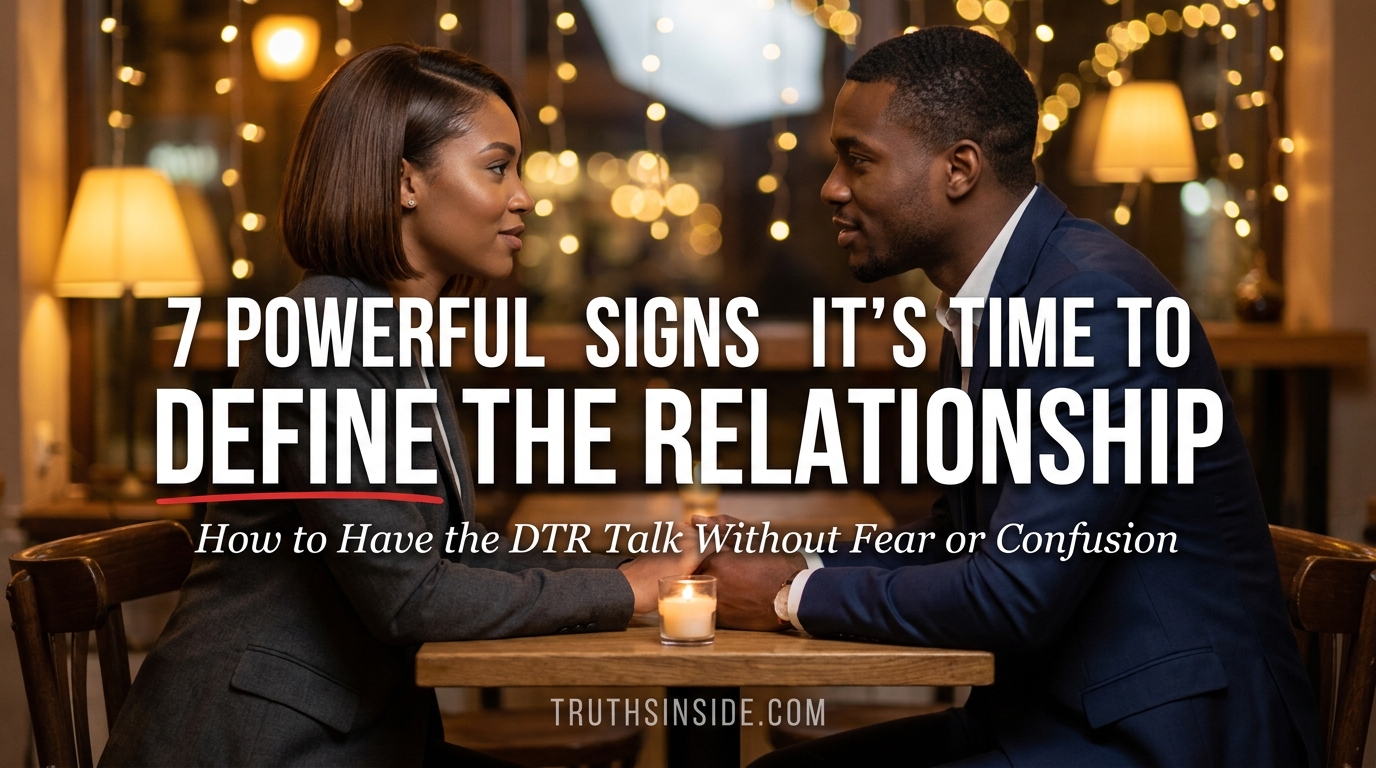
You’ve been seeing each other for weeks — maybe months. The texts come in every morning. The weekends belong to each other. The laughter feels real, the chemistry undeniable. But somewhere in the back of your mind, a quiet question is growing louder: What are we?
You are not alone in this. According to a 2022 survey by the dating app Hinge, over 63% of users admitted they stayed in an undefined relationship longer than they were comfortable with — simply because they were afraid of what the conversation might cost them. That fear is real, deeply human, and completely understandable. But staying silent doesn’t make the uncertainty disappear. It just lets it build walls between two people who might genuinely want the same thing.
This article is here to help you define the relationship — not with pressure or ultimatums, but with confidence, clarity, and emotional intelligence. Whether you’re three weeks in or three months deep, knowing when and how to have the DTR (Define the Relationship) talk could be the single conversation that either saves your situationship or transforms it into something real.
What Does “Define the Relationship” Actually Mean?
Before diving into the signs, let’s get clear on what it means to define the relationship in the modern dating world. The DTR talk is a direct, intentional conversation between two people about the nature and direction of their connection. It answers the questions that neither person has officially said out loud — Are we exclusive? Are we dating seriously? Are we working toward something?
It is not an interrogation. It is not a pressure campaign. At its best, the DTR conversation is an act of self-respect and mutual honesty. It removes the guessing game and replaces anxiety with clarity — whether the outcome is what you hoped for or not.
In today’s era of situationships, talking stages, and “we’re not a thing but we act like one,” defining the relationship has become more necessary than ever. People deserve to know where they stand. And the longer you wait, the more emotionally invested you become without any foundation beneath your feet.
Why People Avoid the DTR Talk
Let’s be honest: most people avoid this conversation because they are terrified of the answer. There is a particular kind of vulnerability in saying “I want more with you” — because the moment you say it, the other person has power. They can say yes, and your world gets brighter. Or they can hesitate, and your heart has to figure out what to do with that.
Psychologist Dr. Brené Brown has written extensively about how humans avoid vulnerability to protect themselves from disappointment. The DTR talk is one of the most emotionally naked moments in early dating. You’re essentially saying: I value this enough to risk losing it by naming it.
Beyond fear, many people avoid the talk because of social scripts that say showing interest too early makes you seem “desperate” or “clingy.” Modern dating culture has created a strange environment where both people often want the same thing but race to appear like they want it less. The result? A connection that quietly dies because neither person had the courage to say what they actually felt.
“The relationship you’re afraid to define is usually the one you care about most. That fear isn’t weakness — it’s proof that it matters.”
The 7 Powerful Signs It’s Time to Define the Relationship
Sign 1: You’ve Been Consistently Seeing Each Other for 4–8 Weeks or More
Time alone doesn’t define readiness, but consistency does. If you’ve been spending real, quality time together — not just late-night texts but actual dates, plans, and shared experiences — for a consistent stretch of four to eight weeks or more, that is a meaningful indicator that the connection has moved past casual.
Research from the Journal of Social and Personal Relationships suggests that emotional attachment begins forming significantly between the four and eight week mark in early romantic interactions. By this point, patterns are established. Feelings are real. And the undefined space starts to feel less exciting and more unsettling.
If you’re seeing each other multiple times per week, talking daily, and genuinely looking forward to them — the relationship is already behaving like one. The only thing missing is the word for it.
Sign 2: You Feel Anxiety When They Interact With Others
One of the clearest emotional signals that you’re ready to define the relationship is a specific kind of quiet anxiety — the kind that shows up when they like someone else’s photo, when they mention a coworker a little too warmly, or when you realize you have no “claim” to feel the way you’re feeling.
This is not jealousy for the sake of control. It is your emotional system telling you that you have already bonded — and that the ambiguity of the situation is creating internal conflict. Your heart has picked a side. Your relationship status hasn’t caught up yet.
When this feeling appears consistently, that is your cue. Not to spiral into insecurity, but to recognize that your feelings have grown real enough to deserve a real conversation.
Sign 3: You’re Turning Down Other People
If you’ve found yourself declining dates, ignoring matches on apps, or simply losing interest in anyone else — you have already made an emotional choice. You have organically become exclusive in your own mind and heart, even if no one has said it out loud.
This is one of the most significant signs that the DTR conversation is overdue. Because here’s the uncomfortable truth: while you are quietly choosing them, they may not know you’ve done that. And they may be doing the opposite.
Defining the relationship at this stage is not about pressuring someone — it is about protecting yourself. You deserve to know whether the person you’re already prioritizing is prioritizing you back.
Sign 4: You’ve Met Each Other’s People
Friends. Siblings. Coworkers. If you’ve been introduced to the important people in their life — or introduced them to yours — that is rarely casual behavior. People don’t generally bring “just someone they’re hanging out with” into their core circles.
Meeting someone’s people signals that they see you as someone worth showing off, someone they’re proud of, someone they imagine being around for more than a few weeks. That kind of social integration carries weight. It means something.
And if that’s already happened, the relationship has functionally expanded beyond just the two of you. The people around you are already forming impressions and asking questions. It’s time you had the answers too.
Sign 5: The Future Is Already Being Discussed
“We should go to that concert next month.” “You’d love my hometown — I’ll take you someday.” “I was thinking we could try that new restaurant when it opens.”
Future-making language is one of the most reliable indicators that someone is mentally projecting you into their life ahead. When conversations naturally drift toward plans, trips, experiences, and moments that haven’t happened yet — both people are subconsciously testing a shared future.
This kind of talk is almost never completely accidental. It reflects emotional investment. It reflects hope. And it is a beautifully natural opening to the DTR conversation, because the future is already being built — it just needs a name.
Sign 6: Physical and Emotional Intimacy Has Deepened
Intimacy is not just physical — it is the kind of conversation you have at 2am when neither of you planned to be awake. It is the things you’ve shared that you don’t normally share. It is the version of yourself that shows up around them that doesn’t show up anywhere else.
When both emotional and physical intimacy have deepened to a point of genuine vulnerability and comfort, continuing without definition creates a kind of emotional risk that grows every day. The deeper the connection, the more it deserves clarity.
Psychologist and relationship researcher Dr. John Gottman notes that emotional intimacy without relational structure is one of the leading causes of “situationship grief” — where someone invests deeply in a connection that was never formally established, only to lose it with no real closure.
Sign 7: The Ambiguity Is Starting to Affect Your Peace
Perhaps the most important sign of all: you are no longer comfortable with not knowing.
When the undefined nature of a connection starts stealing your peace — affecting your mood, creating anxiety before you see them, or leaving you emotionally restless — that is your inner wisdom speaking. Healthy connections should add to your life, not create a background hum of uncertainty and stress.
If you’re reading this article right now, scanning each sign and nodding quietly, that itself is a sign. Your gut is not being dramatic. You are simply ready for more than ambiguity.
“Clarity is an act of self-respect. Asking for what you want in a relationship is not desperation — it is dignity.”
How to Actually Have the DTR Talk
Knowing the signs is one thing. Having the conversation is another. Here’s how to approach it with calm confidence.
Choose the Right Moment — Not a Crisis
Don’t have the DTR talk after an argument, in a moment of jealousy, or in a rushed text message. Choose a calm, connected moment — ideally in person, when you’re both relaxed and present. The energy you bring to the conversation will shape how it’s received.
Start With What You Feel, Not What You Want
Instead of leading with demands or ultimatums, lead with honesty about your own experience. Try something like: “I’ve really enjoyed the time we’ve been spending together, and I’ve been thinking about where we stand. I’d love to talk about it when you’re open.”
This opens a door without kicking it down. It gives the other person space to enter the conversation rather than feeling cornered by it.
Be Clear About What You’re Looking For
Once the conversation opens, don’t bury the point in vague language. Be honest about what you want. You don’t have to be aggressive about it — but you do need to be clear. Clarity is kind. Ambiguity is not a kindness to anyone.
Be Prepared for Any Answer
The DTR talk is not a negotiation. It’s a revelation. You may hear exactly what you hoped. You may hear something that hurts. Either way, the truth is better than a beautiful lie that wastes your time and emotional energy.
Go into the conversation ready to honor whatever answer you receive — and ready to make decisions based on what you hear.
📃 Related article: 15 Signs She Is Testing You: Why Women Test Men and What to Do
What Happens After the Talk
The DTR conversation is not the end of the story. It’s the beginning of a new chapter — regardless of the outcome.
If the answer is yes, you’re both on the same page, and your relationship officially has a foundation to grow on. Celebrate that. Breathe. This is a good thing.
If the answer is uncertain or not what you hoped for, you now have something equally valuable: information. You know where you stand. You are no longer investing blindly. That clarity — even when it hurts — gives you back your power. It lets you make choices that are right for you, not just choices that keep someone else comfortable.

The Emotional Cost of Waiting Too Long
Waiting to define the relationship doesn’t just keep things comfortable — it creates a slow accumulation of emotional debt. Every week you spend in undefined territory adds another layer of investment without security. And when those situations eventually collapse — as many undefined relationships do — the grief is very real, even though the relationship was never “official.”
This is what researchers call “ambiguous loss” in relational contexts. The pain is valid. The attachment was real. But the lack of structure means there’s often no social acknowledgment of the loss, no clean closure, and no clear way to grieve. Friends say “But you weren’t even together” — which makes it worse, not better.
Defining the relationship early enough doesn’t guarantee it will work out. But it does guarantee that whatever you’re building is built on truth — and that if it does end, it ends with dignity and clarity rather than confusion and quiet heartbreak.

Common Mistakes to Avoid During the DTR Talk
Mistake 1: Bringing It Up Over Text
Text removes tone, body language, and emotional presence — all of which matter enormously during this conversation. Unless circumstances make it truly impossible, always choose to have the DTR talk face to face.
Mistake 2: Framing It as a Test or an Ultimatum
“I need to know where this is going or I’m done” — even if true — rarely opens a productive conversation. Lead with curiosity and honesty rather than pressure. The goal is connection, not a cornered confession.
Mistake 3: Waiting for the “Perfect Moment”
There is no perfect moment. There is only the right readiness. If the signs are there, if your peace is being affected, if you’re ready — the moment is now. Waiting for the stars to align is just another version of fear wearing patience’s clothing.
Mistake 4: Settling for a Non-Answer
“I don’t like labels.” “Let’s just see where it goes.” “Can’t we just enjoy what we have?” These are not answers — they are redirections. You are allowed to ask for clarity. You are allowed to not be satisfied with vague responses. Know your worth, and hold it gently but firmly.
📃 Related article: What Does It Actually Feel Like to Fall in Love? Science + Real Stories

FAQ: Defining the Relationship
Q1: How long should you wait before having the DTR talk?
There’s no universal timeline, but relationship counselors generally suggest that if you’ve been consistently seeing someone for 6–8 weeks or more with growing emotional investment, it’s reasonable to initiate the conversation. Every situation is different, but consistent time plus growing feelings is usually the clearest indicator.
Q2: What if they say they’re not ready to define the relationship?
That is a valid answer — but it’s also information. It’s important to ask yourself how long you’re willing to wait and whether staying undefined aligns with what you actually need. “Not ready” should come with a genuine conversation about what they are ready for, not just a request to stay comfortable in ambiguity.
Q3: Can the DTR talk ruin what we already have?
A healthy connection is not ruined by honest conversation. If defining the relationship damages what you have, that fragility already existed — the talk just revealed it. Clarity protects you. Fear of the truth is not a reason to avoid it.
Q4: What if I’m afraid they’ll leave after the DTR talk?
This is the most common fear, and it’s understandable. But consider the alternative: staying indefinitely undefined while your emotional investment grows, knowing you never asked for what you actually wanted. The talk might feel risky, but so is the slow emotional cost of never having it.
Q5: Is it okay to initiate the DTR talk first?
Absolutely. Asking to define the relationship is not a sign of desperation — it is a sign of self-awareness and emotional courage. Whoever feels ready first has every right to open the conversation. It takes strength to ask for what you want.
Final Thoughts
Defining the relationship is not about forcing something to be what it isn’t. It is about honoring what you feel enough to ask whether the other person feels it too. It is about respecting yourself enough to want clarity instead of comfortable uncertainty.
If you recognize yourself in these seven signs — the sleepless nights, the quiet anxiety, the future plans being whispered, the people being introduced — trust what you’re feeling. That is not overthinking. That is your emotional intelligence telling you that you deserve to know where you stand.
Have the talk. Lead with honesty. Hold your worth gently and firmly. And remember: whatever the outcome, the most important relationship you’re ever defining is the one you have with yourself.
💾 Save this article for when you need it most.
📲 Share it with someone who’s stuck in the “what are we?” stage.
➕ Follow Truthsinside.com for more real, honest relationship advice.
📃 Related article: The 5 Love Languages Explained: Which One Are You?
🎵 Music
Maren Lull is a singer-songwriter who writes from the places most people don’t talk about out loud.
Not the dramatic grief. Not the obvious heartbreak. The quiet kind — the ordinary Tuesday emptiness, the habit of reaching for someone who isn’t there anymore, the particular exhaustion of being strong for so long that the strength itself wears thin.
Her music lives at the intersection of emotional honesty and soft beauty — breathy vocals over gentle piano, slow tempos, lyrics that feel less like songs and more like something you wrote in a private notebook at two in the morning and never showed anyone.
Maren Lull writes for the people who feel everything deeply and say very little about it. For the ones who listen to sad music not because they want to feel worse — but because being understood, even by a song, makes the feeling easier to carry.
📱 Follow Maren Lull:
→ Spotify
→ Apple Music
→ Youtube
→ Audiomack