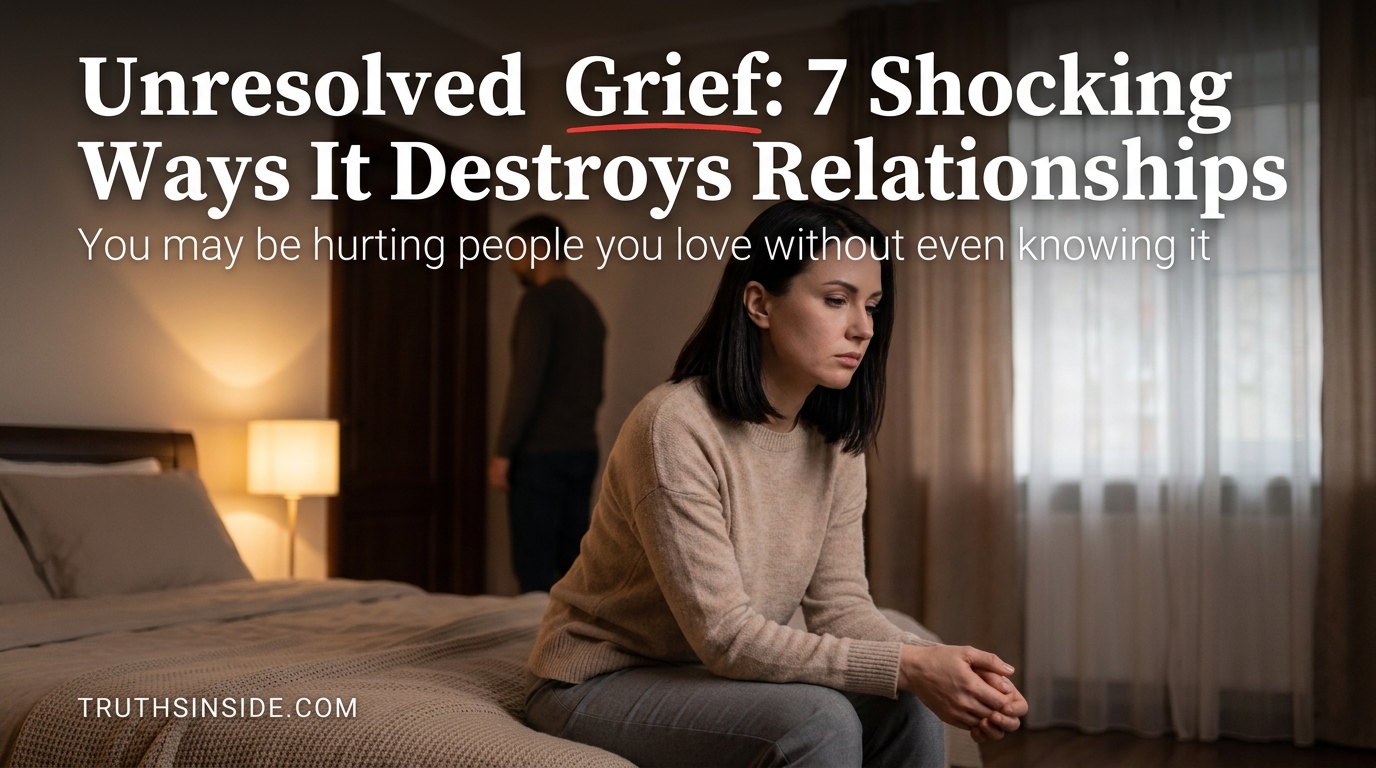
Have you ever found yourself pulling away from someone who genuinely loves you — and had absolutely no idea why? Have you snapped at a partner over something small, gone cold without warning, or felt an inexplicable wall between you and the people closest to you? If any of that sounds familiar, there may be something beneath the surface that has nothing to do with your relationship — and everything to do with a loss you never fully processed.
Unresolved grief is one of the most misunderstood forces in human psychology. According to the American Psychological Association, millions of adults carry grief that was never properly acknowledged or healed — often from losses that happened years or even decades ago. And while most people associate grief with the immediate aftermath of a death, research shows that unprocessed loss quietly rewires how we attach, communicate, and behave in our closest relationships long after the world expects us to be “over it.”
This article is for anyone who has ever loved someone while still carrying something heavy from a past they haven’t fully faced. Understanding how unresolved grief shows up in your relationships is not about blame — it is about finally making sense of patterns that have confused and hurt you, so that healing becomes possible.
What Is Unresolved Grief — And Why Does It Stay?
Grief becomes “unresolved” when the natural process of mourning is interrupted, suppressed, or never fully allowed to happen. This can occur for many reasons. Some people grew up in environments where expressing pain was not safe or acceptable. Others experienced losses that society didn’t recognize as significant — the end of a relationship, a miscarriage, the loss of a friendship, a childhood robbed by dysfunction. Some simply had to keep moving because life demanded it, and they never had the space to stop and feel.
The problem is that grief does not disappear simply because we don’t look at it. Psychologist and grief researcher Dr. Colin Murray Parkes describes unresolved grief as a kind of “frozen mourning” — where the emotional pain of a loss remains suspended in the nervous system, unable to complete its natural cycle. It doesn’t go away. It goes underground. And from there, it shapes behavior in ways the person often cannot consciously explain.
This is why unresolved grief is so dangerous in relationships. The person experiencing it isn’t always aware of how it’s operating. They don’t feel like they’re grieving — they feel like they’re just someone who “doesn’t do well with intimacy,” or someone who “gets angry easily,” or someone who “always seems to self-sabotage.” The grief has disguised itself as personality. And that disguise is remarkably convincing.
📃 Related article:
Why Relationships Become the Battlefield
There is a reason unresolved grief surfaces most powerfully inside intimate relationships. Closeness is a trigger. When someone gets emotionally near enough to matter — near enough to potentially be lost — the nervous system activates old grief like a wound that was never properly closed.
Attachment theory, developed by psychologist John Bowlby, tells us that humans are wired to bond, and that previous experiences of loss and separation directly program how we approach new attachments. In other words, every relationship you enter is filtered through every loss you’ve never fully healed. The closer someone gets, the louder that unprocessed pain becomes — even if you can’t name it, even if you don’t recognize it as grief at all.
“Unresolved grief doesn’t announce itself. It shows up as anger, distance, and the unbearable urge to leave before you can be left.”
The 7 Shocking Ways Unresolved Grief Destroys Relationships
1. Emotional Numbness and Unavailability
One of the most common and damaging ways unresolved grief shows up in relationships is through emotional unavailability. When grief is suppressed over long periods, the brain learns to shut down emotional access as a protective measure. The person doesn’t feel the grief — but they also stop feeling much else with depth or consistency.
Partners of emotionally unavailable people often describe a relationship that feels one-sided, hollow, or like “loving someone through glass.” They can see the person. They can touch them. But genuine emotional connection feels impossible to reach.
The emotionally unavailable partner often genuinely wants to connect — they just can’t access the tools to do it. The grief that locked them down took the key with it. And until that grief is processed, the numbness remains — damaging the relationship’s emotional foundation slowly and steadily.
2. Explosive Anger With No Clear Source
Grief that hasn’t been allowed to exist as grief will often find another exit. And anger is grief’s most common disguise. This is not the clean, understandable anger of someone who has been wronged in the moment. This is disproportionate, sudden, and often shocking anger — the kind that erupts over something small and leaves both people stunned.
Research published in the Journal of Abnormal Psychology found a strong link between suppressed grief and heightened emotional reactivity, particularly in close relationships. Partners become the closest available targets for pain that has no other outlet.
What looks like a temper problem on the surface is often an unacknowledged loss screaming for attention underneath. The person isn’t just angry about the dishes or the tone of voice. They are angry about something much older and much deeper — something they may not even have words for yet.
3. Fear of Abandonment and Clinging Behavior
Loss teaches the nervous system a lesson: the people you love can disappear. When that lesson is learned through a loss that was never grieved, it becomes a filter through which every future relationship is seen. The result is often an intense, consuming fear of abandonment — even when there is no real threat present.
This fear can show up as constant reassurance-seeking, jealousy without cause, difficulty allowing a partner to have independence, or an overwhelming anxiety whenever distance — physical or emotional — appears. The unresolved griever isn’t trying to control their partner. They are genuinely terrified, at a neurological level, of experiencing loss again.
Without understanding the grief underneath, partners often feel suffocated and pull away — which only confirms the griever’s deepest fear and intensifies the cycle.

4. Self-Sabotage at the Height of Happiness
This is one of the most painful and confusing patterns unresolved grief creates. Just when a relationship reaches a point of genuine happiness, security, or commitment — the griever unconsciously destroys it. They start fights out of nowhere. They become emotionally cold. They cheat, withdraw, or find reasons why the relationship “won’t work.”
From the outside, this looks like fear of commitment. But at its root, it is often grief-driven. The nervous system, conditioned by past loss, interprets happiness and closeness as danger. The internal logic is devastating in its simplicity: If I don’t get too attached, I won’t be destroyed when I lose this too.
Self-sabotage is a preemptive escape from anticipated grief. It is the psyche trying to control the outcome of a loss it believes is inevitable. And until the original grief is addressed, the pattern will repeat — relationship after relationship — leaving the person genuinely confused about why they “always ruin everything.”
5. Difficulty Communicating Needs
Unresolved grief often creates a deep, learned silence around emotional needs. People who never had their grief witnessed or validated frequently grow up — or live — believing that their emotional needs are too much, too burdensome, or simply not safe to express.
In relationships, this translates into a painful dynamic where the person cannot ask for what they need — and then feels deeply hurt that their partner cannot see it without being told. The partner feels helpless and shut out. The griever feels invisible and unseen. Both feel lonely inside the same relationship.
Healthy communication requires emotional access — the ability to identify what you feel and trust that expressing it is safe. Unresolved grief blocks both. It whispers that feelings are dangerous and needs are weaknesses, creating a wall of silence where real intimacy should live.
📃 Related article: 15 Subtle Red Flags in a New Relationship Most People Miss
6. Projecting Past Loss Onto Current Partners
When grief from a specific person or situation is unresolved, it has a tendency to cast its shadow over new relationships. A person who lost a parent to emotional unavailability may see that unavailability in a partner who simply had a hard day. Someone who was abandoned in a previous relationship may interpret a partner’s need for space as the beginning of the end.
This projection is not intentional. It is the mind’s desperate attempt to make sense of new situations using the only framework it knows — the unhealed one. Psychologists call this “grief transference,” and it is remarkably common in people who carry significant unresolved loss.
The damage to current relationships can be severe. Partners are held responsible for wounds they didn’t create. They are judged by the standards of people who are no longer in the picture. And they often have no idea why they can never seem to be enough — no matter what they do.

7. Cycles of Intense Connection Followed by Withdrawal
Perhaps the most disorienting pattern unresolved grief creates in relationships is a cycle of pulling in and pushing away. The griever experiences moments of genuine, deep connection — and those moments feel beautiful and real. But they are followed, almost inevitably, by a period of emotional withdrawal, coldness, or distance.
This push-pull dynamic is deeply confusing for partners, who often feel like they are living with two different people. The warmth feels real. The withdrawal feels equally real. And neither can be fully explained or predicted.
This cycle is the unresolved grief oscillating between its two states — the longing for connection, and the terror of it. The person genuinely wants intimacy. But every time they get close enough to it, the grief activates, and the nervous system pulls them back to safety.
Without intervention — without naming and processing the original loss — this cycle can go on indefinitely, slowly eroding even the most patient and loving partner’s ability to hold on.
📃 Related article: What Does It Actually Feel Like to Fall in Love? Science + Real Stories
“Healing your grief is not just an act of self-love. It is one of the most loving things you can do for every relationship in your life.”
How to Begin Healing Unresolved Grief
Recognition is the first and most powerful step. Simply naming what is happening — “This pain I’m carrying is grief, and it is affecting how I love” — begins to loosen grief’s grip on your behavior.
From there, the path forward often includes working with a therapist trained in grief processing, particularly modalities like Complicated Grief Treatment (CGT), EMDR, or Internal Family Systems (IFS) therapy, all of which have shown significant clinical effectiveness in helping people process losses that have been frozen in the nervous system.
Journaling about the original loss — not to analyze it, but simply to witness it — can also create space for the grief to move. Grief needs a witness. It needs to be seen, named, and acknowledged before it can complete its natural process.
Community matters too. Grief thrives in isolation. Whether it is a grief support group, a trusted friend, or a therapeutic relationship, bringing your grief into connection rather than hiding it is a radical and healing act.
What Partners of Unresolved Grievers Can Do
If you love someone who carries unresolved grief, the most important thing to understand is this: their behavior is not about you. The walls, the anger, the withdrawal, the fear — these are the echoes of losses that happened before you existed in their life. That doesn’t make the impact on you less real. But it does change what is needed.
Patience matters. So does honesty. You can hold space for someone’s grief without becoming a casualty of it. Encourage therapy. Name the pattern gently, without blame. And know that there is a limit to what love alone can heal — professional support exists precisely for these moments.

FAQ: Unresolved Grief and Relationships
Q1: How do I know if I have unresolved grief affecting my relationship?
Look for patterns rather than single incidents. If you consistently pull away when relationships deepen, feel disproportionate anger toward partners, or find yourself sabotaging connections at their best moments — unresolved grief may be a significant factor. A therapist can help you identify this with much greater clarity.
Q2: Can a relationship survive unresolved grief?
Yes — but it requires awareness and active effort. Many relationships have not only survived but deepened as one or both partners worked through grief. The key is that the grief must be acknowledged and addressed. It cannot simply be “loved away” by a patient partner alone.
Q3: Does unresolved grief always come from death?
Absolutely not. Grief can stem from the end of a relationship, childhood emotional neglect, a miscarriage, losing a friendship, estrangement from family, loss of identity, or even the loss of a life you expected to have. Any significant loss that was not properly processed can become unresolved grief.
Q4: How long does it take to heal unresolved grief?
There is no universal timeline. Grief is not linear, and healing depends on the nature of the loss, how long it has been suppressed, and the level of support available. Many people experience significant shifts within months of beginning intentional grief work. Others need longer. The most important thing is to start.
Q5: Should I tell my partner that I’m dealing with unresolved grief?
Yes — when you feel safe to do so and have some language for what you’re experiencing. Sharing this with your partner creates an opportunity for understanding rather than resentment. It doesn’t excuse harmful behavior, but it opens the door to genuine compassion and collaborative healing.
Final Thoughts
Unresolved grief is not a character flaw. It is not weakness. It is what happens when a human being experiences a significant loss without adequate space, support, or safety to fully feel it. And it is far more common than most people realize.
If you recognized yourself in any of the seven patterns described in this article — please receive that recognition with compassion, not judgment. Awareness is where healing begins. And choosing to look honestly at the grief you’ve been carrying is one of the bravest things a person can do.
Your past losses deserve to be grieved. Your current relationships deserve a version of you that has been freed from them. Both of those things can be true at the same time — and both are absolutely worth fighting for.
💾 Save this article — you or someone you love may need it.
📲 Share it with anyone who has ever struggled to explain their own emotional patterns.
➕ Follow Truthsinside.com for honest, research-backed psychology and relationship content.
📃 Related article: Anxious Attachment: Signs, Causes, and How to Heal
🎵 Music
Maren Lull is a singer-songwriter who writes from the places most people don’t talk about out loud.
Not the dramatic grief. Not the obvious heartbreak. The quiet kind — the ordinary Tuesday emptiness, the habit of reaching for someone who isn’t there anymore, the particular exhaustion of being strong for so long that the strength itself wears thin.
Her music lives at the intersection of emotional honesty and soft beauty — breathy vocals over gentle piano, slow tempos, lyrics that feel less like songs and more like something you wrote in a private notebook at two in the morning and never showed anyone.
Maren Lull writes for the people who feel everything deeply and say very little about it. For the ones who listen to sad music not because they want to feel worse — but because being understood, even by a song, makes the feeling easier to carry.
📱 Follow Maren Lull:
→ Spotify
→ Apple Music
→ Youtube
→ Audiomack