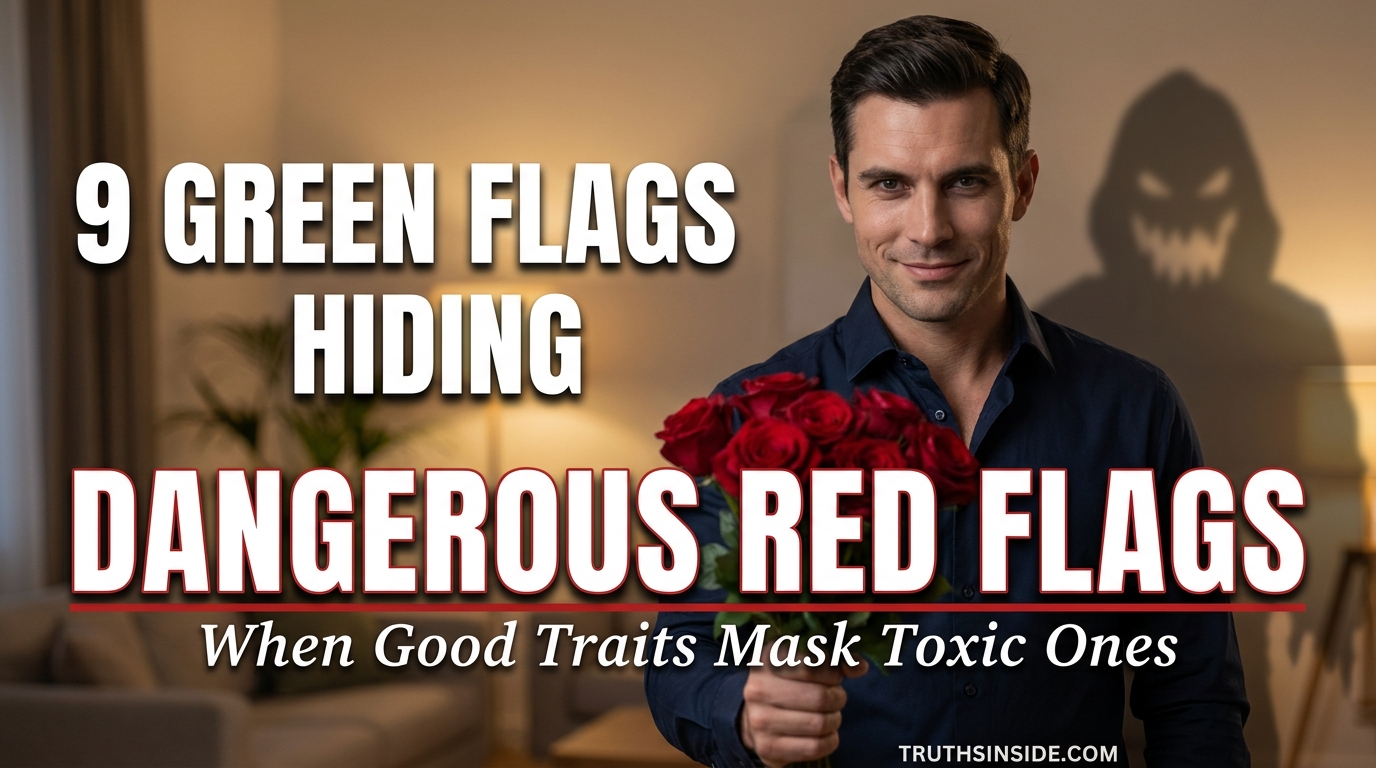
Most people enter relationships scanning for the obvious warning signs. The explosive temper. The possessive texts. The cutting remarks disguised as jokes. But what if the most dangerous patterns in a relationship don’t look like red flags at all? What if they look like green ones — the qualities you’ve been searching for, the behaviors your friends admire, the traits that make you feel like you finally found someone who truly gets it?
According to a study published in the Journal of Interpersonal Violence, a significant majority of individuals in emotionally abusive relationships reported that their partner’s most controlling behaviors were initially perceived as signs of love, devotion, and care. The research found that without education about coercive patterns, most people cannot distinguish between genuine affection and calculated manipulation in the early stages of a relationship. Green flags hiding red flags is not a rare phenomenon — it is one of the most common and least discussed dynamics in modern relationships.
This is what makes certain toxic patterns so devastatingly effective. They don’t announce themselves. They seduce you first. They earn your trust, your affection, and your vulnerability before the mask begins to slip. By the time the red flags become undeniable, you’re already emotionally invested — and leaving feels impossible. Understanding how green flags hiding red flags operate is not about becoming paranoid or suspicious of love. It is about becoming literate in the language of healthy versus unhealthy relationships so that you can protect yourself and the people you care about.
1. Intense Attention That Looks Like Devotion — But Is Really Control
In the beginning, it feels like a dream. They text you good morning before you’ve even opened your eyes. They remember every small detail you mentioned in passing. They make you feel like the most important person in any room. This level of attention feels like devotion, and in a healthy relationship, consistent care and attentiveness genuinely is a green flag.
But there is a crucial line between devotion and surveillance — and green flags hiding red flags cross that line so gradually you barely notice it happening.
The devoted partner checks in because they’re thinking of you. The controlling partner checks in to track you. The devoted partner remembers your preferences because they pay attention. The controlling partner catalogues your information to use it strategically. The devoted partner makes you feel chosen. The controlling partner makes you feel monitored — and then makes you feel guilty for noticing.
Psychologist Lundy Bancroft, author of Why Does He Do That?, explains that early over-investment of attention is one of the most reliable early warning signs of controlling behavior. When someone’s level of attentiveness feels almost too perfect — too consistent, too intense, too overwhelming in its focus — it is worth asking what need that attention is serving. Genuine care grows naturally at a sustainable pace. Calculated attention arrives in a flood designed to overwhelm your defenses before you’ve had time to evaluate the relationship clearly.
The green flag: consistent attentiveness and care.
The hidden red flag: attention as a tool of monitoring, dependency-building, and control.
2. Protectiveness That Looks Like Love — But Is Really Jealousy
“I just don’t trust the people around you.” “I worry about you when I’m not there.” “I only act this way because I love you so much.” These statements feel like evidence of deep love. In a culture that romanticizes jealousy as proof of passion, protectiveness is one of the most universally misread green flags hiding red flags in modern relationships.
Healthy protectiveness looks like a partner who checks in during a late night out, who expresses genuine concern when you’re unwell, who stands up for you when someone treats you badly. It is rooted in care and expressed with respect for your autonomy.
Toxic jealousy disguised as protectiveness looks entirely different — but uses identical language. It escalates from “I worry about you” to “I don’t want you spending time with them.” From concern to interrogation. From love to ownership. And at every stage, it is framed as devotion.
Research from the Journal of Family Violence found that jealousy-driven controlling behavior is one of the leading precursors to intimate partner violence, and that in the vast majority of cases, victims initially interpreted their partner’s jealousy as a sign of how deeply they were loved. The reframe from “they love me so much they can’t stand to share me” to “they don’t trust me to make my own choices” is one of the most critical cognitive shifts in recognizing this pattern.
The green flag: a partner who cares about your safety and wellbeing.
The hidden red flag: jealousy and possessiveness weaponized as love and concern.
Related article: The 5 Love Languages Explained: Which One Are You?
“The person who isolates you from everyone else will always frame it as protection. Real love expands your world. It does not shrink it.”

3. Generosity That Looks Like Kindness — But Is Really Debt-Building
They pay for everything. They surprise you with gifts you mentioned once in passing. They show up with your favorite coffee, your favorite flowers, gestures so perfectly timed they take your breath away. Generosity is beautiful. In a healthy relationship, a giving partner is an extraordinary gift.
But generosity becomes a green flag hiding a red flag when it comes with an invisible price tag — one that is never discussed openly but is always, quietly, expected to be paid.
This dynamic is closely related to what psychologists call “reciprocity manipulation.” The generous partner creates a sense of obligation through their giving. You are showered with affection, gifts, and grand gestures until you feel indebted — until saying no, setting a boundary, or expressing a need feels ungrateful given “everything they’ve done for you.”
This is one of the core mechanics of love bombing — a manipulation tactic identified by mental health professionals as a hallmark of narcissistic and emotionally abusive relationship patterns. Love bombing uses overwhelming generosity, affection, and attention in the early stages of a relationship to rapidly accelerate emotional bonding and create dependency before the recipient has had time to evaluate the relationship at a natural pace.
The distinction between genuine generosity and manipulation lies in the aftermath. Genuine generosity asks for nothing in return and places no conditions on your behavior. Manipulative generosity is a down payment on your compliance — and the invoice arrives the moment you disappoint them.
The green flag: a thoughtful, giving, generous partner.
The hidden red flag: generosity as leverage, obligation, and emotional debt.
4. Passion That Looks Like Romance — But Is Really Instability
They love you with an intensity that feels cinematic. The highs are extraordinary. They write you letters. They make grand declarations. Every argument is followed by the most passionate reconciliation you’ve ever experienced. You’ve never felt so alive in a relationship. This must be what real love feels like — right?
Green flags hiding red flags rarely operate more convincingly than in the realm of passion. Our culture has so thoroughly romanticized emotional intensity that we have lost the ability to distinguish between depth of feeling and emotional dysregulation.
Authentic romantic passion is warm, consistent, and sustainable. It deepens with time rather than depending on cycles of crisis to stay ignited. Toxic passion — the kind that masquerades as romance — is fueled by instability. It requires the dramatic lows to make the highs feel meaningful. The relationship becomes a rollercoaster not because the love is extraordinary, but because the emotional regulation is absent.
Psychologists refer to this as the “intermittent reinforcement” cycle — a pattern in which unpredictable rewards (affection, passion, reconciliation) create stronger psychological bonding than consistent positive behavior would. It is the same mechanism that makes gambling addictive. Your nervous system becomes dependent on the cycle itself, mistaking the relief of reconciliation for evidence of profound love.
The green flag: a passionate, romantic partner who loves deeply.
The hidden red flag: emotional instability and intermittent reinforcement disguised as extraordinary love.

5. Ambition That Looks Like Drive — But Is Really Selfishness
A partner with ambition, goals, and a clear vision for their future is genuinely attractive. Drive is a legitimate green flag. Someone who knows what they want and works hard for it suggests self-sufficiency, purpose, and the kind of energy that builds something real over time.
But ambition becomes a green flag hiding a red flag when it is entirely self-directed — when their goals, their timeline, and their vision consistently occupy the center of the relationship while yours exist only at the periphery.
This pattern is often subtle in the beginning because ambitious people tend to be exciting, confident, and compelling. Their drive is magnetic. But over time, a pattern emerges. Their career decisions are made without genuine consultation. Relationship milestones happen on their schedule. Your sacrifices — of time, opportunity, geographic location — are assumed rather than appreciated. And when you express a need that conflicts with their agenda, it is met with frustration disguised as disappointment.
The difference between an ambitious partner and a selfish one is their relationship with your ambitions. A genuinely driven partner champions your goals alongside their own. A selfish partner uses their ambition as justification for why their needs will always come first — and frames your accommodation as love rather than loss.
The green flag: a motivated, goal-oriented, driven partner.
The hidden red flag: self-centeredness and lack of genuine reciprocity hiding behind the language of ambition.
Related article: 15 Subtle Red Flags in a New Relationship Most People Miss
6. Vulnerability That Looks Like Emotional Openness — But Is Really Manipulation
When someone shares their deepest wounds with you early in a relationship, it feels significant. Rare, even. In a world where emotional walls are the norm, a partner who opens up quickly about their pain, their trauma, and their fear of being hurt feels like the most refreshingly honest person you’ve ever met. Emotional openness is, genuinely, a green flag.
But strategic vulnerability is one of the most sophisticated green flags hiding red flags in the modern dating landscape. When someone shares their trauma specifically to accelerate intimacy, create obligation, or establish themselves as the wounded party in all future conflicts — that is not openness. That is calculated emotional positioning.
Dr. Ramani Durvasula, a clinical psychologist and expert on narcissistic behavior, notes that many individuals with narcissistic traits are exceptionally skilled at performing vulnerability in the early stages of relationships. The shared wounds create rapid emotional bonding, generate sympathy, and establish a dynamic in which the recipient feels compelled to be gentle, accommodating, and endlessly patient — because they’ve been trusted with something fragile.
The trap closes when any attempt to address the partner’s behavior is deflected back to their trauma. “You know I struggle with this because of my past.” “I can’t believe you’d push me on this after everything I’ve shared with you.” Genuine vulnerability invites connection. Weaponized vulnerability creates guilt and silences accountability.
The green flag: emotional openness and willingness to share deeply.
The hidden red flag: strategic vulnerability used to accelerate bonding and deflect accountability.
7. Loyalty That Looks Like Commitment — But Is Really Dependency
Loyalty in a relationship is one of the most valued qualities a partner can have. Someone who is fully committed, who doesn’t keep one foot out the door, who prioritizes the relationship with consistency — this is what most people are genuinely searching for.
But there is a version of loyalty that crosses into something far darker — a suffocating, boundary-dissolving dependency that presents itself as devotion while quietly dismantling your independence and sense of self.
This type of loyalty says “I would do anything for you” while actually meaning “I expect you to do everything for me.” It shows up as a partner who cannot function emotionally without your constant reassurance. Who treats your need for personal space as betrayal. Who frames their dependency as the ultimate proof of love — because who else would love you this completely, this totally, this desperately?
Psychologists identify this as anxious attachment at its most extreme, often crossing into codependency. The partner who cannot exist independently, who defines their entire emotional world around you, places an unsustainable weight on the relationship — and inevitably begins to resent any boundary you attempt to establish.
The green flag: deep commitment and loyalty to the relationship.
The hidden red flag: emotional dependency and codependency disguised as devotion and love.
“Loyalty should make you feel safe, not trapped. If their commitment feels more like a cage than a choice, that is not devotion — that is ownership.”
8. Helpfulness That Looks Like Support — But Is Really Undermining
They are always there to help. They offer advice before you’ve asked for it. They step in to handle things “because they just want to make your life easier.” On the surface, this looks like one of the most attractive qualities a partner can have — someone who genuinely shows up, helps out, and makes the relationship feel like a true partnership.
But chronic unsolicited helpfulness — especially when paired with subtle criticism of how you handle things independently — is one of the most insidious green flags hiding red flags in long-term relationships.
This pattern, sometimes called “benevolent sexism” in research contexts but applicable across all relationship dynamics, slowly erodes your confidence in your own capabilities. Each time they step in uninvited, the implicit message is: you need me to handle this. Each piece of unsolicited advice carries the quiet suggestion that your judgment is insufficient. Over months and years, the partner who presented as your greatest supporter has become the primary reason you doubt yourself.
The distinction is straightforward but easy to miss in the moment. Genuine support responds to what you ask for. Undermining disguised as helpfulness anticipates your failure and positions itself as the solution before you’ve had the chance to succeed or fail on your own terms.
The green flag: a supportive, helpful, involved partner.
The hidden red flag: chronic unsolicited intervention that erodes your autonomy and self-confidence.

9. Forgiveness That Looks Like Maturity — But Is Really Enabling
A partner who doesn’t hold grudges, who forgives quickly, who never brings up past conflicts is often considered emotionally mature, evolved, and easy to be in a relationship with. Forgiveness is, without question, a genuine strength — in both relationships and life broadly.
But instant, unconditional forgiveness without accountability — particularly in response to repeated harmful behavior — is one of the quietest and most self-destructive green flags hiding red flags in any partnership.
When a partner forgives every transgression without discussing it, without establishing consequences, and without requesting meaningful change, they are not demonstrating maturity. They are demonstrating fear — fear of conflict, fear of losing the relationship, or fear of acknowledging the pattern they are trapped within. This is forgiveness as self-protection, not forgiveness as strength.
For the partner on the receiving end of this unconditional forgiveness, it sends a powerful message: there are no real consequences here. Behavior that is consistently forgiven without accountability is behavior that is functionally permitted. The “forgiving” partner believes they are keeping the peace. In reality, they are quietly dismantling it.
True emotional maturity in relationships looks like forgiveness paired with honest communication, clear boundaries, and a mutual commitment to behavioral change. It is not the absence of conflict. It is the healthy navigation of it.
The green flag: a forgiving, non-grudge-holding, emotionally mature partner.
The hidden red flag: conflict avoidance and self-erasure disguised as forgiveness and maturity.
Related article: Anxious Attachment: Signs, Causes, and How to Heal
How to Protect Yourself Without Becoming Closed Off
Recognizing green flags hiding red flags is not an invitation to approach every relationship with suspicion. It is an invitation to approach every relationship with clarity. There is an enormous difference between healthy discernment and defensive cynicism — and developing one does not require becoming the other.
Trust your nervous system. Not the excitement of early attraction, which is often the feeling of novelty rather than safety — but the deeper, quieter signals. Do you feel free to be yourself around this person? Does their “support” leave you feeling capable or dependent? Does their attention feel warm or watchful? Does their love expand your life or begin to quietly contract it?
These are the questions that green flags hiding red flags are designed to prevent you from asking. Ask them anyway. Ask them early. Ask them honestly. And if the answers make you uncomfortable, pay attention — because discomfort is often the first honest thing a relationship tells you.
If this article gave you clarity you didn’t have before — save it. Share it with someone who needs to see this. And follow Truthsinside.com for more honest, research-backed insights on relationships, psychology, and the truths that matter most.
FAQ
Q: What is the difference between a green flag and a red flag in relationships?
A: A green flag is a genuinely positive sign that a partner is emotionally healthy, respectful, and relationship-ready. A red flag is a warning sign of potentially harmful behavior. The challenge arises when toxic behaviors are designed to mimic positive ones — appearing as green flags on the surface while concealing harmful patterns underneath.
Q: How can I tell if someone is love bombing me?
A: Love bombing typically involves an overwhelming intensity of attention, affection, and generosity in the very early stages of a relationship — far beyond what the relationship has naturally developed to warrant. Key indicators include feeling rushed into commitment, receiving expensive or extravagant gifts early on, and sensing that the affection feels more like a performance designed to impress than genuine organic connection.
Q: Can someone show green flags hiding red flags without knowing they’re doing it?
A: Yes. Not all toxic behavior is consciously calculated. Many people learned dysfunctional relationship patterns in childhood and genuinely believe their controlling, dependent, or manipulative behaviors are expressions of love. This does not make the behavior less harmful, but it does mean that intent and impact are two separate things — and impact is what matters most for your wellbeing.
Q: What should I do if I recognize these patterns in my current relationship?
A: Start by documenting patterns rather than isolated incidents — toxic dynamics reveal themselves through repetition over time. Talk to a trusted friend or therapist about what you’re experiencing. If you feel safe doing so, address your concerns with your partner directly. And if the patterns are severe or escalating, prioritize your safety and seek professional support immediately.
Q: Is it possible for someone who showed these red flags to genuinely change?
A: Genuine change is possible, but it requires the individual to acknowledge the harmful behavior without defensiveness, seek professional help independently, and demonstrate consistent behavioral change over an extended period — not just during moments of conflict or when the relationship is at risk. Promises to change are not the same as sustained change. Watch for patterns, not performances.
🎵 Music
Maren Lull is a singer-songwriter who writes from the places most people don’t talk about out loud.
Not the dramatic grief. Not the obvious heartbreak. The quiet kind — the ordinary Tuesday emptiness, the habit of reaching for someone who isn’t there anymore, the particular exhaustion of being strong for so long that the strength itself wears thin.
Her music lives at the intersection of emotional honesty and soft beauty — breathy vocals over gentle piano, slow tempos, lyrics that feel less like songs and more like something you wrote in a private notebook at two in the morning and never showed anyone.
Maren Lull writes for the people who feel everything deeply and say very little about it. For the ones who listen to sad music not because they want to feel worse — but because being understood, even by a song, makes the feeling easier to carry.
📱 Follow Maren Lull:
→ Spotify
→ Apple Music
→ Youtube
→ Audiomack