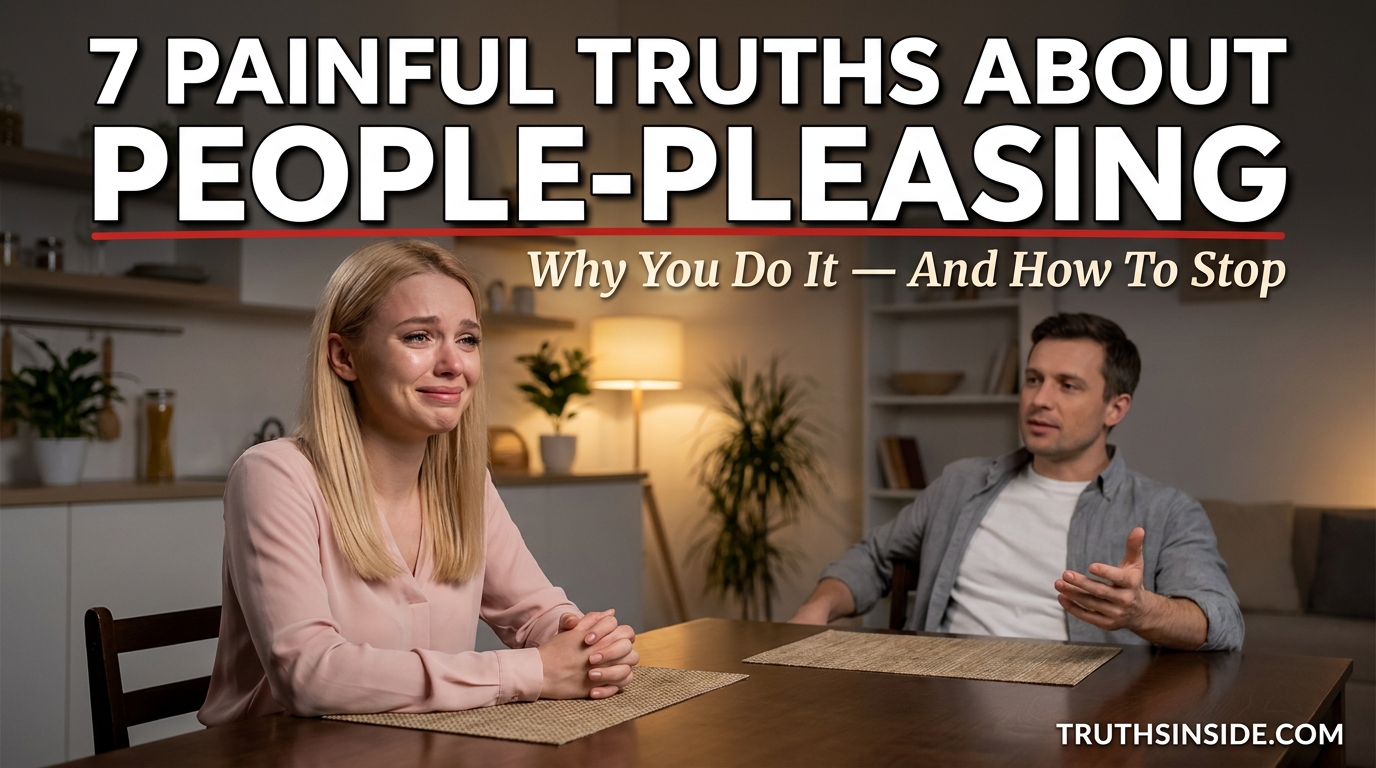
Have you ever said yes to something — a favor, a plan, a compromise — and immediately felt a hollow ache in your chest? Not because you were generous, but because you couldn’t bear the thought of disappointing someone else. That quiet, invisible erosion of your own needs in favor of keeping everyone around you comfortable has a name. It’s called people-pleasing in relationships, and it is far more damaging than most people ever acknowledge.
Research published in the Journal of Social and Clinical Psychology found that chronic people-pleasers experience significantly higher rates of anxiety, emotional exhaustion, and identity confusion than those who maintain healthy boundaries. More alarmingly, a study from the University of California found that individuals who consistently suppress their own needs to avoid conflict show measurable increases in cortisol — the body’s primary stress hormone — over time. Your body keeps score even when your mind tells you everything is fine.
This is not a small habit. People-pleasing in relationships is a deeply rooted psychological pattern — one that often begins in childhood, gets reinforced through social conditioning, and slowly dismantles your sense of self without you even realizing it’s happening. Understanding why you do it is the first step. Knowing how to stop is what changes everything.
1. People-Pleasing in Relationships Is Not Kindness — It’s Fear
This is the truth most people-pleasers resist hearing. What you call kindness, generosity, or being “easy-going” is often — at its core — fear. Fear of conflict. Fear of rejection. Fear that if you express a genuine need or opinion, the people you love will leave, withdraw, or turn against you.
Dr. Susan Newman, a social psychologist and author of The Book of No, explains that people-pleasing behavior is almost always rooted in one of three fears: fear of abandonment, fear of anger, or fear of being perceived as selfish or difficult. These fears don’t announce themselves loudly. They operate quietly in the background, disguised as accommodation and flexibility.
Think about the last time you agreed to something you didn’t want to do. What was the actual thought process? Was it “I genuinely want to do this”? Or was it closer to “If I say no, they’ll be upset” or “It’s not worth the argument”? That split second of calculation — that tiny internal negotiation where your needs always lose — is people-pleasing in action.
Kindness given freely, from a place of genuine desire, feels light and fulfilling. People-pleasing disguised as kindness feels heavy, draining, and quietly resentful. The difference between the two is the most important distinction you will ever make in your relationships.
2. Where It Starts: The Childhood Blueprint
People-pleasing in relationships rarely begins in adulthood. For most people, the pattern is established in childhood — often in families where love felt conditional, conflict felt dangerous, or emotional needs were consistently dismissed.
Children are extraordinarily adaptive. When a child grows up in an environment where expressing anger leads to punishment, where asking for too much leads to shame, or where a parent’s emotional state was fragile and unpredictable, that child learns a survival strategy: make everyone around you comfortable, and you will be safe.
This is not weakness. This was intelligence. This was a child doing the only thing they knew how to do to protect themselves emotionally. The tragedy is that this strategy — which worked beautifully for survival in childhood — becomes a prison in adult relationships.
Dr. Jonice Webb, a psychologist and author of Running on Empty, calls this “childhood emotional neglect.” When children’s emotional needs are consistently minimized or ignored, they internalize the belief that their needs are burdensome, excessive, or simply unimportant. They carry this belief directly into every romantic relationship, friendship, and workplace dynamic they encounter as adults.
Recognizing the childhood origin of your people-pleasing doesn’t mean you’re broken. It means you’re finally seeing the pattern clearly enough to begin changing it.
Related article: What Does It Actually Feel Like to Fall in Love? Science + Real Stories
“You were not born afraid of your own needs. You were taught to be. And anything that was taught can be unlearned.”

3. The Relationship Cost: What People-Pleasing Actually Does to Your Partnership
Here is something deeply counterintuitive: people-pleasing doesn’t protect your relationships. It destroys them. Slowly, invisibly, but absolutely.
When you consistently suppress your true feelings, preferences, and needs in a relationship, you don’t show up as yourself. You show up as a carefully curated version of yourself — one designed to be easy, agreeable, and conflict-free. Your partner, in turn, falls in love with that version. They build a relationship with someone who doesn’t fully exist.
This creates a devastating trap. The more successful you are at people-pleasing, the more invisible your real self becomes. And invisibility breeds resentment. You begin to feel unseen, unheard, and unappreciated — not because your partner doesn’t care, but because they genuinely don’t know who you are beneath the performance.
Over time, the resentment compounds. Small suppressions — agreeing to a restaurant you hate, pretending you’re okay when you’re not, laughing at a comment that hurt you — accumulate into a mountain of unexpressed truth. And mountains eventually erupt. The couple that seemed so harmonious suddenly explodes over something trivial, because the real conflict was never allowed to breathe.
Dr. John Gottman’s research at the Gottman Institute identifies “stonewalling” and “passive flooding” — behaviors that people-pleasers often exhibit — as two of the four primary predictors of relationship breakdown. Healthy relationships require two authentic people in honest communication. People-pleasing in relationships removes authenticity from the equation entirely.
4. The Hidden Anger Beneath the Smile
One of the most misunderstood aspects of people-pleasing in relationships is the anger that lives beneath it. People-pleasers are often perceived — and perceive themselves — as calm, easygoing, and non-confrontational. But the reality is frequently the opposite.
When you consistently give more than you receive, agree when you want to disagree, and sacrifice your needs to preserve someone else’s comfort, anger is the natural result. But because people-pleasers fear conflict and disapproval, that anger has nowhere to go. It doesn’t disappear. It goes underground.
This underground anger expresses itself in indirect ways — passive-aggressive comments, emotional withdrawal, sudden explosive outbursts that seem disproportionate to the trigger, or quiet, chronic bitterness that slowly poisons the emotional atmosphere of the relationship. Partners of people-pleasers often describe feeling confused — sensing something is wrong but never being able to get a straight answer about what it is.
Psychologist Harriet Braiker, author of The Disease to Please, calls this the “pleaser’s paradox.” The very behavior intended to create harmony and connection actually generates the distance and conflict the people-pleaser most fears. By trying to avoid all friction, they create a pressure cooker of unspoken tension that eventually becomes unavoidable.
The solution is not to become aggressive or demanding. It is to develop what psychologists call “assertive communication” — the ability to express your genuine needs clearly, calmly, and directly, without aggression and without self-erasure.

5. Signs You Are a People-Pleaser in Your Relationship
People-pleasing in relationships doesn’t always look obvious. It hides in everyday patterns that feel normal — until they don’t. Here are the most telling signs:
You apologize constantly, even when you’ve done nothing wrong. Sorry becomes your default response to any friction, real or imagined.
You can’t identify your own preferences. When asked what you want for dinner, where you want to go, or how you’re feeling, you genuinely struggle to answer — because your internal compass has been overridden for so long it barely registers.
You feel responsible for everyone’s emotions. If your partner is in a bad mood, you immediately assume you caused it and work to fix it — even before knowing what’s wrong.
You avoid expressing disagreement. Not because you agree, but because the thought of conflict produces physical anxiety. Your heart races. You go quiet. You redirect.
You feel deeply resentful but rarely say why. The resentment is real, but expressing it feels more dangerous than swallowing it — so it stays inside, growing quietly.
You feel exhausted in your relationship more often than you feel nourished by it. Giving is constant. Receiving feels uncomfortable or impossible.
You use their happiness as your measuring stick. If they’re happy, you’re okay. If they’re unhappy — regardless of the reason — you feel like a failure.
If several of these resonate with you, you are almost certainly dealing with people-pleasing in relationships at a level that is affecting your wellbeing, your authenticity, and the genuine depth of your partnership.
Related article: 15 Subtle Red Flags in a New Relationship Most People Miss
6. The Psychology Behind Why It’s So Hard to Stop
Understanding intellectually that you people-please is one thing. Stopping is an entirely different challenge — and there’s a powerful psychological reason why.
People-pleasing activates the brain’s reward system. Each time you successfully manage someone else’s emotions — smooth over a conflict, make someone smile, receive gratitude for your sacrifice — your brain releases a small hit of dopamine. Over time, your neurological system becomes trained to associate your self-worth with other people’s emotional states. Their approval becomes your drug.
This is why simply deciding to “stop caring what people think” doesn’t work. It’s not a mindset problem. It’s a neurological pattern reinforced over years — sometimes decades — of repeated behavior. Breaking it requires deliberate, consistent practice of new patterns, not just a change in perspective.
Additionally, people-pleasers often carry what therapists call “fawn response” — a trauma-based survival mechanism identified alongside fight, flight, and freeze. The fawn response is the automatic impulse to appease, accommodate, and de-escalate to avoid danger. For people who experienced emotional volatility, criticism, or conditional love in childhood, fawning became the brain’s fastest route to safety. Retraining that response takes time, compassion, and often professional support.
7. How to Finally Stop: 7 Powerful Steps Toward Authenticity
People-pleasing in relationships can be unlearned. It requires commitment and discomfort — but the freedom on the other side is worth every difficult moment.
Step one: Name it without shame. Acknowledge that you people-please. Not as a character flaw, but as a learned pattern. Awareness without judgment is the starting point of all real change.
Step two: Pause before responding. Create a habit of pausing before agreeing to anything. Even a simple “let me think about that” gives your authentic self space to surface before fear takes over.
Step three: Practice the discomfort of saying no. Start small. Say no to something low-stakes. Notice that the feared catastrophe doesn’t happen. Each small no rewires your nervous system’s threat response around boundaries.
Step four: Separate your worth from their reaction. Your value as a person is not determined by someone else’s emotional response to you. Begin noticing when you’ve linked the two — and consciously unlinking them.
Step five: Identify your actual needs. Spend time daily asking yourself what you genuinely feel, want, and need. Journal it. The more fluent you become in your own inner language, the easier it becomes to communicate authentically.
Step six: Communicate assertively. Practice expressing your truth calmly, directly, and without over-explaining or apologizing for having a perspective. “I feel this way” is a complete sentence.
Step seven: Seek therapeutic support. For deeply rooted people-pleasing connected to childhood trauma or fawn response, working with a licensed therapist — particularly one trained in attachment theory or cognitive behavioral therapy — can accelerate healing in ways that self-help alone cannot.
“Every time you choose your truth over someone else’s comfort, you reclaim a piece of yourself that people-pleasing stole.”

What Comes Next
Stopping people-pleasing in relationships is not about becoming selfish, cold, or difficult. It is about becoming real. It is about showing up in your relationships as the actual, full, complex, needs-having human being that you are — and trusting that the relationships worth keeping will not only survive your authenticity but will deepen because of it.
The people who truly love you do not need you to perform. They need you to be present. And you cannot be fully present in any relationship while you are busy managing everyone else’s experience of you.
You are allowed to have needs. You are allowed to disagree. You are allowed to say no, to change your mind, to take up emotional space without apologizing for it. These are not privileges you have to earn. They are your birthright as a human being in relationship with other human beings.
The most generous thing you can give anyone who loves you is your authentic self. Everything else is just a beautiful, exhausting performance.
Related article: Gaslighting in Relationships: How to Recognize, Name, and Leave It
If this article spoke to something real in you — save it. Share it with someone who needs permission to stop disappearing. And follow Truthsinside.com for more honest, psychology-backed insights that go beyond the surface.
FAQ
Q: What is the difference between being kind and being a people-pleaser?
A: Kindness comes from a place of genuine desire and free choice — it feels energizing and fulfilling. People-pleasing comes from fear — fear of conflict, rejection, or disapproval — and feels draining, obligatory, and resentful. The key difference is whether you are acting from love or from anxiety.
Q: Can people-pleasing ruin a relationship?
A: Yes. Chronic people-pleasing erodes authenticity, breeds hidden resentment, and creates emotional distance over time. Your partner falls in love with a performance rather than your real self, which ultimately leaves both people feeling disconnected and unfulfilled.
Q: Is people-pleasing a trauma response?
A: For many people, yes. Psychologists identify the “fawn response” — the automatic impulse to appease and accommodate to avoid conflict or danger — as a trauma-based survival mechanism. It is especially common in people who experienced emotionally volatile, critical, or conditional caregiving in childhood.
Q: How long does it take to stop people-pleasing?
A: There is no fixed timeline. For some people, building awareness and practicing new communication habits creates noticeable change within weeks. For others, especially those with deep childhood roots to their people-pleasing, working with a therapist over several months produces the most lasting transformation. Progress is nonlinear — be patient with yourself.
Q: Can you be a people-pleaser and still have good relationships?
A: In the short term, people-pleasing can create an appearance of harmony. But in the long term, it prevents the depth, authenticity, and genuine intimacy that make relationships truly fulfilling. The most deeply connected couples are those where both partners feel safe enough to be completely honest — and that safety requires both people to have genuine voices.
🎵 Music
Maren Lull is a singer-songwriter who writes from the places most people don’t talk about out loud.
Not the dramatic grief. Not the obvious heartbreak. The quiet kind — the ordinary Tuesday emptiness, the habit of reaching for someone who isn’t there anymore, the particular exhaustion of being strong for so long that the strength itself wears thin.
Her music lives at the intersection of emotional honesty and soft beauty — breathy vocals over gentle piano, slow tempos, lyrics that feel less like songs and more like something you wrote in a private notebook at two in the morning and never showed anyone.
Maren Lull writes for the people who feel everything deeply and say very little about it. For the ones who listen to sad music not because they want to feel worse — but because being understood, even by a song, makes the feeling easier to carry.
📱 Follow Maren Lull:
→ Spotify
→ Apple Music
→ Youtube
→ Audiomack