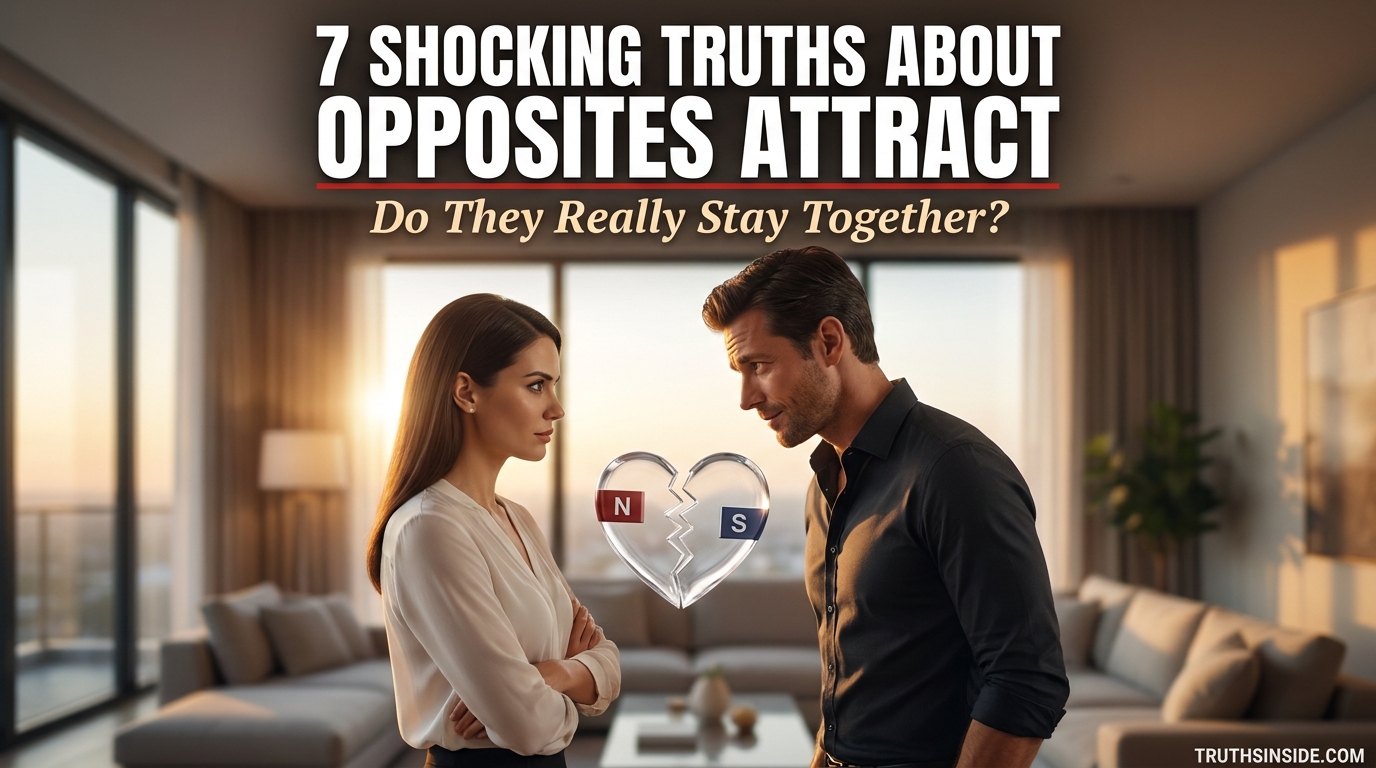
You fell in love with someone who was everything you weren’t. They were spontaneous when you were cautious. They were loud when you were quiet. It felt electric — like two puzzle pieces clicking into place. And everyone around you said the same thing: “Opposites attract.”
But here’s what nobody warned you about. According to a landmark study published in the Journal of Personality and Social Psychology, couples who differ significantly in core personality traits report up to 40% lower relationship satisfaction after the initial honeymoon phase fades. The spark that brought you together might be the very friction that tears you apart.
So the question about opposites attract compatibility isn’t whether different people fall in love — they absolutely do. The real question is whether they can build a life together once the novelty wears off and real life begins. That answer is far more complicated, far more uncomfortable, and far more important than any rom-com ever told you. Let’s break it apart.
1. The Magnetic Pull: Why Opposites Attract in the First Place
There’s a biological reason you’re drawn to people who are different from you. Evolutionary psychology suggests we are hardwired to seek genetic diversity. A partner who brings different strengths, different immune markers, and different perspectives signals biological advantage for potential offspring.
But it goes deeper than biology. Psychologically, we are often attracted to traits we lack or suppress in ourselves. If you grew up being the responsible, serious one in your family, someone free-spirited and impulsive can feel intoxicating. They represent a version of life you secretly crave but never gave yourself permission to live.
Dr. Helen Fisher, a renowned biological anthropologist at Rutgers University, explains that dopamine — the brain’s reward chemical — surges when we encounter novelty and unpredictability. A partner who thinks, acts, and feels differently from you is the ultimate source of novelty. Your brain literally rewards you for being near them.
This is where the illusion begins. That rush of dopamine feels like destiny. It feels like proof that this person is “the one.” But dopamine doesn’t measure compatibility. It measures excitement. And excitement, while intoxicating, is not the same as enduring partnership.
The early stage of opposites attract compatibility feels magical precisely because the differences haven’t become daily realities yet. His spontaneity is charming — until it means he can’t hold a budget. Her quiet nature is calming — until it means she shuts down during every conflict.
“We are not attracted to our opposites because they complete us. We are attracted to them because they fascinate us. Fascination fades. Compatibility doesn’t.”
2. The Science Says: Similarity Wins in the Long Run
Here is where the romantic myth starts to crumble. While opposites may attract initially, research overwhelmingly shows that similarity predicts long-term relationship success far more reliably than difference does.
A comprehensive 2017 meta-analysis published in the Journal of Research in Personality, examining over 45,000 couples, concluded that partners who share similar attitudes, values, and personality traits experience greater relationship satisfaction, stronger emotional bonds, and lower rates of separation.
Matthew D. Johnson, a professor of psychology and relationship researcher, found that while complementary traits can create short-term excitement, they often become sources of chronic conflict over time. The extrovert who energized you at parties starts to exhaust you on Tuesday nights. The partner whose decisive nature felt powerful now feels controlling.
This doesn’t mean you need to date your clone. Moderate differences — especially in surface-level preferences like hobbies, music taste, or food — can keep a relationship fresh. The danger lies in deep-level differences: core values, communication styles, life goals, emotional needs, and conflict resolution approaches.
When those foundational elements clash, no amount of love or attraction can sustain the relationship without enormous, ongoing effort from both people. Opposites attract compatibility becomes a daily negotiation rather than a natural flow.

3. When Differences Become Daily Battles
In the beginning, you admired their differences. You called them refreshing. You told your friends how perfectly they “balanced you out.” But balance is a generous word for what often becomes an exhausting tug-of-war.
Consider this common scenario. One partner is an introvert who recharges through solitude. The other is an extrovert who recharges through social connection. In the honeymoon phase, this feels complementary. The introvert gets gently pulled out of their shell. The extrovert finds a peaceful anchor.
But fast-forward two years. It’s Friday evening. The extrovert wants to host dinner with friends. The introvert desperately needs quiet after a draining week. Neither person is wrong. Neither person is being unreasonable. But the fundamental difference in their wiring means someone always has to compromise — and over time, compromise without resolution becomes resentment.
This is just one axis of difference. Now multiply it across finances, parenting philosophies, cleanliness standards, communication during conflict, intimacy needs, career ambitions, and how each person processes stress. When you differ on several of these core dimensions, every single day contains a small battle.
Relationship therapist Esther Perel notes that “the very qualities that drew you to your partner often become the source of your greatest frustrations.” This is the paradox of opposites attract compatibility. What felt like your greatest asset becomes your deepest wound if it’s not consciously managed.
Related article: What Does It Actually Feel Like to Fall in Love? Science + Real Stories
4. The Complementary Myth: “We Complete Each Other” Is Dangerous
Hollywood sold us a beautiful lie. Jerry Maguire stood in that living room and said, “You complete me,” and an entire generation believed that’s what love should feel like. But the idea that another person completes you assumes you are incomplete on your own — and that is a psychologically dangerous foundation for any relationship.
When two people enter a relationship believing they need each other’s opposite traits to function, they create a dependency dynamic rather than an interdependent partnership. The structured partner becomes solely responsible for organization. The free-spirited partner becomes solely responsible for fun. Neither person grows because neither person has to.
Dr. John Gottman, whose research at the Gottman Institute has tracked thousands of couples over decades, emphasizes that the healthiest relationships are built between two whole individuals who choose to share life — not two half-people desperately clinging to each other’s missing pieces.
This is a critical distinction when discussing opposites attract compatibility. Complementary relationships can work, but only when each person is actively developing the traits they admire in their partner rather than outsourcing those traits entirely.
If you rely on your partner to be the organized one, challenge yourself to build structure in your own life. If you rely on your partner to be the emotional one, push yourself to access vulnerability independently. The goal isn’t to become identical. The goal is to become individually whole so that your differences are enhancements — not crutches.
“A relationship should not be two halves making a whole. It should be two wholes creating something greater.”
5. What Actually Makes Couples Stay Together
If opposites attract but don’t always last, what does make couples stay together? The research points to several consistent factors that outweigh the novelty of difference.
Shared core values. Couples who agree on fundamental life values — honesty, family, ambition, faith, kindness — have a stable foundation that can weather surface-level differences. You can disagree about where to vacation and still build a life together. You cannot disagree about whether honesty matters and survive.
Compatible communication styles. How you fight matters more than what you fight about. If one partner processes conflict through talking and the other through withdrawing, the disconnect can become toxic. Research by Dr. Gottman identified the “pursuer-distancer” dynamic as one of the top predictors of divorce.
Aligned life goals. Do you both want children? Do you agree on where to live? Do your career ambitions complement or conflict with each other? These aren’t small questions. These are the architecture of a shared future. Opposing answers create structural fractures that love alone cannot repair.
Emotional responsiveness. Dr. Sue Johnson, the founder of Emotionally Focused Therapy, identifies emotional accessibility, responsiveness, and engagement as the core pillars of lasting love. When your partner reaches for you emotionally, do you turn toward them or away? This pattern matters more than any personality trait.
Willingness to grow. Lasting relationships require two people who are committed to evolving — individually and together. Rigid people in rigid relationships break. Flexible people in growing relationships bend and survive.
Opposites attract compatibility is not impossible. But it demands that both partners actively choose growth, communication, and compromise every single day. It’s not a fairy tale. It’s a decision.

6. Can Opposite Couples Actually Make It Work?
Yes. But not by accident. And not without intention.
Couples who differ significantly can absolutely build thriving, lasting partnerships — but only when they meet specific conditions. The difference between opposite couples who succeed and those who fail isn’t luck. It’s strategy.
Condition one: mutual respect for differences. You cannot simply tolerate your partner’s differences. You must genuinely respect them. If you secretly believe your way of doing things is superior, resentment will grow silently beneath every interaction. Respect means truly valuing what your partner brings, even when it contradicts your instincts.
Condition two: rock-solid communication. Opposite couples face more friction points than similar couples. This means they need stronger communication skills, not weaker ones. They must learn to articulate needs clearly, listen without defensiveness, and negotiate without scorekeeping.
Condition three: shared non-negotiables. Even the most different couples need anchors — shared agreements about fidelity, financial transparency, how to raise children, and how to handle conflict. Without these shared non-negotiables, differences spin into chaos.
Condition four: individual self-awareness. Each partner must understand their own triggers, patterns, and emotional needs deeply enough to communicate them. You cannot expect your partner to navigate your inner world if you haven’t mapped it yourself.
Condition five: professional support when needed. There is no shame in couples therapy. In fact, opposite couples benefit enormously from a trained therapist who can help them translate each other’s emotional languages. Therapy isn’t a sign of failure. It’s a sign of commitment.
Opposites attract compatibility doesn’t happen passively. It’s built actively, brick by brick, conversation by conversation, compromise by compromise. The couples who survive it are the ones who treat their differences as a project worth working on rather than a problem to endure.
Related article: The 5 Love Languages Explained: Which One Are You?
7. The Uncomfortable Truth Nobody Talks About
Here is the truth most relationship articles won’t tell you. Sometimes — despite love, despite effort, despite therapy and compromise and genuine good intentions — two people are simply too different to make it work long-term. And that is not a failure.
Society teaches us that if we love someone enough, we can overcome anything. This belief keeps people trapped in incompatible relationships for years, sometimes decades, slowly eroding their sense of self while trying to force a fit that was never meant to be.
Not every attraction is meant to become a relationship. Not every relationship is meant to become a marriage. And not every marriage is meant to last forever. Sometimes the most loving thing you can do — for yourself and for your partner — is to acknowledge that your differences are too fundamental to bridge without both people losing themselves in the process.
This isn’t cynicism. This is maturity. This is the kind of honest self-reflection that leads to genuine happiness rather than performed togetherness.
The question was never really “do opposites attract?” Of course they do. The real question is whether you and your specific partner have the shared foundation, mutual willingness, and emotional tools to transform attraction into lasting, fulfilling partnership. Only you can answer that — and only if you’re brave enough to be honest with yourself.

What Should You Do Now?
If you’re in a relationship with someone who is fundamentally different from you, don’t panic. Difference alone doesn’t doom a relationship. But it does demand attention.
Start by having an honest conversation with your partner about your core values, your life vision, and your non-negotiables. Not your favorite movies or vacation preferences — your actual, deep, life-shaping values. Where do you align? Where do you diverge? And in the places you diverge, are both of you willing to do the ongoing work of bridging that gap?
If the answer is yes from both sides, you have something worth fighting for. Get support if you need it. Read together. Grow together. Build communication rituals that prevent small differences from becoming silent resentments.
If the answer is no — or if only one of you is willing — then you owe it to yourself to ask the harder question. Not “do I love this person?” but “can I build the life I want with this person without losing who I am?”
Love is not enough. It never was. Love is the starting line. Compatibility, communication, and shared commitment are the race.
Related article: Gaslighting in Relationships: How to Recognize, Name, and Leave It
If this article opened your eyes, save it for later. Share it with someone who needs to hear this. And follow Truthsinside.com for more honest, research-backed relationship insights that don’t sugarcoat the truth.
FAQ
Q: Do opposites really attract?
A: Yes, opposites often attract initially due to novelty, curiosity, and dopamine-driven excitement. However, research shows that similarity in core values and personality traits is a stronger predictor of long-term relationship satisfaction than difference.
Q: Can opposite couples have a successful long-term relationship?
A: Absolutely, but it requires intentional effort. Opposite couples must develop strong communication skills, establish shared non-negotiables, maintain mutual respect for their differences, and be willing to grow individually and together. Without these elements, differences tend to become sources of chronic conflict.
Q: What matters more in a relationship — attraction or compatibility?
A: Both matter, but compatibility is more important for long-term success. Attraction brings people together, but compatibility — shared values, aligned goals, and compatible communication styles — keeps them together. The healthiest relationships have both, but if forced to choose, compatibility sustains love far longer than attraction alone.
Q: What are the biggest risk factors for opposite couples?
A: The biggest risks include differences in core values, opposing communication styles during conflict (especially the pursuer-distancer dynamic), misaligned life goals such as differing views on children or finances, and an unwillingness from one or both partners to compromise consistently.
Q: How do I know if my differences with my partner are too big to overcome?
A: If your core values fundamentally conflict, if conversations about differences consistently lead to resentment rather than resolution, if only one partner is willing to do the work of bridging the gap, or if you feel you’re losing your identity in the effort to make things work — these are signs the differences may be too significant to sustain a healthy partnership.
🎵 Music
Maren Lull is a singer-songwriter who writes from the places most people don’t talk about out loud.
Not the dramatic grief. Not the obvious heartbreak. The quiet kind — the ordinary Tuesday emptiness, the habit of reaching for someone who isn’t there anymore, the particular exhaustion of being strong for so long that the strength itself wears thin.
Her music lives at the intersection of emotional honesty and soft beauty — breathy vocals over gentle piano, slow tempos, lyrics that feel less like songs and more like something you wrote in a private notebook at two in the morning and never showed anyone.
Maren Lull writes for the people who feel everything deeply and say very little about it. For the ones who listen to sad music not because they want to feel worse — but because being understood, even by a song, makes the feeling easier to carry.
📱 Follow Maren Lull:
→ Spotify
→ Apple Music
→ Youtube
→ Audiomack