You picked up your phone again — didn’t you? Maybe you told yourself it was just to check the time, but your thumb hovered a little too long over their name. If that sounds familiar, you are not weak. You are human. And what you are experiencing right now has been studied, documented, and understood by relationship psychologists for decades.
Breakups are not just emotional events. They are neurological ones. Research published in the Journal of Neurophysiology found that romantic rejection activates the same regions of the brain as physical pain. That means the withdrawal you feel — the compulsive urge to reach out, to check their social media, to send that “just checking in” text — is not a personality flaw. It is your brain in withdrawal, much like a chemical dependency.
That is exactly where the no contact rule enters the picture. It is one of the most discussed, debated, and misunderstood strategies in modern relationship advice — and when it is done right, the results can be genuinely life-changing. This article is going to show you not only whether the no contact rule works, but exactly how to apply it with intention, self-respect, and real psychological power behind it.
What Is the No Contact Rule?
The no contact rule is exactly what it sounds like: a deliberate, committed period of zero communication with your ex-partner after a breakup. No texts. No calls. No checking their Instagram at 11 PM. No asking mutual friends how they are doing. No “accidental” drive-bys. Complete and total silence.
Most relationship experts recommend a minimum of 30 days, though many suggest 60 to 90 days depending on the length and intensity of the relationship. The rule is not designed as a manipulation tactic to make your ex miss you — though that can sometimes happen as a side effect. The deeper and more important purpose of the no contact rule is to give you the space and silence you need to begin healing, rebuilding your identity, and regaining emotional clarity.
It is a boundary. It is a form of self-care. And it is far harder than it sounds.
Why the No Contact Rule Works — The Psychology Behind It
Understanding the psychology behind this strategy is what separates people who commit to it successfully from those who break it after three days and find themselves worse off than before.
When a relationship ends, your brain does not simply accept the new reality. It continues to search for the person it bonded with. Psychologist Dr. Helen Fisher, who has dedicated much of her career to studying the neuroscience of love, describes romantic love as a survival system wired into the human brain. When that bond is severed, the brain enters a state similar to addiction withdrawal — craving contact, obsessing over memories, and manufacturing reasons to reconnect.
Every time you send a text or stalk their profile, you are feeding that craving. You are resetting the withdrawal cycle and making the healing process longer. The no contact rule works because it forces your brain to stop receiving the neurological “hits” that kept the attachment alive. Over time, with no new input from your ex, your nervous system begins to regulate. The obsessive thoughts gradually lose their intensity. The emotional fog starts to lift.
This is not wishful thinking. This is brain chemistry working in your favor — but only if you give it the silence it needs to do its work.
“The no contact rule is not about punishing your ex. It is about protecting your healing. Every day of silence is a day you choose yourself.”
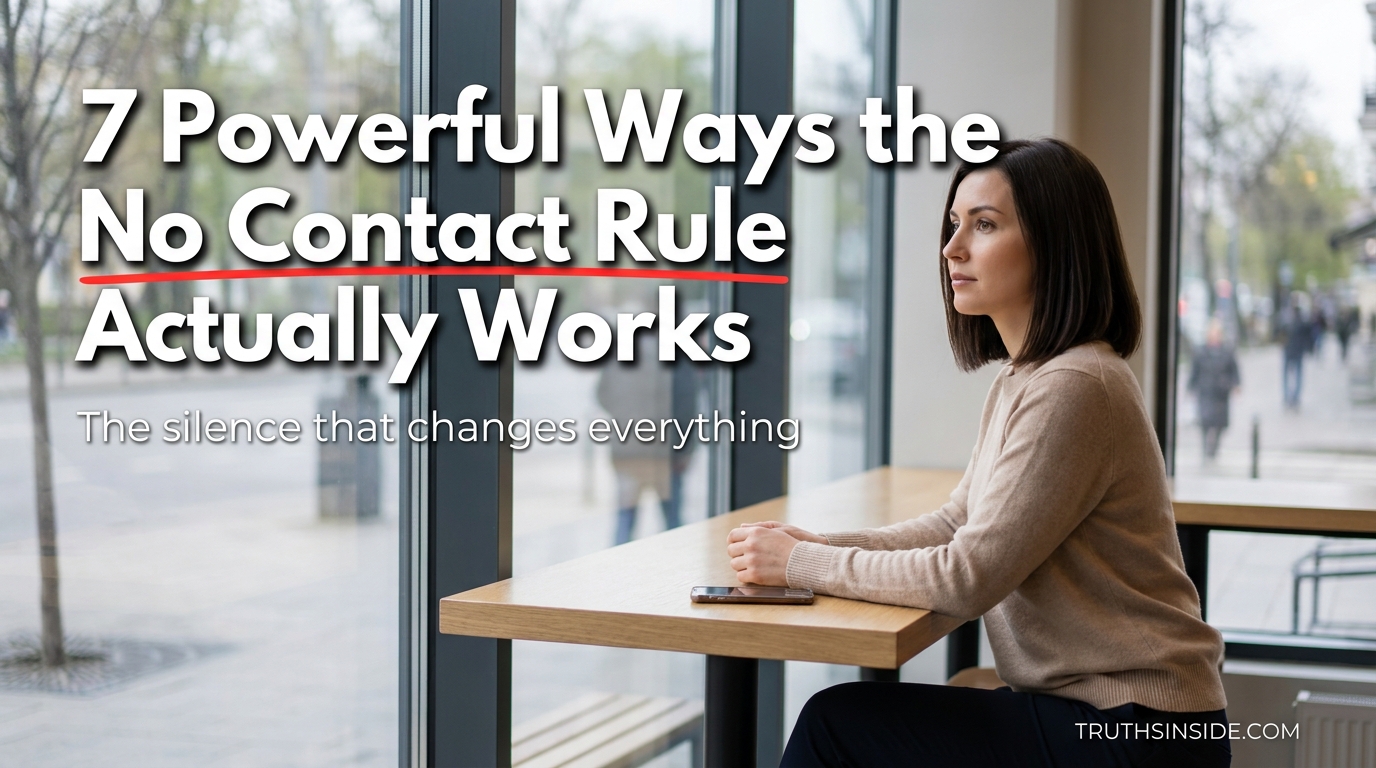
7 Powerful Ways the No Contact Rule Actually Works
1. It Interrupts the Toxic Cycle of Emotional Dependency
One of the most destructive patterns after a breakup is the on-again, off-again communication cycle. You break up, you text, they respond warmly, you feel hope, they pull back, your heart breaks again. Then you repeat the entire sequence. This cycle is emotionally exhausting and prevents both parties from ever truly moving forward.
The no contact rule acts as a hard stop to this cycle. By removing yourself entirely from the communication loop, you break the pattern. You stop giving your emotions something to react to. You stop living on the emotional crumbs of a relationship that has already ended.
Over time, this interruption creates something powerful: stability. Without the constant emotional highs and lows triggered by their messages, your nervous system gets a chance to stabilize, and you begin to experience longer stretches of calm, clarity, and genuine peace.

2. It Forces You to Sit With Your Feelings Instead of Escaping Them
This is the uncomfortable truth that most people do not want to hear: reaching out to your ex is often not about them. It is about avoiding the pain of sitting alone with your own emotions. Sending that text feels productive. It feels like doing something. But in reality, it is a distraction that delays the grieving process.
The no contact rule removes that escape route. When you cannot text them, when you cannot check on them, you are left with yourself. Your thoughts. Your grief. Your confusion. And as brutal as that sounds, this is exactly where healing begins.
Grief researchers, including Dr. David Kessler who worked alongside Elisabeth Kübler-Ross, emphasize that the only way through grief is through it — not around it. Sitting with the pain, naming it, journaling about it, crying through it — these are not signs of weakness. They are signs that you are processing, not suppressing. And the no contact rule creates the environment necessary for that authentic emotional processing to happen.
📃 Related article: The 5 Love Languages Explained: Which One Are You?
3. It Gives You Back Your Sense of Self
Long-term relationships — especially emotionally intense ones — have a way of blurring your identity. You start to define yourself through the relationship: what your partner liked, what made them happy, what your future together looked like. When that relationship ends, it can feel like you have lost not just a person but an entire version of yourself.
No contact gives you something invaluable: time and mental space to rediscover who you are independently. Without constant communication with your ex pulling your thoughts back into the relationship, you can start asking new questions. What do I want? What makes me happy? Who am I when I am not somebody’s partner?
This process of identity reconstruction is one of the most underrated benefits of the no contact rule, and it is one that research strongly supports. A 2020 study published in the Journal of Personality and Social Psychology found that people who experienced strong “self-concept clarity” after a breakup reported significantly faster and more complete emotional recovery.
4. It Creates Space for Genuine Reflection — For Both People
Human beings rarely think clearly when they are in constant contact with someone they have unresolved feelings for. Every message, every meme shared, every late-night call keeps both parties emotionally entangled in something that is no longer clearly defined. Real reflection — the kind that leads to honest answers about what went wrong, what you need, and whether reconciliation is even something you want — requires distance.
The no contact rule creates that distance deliberately. In that space, you may discover things about the relationship you could not see while you were in it. You may recognize patterns that were unhealthy. You may understand your own contribution to the dynamic. Or you may realize that what you had was genuinely beautiful and worth revisiting — but from a healthier, more grounded place.
And here is something people rarely talk about: the same reflection happens on the other side. When your ex stops hearing from you, they too are left with their own thoughts. The silence has a way of amplifying what was real and significant about the relationship, often more effectively than any conversation could.
5. It Rebuilds Your Confidence and Self-Worth
Breakups — particularly the ones you did not choose — can do serious damage to your self-esteem. When someone leaves, the brain often interprets it as a verdict on your worth. Am I not enough? Am I too much? What is wrong with me? These questions are natural, but they are also deeply corrosive if left unchallenged.
Every single day that you maintain the no contact rule, you are sending yourself a message. You are saying: I can handle this. I am not going to beg. I am not going to chase someone who chose to leave. I respect myself enough to give myself space. That message, repeated day after day, begins to rebuild the confidence that the breakup may have fractured.
This is not performance. This is not pretending to be fine when you are not. It is the slow, genuine accumulation of self-respect that comes from choosing your own wellbeing over the temporary comfort of an unwanted text back.
“Every day you stay silent, you are not losing. You are building something your ex can never give you — your power back.”
6. It Breaks Trauma Bonding and Unhealthy Attachment Patterns
This benefit is particularly important for people coming out of toxic, manipulative, or emotionally abusive relationships. Trauma bonding — the psychological attachment that forms through cycles of pain and reward — is one of the most powerful and misunderstood forces in relationship psychology.
If you were in a relationship with someone who was hot and cold, loving and critical, present and then distant, your nervous system may have become wired to find that chaos familiar, even comforting. This is not a character flaw — it is a trauma response. And it makes going no contact feel almost unbearable, because your system is wired to seek the very source of your pain.
But this is precisely why the no contact rule is so essential in these situations. Distance from the person who created the trauma bond is the first and most important step in breaking it. Over time, your nervous system learns a new baseline. You begin to recognize what calm, consistent, safe connection actually feels like — and you stop mistaking chaos for passion.

7. It Opens the Door to Real Healing — Not Just Distraction
There is a difference between feeling better and actually healing. Distractions — going out every night, immediately dating someone new, staying in constant contact with your ex “as friends” — can make you feel better in the short term. But they do not address the underlying emotional wound. They just cover it.
The no contact rule, when practiced with intentionality, is not about distraction. It is about doing the real work. Using that silence to journal. To go to therapy. To rebuild routines and habits that support your mental health. To reconnect with friendships and passions that the relationship may have dimmed. To learn what you genuinely want in a future partner.
When you come out the other side of a committed no contact period — 30, 60, or 90 days of real silence and genuine inner work — you are not the same person who was crying on the bathroom floor at midnight. You are someone who chose growth when grief was the easier option. And that transformation is real, lasting, and yours.
📃 Related article: 15 Subtle Red Flags in a New Relationship Most People Miss
How to Do the No Contact Rule Correctly
Knowing it works is one thing. Doing it is another. Here is a clear, practical framework to follow:
Step 1 — Make a clear decision. No contact does not work if you leave yourself loopholes. Decide that you are doing this, commit to a timeframe, and write it down.
Step 2 — Remove the temptations. Unfollow or mute them on social media. Move their contact to a folder you will not accidentally open. Remove old text chains from your screen. You do not have to delete everything — just remove the easy access.
Step 3 — Tell someone you trust. Accountability matters. Tell a close friend or family member what you are doing so they can check in on you and remind you of your reasons on the hard days.
Step 4 — Fill the silence with intention. No contact creates space. Fill it deliberately — with therapy, journaling, exercise, creativity, community, or any practice that reconnects you with yourself.
Step 5 — Prepare for the urge. You will want to reach out. Probably around day 3, day 7, and again around day 21. These are predictable. Have a plan: call a friend instead, write in your journal, go for a walk. Survive the urge and it will pass.
Step 6 — Do not announce it. You do not need to send a “I’m doing no contact now” text. Just go silent. Actions always speak more clearly than explanations.
Step 7 — Revisit your “why” daily. Write down your reasons for doing this. Read them every morning. Let your purpose be bigger than your temporary pain.

What to Do If You Break No Contact
First — do not punish yourself. Breaking no contact does not mean you have failed. It means you are human. What matters is what you do next.
If you sent a message, do not send a follow-up to explain or apologize for it. That only creates more contact. Simply return to silence immediately. Reset your timer. Recommit to your reasons. And use what just happened as information — what triggered you? What emotional need were you trying to meet? Understanding the trigger helps you protect against it in the future.
Many people break no contact multiple times before they finally maintain it. That is not failure. That is the process. Every time you recommit, you build a little more emotional strength.
📃 Related article: Anxious Attachment: Signs, Causes, and How to Heal
When No Contact Is Not the Right Choice
The no contact rule is a powerful tool but it is not universally appropriate. There are situations where zero communication is not safe, realistic, or healthy:
- If you share children and must co-parent, complete no contact is not possible. In this case, practice limited contact — keep communication minimal, factual, and child-focused only.
- If you work together, adapt the principle to minimal, professional communication only.
- If you are currently in a dangerous situation — emotional, physical, or otherwise — please seek support from a crisis counselor or domestic violence resource before applying any relationship framework.
The spirit of the rule still applies in these situations — protect your emotional energy, limit unnecessary contact, and redirect your focus inward.
FAQ: No Contact Rule
Q1: How long should no contact last?
Most relationship psychologists recommend a minimum of 30 days. For longer or more intense relationships, or in cases involving trauma bonding, 60 to 90 days is more effective. The right length is however long it takes for you to feel genuinely grounded and emotionally independent again — not just calmer.
Q2: Will the no contact rule make my ex miss me?
It can — and often does. When you go silent, you remove yourself from their daily emotional landscape. People tend to value what they no longer have access to. However, making your ex miss you should never be the primary reason for doing no contact. The primary reason should always be your own healing.
Q3: What if my ex reaches out during no contact?
This is one of the most common challenges. If your ex reaches out, you are not obligated to respond. In fact, maintaining silence at this point can be one of the most powerful decisions you make. If you choose to respond, take your time — at least 24 hours — and keep it brief and neutral. Ask yourself honestly: am I responding because I am healed and curious, or because I am still in pain and hoping?
Q4: Can no contact work if I want my ex back?
In some cases, yes. Creating space can shift the emotional dynamic significantly. However, returning to the same relationship without addressing what caused the breakup usually leads to the same outcome. If reconciliation is your goal, use the no contact period to do genuine self-work, and consider couples therapy if you do reconnect.
Q5: Is no contact cruel or manipulative?
No. Choosing not to communicate is a fundamental personal right. You are not obligated to remain emotionally available to someone who is no longer your partner. No contact is an act of self-preservation, not manipulation. The difference lies in intent — it is not designed to harm your ex. It is designed to heal you.
Final Thoughts
The no contact rule is not a game. It is not a trick. It is not about making someone jealous or playing emotional chess. At its core, it is one of the most honest and courageous things you can do after a breakup — choosing your own healing over the temporary comfort of connection that no longer serves you.
It will be hard. There will be days when the silence feels unbearable and the urge to reach out feels impossible to resist. But every day you choose yourself, you build something real. Something no relationship can give you and no breakup can take away.
You are not going silent because you do not care. You are going silent because you care about yourself enough to heal properly.
Save this article — you will want to come back to it on the hard days.
Share it with someone who needs to read this right now.
Follow Truthsinside.com for more honest, research-backed relationship and psychology content that actually helps.
🎵 Music
Maren Lull is a singer-songwriter who writes from the places most people don’t talk about out loud.
Not the dramatic grief. Not the obvious heartbreak. The quiet kind — the ordinary Tuesday emptiness, the habit of reaching for someone who isn’t there anymore, the particular exhaustion of being strong for so long that the strength itself wears thin.
Her music lives at the intersection of emotional honesty and soft beauty — breathy vocals over gentle piano, slow tempos, lyrics that feel less like songs and more like something you wrote in a private notebook at two in the morning and never showed anyone.
Maren Lull writes for the people who feel everything deeply and say very little about it. For the ones who listen to sad music not because they want to feel worse — but because being understood, even by a song, makes the feeling easier to carry.
📱 Follow Maren Lull:
→ Spotify
→ Apple Music
→ Youtube
→ Audiomack