Have you ever met someone for the first time and instantly decided they were kind, trustworthy, and everything you have been looking for — based almost entirely on how attractive they were? You are not alone, and you are not shallow. You are human. And your brain was doing something it has been doing for thousands of years without asking your permission.
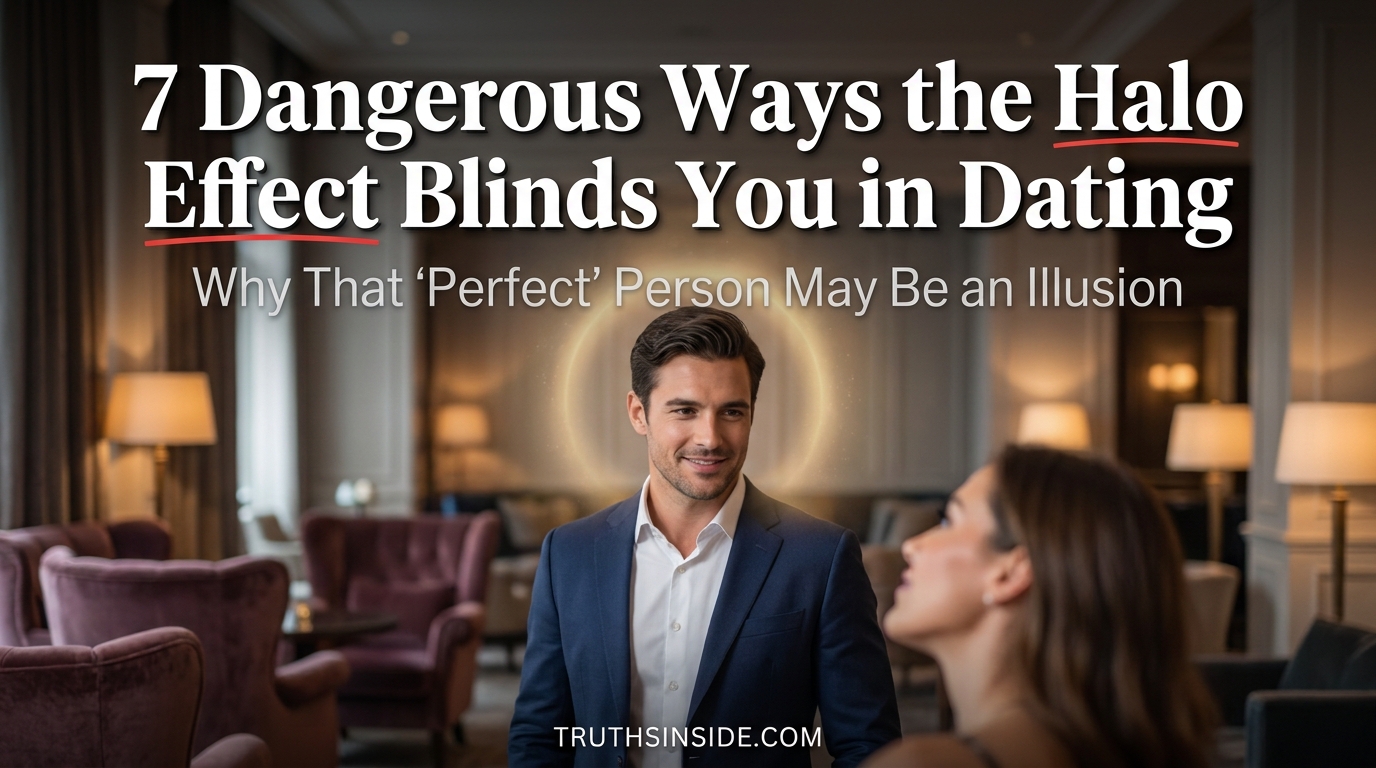
The halo effect in dating is one of the most well-documented and quietly destructive cognitive biases in all of relationship psychology. First identified by psychologist Edward Thorndike in 1920, it describes the way a single positive trait — most often physical attractiveness — causes us to unconsciously assume a person possesses a whole constellation of other positive qualities: intelligence, honesty, warmth, reliability. A landmark study published in the Journal of Personality and Social Psychology found that physically attractive individuals are consistently rated as more competent, more moral, and more socially skilled — even by total strangers who have exchanged not a single word with them.
That is the quiet danger living inside every first date, every swipe right, and every butterflies-in-the-stomach moment. The halo effect in dating does not ask for your consent. It does not wait for evidence. It simply rewrites reality in real time — and most people never notice it happening until they are deep inside a relationship that looks nothing like what they thought they signed up for. This article is going to change that.
What Is the Halo Effect — And Why Does It Hit Harder in Dating?
The halo effect is a cognitive bias in which our overall impression of a person is disproportionately influenced by one single characteristic. In a general social context, this might mean assuming a well-dressed person is more competent at their job, or believing a confident speaker must also be knowledgeable. In dating, the primary trigger is almost always physical attractiveness — and the consequences run significantly deeper.
When you are attracted to someone, your brain does not operate as a neutral information-processing machine. It operates as an advocate. It begins collecting evidence that confirms what it already wants to believe and quietly discarding information that contradicts it. Psychologists call the broader pattern confirmation bias, but in the emotional context of romantic attraction, the halo effect supercharges it to a level that can genuinely impair your judgment in ways you would never accept in any other area of your life.
You would not hire an employee based on their smile alone. You would not trust a financial advisor simply because they had good posture and a warm handshake. But in dating — when chemistry is involved, when loneliness is a factor, when the hope of love is in the room — the rational part of your brain quietly steps aside. And the halo effect in dating takes the wheel.
The Psychology Behind Why It Happens
Understanding the mechanism behind this bias is the first step to protecting yourself from it. The halo effect is not a modern invention of the social media age. It is deeply rooted in evolutionary psychology. For most of human history, physical health markers — symmetrical features, clear skin, strong posture — were genuinely correlated with genetic fitness, health, and survival potential. Our ancestors who found these traits attractive had an evolutionary advantage: they were more likely to choose healthy, capable partners.
The problem is that the modern dating landscape has evolved far faster than our brains have. Physical attractiveness today tells us very little about a person’s emotional intelligence, their capacity for loyalty, their communication patterns, or their long-term compatibility with us. But our ancient brain has not received the update. It still runs the same software — and in the context of the halo effect in dating, that outdated software can lead us directly into relationships that look perfect on the surface and feel catastrophic from the inside.
Neuroimaging research has shown that when we view an attractive face, the brain’s reward center — specifically the nucleus accumbens — activates in a way that is chemically similar to receiving an unexpected reward. Dopamine floods the system. Rational evaluation becomes harder. And the halo is born.
“Attraction is not evidence of compatibility. The most dangerous relationships often begin with the most electric chemistry.”
7 Dangerous Ways the Halo Effect Blinds You in Dating
1. It Makes You Overlook Genuine Red Flags in Real Time
This is perhaps the most immediately dangerous consequence of the halo effect in dating. When you are powerfully attracted to someone, your brain actively minimizes or reframes behavior that, in any other context, would register as a clear warning sign.
They cancel plans at the last minute? “They must be so busy — they’re probably really driven.” They make a cutting comment about your appearance? “They’re just being honest — I love that they’re direct.” They talk exclusively about themselves for two hours? “They’re just passionate. I find that exciting.”
None of those reframes are happening consciously. That is the insidious part. The halo effect rewires your interpretation of behavior in real time, turning red flags into green ones simply because the person delivering them is attractive to you. Research from the University of Groningen found that people rated the same ambiguous behavior as significantly more acceptable when it came from physically attractive individuals compared to less attractive ones.
The result? You enter deeper into a dynamic that is already showing you exactly who it is — and you cannot see it because the halo is too bright.

2. It Inflates Your Assumptions About Their Character
The moment you find someone physically attractive, your brain begins building an entire character profile for them — before they have said or done anything to earn it. You assume they are kind because they smiled warmly. You assume they are intelligent because they are well-dressed. You assume they are emotionally mature because they seem confident. None of these assumptions are based on evidence. They are projections — gifts your brain gives to someone it finds appealing.
This character inflation becomes dangerous when reality eventually contradicts the profile your brain built. You have spent weeks or months investing emotionally in a version of this person that was never real. When their actual behavior reveals who they truly are, the cognitive dissonance is painful — and many people respond not by updating their perception but by doubling down on the original illusion.
The halo effect in dating does not just mislead you at the beginning. It creates a fictional character you fall in love with, and then it makes it deeply uncomfortable to let that fiction go.
📃 Related article: What Does It Actually Feel Like to Fall in Love? Science + Real Stories
3. It Causes You to Misread Confidence as Competence
Confidence is one of the most attractive traits in a dating context. Research consistently shows that confident body language, strong eye contact, and assertive communication are rated as highly desirable. And this is where the halo effect in dating creates a particularly costly misread: it causes you to interpret confidence as evidence of capability, reliability, and depth.
But confidence and competence are not the same thing. Confidence and emotional intelligence are not the same thing. Confidence and trustworthiness are not the same thing. Some of the most charismatic, self-assured people in a dating context are also the most emotionally unavailable, inconsistent, or self-centered.
The halo effect causes you to loan someone the benefit of the doubt they have not yet earned — and the more attractive and confident they are, the larger that unearned credit becomes. By the time their actual behavior catches up with your perception, you may already be deeply emotionally invested.
4. It Shortens Your Evaluation Timeline Dangerously
Healthy relationship formation involves a process of gradual evaluation — observing how someone behaves across different contexts, under different emotional conditions, with different people in their life. It takes time. It requires patience. And it requires you to remain open to information that challenges your initial impression.
The halo effect in dating collapses this timeline. When you are attracted to someone and your brain has assigned them a halo, the internal question shifts from “Is this person right for me?” to “How do I make this work?” You stop evaluating and start accommodating. You stop observing and start justifying.
This premature closing of the evaluation window is one of the primary reasons people find themselves months into a relationship that was never actually working — wondering how they missed so many obvious signs. They did not miss them. Their halo-biased brain simply processed them differently.
“Your feelings are real. But feelings are not facts. And attraction, no matter how powerful, is not a character reference.”
5. It Makes Breakups From Halo-Biased Relationships Uniquely Painful
When the halo effect has been a significant factor in a relationship, the breakup is not just the loss of a real person — it is the loss of an idealized version of a person that your brain constructed and deeply believed in. This layered grief is one of the reasons people describe certain breakups as disproportionately devastating compared to what the actual relationship warranted.
You are grieving two losses simultaneously: the real person and the fictional person you were convinced they were. The inner dialogue often sounds like: “But they were so amazing at the beginning.” And the painful truth is that the beginning was partly a story your halo-biased brain was telling you — and you believed every word of it.
Recognizing this dynamic does not minimize your pain. It explains it. And understanding why the grief feels so outsized is a genuine step toward processing it clearly and moving forward with healthier perceptions the next time.
6. It Creates Unequal Relationship Dynamics From the Start
When the halo effect in dating is in full operation, one person in the emerging relationship is operating from a place of unconscious idealization. They are more forgiving. More accommodating. More eager to please. More willing to overlook discomfort because the other person’s halo makes all of it seem worth it.
This creates an inherent power imbalance — and often, the person wearing the halo senses it, whether consciously or not. They may not exploit it intentionally, but the dynamic still shapes how the relationship functions. The idealized person has more emotional leverage. The person doing the idealizing has less. Decisions are made from a place of wanting to preserve the fantasy rather than honest, equal negotiation.
Healthy relationships require two people who see each other clearly and choose each other anyway. The halo effect makes that mutual clarity nearly impossible in the early stages — and if never examined, it can define the entire trajectory of a relationship.

7. It Can Trap You in a Cycle of Chasing the Halo Instead of Building Real Connection
Perhaps the longest-term damage done by the halo effect in dating is what it does to your entire dating pattern over time. If you consistently select partners based on the halo — choosing based on initial chemistry, surface attraction, and the exciting narrative your brain builds in the first few weeks — and those relationships consistently disappoint, your brain does not always draw the right conclusion.
Instead of recognizing the pattern, many people conclude that they simply have not found the right person yet. So they keep searching for the next halo. The next person who makes their brain light up in that particular way. And because the halo effect feels so much like genuine connection — because the dopamine, the excitement, the sense of instant understanding feel so real — they keep trusting it as a reliable guide.
This is how some people spend years, even decades, in a cycle of intensely felt but ultimately incompatible relationships — chasing a feeling that was never actually evidence of what they thought it was.
📃 Related article: The 5 Love Languages Explained: Which One Are You?
How to Date More Clearly — Protecting Yourself From the Halo Effect
Recognizing the halo effect in dating is the first line of defense. But awareness alone is not enough. Here is a practical framework for dating with greater psychological clarity:
Slow down deliberately. The halo effect is most powerful in the early stages of attraction. Build in intentional pauses before making emotional or logistical commitments. Slow is not a lack of interest. Slow is intelligence.
Observe, do not just listen. Words are easy. Behavior across time, context, and especially stress reveals character. Watch how they treat service workers, how they handle disappointment, how they speak about their ex-partners. These are your data points — not their charm on a first date.
Name what you actually know versus what you are assuming. After a first or second date, write two lists: one of things you have actually observed about this person, and one of things you have assumed or projected. The length of that second list is your halo effect measurement.
Actively look for contradicting evidence. This is the direct counter to confirmation bias. Instead of looking for reasons why this person is great, look equally hard for reasons why they might not be. Not to be cynical — but to be balanced.
Wait before introducing physical intimacy. Physical intimacy significantly amplifies the halo effect and triggers bonding hormones like oxytocin that further cloud rational evaluation. This is not a moral judgment — it is neuroscience.
Talk to people who do not find them attractive. Trusted friends who have no skin in the game can often see what you cannot. Their observations are not jealousy — they are data collected without a halo filter.

When the Halo Fades — What Happens Next
Every halo eventually dims. Research on the halo effect consistently shows that it is strongest in the early stages of acquaintance and gradually weakens as we accumulate more real behavioral information about a person. This is commonly referred to in relationship psychology as the transition from the “idealization phase” to the “disillusionment phase.”
This transition is normal. It is actually healthy. But how you navigate it depends entirely on whether the foundation beneath the halo was real. Some relationships, when the halo fades, reveal two genuinely compatible people who built something real alongside the initial attraction. Others reveal a painful gap between the person you thought you were dating and the one who was actually there all along.
The goal is not to stop feeling attraction. The goal is to refuse to let attraction do all the work of evaluation. A halo is a beautiful thing — as long as you remember it is a light source, not a character reference.
📃 Related article: Gaslighting in Relationships: How to Recognize, Name, and Leave It
FAQ: Halo Effect in Dating
Q1: Is the halo effect the same as love at first sight?
They overlap significantly. What people often describe as love at first sight is frequently the halo effect operating at full intensity — the instant assignment of deeply positive qualities to someone based almost entirely on appearance and initial chemistry. It feels profound and real. But love, in the truest sense, requires knowledge of a person. You cannot love someone you do not know. You can be powerfully drawn to them — and that is the halo talking.
Q2: Does the halo effect only apply to physical attractiveness?
No, though attractiveness is the most common trigger in dating contexts. The halo effect can also be activated by other prominent positive traits — high social status, wealth, humor, or exceptional confidence. Any single standout quality can cast a halo that inflates your perception of everything else about the person.
Q3: Can the halo effect work in reverse — making us judge someone too harshly?
Absolutely. Psychologists call this the “horn effect” — the cognitive bias in which one negative trait causes us to view all other characteristics of a person more negatively. Just as a halo inflates positive perception, horns inflate negative perception. Both biases share the same underlying mechanism: using one data point to draw sweeping conclusions.
Q4: How long does the halo effect typically last in a relationship?
Research suggests the idealization phase — driven largely by the halo effect and early-stage neurochemistry — typically lasts between six months and two years. After that, as the novelty neurochemicals (dopamine and norepinephrine) settle and real behavioral patterns emerge, people see their partners more clearly. This is why the transition from “honeymoon phase” to a more realistic assessment of the relationship can feel so jarring.
Q5: Can awareness of the halo effect actually help me date better?
Yes — and research supports this. Studies on cognitive bias have found that simply being aware of a bias does not eliminate it, but it does reduce its influence when combined with deliberate strategies. Naming what you are experiencing — “I notice I am making a lot of assumptions about this person” — activates the prefrontal cortex and invites more rational processing. Awareness is not a cure, but it is a genuinely powerful tool.
Final Thoughts
The halo effect in dating is not evidence that you are naive or foolish. It is evidence that you are human — running ancient psychological software in a modern emotional landscape. Every person reading this has felt a halo. Every person has, at some point, looked at someone across a table and decided they were extraordinary before they had done anything to prove it.
The difference between people who keep repeating painful relationship patterns and those who gradually learn to choose better is not the absence of attraction. It is the development of awareness. The willingness to ask harder questions. The discipline to slow down when every emotion is pushing you to speed up.
You deserve to be chosen by someone who is genuinely what they appear to be. And you deserve to see the people you date clearly enough to know whether they are real or just wearing a very beautiful light.
Save this article — the next time you feel that instant pull, you will want to come back and read it slowly.
Share it with someone who keeps ending up in relationships that started perfectly and fell apart confusingly.
Follow Truthsinside.com for psychology-backed relationship content that helps you see love more clearly.
🎵 Music
Maren Lull is a singer-songwriter who writes from the places most people don’t talk about out loud.
Not the dramatic grief. Not the obvious heartbreak. The quiet kind — the ordinary Tuesday emptiness, the habit of reaching for someone who isn’t there anymore, the particular exhaustion of being strong for so long that the strength itself wears thin.
Her music lives at the intersection of emotional honesty and soft beauty — breathy vocals over gentle piano, slow tempos, lyrics that feel less like songs and more like something you wrote in a private notebook at two in the morning and never showed anyone.
Maren Lull writes for the people who feel everything deeply and say very little about it. For the ones who listen to sad music not because they want to feel worse — but because being understood, even by a song, makes the feeling easier to carry.
📱 Follow Maren Lull:
→ Spotify
→ Apple Music
→ Youtube
→ Audiomack