
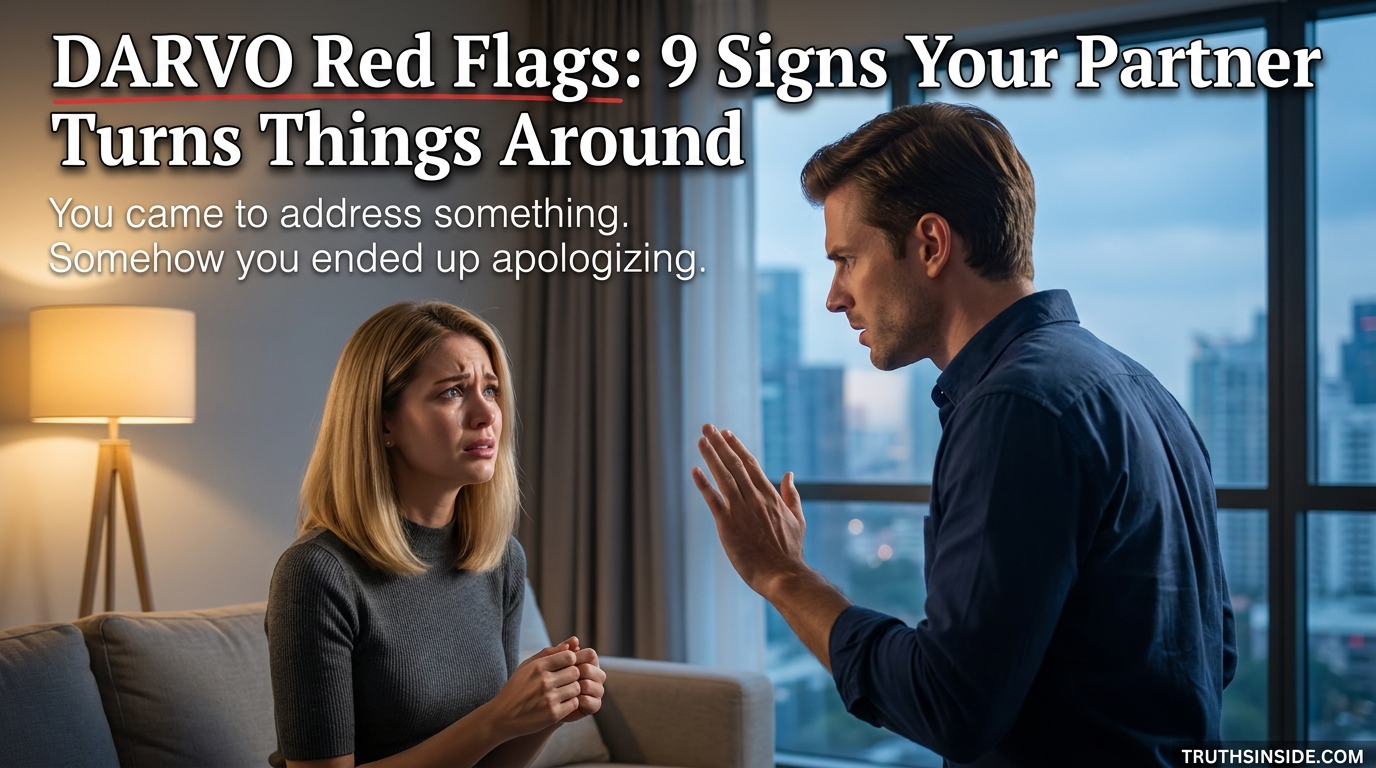
DARVO red flags are among the most psychologically disorienting warning signs in any relationship — not because they are rare, but because they are specifically designed to make the person experiencing them doubt their own perception of what is happening. You raise a concern. You try to have an honest conversation about something that hurt you. And somehow, by the end of that conversation, you are the one defending yourself, apologizing, and comforting the person whose behavior you originally tried to address. You leave the interaction more confused than when you entered it — and increasingly uncertain about whether your feelings and perceptions can be trusted at all.
DARVO is an acronym coined by psychologist Dr. Jennifer Freyd in 1997 to describe a specific pattern of response used by people who are confronted with their own harmful behavior. It stands for Deny, Attack, Reverse Victim and Offender. First, the person denies the behavior being raised. Then they attack the person raising it — questioning their credibility, their motives, or their emotional stability. Finally, they reverse the roles of victim and offender — positioning themselves as the real injured party and casting the person who raised the concern as the aggressor.
Research published in the Journal of Trauma and Dissociation found that DARVO is a documented and measurable response pattern used by perpetrators of interpersonal harm across a wide range of relationship contexts — and that exposure to DARVO significantly increases self-blame, self-doubt, and psychological distress in the people subjected to it. A separate study found that individuals who experienced DARVO responses were significantly more likely to doubt their own memories and perceptions of events — a finding that explains why this pattern is so closely associated with the experience of gaslighting.
This article identifies 9 specific DARVO red flags — the signs that your partner is using this pattern to avoid accountability and turn every confrontation back on you. Recognizing them is the first step toward reclaiming your grip on your own reality.
What DARVO Actually Looks Like in a Real Relationship
Before examining the 9 red flags, it is worth grounding the concept of DARVO in the texture of how it actually appears in everyday relationship dynamics — because in real life, it rarely looks as clean or obvious as the acronym might suggest.
DARVO doesn’t typically announce itself. It doesn’t feel like manipulation in the moment — it feels like a conversation that has somehow gone completely sideways. You came into the interaction with a clear, legitimate concern. Within minutes, that concern has been buried under a counter-narrative so complete that you can barely remember what you originally wanted to address.
It happens fast. The denial comes first — often so immediate and so absolute that it creates its own kind of disorientation. Then the attack, which may not be loud or aggressive. It may be quiet, wounded, and delivered with the language of hurt rather than aggression: “I can’t believe you would say that about me.” “You always do this.” “After everything I’ve done for you.”
And then the reversal — the moment when the person you came to address has somehow become the victim of the conversation, and you are left holding a guilt and defensiveness that has no clear origin because the shift happened so smoothly you didn’t fully track it.
Understanding this texture — the specific way DARVO feels from the inside — is what makes the 9 red flags that follow recognizable rather than merely theoretical.

Red Flag #1: DARVO Red Flags Begin With Instant, Absolute Denial
The first component of DARVO — denial — is where every episode of this pattern begins. And its most recognizable feature is not simply that the person denies the behavior, but that the denial is immediate, absolute, and delivered with a conviction so complete that it creates its own reality in the room.
There is no pause. No consideration. No “let me think about how that came across.” The denial arrives before you have finished speaking — a wall erected so quickly that it leaves no space for your experience to exist.
This is not the same as genuine disagreement about what happened. Healthy partners can and do have different memories and perceptions of the same event. The red flag is the specific quality of the denial — its speed, its totality, and its consistent refusal to consider the possibility that your perception might contain any validity whatsoever.
Over time, this pattern of instant absolute denial trains you to preemptively soften, minimize, and qualify your concerns before you even raise them — because you have learned that anything you say will be denied completely, and some part of you has started to wonder if the denial might be right.
📃 Related article: Gaslighting in Relationships: How to Recognize, Name, and Leave It
Red Flag #2: Your Emotional State Becomes the Subject — Not Their Behavior
One of the most effective elements of DARVO is the rapid pivot from the content of what you raised to the manner in which you raised it. Before your concern has been genuinely heard or addressed, the conversation shifts entirely to how you expressed it.
You’re too emotional. You always bring things up at the wrong time. You’re being aggressive. You’re overreacting. The way you said it was hurtful. You can’t have a rational conversation.
Each of these statements redirects attention away from what your partner did and plants it firmly on what you did — specifically, the act of raising the concern itself. Your legitimate expression of hurt or frustration has been reframed as the problem. The original behavior that prompted the conversation has been effectively erased from the discussion.
This pivot is particularly insidious because it contains enough surface plausibility to create genuine self-doubt. Perhaps you did raise your voice slightly. Perhaps the timing wasn’t ideal. And so you find yourself defending your delivery rather than maintaining your concern — which is precisely the outcome this maneuver is designed to produce.
In healthy conflict, both partners can acknowledge each other’s feelings and take responsibility for their own behavior regardless of how imperfectly it was communicated. In DARVO, your emotional expression becomes the offense that overshadows everything else.
Red Flag #3: They Attack Your Character Rather Than Address the Issue
When denial alone is insufficient to shut down a concern, DARVO escalates into the attack phase — and in intimate relationships, the attack is rarely physical or overtly aggressive. It is targeted, personal, and delivered with the precision of someone who knows exactly where your most vulnerable self-doubts live.
You’re always so dramatic. You’re paranoid. You’re insecure. You never trust anyone. You’re just like your mother. You’re mentally unstable. You make everything about yourself.
These attacks do not address the behavior you raised. They address your fundamental credibility as a person raising it — positioning you as someone whose perceptions and emotional responses cannot be trusted because of some inherent flaw in who you are.
The effect is to shift the entire frame of the conversation. You came to address a specific behavior. Now you are defending your entire character, your mental health, your history, and your worthiness to have concerns taken seriously at all.
And in defending yourself, you have completely abandoned the original issue — which remains unaddressed, unacknowledged, and increasingly likely to be raised again in the future, where the same pattern will unfold again with the same result.
“DARVO doesn’t just avoid accountability — it makes accountability feel like an act of aggression against the person who caused the harm.”
Red Flag #4: They Suddenly Become the Victim of the Conversation
The reversal component of DARVO — the R in the acronym — is where the pattern reaches its most complete and most disorienting expression. This is the moment when your partner, who was the subject of your concern moments ago, has somehow become its primary casualty.
They are crying. They are expressing deep hurt about how you spoke to them, what you accused them of, or what it says about your lack of trust in them. They are describing their pain in language that is often more vivid and more emotionally compelling than anything you had the chance to express about your own.
And you — who came into this conversation with a genuine concern about their behavior — now find yourself in the position of comforter, apologizer, and reassurer. The emotional labor of the conversation has completely inverted. Their pain has become the dominant emotional reality of the room, and yours has been erased.
Research by Dr. Freyd and colleagues found that this reversal is particularly effective because it activates the empathy of the person who raised the concern — and empathy, in this context, becomes a mechanism of manipulation. Your genuine care for this person is used to redirect your attention from their accountability to their feelings — feelings that were generated, at least in part, by your attempt to hold them accountable.
Red Flag #5: You Consistently Leave Arguments Feeling Like the Villain
Over time, repeated exposure to DARVO produces a specific and deeply corrosive internal experience: the persistent, growing sense that you are the problem in the relationship. Not in a vague way — but in a specific, embodied way that makes you increasingly reluctant to raise concerns, express needs, or address anything that might lead to another conversation like the ones that have left you feeling this way.
You start to believe that your concerns are always disproportionate. That your emotional responses are always excessive. That you are always bringing drama, always starting conflict, always hurting the person who is actually trying their best with someone as difficult as you.
This narrative — which has been systematically constructed through repeated DARVO encounters — is not an accurate reflection of who you are. It is the cumulative residue of a pattern designed to make you doubt yourself thoroughly enough that you stop challenging the behavior that prompted it.
Psychologists call this “victim self-blame” — and research consistently shows it is one of the most significant psychological outcomes of sustained exposure to DARVO and related manipulation patterns.
If you consistently leave difficult conversations in your relationship feeling worse about yourself than about the issue you raised — that is not evidence of your inadequacy. It is evidence of a pattern.

Red Flag #6: Apologies Are Always Conditional or Turned Back on You
In healthy relationships, genuine accountability includes genuine apology — an acknowledgment of impact, an expression of remorse, and a commitment to changed behavior that does not require the other person to first prove they deserved the apology or accept blame for provoking the behavior being apologized for.
In relationships where DARVO is operating, apology — when it arrives at all — is almost always conditional, qualified, or structurally inverted in ways that preserve the offending partner’s position rather than genuinely acknowledging the harm caused.
“I’m sorry you feel that way.” “I’m sorry I did that, but if you hadn’t said what you said first, I never would have.” “I’m sorry — but you need to understand how hard it is to deal with your constant accusations.” “Fine, I’m sorry. Are you happy now?”
Each of these responses mimics the form of an apology while evacuating its substance. They transfer responsibility back to the person who was harmed. They make the apology contingent on your prior acceptance of some degree of blame. And they ensure that the pattern of non-accountability remains intact — even in the moments that appear, on the surface, to represent genuine repair.
Over time, these conditional apologies lose what little meaning they carried and begin to function as another tool of the DARVO cycle — keeping you engaged with the possibility of genuine accountability that never fully arrives.
📃 Related article: 15 Subtle Red Flags in a New Relationship Most People Miss
Red Flag #7: Witnesses and Evidence Are Dismissed or Reframed
A particularly revealing sign that DARVO is operating in a relationship is what happens when there is external corroboration of the concern being raised. When a friend witnessed the behavior. When there is a text message or recording. When multiple people have expressed the same concern independently.
In a relationship characterized by genuine accountability, external corroboration creates an opening for honest reflection — a third-party perspective that helps both partners access a less emotionally filtered view of what happened.
In a DARVO dynamic, external corroboration is not an opening. It is a new front of attack. The friend is jealous or interfering. The text message is being misread or taken out of context. The multiple people who raised concerns are all part of a pattern of your negative influence on the relationship, or evidence of your tendency to turn others against your partner.
The external evidence — regardless of its nature — gets processed through the same DARVO mechanism: denied, reframed as an attack, and reversed into evidence of something problematic about you rather than something revealing about them.
This particular red flag is important because it closes off one of the most natural routes to clarity. In most situations, external evidence helps people reality-test their perceptions. In a DARVO relationship, even that avenue gets systematically blocked.
Red Flag #8: You Have Started Censoring Yourself to Avoid the Pattern
One of the most telling signs that DARVO has become an established dynamic in a relationship is what it produces in your own behavior over time — specifically, the degree to which you have unconsciously begun to self-censor, self-suppress, and self-edit in order to avoid triggering another episode of the pattern.
You have stopped raising certain topics entirely because you know how the conversation will go. You have learned to frame your concerns in such heavily qualified, pre-apologetic language that the legitimate core of what you need to say barely survives the softening. You have internalized the criticism — the too sensitive, always dramatic, never trust anyone — to the point where your own internal voice sounds like the DARVO response before you’ve even spoken.
This self-censorship is not a character flaw. It is an adaptive response to a pattern that has consistently punished self-expression with disorientation, self-doubt, and emotional exhaustion.
But it is also one of the clearest possible signals that something is seriously wrong. A relationship in which one partner has systematically learned to suppress their own legitimate needs and concerns to avoid a predictable painful response is not a relationship operating within healthy parameters. It is a relationship that has produced a significant and ongoing harm — regardless of whether that harm was consciously intended.
“When you start editing yourself before you speak — not for kindness, but out of fear of what comes next — the relationship has already taken something from you that belongs to you.”
Red Flag #9: The Pattern Repeats With Remarkable Consistency
The final and perhaps most definitively diagnostic DARVO red flag is the one that only becomes visible over time — the remarkable, almost mechanical consistency with which the pattern repeats across different conversations, different topics, and different contexts.
It is not that this happened once when your partner was under unusual stress. It is not that this was an isolated incident in an otherwise accountable relationship dynamic. It is that this is what happens — reliably, predictably, and without significant variation — every time a concern is raised. Every time accountability is requested. Every time you try to address something that matters to you.
The specific content changes. The topic, the behavior, the particular accusation in the attack phase — these shift. But the structure is always the same: denial, attack, reversal. You leave the conversation the same way you always leave it. Confused. Doubting yourself. Somehow responsible for the harm that was done to you.
This consistency is important for two reasons. First, it confirms that what is happening is a pattern rather than a series of coincidences. Second, it provides the clearest possible evidence that the pattern is not going to self-correct — because it has been too consistent for too long to be the accidental byproduct of stress, poor communication habits, or a bad season.
A pattern this consistent and this damaging requires either significant intervention — therapeutic support for both partners, with genuine accountability from the partner using DARVO — or an honest assessment of whether the relationship can continue to be safe and healthy for the person on the receiving end of it.

What to Do If You Recognize DARVO in Your Relationship
Recognizing DARVO red flags in your relationship is a significant and often disorienting moment — because it requires simultaneously understanding that what has been happening to you is real, named, and documented, while also sitting with the grief and complexity of what that recognition means for the relationship you are in.
The first and most important step is to find external validation for your perception — not because you need someone else’s permission to trust your own experience, but because DARVO specifically targets your ability to trust your perception. A therapist, a trusted friend who has witnessed the dynamic, or a support group for people in emotionally manipulative relationships can all provide the grounding that the DARVO pattern has been systematically undermining.
Document what happens. Keep a private record — a journal, voice memos, or written notes — of specific incidents, including what you raised, how the conversation shifted, and how you felt afterward. This documentation serves two purposes: it provides an external reference point for your own reality-testing, and it creates a record that may be important if the relationship reaches legal or therapeutic intervention.
Seek individual therapy with a professional who has experience with psychological manipulation and emotional abuse dynamics. The self-doubt, self-blame, and confusion that DARVO produces are real psychological injuries — and they deserve professional support to heal.
And approach the question of the relationship’s future with honesty and with your own safety as the primary consideration. Some partners, when genuinely confronted with evidence of this pattern and offered the opportunity for therapeutic work, are capable of genuine change. Many are not. The difference between these two outcomes is not something that can be determined by hope or by more effort on your part. It requires demonstrated, sustained, accountable behavior change — and that is something only time and honest observation can confirm.
You are not too sensitive. You are not overreacting. You are not the problem. And the clarity you are beginning to find — however disorienting — is the first step toward a life and a relationship that treats you as the full, trustworthy, deserving person you have always been.
💾 Save this article — return to it when the self-doubt returns and you need a reminder of what you know.
📤 Share it with someone whose relationship descriptions have been quietly sounding like this for longer than either of you has fully named.
👣 Follow Truthsinside.com for more honest, research-backed content on relationship psychology, red flags, and the patterns that matter most to recognize and name.
FAQ: DARVO Red Flags
Q1: What does DARVO stand for and who coined the term?
DARVO stands for Deny, Attack, Reverse Victim and Offender. The term was coined by psychologist Dr. Jennifer Freyd in 1997 in the context of her research on institutional betrayal and perpetrator responses to being confronted with harmful behavior. It has since been extensively applied to interpersonal relationship dynamics, particularly in the context of emotional abuse, narcissistic behavior patterns, and intimate partner manipulation.
Q2: Is DARVO always intentional and deliberate?
Not necessarily. While some people use DARVO consciously and strategically as a tool of manipulation and control, others engage in the pattern without full conscious awareness — driven by deep-seated defensive mechanisms, shame responses, and attachment insecurities that make accountability feel existentially threatening. Whether intentional or not, the impact on the person experiencing it is the same. And whether intentional or not, it requires genuine therapeutic work and behavioral change to address — not simply greater understanding or more patient communication from the partner on the receiving end.
Q3: How is DARVO different from gaslighting?
DARVO and gaslighting frequently co-occur and produce similar outcomes — specifically, self-doubt and confusion in the person being subjected to them. The distinction is primarily one of mechanism. Gaslighting specifically involves making someone question their memory, perception, and sanity — “that never happened,” “you’re imagining things,” “you’re losing your mind.” DARVO is a broader response pattern that includes denial but adds the attack and role-reversal components. Many relationships where DARVO is present also involve gaslighting as part of the denial phase.
Q4: Can a relationship recover if one partner has been using DARVO?
Recovery is possible but requires conditions that are genuinely demanding and not always achievable. The partner using DARVO must first genuinely acknowledge the pattern — not as a defensive concession made under pressure, but as an honest recognition of what they have been doing and the harm it has caused. They must engage in sustained therapeutic work, ideally with a therapist who specializes in accountability and manipulation patterns.
And they must demonstrate changed behavior consistently over time — not as a performance designed to end the conversation, but as a genuine shift in how they respond to being held accountable. These conditions are possible. They are also not common. And the person on the receiving end of DARVO deserves to make decisions about the relationship’s future based on demonstrated reality rather than hoped-for potential.
Q5: What should I say if I recognize my partner using DARVO in real time?
Naming the pattern calmly and directly can be valuable — but only if you feel emotionally and physically safe doing so. Saying something like “I notice this conversation has shifted from what I originally raised to being about my behavior in raising it — I’d like to return to the original concern” can interrupt the pattern momentarily and signal that you are aware of the dynamic.
However, in relationships where DARVO is well-established, naming it often triggers escalation rather than genuine reflection. The most important thing you can do in real time is to decline to engage with the reversal — to maintain your original concern without defending yourself against the counter-attack — and to seek support from a therapist who can help you navigate the dynamic safely and effectively.
🎵 Music
Maren Lull is a singer-songwriter who writes from the places most people don’t talk about out loud.
Not the dramatic grief. Not the obvious heartbreak. The quiet kind — the ordinary Tuesday emptiness, the habit of reaching for someone who isn’t there anymore, the particular exhaustion of being strong for so long that the strength itself wears thin.
Her music lives at the intersection of emotional honesty and soft beauty — breathy vocals over gentle piano, slow tempos, lyrics that feel less like songs and more like something you wrote in a private notebook at two in the morning and never showed anyone.
Maren Lull writes for the people who feel everything deeply and say very little about it. For the ones who listen to sad music not because they want to feel worse — but because being understood, even by a song, makes the feeling easier to carry.
📱 Follow Maren Lull:
→ Spotify
→ Apple Music
→ Youtube
→ Audiomack