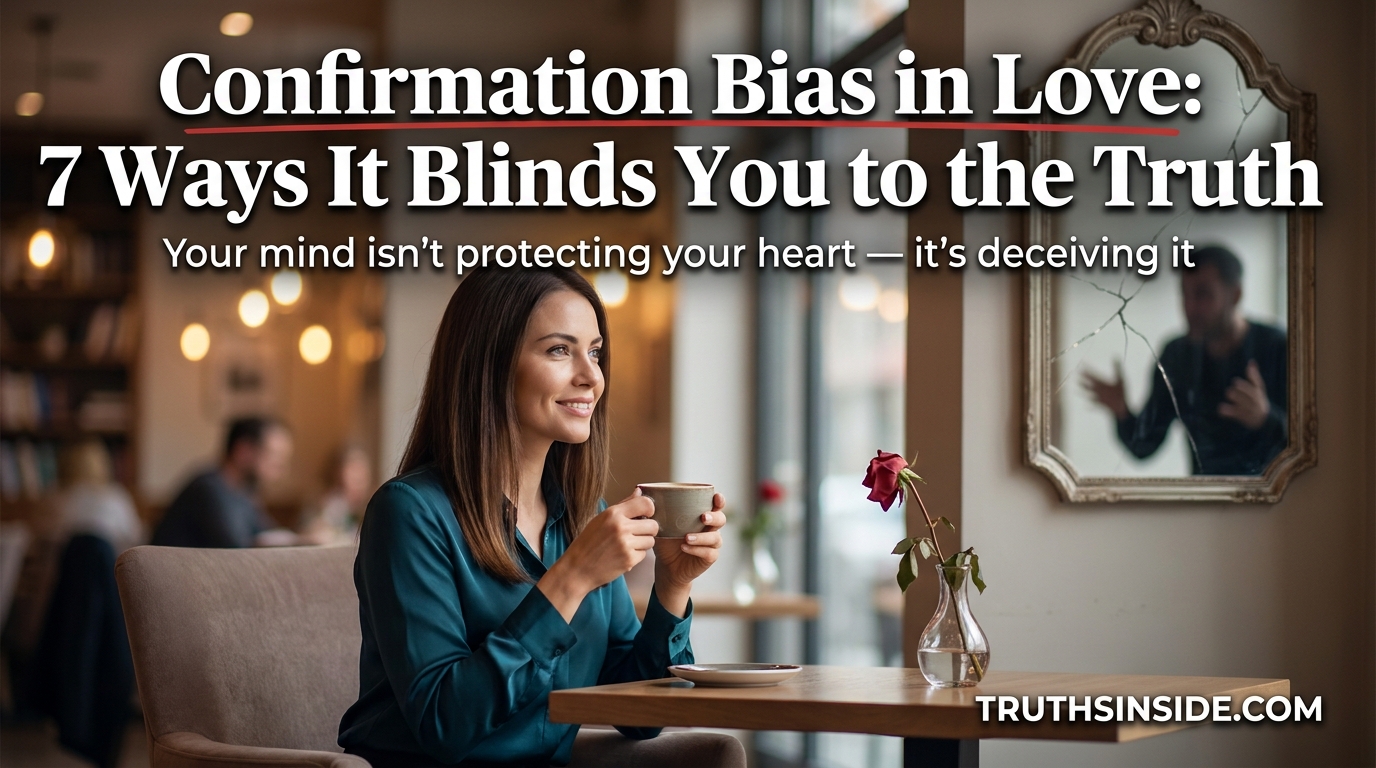
Confirmation bias in love is one of the most well-documented and least discussed psychological forces operating in romantic relationships today. It is the reason intelligent, self-aware people stay in relationships that are clearly wrong for them. It is the reason red flags get explained away, warning signs get reframed as misunderstandings, and the same painful patterns repeat across relationship after relationship without the person ever quite understanding why.
It is not stupidity. It is not weakness. It is one of the most powerful cognitive mechanisms the human brain possesses — and in the context of love, it operates with particular force.
Confirmation bias, first formally studied by psychologist Peter Wason in the 1960s, is the tendency to search for, interpret, and remember information in a way that confirms what we already believe — while unconsciously discounting or dismissing evidence that contradicts it. In everyday life, this bias influences everything from political beliefs to financial decisions. In romantic relationships, it shapes who we fall for, how we interpret their behavior, and how long we stay — often long past the point where the evidence should have told us something important.
A landmark study published in the Journal of Experimental Psychology found that people in romantic relationships consistently rated ambiguous partner behaviors more favorably than objective observers did — and that this favorable interpretation bias was strongest in people with the highest emotional investment in the relationship. The more you love someone, the more powerful your confirmation bias becomes. And the more powerful it becomes, the less clearly you see.
This article examines 7 specific ways confirmation bias in love blinds you to the truth — and what genuine clarity in relationships actually requires.
The Psychology Behind Why Love Makes Us Selectively Blind
Before examining the 7 ways confirmation bias operates in love, it helps to understand why love is such fertile ground for this particular cognitive bias in the first place.
When we fall in love, the brain undergoes a documented neurochemical shift. Dopamine floods the reward system. Oxytocin builds feelings of trust and safety. And critically — activity in the prefrontal cortex, the brain region responsible for critical thinking and objective judgment, measurably decreases.
Dr. Andreas Bartels and Dr. Semir Zeki of University College London used fMRI imaging to demonstrate that romantic love literally suppresses neural activity in areas associated with negative emotion and critical social assessment. In plain terms: falling in love neurologically impairs your ability to evaluate your partner objectively.
This is not a flaw in the design. Evolutionarily, it served a purpose — reducing the critical evaluation of a potential mate long enough for attachment to form. But in the modern landscape of complex relationships and long-term partnership, this neurological tendency creates conditions in which confirmation bias can operate largely unchecked — filtering your perception of your partner through the lens of what you want them to be rather than who they actually are.
Understanding this is not cause for cynicism. It is cause for intentional awareness — the kind that allows you to love fully while also seeing clearly.

Way #1: Confirmation Bias in Love Makes You Collect Green Flags and Dismiss Red Ones
The most immediate and recognizable way confirmation bias in love operates is through selective evidence collection. Once you have formed a positive belief about a partner — once you have decided, consciously or not, that this person is the right one — your brain begins filtering all incoming information through that conclusion.
Behaviors that support the belief become highly visible and emotionally weighted. A thoughtful gesture, a moment of vulnerability, a time they showed up when you needed them — these register clearly and are stored with emotional significance.
Behaviors that contradict the belief become systematically minimized. The pattern of cancelling plans gets attributed to their busy schedule rather than their priorities. The sharp comment gets written off as stress. The inconsistency between their words and actions gets explained away before it can fully register as data.
This is not conscious dishonesty. You are not deliberately ignoring evidence. Your brain is doing it for you — automatically, efficiently, and with the genuine conviction that it is being accurate.
The result is a relationship perception that is curated rather than complete. A mental image of your partner that emphasizes their best and obscures their most important truths. And decisions — about staying, about commitment, about how much to invest — made on the basis of that incomplete picture rather than the full reality.
📃 Related article: Gaslighting in Relationships: How to Recognize, Name, and Leave It
Way #2: It Causes You to Reinterpret Negative Behavior as Something Positive
A particularly sophisticated expression of confirmation bias in love is not merely dismissing negative behavior but actively reframing it as evidence for a positive belief. This cognitive maneuver is so seamless that most people who do it have no awareness it is happening.
Your partner cancels plans at the last minute — again. Rather than registering this as a pattern of unreliability, your mind offers an alternative interpretation: they must be overwhelmed, and the fact that they apologized shows how much they care. The negative behavior has been converted, through reinterpretation, into confirmation of the positive belief.
They say something cutting during an argument. Rather than acknowledging it as evidence of how they treat you when they’re angry, your mind offers: they didn’t mean it, they were just hurt, the fact that they felt safe enough to be vulnerable shows the depth of the connection.
Each individual reinterpretation is plausible. The cumulative pattern is not. When every negative behavior your partner exhibits is consistently converted into further evidence of the relationship’s worth, you have stopped evaluating the relationship and started defending your belief in it.
Dr. Ziva Kunda’s research on “motivated reasoning” — the cognitive process by which people unconsciously work backward from a desired conclusion to construct supporting evidence — shows that this reinterpretation pattern is both extremely common and extremely resistant to correction through simple information alone.
Way #3: It Makes You Selectively Remember the Relationship’s History
Confirmation bias in love doesn’t only operate in the present. It reaches backward into the past, reshaping how you remember the history of the relationship to align with your current beliefs about it.
If you believe you are in a good relationship, your memory will tend to emphasize the warmest moments, the most connected interactions, and the times your partner showed up most beautifully — while the difficult periods, the patterns that concerned you, and the moments that hurt you most become hazier and less emotionally weighted over time.
This selective memory serves an important psychological function — it protects the emotional investment you’ve made in the relationship and maintains the consistency of your self-narrative as someone who made a good choice. But it also makes it genuinely difficult to assess the relationship accurately.
When you try to evaluate whether the relationship is healthy, your mind reaches for memories — and the memories it surfaces are disproportionately the ones that support what you already believe. The evidence base you’re drawing from has already been filtered before you even begin to reason from it.
This is why journaling, honest conversations with trusted friends who knew you throughout the relationship, and therapeutic support are so valuable when trying to see a relationship clearly. They provide access to a less filtered version of the history than your own memory, in its confirmation-biased state, can reliably offer.
“In love, we don’t just see what we want to see. We remember what we need to remember — and forget what would require us to think differently.”
Way #4: It Causes You to Seek Validation Rather Than Truth From Others
One of the most socially visible expressions of confirmation bias in love is the pattern of seeking validation of existing beliefs from the people around you — rather than genuine perspective or honest feedback.
When something happens in a relationship that produces doubt or discomfort, the natural impulse is to discuss it with a trusted friend or family member. In principle, this is healthy — social support and outside perspective are valuable tools for processing complex relational experiences.
In practice, confirmation bias frequently turns this process into something else entirely. Rather than asking “what do you honestly think about this situation?” the conversation is unconsciously framed to produce agreement: “He was probably just stressed, right?” “She didn’t mean it that way, I’m overreacting?” “Things have been good lately, this is probably just a rough patch?”
The friend who agrees gets framed as wise and perceptive. The friend who gently challenges the interpretation gets labeled as negative, jealous, or not fully understanding the relationship. Over time, the social feedback loop narrows to the voices that confirm rather than those that genuinely inform.
This is why the people closest to a problematic relationship are often the last to fully see it — not because the people around them haven’t tried to offer honest perspective, but because confirmation bias has been systematically filtering which perspectives get heard and which get dismissed.
Way #5: It Keeps You Attached to Potential Rather Than Reality
Perhaps the most emotionally compelling expression of confirmation bias in love is the way it anchors perception not to who a partner actually is — but to who they could be, who they have occasionally shown glimpses of being, and who you believe they are capable of becoming.
Every person who has ever stayed in a relationship longer than the evidence supported has experienced this. The partner who is occasionally the person you fell in love with — warm, present, genuinely connected — and frequently something else entirely. And yet the occasional presence of the person you love is sufficient to sustain the belief that that person is the real one.
Confirmation bias collects those glimpses and treats them as the truth. The difficult, inconsistent, or hurtful version of the partner gets filed as the exception. The warm, present version — however rare — gets filed as the rule.
Research on “intermittent reinforcement” in relationship psychology shows that inconsistent positive behavior is actually more psychologically binding than consistent positive behavior — because the unpredictability of the reward activates the brain’s dopamine system more powerfully than reliable reward does.
Confirmation bias and intermittent reinforcement work together in these dynamics to create an attachment to potential that can persist long after a realistic assessment of the evidence would have concluded that the potential is not being fulfilled — and may not be.

Way #6: It Makes Outsider Perspectives Feel Like Attacks
When confirmation bias is operating strongly in a relationship, outside perspectives — even those offered with genuine care and concern — frequently feel not like helpful information but like personal attacks on your judgment, your relationship, and your partner.
A friend raises a concern about a pattern they’ve observed. Instead of receiving it as information worth considering, the brain — primed by confirmation bias to protect the existing belief — processes it as a threat. The immediate response is defensive. The friend doesn’t understand. They don’t see the full picture. They have their own relationship issues. They’ve never liked this partner.
Each of these responses may contain a grain of truth. But none of them are what is actually happening in that moment. What is actually happening is that information which contradicts a deeply held belief has arrived — and confirmation bias is mobilizing every available resource to neutralize it before it can produce genuine reconsideration.
This pattern is particularly worth examining because the people most likely to offer genuinely honest perspective about your relationship — close friends, family members who have known you across multiple relationships — are also the people most likely to be dismissed when confirmation bias is at its peak.
If you find yourself consistently explaining away the concerns of multiple people who care about you — people who have no obvious ulterior motive for raising those concerns — that pattern of dismissal is itself a significant signal worth examining with honesty.
📃 Related article: Anxious Attachment: Signs, Causes, and How to Heal
Way #7: It Prevents You From Leaving Even When You Know You Should
The final and most consequential way confirmation bias in love operates is in the decision of whether to stay in or leave a relationship that is causing consistent harm. And it is here that the bias’s real cost becomes most clear.
By the time many people reach the point of seriously considering whether to leave a relationship, confirmation bias has been operating for months or years — systematically filtering evidence, reframing negative behavior, curating memory, and dismissing outside perspective. The result is a belief system about the relationship that is heavily weighted toward staying — not because the evidence supports staying, but because the evidence has been selectively processed for so long that the case for leaving feels smaller than it actually is.
Every time you consider leaving, the bias activates the best memories. The warmest moments. The times the relationship felt like exactly what you wanted. It surfaces the partner at their most lovable and most promising — and uses that curated picture to generate doubt about the decision to go.
Breaking through this final layer of confirmation bias requires something that goes beyond simply gathering more information — because more information will be filtered through the same bias. It requires a conscious, deliberate commitment to examining the relationship’s full reality rather than the version your belief system has been curating.
Therapeutic support is invaluable here. A skilled therapist can help you access a less filtered version of your relationship’s history, examine the patterns your confirmation bias has been minimizing, and make decisions from a place of genuine clarity rather than cognitively managed belief.
“Confirmation bias doesn’t just prevent you from seeing the truth. It makes the truth feel like the lie — and the comfortable story feel like the facts.”
How to Begin Seeing More Clearly
Awareness of confirmation bias in love is the essential first step toward seeing more clearly — but awareness alone is not sufficient. The bias operates automatically and largely beneath conscious control, which means that simply knowing it exists does not neutralize its effects.
What does begin to neutralize it is the deliberate practice of seeking disconfirming evidence — actively looking for information that challenges your current belief rather than only processing what supports it.
Ask yourself honestly: what would I need to see to change my mind about this relationship? If you struggle to identify anything — if the relationship feels completely unfalsifiable in your mind — that is itself important information.
Actively invite honest perspective from people who know you well and have no stake in the answer. Not to be told what to do — but to access a perspective that hasn’t been filtered through your own investment.
And practice the discipline of sitting with discomfort before resolving it. When something your partner does produces unease, resist the immediate impulse to explain it away. Let it exist as data for long enough that you can examine it honestly rather than converting it immediately into confirmation of what you already believe.
Seeing clearly in love is not the opposite of loving deeply. It is the foundation on which deep love can be both honest and genuinely sustaining.
💾 Save this article — return to it the next time you find yourself explaining something away that deserves a second look.
📤 Share it with someone you care about who has been in the same relationship pattern longer than makes sense.
👣 Follow Truthsinside.com for more psychology-backed relationship content that helps you see yourself — and your love life — with honesty and clarity.
FAQ: Confirmation Bias in Love
Q1: What is confirmation bias in love?
Confirmation bias in love is the cognitive tendency to seek, interpret, and remember information about your partner and relationship in ways that confirm what you already believe — while unconsciously discounting evidence that contradicts it. It causes people to emphasize positive partner behavior, minimize negative patterns, and resist outside perspectives that challenge their existing belief about the relationship.
Q2: How do I know if confirmation bias is affecting my relationship?
Key signs include: consistently explaining away your partner’s negative behavior, feeling defensive when trusted friends raise concerns, being unable to identify anything that would change your mind about the relationship, remembering mostly positive experiences while the difficult ones feel vague, and staying attached to your partner’s potential rather than their consistent reality.
Q3: Can confirmation bias work positively in relationships?
Yes — in relationships that are genuinely healthy, a mild positive bias toward your partner can strengthen trust, increase relationship satisfaction, and build resilience during difficult periods. The bias becomes problematic when it prevents you from accurately assessing genuine incompatibility, consistent harmful behavior, or patterns that are causing real damage to your wellbeing.
Q4: Is confirmation bias in love the same as being in denial?
They overlap significantly but are not identical. Denial is a conscious or semi-conscious refusal to acknowledge something known to be true. Confirmation bias operates largely automatically and unconsciously — you are not deliberately ignoring evidence. You are genuinely not seeing it clearly, because your cognitive system is filtering it before it reaches full conscious awareness. Both produce similar outcomes but through slightly different psychological mechanisms.
Q5: Can therapy help with confirmation bias in relationships?
Significantly. A skilled therapist — particularly one working within cognitive behavioral, schema, or emotionally focused frameworks — can help you identify the specific belief systems driving your confirmation bias, examine relationship patterns with less filtered perspective, and develop the cognitive habits of disconfirmation-seeking that allow for clearer, more honest relationship assessment over time.
🎵 Music
Maren Lull is a singer-songwriter who writes from the places most people don’t talk about out loud.
Not the dramatic grief. Not the obvious heartbreak. The quiet kind — the ordinary Tuesday emptiness, the habit of reaching for someone who isn’t there anymore, the particular exhaustion of being strong for so long that the strength itself wears thin.
Her music lives at the intersection of emotional honesty and soft beauty — breathy vocals over gentle piano, slow tempos, lyrics that feel less like songs and more like something you wrote in a private notebook at two in the morning and never showed anyone.
Maren Lull writes for the people who feel everything deeply and say very little about it. For the ones who listen to sad music not because they want to feel worse — but because being understood, even by a song, makes the feeling easier to carry.
📱 Follow Maren Lull:
→ Spotify
→ Apple Music
→ Youtube
→ Audiomack