
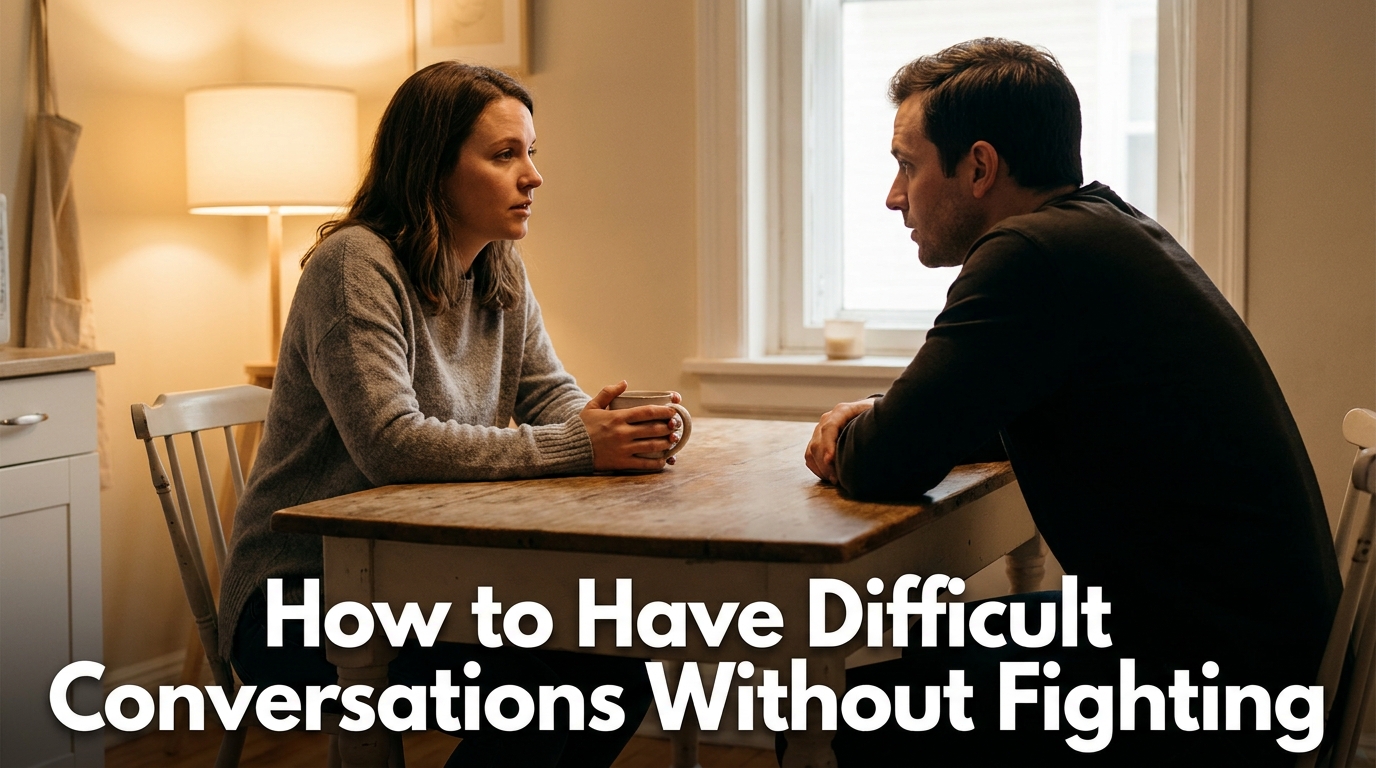
Every relationship has them — the conversations you have been putting off for weeks. The topic that keeps coming up and never gets resolved. The thing you need to say but can’t quite find the right moment for. Difficult conversations are not a sign that something is wrong with your relationship. They are a sign that something real is happening in it.
Research from the Gottman Institute shows that couples who avoid difficult conversations don’t avoid conflict — they simply delay it, allowing resentment and distance to quietly accumulate in the space where honesty should be. The ability to have difficult conversations without fighting is not a personality trait you either have or don’t. It is a skill. And like every skill, it can be learned, practiced, and genuinely mastered.

Why Difficult Conversations Turn Into Fights
Before exploring how to have these conversations well, it helps to understand why they so often go wrong. Most difficult conversations don’t explode because the topic is too sensitive. They explode because of how the conversation begins, how each person feels heard — or doesn’t — and what each person believes is actually at stake.
Several patterns consistently derail difficult conversations before they have a chance to resolve anything.
A harsh startup. Gottman’s research shows that 96% of the time, the way a conversation begins predicts how it will end. Opening with criticism, blame, or accusation — “You always do this,” “You never think about me,” “This is your fault” — immediately activates your partner’s defensive system. Once defensiveness is triggered, the brain shifts from problem-solving mode into threat-response mode. Rational conversation becomes neurologically difficult.
Flooding. When emotional intensity rises past a certain threshold, the nervous system becomes overwhelmed — a state Gottman calls flooding. In this state, heart rate increases significantly, stress hormones spike, and the capacity for empathy, nuance, and rational thinking drops sharply. People say things they don’t mean. Old wounds get reopened. The original topic gets buried under the emotional avalanche.
Unspoken underlying needs. Most difficult conversations are not actually about their surface topic. An argument about household chores is often about feeling unseen or undervalued. A conflict about time spent apart is often about feeling deprioritized or unloved. When the underlying need is never named — because neither person is aware of it — the surface argument cycles endlessly without resolution.
Winning instead of understanding. When the goal of a conversation shifts from mutual understanding to being right, connection becomes impossible. Two people trying to win the same argument cannot simultaneously build a bridge.
“The goal of a difficult conversation is not to win. It is to be understood — and to understand. Everything else follows from that.”

Before the Conversation: How to Prepare
The most important part of a difficult conversation often happens before it begins. Preparation — internal and practical — is what separates a conversation that resolves something from one that simply creates more damage.
Know What You Actually Need to Say
Before you speak, get clear on what you are actually trying to communicate. Write it down if that helps. Ask yourself: what is the core thing I need my partner to understand? What feeling am I carrying that hasn’t been named yet? What outcome am I hoping for from this conversation?
The clearer you are before you begin, the less likely you are to lose the thread when emotions rise.
Know What You Need — Not Just What You Want Them to Do
There is an important difference between a demand and a need. “I need you to stop making plans without asking me” is a demand. The underlying need might be: “I need to feel like a priority in your life.” Naming the need — rather than the demand — opens the conversation rather than closing it.
Check Your Timing
A difficult conversation attempted when one or both partners are tired, hungry, rushed, or already emotionally activated is unlikely to go well. This is not avoidance — it is strategy. Ask your partner: “There’s something important I’d like to talk about. Can we find a good time today or tomorrow when we’re both calm?” This simple step signals respect and increases the likelihood of a productive conversation dramatically.
Regulate Yourself First
If you are flooded before the conversation even begins — heart racing, jaw tight, thoughts already escalating — take time to self-regulate first. A short walk, deep breathing, or even a few minutes of quiet can bring your nervous system back to a state where genuine conversation is possible. You cannot communicate effectively from inside a stress response.
During the Conversation: 10 Techniques That Actually Work
1. Start With a Softened Startup
Begin with appreciation, context, or a statement of positive intent before raising the difficult topic. Not as a manipulation tactic — but as an honest signal that this conversation comes from love, not attack.
Try: “I love you and I want us to be able to talk about this openly. There’s something that’s been bothering me and I’d really like us to work through it together.”
This framing lowers the threat response before it begins. Your partner’s nervous system receives the message: this is a conversation, not an ambush.
2. Use ‘I’ Statements Exclusively
This is foundational. Every “you” statement in a difficult conversation carries implicit blame and triggers defensiveness. Every “I” statement takes ownership of your own experience and keeps the door open.
Replace “You never make time for me” with “I’ve been feeling really disconnected from you lately and I miss us.” Replace “You always shut down when things get hard” with “I feel alone when our conversations stop before we’ve resolved anything.”
The content is the same. The emotional impact is completely different.
3. State Your Positive Need, Not Just the Negative Problem
Most people communicate what they don’t want. The more powerful move is to name what you do want — what you need, what would help, what would make things feel better.
Instead of “I need you to stop dismissing me,” try “What I really need is to feel like my feelings are taken seriously, even when you see things differently.”
Positive needs give your partner something to move toward rather than simply something to stop doing.

4. Listen to Understand — Not to Respond
When your partner is speaking, your entire job is to understand what they are saying and feeling — not to prepare your counter-argument. This is harder than it sounds, particularly when what they’re saying is difficult to hear.
Practice reflecting back before responding: “What I hear you saying is that you’ve felt overlooked when I make decisions without consulting you — is that right?” This confirms understanding, gives your partner the experience of being heard, and often de-escalates emotional intensity significantly before you’ve even begun to respond.
5. Take Repair Attempts Seriously
A repair attempt is any gesture — verbal or nonverbal — that tries to reduce tension and bring the conversation back to connection. It might be a moment of humor, a touch on the hand, “Can we slow down for a second?”, or simply “I love you even when this is hard.”
Gottman’s research found that the ability to make and receive repair attempts is one of the strongest predictors of relationship stability. In healthy couples, repair attempts are noticed and accepted even during conflict. In struggling couples, they are missed or rejected — and the conversation escalates unnecessarily.
When your partner offers a repair attempt — however small or imperfectly timed — receive it. It is an act of love in the middle of difficulty.
6. Name the Pattern, Not the Person
There is a crucial difference between “you are defensive” and “I notice we’ve gotten into a pattern where I raise something and we both end up feeling attacked.” The first attacks character. The second describes a shared dynamic that both of you can work on together.
Naming patterns rather than people removes the shame and blame from the conversation and repositions both of you on the same side — two people dealing with a dynamic, rather than two adversaries dealing with each other.
7. Call a Timeout — The Right Way
If flooding occurs — if either of you becomes too emotionally activated to think clearly — a timeout is not avoidance. It is wisdom. But it must be done in a way that doesn’t feel like abandonment.
Say: “I’m feeling really overwhelmed right now and I don’t want to say something I’ll regret. Can we take 20 minutes and come back to this?” Then actually come back. A timeout without return is stonewalling. A timeout with return is self-regulation in service of the relationship.
During the break, do something genuinely calming — not ruminating on the argument. The goal is to return with a regulated nervous system, not a rehearsed counter-argument.

8. Stay on One Topic
One of the most common ways difficult conversations derail is topic drift — one issue brings up another, which brings up another, until both partners are buried under years of accumulated grievances and no one can remember what the original conversation was even about.
Agree, at the start if necessary, to address one issue at a time. If another topic comes up, acknowledge it: “That’s important and I want to talk about it — can we come back to it after we finish this?” Then actually come back to it. This keeps conversations focused, manageable, and more likely to reach genuine resolution.
9. Look for the Truth in What They’re Saying
Even when your partner’s delivery is imperfect — even when the way they’ve raised something feels unfair or harsh — there is almost always a kernel of truth somewhere in what they’re expressing. The willingness to find and acknowledge that truth, rather than dismissing everything because of the delivery, is one of the most disarming and productive things you can do in a difficult conversation.
“You’re right that I’ve been distracted lately. I haven’t been fully present and I understand why that’s been frustrating.” This kind of acknowledgment doesn’t mean you agree with everything. It means you are listening honestly — and that signal alone can transform the entire emotional tone of a conversation.
10. End With Connection, Not Just Resolution
Not every difficult conversation will reach full resolution in a single sitting. Some issues are complex, layered, and require multiple conversations over time. What matters is that you end each conversation with connection — a clear signal that whatever was discussed, you are still on the same team.
This might be a hug, a shared acknowledgment of how hard the conversation was, a statement of love, or simply sitting together quietly for a moment before moving on. The conversation may be unfinished. The relationship should never feel that way.
After the Conversation: What Comes Next
Follow Through
If commitments were made during the conversation — to change a behavior, to think about something, to come back to a topic — follow through on them. Nothing erodes trust faster than a difficult conversation that produces promises that quietly evaporate. Nothing builds it faster than visible, consistent follow-through.
Check In
A day or two after a difficult conversation, check in with your partner. “How are you feeling about what we talked about?” This signals that the conversation mattered enough to revisit, that their feelings are still on your mind, and that you are committed to the ongoing process — not just the single event.
Reflect on Your Own Role
After the conversation has settled, honest self-reflection is valuable. Not self-criticism — reflection. What did you do well? What could you have handled differently? Where did you feel yourself getting reactive, and what triggered it? This kind of reflection, practiced regularly, makes you a progressively better communicator in every difficult conversation that follows.

The Relationship Truth Nobody Tells You
Couples who never fight are not couples without problems. They are couples without honest conversation. The absence of conflict is not the same as the presence of harmony. Real harmony — the kind that sustains a relationship through decades — is built not by avoiding hard topics but by developing the capacity to move through them together without losing each other in the process.
Every difficult conversation you navigate well — even imperfectly, even with some stumbling — builds a layer of trust that easy conversations never could. It says: we can do hard things together. We can be honest with each other and still be safe. We can disagree and still belong to each other.
That is not just good communication. That is the foundation of a relationship that lasts.
The couples who last aren’t the ones who never fight. They’re the ones who learned how to come back to each other — every single time.
💾 Save this — return to it before the next conversation you’ve been putting off. 📤 Share it with your partner. Reading it together is already a start. 👣 Follow Truthsinside.com for honest, psychology-backed relationship advice every week.
Frequently Asked Questions
Q1: What if my partner refuses to have difficult conversations at all? A partner who consistently avoids difficult conversations is not necessarily uncaring — they may be conflict-avoidant due to past experiences, attachment style, or simply never having learned that conflict can be safe. The most effective approach is to create as low-threat an environment as possible: raise the topic gently, at a calm moment, with explicit reassurance that you are not looking for a fight. If avoidance is a deeply entrenched pattern, couples therapy with an attachment-informed therapist can be transformative — giving both partners tools and a safe container for conversations that feel too dangerous to have alone.
Q2: How do I stay calm when my partner says something that really hurts me? The physiological reality is that when we feel attacked or hurt, the nervous system activates before the rational mind can intervene. In the moment, the most effective tool is the pause — a deliberate breath, a brief internal acknowledgment of what you’re feeling, and a conscious choice about how to respond rather than react. Over time, practicing this pause — even imperfectly — builds genuine emotional regulation capacity. Outside the conversation, therapy and mindfulness practices can significantly increase your window of tolerance for emotional difficulty.
Q3: Is it ever okay to walk away from a difficult conversation mid-way? Yes — with one non-negotiable condition: you must communicate that you are stepping away and commit to returning. “I need 20 minutes to calm down — I’ll be back” is self-regulation. Walking out without a word and not returning is stonewalling, which Gottman’s research identifies as one of the most damaging behaviors in a relationship. The walk away is fine. The abandonment is not.
Q4: What if we keep having the same difficult conversation over and over without resolution? Recurring arguments that never resolve usually indicate one of two things: either an underlying need is not being named or heard, or the two partners have a genuine values difference that requires negotiation rather than resolution. In the first case, going deeper — asking “what do you most need me to understand about how this affects you?” — can break the cycle. In the second case, working with a couples therapist to find a livable compromise is often the most productive path forward.
Q5: How do I bring up something difficult without sounding like I’m attacking my partner? Preparation and framing are everything. Know what you want to say before you say it. Lead with positive intent: “I want to talk about something because I care about us, not because I want to criticize you.” Use “I” statements rather than “you” accusations. Raise the topic at a calm moment, not in the heat of another argument. And give your partner time to respond without interrupting. None of this guarantees a perfect conversation — but it dramatically increases the likelihood of one that actually goes somewhere productive.
🎵 Music
Maren Lull is a singer-songwriter who writes from the places most people don’t talk about out loud.
Not the dramatic grief. Not the obvious heartbreak. The quiet kind — the ordinary Tuesday emptiness, the habit of reaching for someone who isn’t there anymore, the particular exhaustion of being strong for so long that the strength itself wears thin.
Her music lives at the intersection of emotional honesty and soft beauty — breathy vocals over gentle piano, slow tempos, lyrics that feel less like songs and more like something you wrote in a private notebook at two in the morning and never showed anyone.
Maren Lull writes for the people who feel everything deeply and say very little about it. For the ones who listen to sad music not because they want to feel worse — but because being understood, even by a song, makes the feeling easier to carry.
📱 Follow Maren Lull:
→ Spotify
→ Apple Music
→ Youtube
→ Audiomack