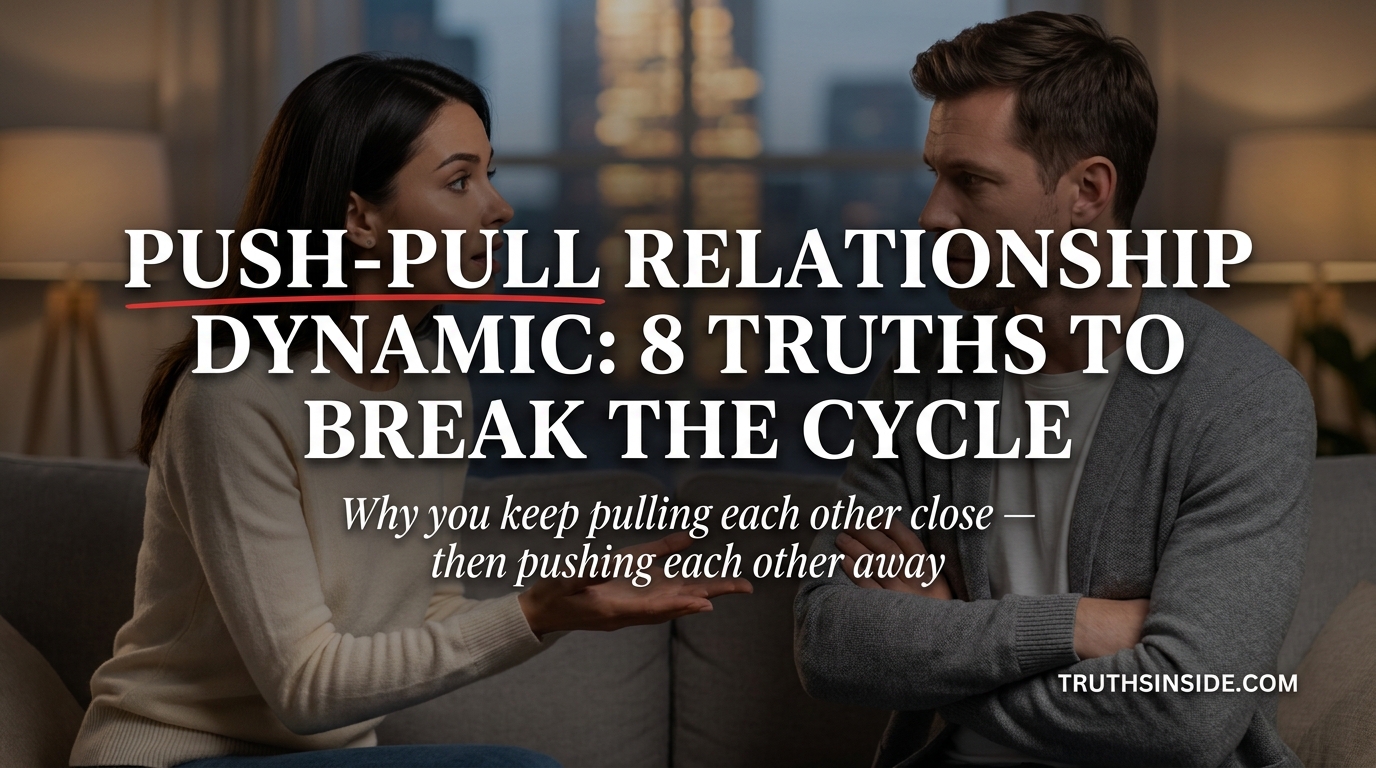
The Push-Pull Relationship Dynamic: Why It Happens and How to Break It
The push-pull relationship dynamic is one of the most psychologically consuming patterns that adult relationships can develop — a cycle of closeness followed by distance, pursuit followed by withdrawal, intense connection followed by inexplicable disconnection that repeats with enough consistency to feel inevitable. If you have ever experienced a relationship where things felt deeply connected one week and mysteriously cold the next — where one person pursues as the other retreats, then the roles reverse — you have experienced the push-pull dynamic.
Research from the Journal of Personality and Social Psychology identifies this pattern as closely associated with anxious-avoidant attachment pairings, estimated to be one of the most common relationship dynamics in the adult population. The push-pull cycle is not simply the product of incompatibility or poor communication. It is the result of two people’s attachment systems interacting in ways that produce mutual activation — each person’s behavioral response triggering the exact response from the other that intensifies what they most fear.
Understanding the push-pull dynamic requires understanding what it actually is and what it is not. It is not simply passion or intensity — though it is often mistaken for both. It is not evidence that the connection is uniquely powerful or destined. It is a neurologically driven behavioral cycle rooted in attachment insecurity, activated by the specific combination of one partner’s fear of abandonment and the other’s fear of engulfment, producing a rotation of pursuit and withdrawal that neither person fully controls and both people find genuinely difficult to exit.
This article examines the push-pull relationship dynamic with psychological honesty — its origins, its mechanisms, its costs, and most importantly, the specific, grounded steps that actually break the cycle rather than simply interrupting it temporarily. Eight truths follow. They are intended not to assign blame but to provide the clarity that the push-pull dynamic is specifically designed to prevent.
Truth 1: The Push-Pull Relationship Dynamic Is Rooted in Attachment Wounding
The push-pull relationship dynamic does not begin in the current relationship. It begins in the earliest relational experiences of both people involved — the attachment patterns formed in childhood that become the nervous system’s template for how intimacy is expected to function in adult relationships.
The most common pairing that produces the push-pull dynamic is the anxious-avoidant combination. The anxiously attached partner carries a deep, often unconscious fear of abandonment — a nervous system calibrated by early experiences of inconsistent care to remain hypervigilant to signs of withdrawal. The avoidantly attached partner carries a complementary fear — of engulfment, of losing independence, of the threat that closeness represents to a nervous system that learned emotional dependence was dangerous.
When these two attachment systems interact, they produce the push-pull cycle almost automatically. The anxious partner pursues — because pursuit is what their attachment system does when it perceives distance. The avoidant partner withdraws — because withdrawal is what their attachment system does when it perceives closeness. The withdrawal intensifies the anxious partner’s pursuit. The pursuit intensifies the avoidant partner’s withdrawal. The cycle tightens. Both people are responding to genuine internal experience. Both responses make the other person’s fear worse.

Truth 2: The Cycle Feels Like Chemistry — But It’s Neurological Activation
One of the primary reasons the push-pull dynamic is so difficult to exit is that it is experienced subjectively as intense chemistry — as evidence of a uniquely powerful connection rather than as a dysfunctional pattern. The intensity feels like passion. The uncertainty feels like excitement. The reunion after distance feels like genuine love confirmed. None of these feelings are fake. But their source is not what they appear to be.
The neurological mechanism underlying this experience is intermittent reinforcement — the same variable-ratio reward schedule that makes gambling neurologically compelling. When positive emotional experiences — warmth, connection, affection, closeness — arrive unpredictably rather than consistently, the brain’s dopamine system responds with heightened reactivity. Each instance of connection after distance produces a stronger neurochemical response than consistent connection would. The unpredictability itself is neurologically amplifying.
This means the push-pull dynamic does not feel less powerful than a healthy relationship — it feels more powerful. The highs are higher because they follow lows. The connection feels more intense because it was preceded by distance. The reunion feels more meaningful because the separation made it seem uncertain. These are all neurological artifacts of intermittent reinforcement, not evidence of a uniquely deep connection. Understanding this distinction is genuinely liberating — because it relocates the source of the intensity from the relationship’s specialness to the pattern’s neurological mechanism.
📃 Related article: Psychology of Ghosting: 7 Shocking Truths About Ghosters
Truth 3: Both Roles Are Painful — Just Differently
A common misunderstanding about the push-pull dynamic is that it is painful only for the pursuing partner — the one chasing, hoping, anxiously monitoring the other’s emotional temperature. This framing misses the experience of the withdrawing partner, which is equally painful in ways that are less visible but no less real.
The pursuing partner experiences the pain of felt rejection — the specific anguish of reaching for someone who seems to be retreating, of never quite feeling securely held, of perpetual relational uncertainty that colonizes attention and produces chronic anxiety. This pain is real, significant, and deserves genuine acknowledgment.
The withdrawing partner experiences a different pain — the pain of feeling overwhelmed by the very closeness they simultaneously desire, of wanting connection while feeling suffocated by it, of carrying guilt about the impact of their withdrawal while being genuinely unable to sustain the closeness without triggering their own protective response. They want to be closer. Their nervous system will not permit it without cost. That internal conflict is genuinely distressing — even when it appears from the outside as indifference or control.
Both roles carry suffering. Both roles produce behaviors that harm the other person. Recognizing this equivalence of pain — even in the absence of equivalence of visible expression — is necessary for approaching the dynamic with the kind of mutual compassion that breaking it requires.
“The push-pull dynamic doesn’t have a villain. It has two people with unhealed wounds creating the same painful cycle together — each one’s fear activating the other’s, neither one choosing it consciously, both paying the price.”
Truth 4: The Cycle Has Predictable Stages — And Knowing Them Is Power
The push-pull relationship dynamic follows a predictable sequence that, once identified, becomes recognizable in real time — and recognizable patterns can be interrupted in ways that invisible ones cannot.
Stage one — Approach: The withdrawing partner, having regulated from the previous cycle’s closeness, re-initiates contact and connection. The pursuing partner, whose anxiety has been building during the distance, responds with relief and intensified engagement.
Stage two — Peak closeness: Both people are present, warm, and genuinely connected. This phase feels wonderful — and it is not false. The connection is real. The problem is not the closeness itself but the inability of the dynamic to sustain it.
Stage three — Threshold: The withdrawing partner reaches their closeness threshold. Their nervous system activates the familiar threat response. Subtle — then less subtle — withdrawal begins. Emotional temperature drops. Availability decreases.
Stage four — Pursuit and withdrawal: The pursuing partner detects the withdrawal and activates their abandonment fear. Pursuit begins — more contact, more reassurance-seeking, more emotional intensity. This intensifies the withdrawing partner’s need to create distance. The cycle deepens.
Stage five — Distance and reset: The withdrawing partner achieves sufficient distance to deregulate. The pursuing partner exhausts their pursuit energy or receives enough distance to activate their own self-protective withdrawal. Both people reset — and the cycle returns to stage one.
Knowing these stages does not break the cycle alone. But it creates the metacognitive awareness — the ability to observe the cycle from outside rather than living only within it — that makes genuine interruption possible.
Truth 5: The Pursuing Partner Maintains the Cycle Too
This truth is uncomfortable — particularly for the partner who experiences themselves primarily as the one trying to connect, trying to sustain the relationship, doing the emotional work. But it is essential. The pursuing partner is not simply a passive victim of the withdrawing partner’s cycles. Their pursuing behavior is an active component of the dynamic that sustains the cycle as reliably as the withdrawal does.
Pursuit — in the specific form the push-pull cycle produces — raises the emotional temperature of the relationship in ways that intensify the withdrawing partner’s threat response. More contact, more emotional intensity, more seeking of reassurance: each of these represents an escalation of closeness that the avoidant partner’s nervous system experiences as the thing it is trying to escape. The pursuit that feels like love to the pursuing partner reads as pressure to the withdrawing one — and triggers deeper withdrawal.
This does not mean the pursuing partner is at fault for wanting connection. They are responding authentically to genuine attachment need. It means that the expression of that need through pursuit is itself a maintaining mechanism of the cycle. Breaking the cycle requires the pursuing partner to develop the capacity to regulate their own abandonment fear through means other than pursuit — which is genuinely difficult work, but also genuinely transformative when undertaken.

Truth 6: The Withdrawing Partner Must Address Their Intimacy Fear Directly
If the pursuing partner’s contribution to the cycle is pursuit, the withdrawing partner’s is the intimacy avoidance that makes pursuit feel necessary. Breaking the cycle requires honest examination of this fear — not rationalization, not the reframing of emotional withdrawal as independence or self-care, but genuine confrontation with the internal experience that makes closeness threatening.
For most withdrawing partners, this confrontation is profoundly uncomfortable — because the avoidant strategy was built specifically to prevent the vulnerability that examining it requires. Asking “why does closeness feel threatening to me?” requires tolerating the discomfort of exploring experiences that the entire avoidant strategy was designed to protect against. This is the specific work that makes individual therapy — particularly trauma-informed approaches that work directly with the nervous system — so valuable for the withdrawing partner.
The practical goal is not the elimination of the need for space — that need is legitimate and does not require elimination. It is the development of the capacity to communicate that need honestly and directly rather than enacting it through behavioral withdrawal. “I’m starting to feel overwhelmed and I need some time to myself — I’ll reach out tomorrow” is a fundamentally different relational act than going cold without explanation. The first is honest self-regulation. The second is a deactivation strategy that activates the cycle.
📃 Related article: Love-Hate Dynamic: 7 Reasons Toxic Love Traps You
Truth 7: Mutual Self-Awareness Is the Only Genuine Path Out
Individual awareness — one partner recognizing their role, developing better self-regulation, communicating more honestly — can reduce the cycle’s intensity but rarely breaks it completely. The push-pull dynamic is a relational pattern sustained by both people’s participation. Complete exit from it requires both people to develop sufficient self-awareness about their own role, combined with genuine, honest communication about the dynamic itself.
This means the kind of conversation that the push-pull dynamic’s emotional intensity makes genuinely difficult — a calm, metacognitive discussion about the pattern rather than another round within it. “I’ve noticed we have a cycle where I tend to pursue when you pull away, and my pursuing seems to make you pull further. I’d like to talk about what’s actually happening for each of us when that starts.” This conversation — held during a regulated, connected moment rather than in the heat of the cycle — is where genuine pattern interruption begins.
Both people bringing honest self-knowledge to this conversation is what makes it productive rather than just another layer of the dynamic. The pursuing partner acknowledging that their pursuit is driven by abandonment fear rather than simply by reasonable relational need. The withdrawing partner acknowledging that their withdrawal is driven by intimacy fear rather than simply by a preference for independence. That mutual honesty — uncomfortable as it is — creates the shared map that makes navigating out of the cycle genuinely possible.
Truth 8: Breaking the Cycle Requires New Behavior Before New Feeling
This final truth is perhaps the most practically important — and the most commonly misunderstood. Most people attempting to break the push-pull cycle wait to feel differently before behaving differently. They wait until they no longer feel the pull to pursue before stopping pursuit. They wait until closeness no longer feels threatening before remaining present within it. This sequencing does not work. Feeling follows behavior — not the other way around.
The pursuing partner must stop the pursuing behavior before the abandonment anxiety resolves — which means tolerating the anxiety of not pursuing while it is still present. This is genuinely difficult. It requires the development of alternative anxiety regulation strategies — therapy, mindfulness, physical exercise, honest conversation with trusted friends — that do not involve the pursuing behavior that maintains the cycle.
The withdrawing partner must remain present beyond their comfort threshold before the intimacy fear fully resolves — communicating rather than withdrawing when the discomfort of closeness begins to activate. This is equally difficult. It requires tolerating the discomfort of sustained closeness while the nervous system is still generating its threat response.
Both of these behavioral changes are uncomfortable in ways that feel counterintuitive. They require doing the opposite of what the nervous system is insisting on — and doing it before feeling ready. But this is where genuine cycle-breaking actually happens. Not in the understanding, however accurate. In the new behavior, chosen deliberately, in the exact moment the old one is being loudly demanded.

What the Cycle Costs — Over Time
The push-pull relationship dynamic is not a neutral experience that simply produces intensity without consequence. It carries a cumulative cost that compounds with each cycle — and that cost deserves honest accounting before any decision about whether to continue attempting to break the pattern within the relationship is made.
For the pursuing partner, the cost is progressive erosion of self-worth. Each pursuit that fails to produce sustainable connection confirms, at some level, the fear that they are not enough to be chosen consistently. Each withdrawal reactivates the abandonment wound. Over time, the chronic anxiety of the cycle produces measurable psychological effects — heightened general anxiety, reduced self-esteem, and a growing confusion about what genuine safety in relationship is supposed to feel like.
For the withdrawing partner, the cost is increasing isolation — the progressive narrowing of genuine intimacy as the avoidant strategy succeeds in its protective function at the expense of the connection it was supposed to make safe enough to sustain. Both people, in different ways, lose ground with each cycle. What is gained — the intensity, the reunion, the chemistry — is real but finite. What is lost is the possibility of the stable, genuine, chosen closeness that both people, beneath their protective strategies, actually want.
📃 Related article: 15 Signs She Is Testing You: Why Women Test Men and What to Do
When Professional Support Is Necessary
For many couples caught in the push-pull dynamic, individual self-awareness and honest communication are necessary but not sufficient. The pattern is neurologically embedded — it was not learned cognitively and it does not resolve through cognitive understanding alone. Professional support that works with the nervous system directly — Emotionally Focused Therapy, somatic approaches, EMDR for attachment trauma — addresses the root of the cycle at the level where it actually lives.
Individual therapy for both partners, pursued separately, is often the most effective starting point — each person developing genuine insight into their own attachment pattern, their own role in the cycle, and their own nervous system’s specific triggers and regulation needs. Couples therapy becomes most productive when both individuals have developed this individual clarity — bringing it into the shared therapeutic space where the dynamic can be examined and interrupted with professional support.
The couples who break the push-pull cycle most completely are those who bring genuine individual work to the shared relational work — not expecting the relationship’s improvement to substitute for personal growth, but investing in both simultaneously with the understanding that each strengthens the other.
A Final Word on Choosing Differently
The push-pull dynamic can be broken. It is not inevitable, not permanent, and not the defining truth of either person involved in it. But breaking it requires something that the cycle’s intensity specifically discourages — the willingness to step outside the familiar emotional experience and choose a different behavior, in the exact moment when the familiar one is being most loudly demanded.
That choice — made once, then again, then again — is what changes the pattern. Not understanding alone. Not good intentions. Not the hope that the other person will change enough to make the cycle unnecessary. But the daily, specific, sometimes very difficult choice to regulate differently, communicate more honestly, and show up in ways that the nervous system finds unfamiliar precisely because they are new.
The relationship that becomes possible on the other side of that work — quieter than the push-pull intensity, less dramatic, more genuinely chosen — is also more sustainable, more honest, and more deeply satisfying than any cycle, however intense, was ever capable of producing.
💾 Save this article. Share it with someone stuck in this cycle. Follow Truthsinside.com for relationship psychology that gives you clarity — and a genuine way forward.
FAQ
Q1: Is the push-pull dynamic always the anxious-avoidant pairing?
The anxious-avoidant combination is the most common pairing that produces the push-pull dynamic, but it is not the only one. Fearful-avoidant individuals — sometimes called disorganized attachment — can produce push-pull dynamics within themselves, simultaneously craving and fearing closeness in ways that generate the cycle internally. Two people with anxious attachment can also produce a push-pull dynamic when each activates the other’s insecurity. The specific attachment combination shapes the cycle’s particular character, but the common thread is always the interaction of attachment fear with behavioral response.
Q2: Can the push-pull dynamic exist in otherwise healthy relationships?
Mild versions of the push-pull pattern can appear in relationships that are otherwise genuinely healthy — particularly during periods of significant stress, major life transitions, or when one partner’s individual anxiety is temporarily elevated. The distinguishing feature is whether the pattern is episodic and responsive to honest communication, or whether it is the relationship’s consistent operating mode. Episodic push-pull in a fundamentally healthy relationship is navigable. The chronic, entrenched version described in this article requires more deliberate intervention.
Q3: How do I know which role I play — the pursuer or the withdrawer?
Most people identify primarily with one role — but context matters. Some people pursue in one relationship and withdraw in another, depending on the attachment dynamic the specific pairing produces. A useful question: When things feel uncertain in a relationship, what is your first instinct? To reach for more contact, more reassurance, more connection? That is the pursuing response. To create space, increase independence, reduce emotional exposure? That is the withdrawing response. Many people also shift roles depending on the relationship’s current phase — which is why self-examination rather than fixed labeling is most useful.
Q4: Is the intensity of a push-pull relationship a sign of genuine chemistry?
The intensity is genuine — but its source is neurological activation rather than uniquely powerful connection. Intermittent reinforcement produces stronger dopamine responses than consistent reward, which is why push-pull relationships feel more intense than stable ones. This intensity is frequently misread as evidence of a special connection. It is more accurately evidence of the specific neurological pattern that inconsistency produces. Stable, genuinely healthy relationships rarely feel as intensely dramatic — not because they are less real, but because they are not generating the neurochemical spike that unpredictability produces.
Q5: What if only one partner is willing to work on breaking the cycle?
One partner’s genuine behavioral change can reduce the cycle’s intensity — because changing one person’s input changes the dynamic’s output, even when the other person’s behavior remains unchanged initially. However, complete cycle resolution requires both people’s participation. If one partner consistently refuses to examine their role, engage in any growth work, or acknowledge the pattern despite clear, honest communication about it — that refusal itself is meaningful information about whether genuine change is available within this specific relationship. The question then becomes not how to break the cycle but whether the relationship, as it currently stands, is one worth continuing to invest in.
🎵 Music
Maren Lull is a singer-songwriter who writes from the places most people don’t talk about out loud.
Not the dramatic grief. Not the obvious heartbreak. The quiet kind — the ordinary Tuesday emptiness, the habit of reaching for someone who isn’t there anymore, the particular exhaustion of being strong for so long that the strength itself wears thin.
Her music lives at the intersection of emotional honesty and soft beauty — breathy vocals over gentle piano, slow tempos, lyrics that feel less like songs and more like something you wrote in a private notebook at two in the morning and never showed anyone.
Maren Lull writes for the people who feel everything deeply and say very little about it. For the ones who listen to sad music not because they want to feel worse — but because being understood, even by a song, makes the feeling easier to carry.
📱 Follow Maren Lull:
→ Spotify
→ Apple Music
→ Youtube
→ Audiomack