The Question Everyone Has Been Asking
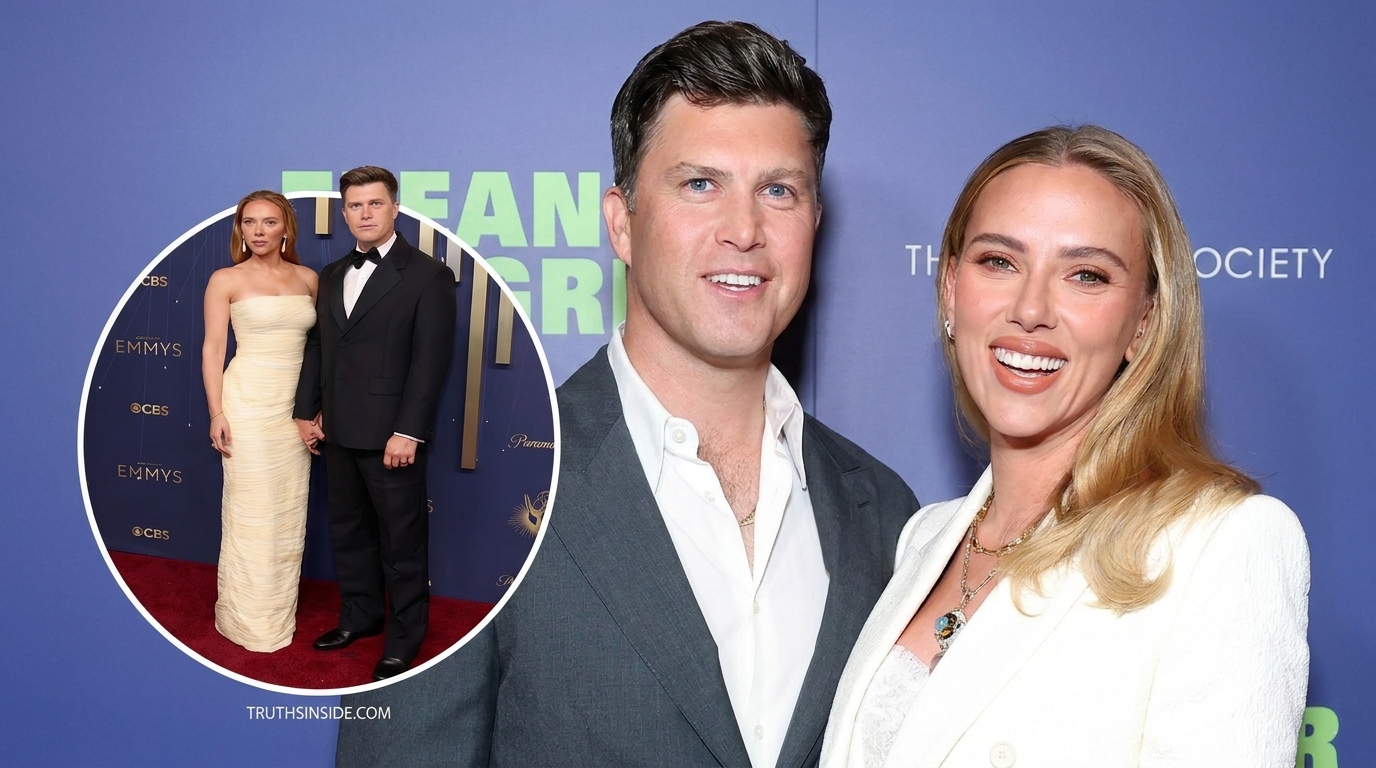
Have you ever found yourself in a conversation where someone confidently pronounces a celebrity’s name — and a small but persistent voice in your head wonders whether that is actually correct? You are not alone. Name pronunciation anxiety is a real and remarkably common experience. According to a 2022 survey by the linguistics research platform Forvo, over 71% of English speakers admit to regularly mispronouncing names they have seen written but rarely heard spoken aloud. Few names in Hollywood have generated more quiet uncertainty than the Scarlett Johansson last name pronunciation — and now, thanks to a candid and charming conversation on Jeopardy’s TikTok account, her husband Colin Jost has finally given the world the answer it has been looking for.
The revelation, delivered with Jost’s characteristic wit and casual intelligence, opened up a genuinely fascinating conversation about more than just how to say a single word correctly. It led directly into the rich, complex, and surprisingly compelling history of how both Johansson’s and Jost’s surnames arrived at their current forms — a journey that spans continents, centuries, and the kind of organic linguistic evolution that quietly shapes the identities of millions of families across generations.
This article takes you through everything Jost revealed, the historical origins of both surnames, and what this delightfully casual celebrity moment teaches us about the deeper stories hidden inside the names we carry.

Who Are Colin Jost and Scarlett Johansson?
Before diving into the linguistic and historical details at the heart of this story, it is worth grounding ourselves in who these two people are and why a casual TikTok conversation between them generated such widespread interest.
Scarlett Johansson is, by any measure, one of the most recognizable and accomplished actresses in the history of Hollywood. Born on November 22, 1984, in New York City, Johansson began her acting career as a child and rose to global superstardom through a combination of extraordinary dramatic range, remarkable physical presence, and an instinctive ability to inhabit characters across wildly different genres and tones.
Her filmography is staggering in both its breadth and its quality. From her breakthrough in Ghost World and her luminous performances in Lost in Translation and Girl with a Pearl Earring, to her decade-long portrayal of Natasha Romanoff — Black Widow — in the Marvel Cinematic Universe, Johansson has demonstrated a creative versatility that very few performers of any generation can match. She has received Academy Award nominations, Golden Globe recognition, and the kind of sustained critical and commercial success that speaks to genuine, enduring talent rather than fleeting popularity.
Colin Jost occupies a different but equally impressive corner of the entertainment world. A longtime head writer and Weekend Update anchor at Saturday Night Live, Jost has established himself as one of the sharpest comedic minds working in American television. His particular gift — the ability to find the precise angle on any topic that makes it simultaneously funny and insightful — has made him one of the most consistently entertaining presences on late-night television for over a decade.
Beyond SNL, Jost is a published author, a screenwriter, and a performer whose intelligence and genuine warmth come through in every public appearance he makes. His memoir, A Very Prick, offered readers an unexpectedly candid and deeply funny window into his life and career. And his relationship with Scarlett Johansson — the couple married in October 2020 after several years together — has been one of Hollywood’s most genuinely charming and enduring partnerships.
Together, they represent one of entertainment’s most interesting couples: two extraordinarily accomplished people from very different creative worlds who clearly bring out the best in each other.
📃 Related article: Christopher Nolan The Odyssey: Brilliant Rules Behind Success
The Jeopardy TikTok Moment That Started Everything
The clarification of the Scarlett Johansson last name pronunciation did not emerge from a formal interview, a press junket, or a carefully managed publicity moment. It came from exactly the kind of casual, unguarded conversation that the TikTok format at its best tends to produce.
Colin Jost was participating in a lighthearted exchange on Jeopardy’s TikTok account when the subject of his wife’s surname came up in response to a fan inquiry. It is the kind of question that might seem almost too simple to be worth asking — surely her own husband knows how to pronounce her name? — but the answer Jost provided turned out to be considerably more nuanced and interesting than anyone might have expected.
The format of the conversation was perfectly suited to the revelation. TikTok’s short-form, informal environment created exactly the right conditions for Jost to speak candidly and without the kind of careful message management that tends to accompany more formal celebrity media appearances. What the audience got was genuine: a thoughtful, curious, slightly self-deprecating exploration of a question that Jost himself found genuinely interesting to consider.
The video’s reach extended far beyond Jeopardy’s regular TikTok audience, spreading across social media platforms as fans of both Johansson and Jost discovered and shared a moment that was equal parts informative and genuinely entertaining.

So How Do You Actually Pronounce Johansson?
Let us address the central question directly before exploring the richer historical context that surrounds it.
Colin Jost confirmed that the pronunciation he uses — and the one that aligns with Scarlett Johansson’s professional and public usage — is “Johansson,” pronounced essentially as it appears in its written English form: Jo-HAN-son.
This is the pronunciation that has been used consistently throughout Johansson’s career, in interviews, introductions, awards ceremonies, and every other professional context in which her name has been spoken aloud by others or by herself. It is, for all practical purposes, the accepted and correct pronunciation in the English-speaking world.
However — and this is where the story becomes genuinely fascinating — Jost was candid about the fact that he himself rarely has occasion to say the name aloud in the course of daily life. As he explained with characteristic humor, you do not typically address your spouse by their full surname in ordinary domestic conversation. The admission was refreshingly honest and immediately relatable to anyone who has ever thought carefully about how rarely they actually speak the names they think they know perfectly well.
Jost also acknowledged something more personally revealing: because he has had limited direct contact with Scarlett’s extended family members, he feels a degree of genuine uncertainty about the name’s original or most ancestrally authentic form. The pronunciation he uses is the one he knows — but the history behind it, he admitted, is something he finds genuinely interesting and not entirely resolved in his own understanding.
📃 Related article: Gwen Stefani Blake Shelton Anniversary: 5 Gorgeous Years
The Origins of the Johansson Surname
This is where the conversation moved from casual celebrity trivia into something considerably more interesting — a brief but illuminating exploration of linguistic history and ancestral identity.
The surname Johansson has its roots in Scandinavian naming traditions, specifically the Swedish and Danish practice of patronymic naming — the system by which a child’s surname was derived from their father’s first name. In this tradition, the son of a man named Johan would be called Johansson, meaning literally “son of Johan.”
Johan itself is a Scandinavian form of the name John, which traces its origins through Latin — Johannes — back to the Hebrew name Yohanan, meaning “God is gracious.” The name has been in continuous use across European cultures for over two thousand years, carried forward by religious tradition, cultural exchange, and the kind of linguistic migration that happens whenever populations move, mix, and adapt to new environments.
Scarlett Johansson’s family heritage is a rich blend of Danish and Swedish backgrounds, which means her surname sits at exactly the intersection of two closely related but distinctly different Scandinavian traditions. The fluidity between Danish and Swedish forms of the name — which differ in subtle ways of spelling and pronunciation depending on the specific regional and historical context — created the kind of natural variation that Jost was describing when he talked about the name’s evolution over time.
The likely original form of the name, as Jost explained, was something in the tradition of Johan Johansson — a name that has traveled across an ocean and through several generations to arrive at the form that appears on marquees, movie posters, and award show envelopes around the world today.

“Behind one of Hollywood’s most famous surnames lies a journey that spans Scandinavia, the Atlantic Ocean, and centuries of linguistic evolution — a story of identity shaped by movement, memory, and the quiet adaptations families make as they build new lives in new places.”
The Origins of the Jost Surname
The exploration of surname history did not stop with Johansson. Jost also offered a glimpse into the origins of his own family name — a detail that added a delightful symmetry to the conversation and made the exchange feel like a genuine mutual discovery rather than a one-sided explanation.
Jost suggested that his own surname may have evolved from “Yoast” — a German form that would have undergone the kind of phonetic and orthographic simplification that was extremely common among European immigrant families arriving in the United States during the great waves of immigration in the nineteenth and early twentieth centuries.
The process of name simplification and anglicization was one of the most widespread and significant linguistic phenomena of the immigration era. Families arriving at American ports of entry — often facing language barriers, bureaucratic systems that were not designed to accommodate the phonetic complexities of non-English names, and the practical pressures of building new lives in a new country — frequently found their surnames altered, simplified, or phonetically approximated in the official records that would define their identities going forward.
In many cases, these changes were made deliberately by families who understood that a name more easily pronounced and spelled by English speakers would ease their integration into American society. In other cases, the changes happened organically through the simple mechanics of how names were recorded, repeated, and passed down through generations increasingly distant from the original linguistic context.
The evolution from Yoast to Jost is a perfect example of this process — a subtle but meaningful shift that carries within it the entire story of a family’s movement from one world to another.

When Two Surname Histories Converge
Perhaps the most charming element of Jost’s explanation was his description of what he and Scarlett have come to understand as a kind of informal family “coordination” — the idea that both of their families may have, through processes of migration, adaptation, and cultural integration, arrived at simplified and unified forms of surnames that once carried more complex historical freight.
This framing is not just whimsical. It reflects a genuine and well-documented historical phenomenon. Across the vast sweep of European immigration to the United States and other English-speaking countries, families from diverse linguistic backgrounds underwent remarkably similar processes of surname evolution — driven by the same forces of practical necessity, cultural assimilation, and the natural changes that occur when names are carried across language barriers and generational distances.
The fact that both Jost’s German-origin surname and Johansson’s Scandinavian-origin surname underwent comparable processes of simplification and anglicization gives their coupling a kind of unexpected historical rhyme — two families who arrived in America from different parts of Europe and made similar adaptive choices, whose descendants eventually found each other and built a life together.
It is, in its way, a small but genuinely moving illustration of the immigrant experience that shaped so much of American identity — the ways in which families remake themselves in new places while carrying, in their names and their stories, the traces of everything that came before.

The Broader Phenomenon of Surname Evolution
Colin Jost’s casual TikTok conversation about the Scarlett Johansson last name pronunciation opened a window onto one of the most fascinating and underappreciated aspects of cultural and linguistic history: the way surnames change over time, and what those changes reveal about the families and communities that carry them.
Surnames, as linguistic artifacts, are among our most durable connections to the past. Unlike first names, which parents choose freshly for each child, surnames carry forward — generation after generation, across borders and oceans and centuries — the traces of decisions made by ancestors who often could not have imagined the worlds their descendants would inhabit.
The patronymic system that produced the Johansson name was itself a relatively modern innovation in Scandinavian history. For centuries, Scandinavian families used purely patronymic naming, with each generation taking a new surname derived from the father’s first name. It was only in the nineteenth century, under pressure from modernizing governments that needed more stable records for census, taxation, and military purposes, that Scandinavian families were encouraged or required to adopt fixed hereditary surnames.
The surnames many Scandinavian families chose at that point — often patronymics that had been in use for the most recent generation — became permanent identifiers carried forward regardless of what names appeared in subsequent generations. Johansson, frozen at a moment when the family patriarch was named Johan, became a fixed surname that would persist regardless of what names his descendants chose for their own children.
Scarlett Johansson Last Name Pronunciation: A Summary of What We Know
Given everything Colin Jost revealed in his Jeopardy TikTok conversation, here is a clear and comprehensive summary of what we now know about the Scarlett Johansson last name pronunciation and the history behind it.
The accepted pronunciation — both in professional contexts and as confirmed by Jost — is “Johansson” (Jo-HAN-son). This is the form Scarlett has used consistently throughout her career, and it is the pronunciation that audiences, journalists, and fellow industry professionals have adopted as standard.
The name’s origins lie in Scandinavian patronymic tradition, most likely deriving from a family patriarch named Johan — a Swedish or Danish form of John. Scarlett’s mixed Danish and Swedish heritage created a degree of natural variation in how the name was spelled and pronounced across different branches of her family and different points in its historical journey.
The name arrived at its current English form through the same processes of migration, adaptation, and linguistic evolution that transformed surnames across countless immigrant families — a journey from Scandinavia to America, from one phonetic tradition to another, and from a living patronymic description to a fixed hereditary identifier.
“The Scarlett Johansson last name pronunciation question, seemingly simple on its surface, turns out to be a doorway into a rich and genuinely fascinating story about migration, identity, and the ways names carry history across generations.”
Key Facts at a Glance
| Aspect | Details |
|---|---|
| Current Accepted Pronunciation | Johansson (Jo-HAN-son) |
| Likely Name Origin | Johan Johansson — Swedish/Danish patronymic tradition |
| Scarlett’s Family Heritage | Mixed Danish and Swedish background |
| Colin Jost’s Surname Origin | Likely evolved from “Yoast” — German origin |
| Reason for Name Evolution | Migration, cultural integration, family adaptation |
| Where Jost Made the Clarification | Jeopardy’s TikTok account |
| Jost’s Personal Pronunciation | Johansson — consistent with Scarlett’s professional usage |
Why This Conversation Matters Beyond Celebrity Trivia
It would be easy to dismiss this story as lightweight celebrity content — a fun but ultimately inconsequential moment in the relentless cycle of entertainment news. But doing so would mean missing something genuinely worth appreciating.
Colin Jost’s willingness to engage thoughtfully and honestly with a question about his wife’s surname — to acknowledge his own uncertainty, to explore the historical context, and to share what he and Scarlett have come to understand about their shared ancestral histories — is a small but meaningful act of public intellectual curiosity.
In a media landscape that often rewards confident performance over genuine reflection, there is something refreshing about a celebrity choosing to say “I find this genuinely interesting and not entirely settled in my own understanding” rather than delivering a polished, certain answer that closes down further thought.
The conversation also serves as a reminder that names — those most personal and most public of identifiers — carry within them histories that most of us have never fully explored. Every surname is a story. Every pronunciation is the residue of a journey. And sometimes, a casual TikTok conversation between a Saturday Night Live anchor and a Jeopardy account is all it takes to remind us of that remarkable fact.

FAQ: Scarlett Johansson Last Name Pronunciation — Your Questions Answered
1. How do you correctly pronounce Scarlett Johansson’s last name?
The accepted and professionally used pronunciation is “Johansson,” spoken as Jo-HAN-son. This is the pronunciation Colin Jost confirmed during his conversation on Jeopardy’s TikTok account, and it is consistent with how Scarlett Johansson herself has used the name throughout her career.
2. Where does the surname Johansson come from originally?
The name Johansson derives from Scandinavian patronymic naming tradition, meaning “son of Johan.” Johan is a Swedish and Danish form of the name John, which traces its origins through Latin and ultimately to the Hebrew name Yohanan. Scarlett Johansson’s family has mixed Danish and Swedish heritage, which accounts for some natural variation in the name’s historical forms.
3. What is the origin of Colin Jost’s surname?
Jost has suggested that his surname may have evolved from the German form “Yoast,” undergoing the kind of simplification and anglicization that was common among European immigrant families arriving in the United States during the major immigration waves of the nineteenth and twentieth centuries.
4. Why did Jost say he is uncertain about the correct pronunciation?
Jost acknowledged that he rarely addresses Scarlett by her full surname in daily life, and that his limited direct contact with her extended family has given him less opportunity to hear the name spoken in its most ancestrally authentic form. He was candid about this personal uncertainty while confirming that the pronunciation he uses aligns with her professional usage.
5. What does Jost mean by both families having “coordinated” their surnames?
Jost used the term to describe the way both his and Scarlett’s families appear to have, through independent but parallel processes of migration and cultural adaptation, arrived at simplified or unified forms of surnames that once carried more complex historical and linguistic details. It is a charming way of framing the broader immigrant experience of surname evolution.
Final Thoughts
The question of Scarlett Johansson last name pronunciation turns out to be one of those rare celebrity trivia moments that is actually more interesting than it first appears — a doorway into genuine history, linguistic complexity, and the kinds of quiet, fascinating stories that hide inside the names we carry without always thinking about.
Colin Jost’s honest, curious, and genuinely thoughtful engagement with the question on Jeopardy’s TikTok account gave us more than a pronunciation guide. It gave us a glimpse into the historical journeys of two extraordinary families — one from Scandinavia, one from Germany — who found their way to America, adapted their names to their new world, and eventually produced two of the most talented and interesting people working in entertainment today.
And now, the next time someone asks you how to say it, you will know — and you will know the story behind it, too.
💾 Save this article the next time someone asks you how to pronounce Scarlett Johansson’s name.
📤 Share this with a friend who loves celebrity history and the fascinating stories behind famous names.
👉 Follow Truthsinside.com for the most interesting celebrity stories, delivered fresh every single day.
🎵 Music
Maren Lull is a singer-songwriter who writes from the places most people don’t talk about out loud.
Not the dramatic grief. Not the obvious heartbreak. The quiet kind — the ordinary Tuesday emptiness, the habit of reaching for someone who isn’t there anymore, the particular exhaustion of being strong for so long that the strength itself wears thin.
Her music lives at the intersection of emotional honesty and soft beauty — breathy vocals over gentle piano, slow tempos, lyrics that feel less like songs and more like something you wrote in a private notebook at two in the morning and never showed anyone.
Maren Lull writes for the people who feel everything deeply and say very little about it. For the ones who listen to sad music not because they want to feel worse — but because being understood, even by a song, makes the feeling easier to carry.
📱 Follow Maren Lull:
→ Spotify
→ Apple Music
→ Youtube
→ Audiomack