
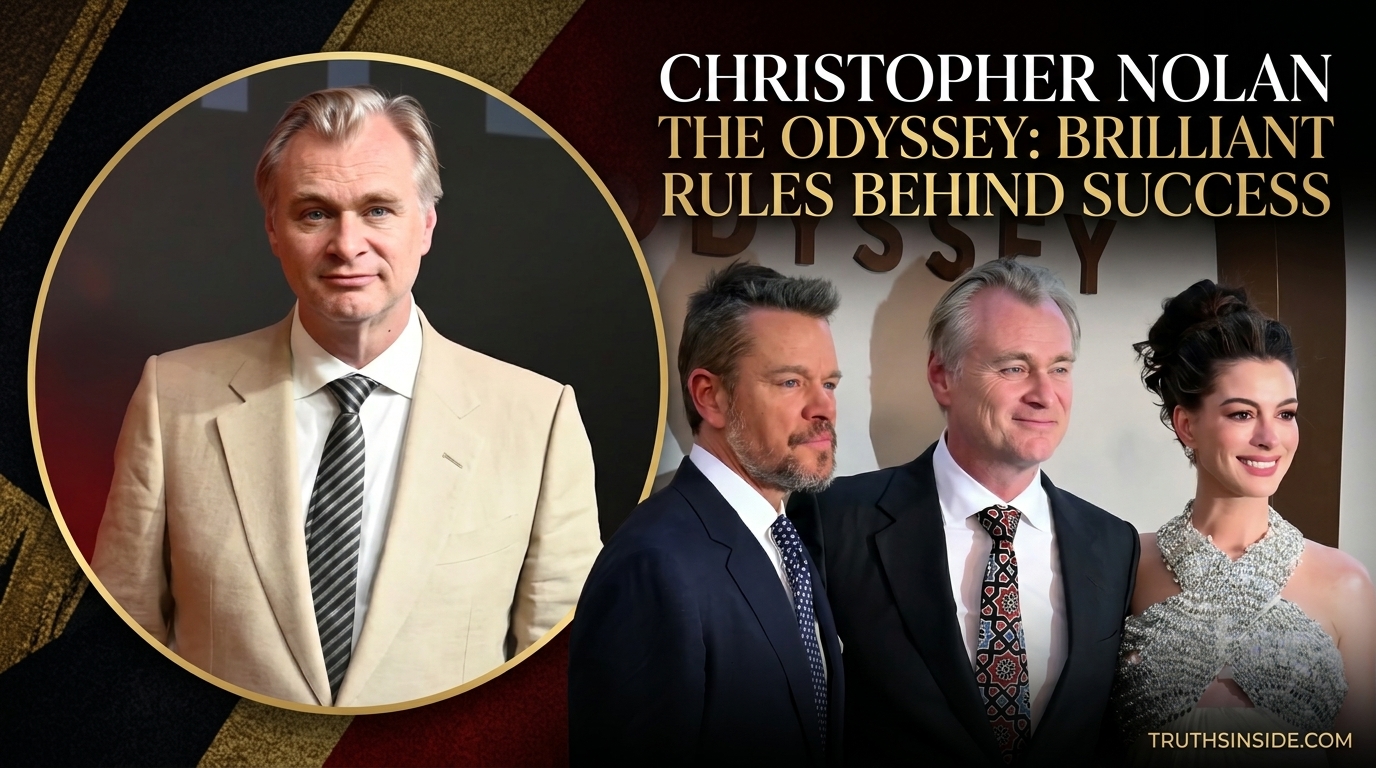
The Details That Make the Difference
Have you ever wondered what truly separates a good film from a transcendent one — the kind of movie that pulls you so completely out of your seat and into its world that you forget, for two or three breathtaking hours, that you are sitting in a theater at all? The answer, according to one of the greatest filmmakers alive today, might begin with something as seemingly insignificant as a pair of boots. Christopher Nolan’s The Odyssey opened to a staggering $124.5 million at the box office, claiming the title of the biggest live-action opening weekend of the year — and the philosophy behind that success runs deeper than most audiences will ever realize.
According to research published in the British Journal of Psychology, environmental consistency plays a critical role in maintaining focus, creativity, and immersive performance. Nolan has understood this principle for years.
The director’s now-famous ban on Ugg boots on his film sets is not a quirky celebrity demand. It is a window into an entire filmmaking philosophy — one built on the conviction that immersion is everything, that every detail matters, and that the line between reality and fiction on a movie set is far more fragile than it might appear. Understanding Nolan’s set rules helps us understand his films. And understanding his films helps us understand why The Odyssey arrived in theaters and immediately rewrote the commercial landscape of the current year.
This article takes you inside Christopher Nolan’s unique approach to filmmaking, explores the fascinating reasoning behind his distinctive set etiquette, and examines what the blockbuster debut of The Odyssey tells us about the enduring power of disciplined, visionary cinema.

Who Is Christopher Nolan? A Director Unlike Any Other
Before exploring the specific details of his set philosophy and the extraordinary success of Christopher Nolan’s The Odyssey, it is worth stepping back to appreciate the full scope of who Christopher Nolan is and what he has achieved across a career that has consistently redefined what mainstream cinema can accomplish.
Born in London in 1970 and raised between England and the United States, Nolan developed his passion for filmmaking from an early age, experimenting with his father’s Super 8 camera as a child and eventually studying English Literature at Cambridge — a background that would profoundly shape his storytelling sensibility. He made his feature debut with Following in 1998, a low-budget black-and-white thriller that announced the arrival of a genuinely distinctive cinematic voice.
What followed was one of the most remarkable directorial careers in the history of Hollywood. Memento in 2000 established him as a master of non-linear narrative. Batman Begins, The Dark Knight, and The Dark Knight Rises transformed the superhero genre and demonstrated that blockbuster filmmaking could operate at the highest levels of dramatic and thematic ambition. Inception bent reality with audacious creativity. Interstellar reached for the cosmos. Dunkirk stripped war cinema to its most elemental and visceral form. Tenet played with the concept of time itself. And Oppenheimer — winner of seven Academy Awards including Best Picture and Best Director — cemented his place among the all-time greats.
Every one of these films shares a common quality: they demand total immersion. They require their audiences — and their casts and crews — to believe completely in the world being created. That requirement does not begin in the editing room or the mixing suite. It begins on set, on day one, with decisions that might seem minor to an outsider but that Nolan understands to be absolutely fundamental.
📃 Related article: Gwen Stefani Blake Shelton Anniversary: 5 Gorgeous Years
The Ugg Boot Ban: A Philosophy Expressed in Footwear
Of all the distinctive rules and practices that define a Christopher Nolan film set, none has captured public imagination quite like his now-famous ban on Ugg boots during production. It is the kind of detail that sounds almost comedic when described out of context — and yet, when Nolan explains the reasoning behind it, the logic becomes not just understandable but genuinely illuminating.
Ugg boots, for the uninitiated, are the extraordinarily popular sheepskin footwear that became a cultural phenomenon in the early 2000s and have maintained a devoted following ever since. Comfortable, warm, casual, and utterly recognizable, they are the kind of footwear you associate with relaxed weekends, coffee shops, and the kind of effortless comfort that has nothing to do with period drama, science fiction, epic adventure, or any of the worlds Nolan typically creates on screen.
And that, precisely, is the problem.
When an actor is deep inside a scene — embodying a character from another era, another world, or another psychological reality entirely — the last thing they should be seeing in their peripheral vision is a crew member walking past in footwear that screams twenty-first century casual comfort. That single visual incongruity, Nolan argues, is enough to crack the surface of the fictional world and let the real one leak back in.

The Potato Chip Analogy: Nolan Explains His Thinking
Christopher Nolan has a gift for explaining complex creative instincts in language that is immediately accessible and vivid. His description of why the Ugg boot ban matters is a perfect example of that gift in action.
Nolan compares the effect of seeing Ugg boots on set to hearing someone eating a noisy bag of chips just off camera while a scene is being filmed. On the surface, the two things seem unrelated — one is visual, one is auditory, and neither is technically part of the scene being recorded. But both accomplish the same thing: they pull the performer’s attention, however briefly and involuntarily, out of the world they are trying to inhabit and back into the ordinary, distracting reality of a film production in progress.
The potato chip analogy is brilliant in its simplicity because it makes the principle immediately understandable to anyone who has ever tried to concentrate on something demanding while a trivial distraction competed for their attention. You know the experience. You are trying to read, or write, or think through a difficult problem, and someone nearby is making a noise that is small enough to be ignored but persistent enough to be genuinely disruptive. The distraction does not have to be large to be effective. It just has to be present.
For an actor attempting to inhabit a character at the deepest level of emotional and psychological authenticity, even the most fleeting break in environmental consistency can be costly. The moment of recovery — the mental work of returning to full immersion after being momentarily pulled out — costs time, energy, and creative momentum. Nolan’s job, as he sees it, is to eliminate as many of those moments as possible before the camera rolls.
📃 Related article: Tyrese Haliburton Married: A Beautiful Love Story
“Nolan’s ban on Ugg boots is not about the boots themselves — it is about the principle they represent. Every detail of the environment either supports the fiction or undermines it. There is no neutral ground on a Christopher Nolan set.”
The Rule Is Functional, Not Personal
One of the most humanizing aspects of Nolan’s explanation of the Ugg boot ban is the candor with which he acknowledges his own relationship with the footwear in question.
He is clear that the rule has nothing to do with any personal dislike of Ugg boots as a product. On the contrary, Nolan admits that he personally likes Ugg boots — which makes the ban an even more compelling illustration of his filmmaking philosophy. This is not a director imposing arbitrary aesthetic preferences on his cast and crew. This is a filmmaker making a calculated, functional decision about what serves the creative environment and what does not.
The distinction matters because it reveals something important about how Nolan approaches his craft. His decisions on set are not driven by ego, personal taste, or the kind of capricious authority that gives some directors a reputation for difficult behavior. They are driven by a clear-eyed assessment of what works — what genuinely serves the story, the performances, and the world being created — and what does not.
A director who bans something he personally enjoys, purely because it serves the integrity of the creative process, is a director operating from principle rather than preference. That is a rare and genuinely admirable quality in any profession, and it helps explain why the people who work with Nolan consistently describe the experience as demanding but profoundly rewarding.

Immersion as Creative Infrastructure
The Ugg boot ban is, of course, just one visible expression of a much broader and more comprehensive philosophy about the relationship between environment and creative output.
Nolan’s approach to set design, costume, and the physical reality of his productions is legendary in the film industry for its commitment to practical, tangible authenticity. Where many contemporary directors lean heavily on digital effects and green screen environments, Nolan consistently argues for building real things — real sets, real locations, real practical effects — whenever humanly possible.
The reasoning is directly connected to the same principle that motivates the Ugg boot rule. When actors are surrounded by real, physical environments that have been carefully constructed to be consistent with the world of the film, their ability to inhabit their characters is fundamentally enhanced. They are not imagining a wall, a landscape, or a physical sensation — they are experiencing it. And that experiential reality translates directly into the quality and authenticity of their performances.
This commitment to practical filmmaking is one of the most costly and technically demanding approaches available to a director in the current era of cinema. It requires more time, more money, more logistical complexity, and more creative problem-solving than the digital alternatives. Nolan pursues it anyway, because he believes — and has demonstrated repeatedly — that the results justify every additional difficulty.
📃 Related article: Deadpool Future Films: Reynolds Makes Exciting Confirmation
Christopher Nolan’s The Odyssey: A Record-Breaking Debut
All of this context — the philosophy, the set etiquette, the commitment to immersion and practical authenticity — converges in the extraordinary commercial performance of Christopher Nolan’s The Odyssey during its opening weekend.
The film opened to a remarkable $124.5 million in its debut weekend, immediately claiming the title of the biggest live-action opening weekend of the year. The number is impressive in absolute terms, but it becomes even more significant when considered in context.
The current theatrical landscape is one that has challenged even the most established franchises and the most bankable stars. Audiences have become more selective, more discerning, and harder to motivate toward a theater visit when streaming alternatives are available at home with unprecedented ease and accessibility. Against that backdrop, a $124.5 million opening weekend for an original, non-franchise, non-sequel cinematic adaptation of one of history’s oldest and most complex literary works is nothing short of extraordinary.
It is a number that reflects not just the appeal of the source material, but the specific and irreplaceable power of the Christopher Nolan brand — the understanding among audiences that a Nolan film is worth the theater experience, worth the full-price ticket, worth the deliberate choice to go out rather than stay in.
Why The Odyssey’s Success Makes Perfect Sense
Homer’s The Odyssey is one of the oldest and most universally recognized narratives in human history — a sweeping epic of adventure, homecoming, identity, loyalty, and the enduring human struggle against forces both external and internal. It is a story that has been told and retold across thousands of years, in countless languages and forms, precisely because its central themes are not specific to ancient Greece. They are specific to being human.
Christopher Nolan’s decision to adapt this material for the screen is, in retrospect, almost obvious. The Odyssey is the kind of epic narrative that demands exactly the qualities Nolan brings to every project: visual grandeur, narrative complexity, psychological depth, and an absolute commitment to creating a world that audiences can inhabit completely.
The fact that Nolan’s adaptation opened to the biggest live-action debut of the year confirms what his most devoted fans have always known and what his commercial track record has consistently demonstrated: there is a version of ambitious, serious, technically rigorous cinema that mainstream audiences genuinely hunger for. Nolan finds that version, film after film, with a reliability that is itself a kind of artistic achievement.
“A $124.5 million opening weekend for a literary epic adaptation tells us something important — audiences are not tired of cinema. They are tired of cinema that does not take them seriously. Nolan takes his audiences very seriously indeed.”
The Connection Between Set Philosophy and Box Office Results
It would be tempting to treat Nolan’s set rules and The Odyssey’s box office success as two separate stories — one a quirky behind-the-scenes detail, the other a straightforward financial report. But they are, in fact, deeply connected.
The discipline, intentionality, and commitment to total immersion that motivates Nolan to ban Ugg boots on his sets is the same discipline, intentionality, and commitment that produces films capable of generating $124.5 million in a single weekend. These are not separate qualities. They are the same quality expressed at different scales.
When an audience sits down in a theater and finds themselves completely absorbed in a Nolan film — unable to look away, unwilling to check their phones, genuinely invested in every development and every frame — they are experiencing the direct result of a thousand careful decisions, from the grandest narrative choices to the smallest environmental details. The Ugg boot ban is one of those decisions. And in a very real sense, it contributes, however indirectly, to the final number on the box office report.
This is what genuine creative discipline looks like when it reaches its fullest expression — not in a single dramatic gesture, but in the cumulative effect of consistently getting the details right, from the biggest to the most apparently trivial.

What Other Filmmakers Can Learn From Nolan’s Approach
Christopher Nolan’s set philosophy offers lessons that extend well beyond the specific context of blockbuster filmmaking and into any creative endeavor where environment and immersion play a role.
The core principle — that environmental consistency supports creative authenticity, and that even small disruptions can have disproportionate effects on performance and output — is applicable across a remarkably wide range of disciplines. Writers, musicians, actors, athletes, and anyone whose work requires sustained concentration and deep engagement with an imaginative or technical process can recognize the essential truth in Nolan’s approach.
The willingness to impose discipline not for its own sake but in service of a clearly understood creative goal is equally transferable. Nolan does not ban Ugg boots because he enjoys having rules. He bans them because he has identified, through experience and observation, that their presence undermines something he cares deeply about protecting. That kind of evidence-based, purposeful discipline is the foundation of excellence in any field.

Box Office Breakdown: The Odyssey’s Impressive Debut
| Metric | Detail |
|---|---|
| Opening Weekend Gross | $124.5 million |
| Year-to-Date Ranking | Biggest live-action opening weekend of the year |
| Director | Christopher Nolan |
| Source Material | Homer’s The Odyssey |
| Theatrical Context | Original literary adaptation in a challenging streaming era |
FAQ: Christopher Nolan The Odyssey — Your Questions Answered
1. Why does Christopher Nolan ban Ugg boots on his film sets?
Nolan bans Ugg boots because he believes that casual, out-of-place footwear can break the immersive atmosphere he works to create on set. He compares the distraction to hearing someone eating a noisy bag of chips off camera — a small but real disruption to an actor’s ability to stay fully in character.
2. Does Christopher Nolan personally dislike Ugg boots?
No. Nolan has been candid about the fact that he personally likes Ugg boots. The ban is entirely functional and set-specific — it is about maintaining environmental consistency during filming, not about any personal aesthetic objection to the product.
3. How much did Christopher Nolan’s The Odyssey make on its opening weekend?
The Odyssey opened to $124.5 million, making it the biggest live-action opening weekend of the year and a major commercial success for Nolan and his studio.
4. What is The Odyssey based on?
The Odyssey is based on Homer’s ancient Greek epic poem of the same name, one of the foundational texts of Western literature. The poem follows the hero Odysseus on his long, adventure-filled journey home following the conclusion of the Trojan War.
5. What does Nolan’s set philosophy tell us about his filmmaking approach?
Nolan’s set rules reflect a broader commitment to creating fully immersive, consistent environments that support authentic performances. His belief that every detail — including seemingly trivial ones like footwear — either supports or undermines the fictional world being created is central to his filmmaking identity and directly connected to the consistently high quality of his films.
Final Thoughts
Christopher Nolan’s The Odyssey and the behind-the-scenes philosophy that produced it offer a masterclass in what it means to take your craft completely seriously — at every level, in every detail, without exception.
The Ugg boot ban is a small rule with an enormous implication: that excellence in filmmaking is not achieved through grand gestures alone, but through the patient, consistent, disciplined management of every element that could compromise the world you are trying to build. And when you get those details right — when the environment is consistent, the performances are authentic, and the world is fully realized — audiences notice. They might not know exactly why they feel so completely absorbed, so entirely convinced, so genuinely moved. But they feel it.
One hundred and twenty-four million dollars in a single weekend is the sound of an audience feeling it.
💾 Save this article for the next time someone asks why Christopher Nolan is different from every other filmmaker working today.
📤 Share this story with the movie lover in your life who will appreciate every fascinating detail.
👉 Follow Truthsinside.com for the latest in celebrity entertainment, film news, and the stories behind the stories — updated every day.
🎵 Music
Maren Lull is a singer-songwriter who writes from the places most people don’t talk about out loud.
Not the dramatic grief. Not the obvious heartbreak. The quiet kind — the ordinary Tuesday emptiness, the habit of reaching for someone who isn’t there anymore, the particular exhaustion of being strong for so long that the strength itself wears thin.
Her music lives at the intersection of emotional honesty and soft beauty — breathy vocals over gentle piano, slow tempos, lyrics that feel less like songs and more like something you wrote in a private notebook at two in the morning and never showed anyone.
Maren Lull writes for the people who feel everything deeply and say very little about it. For the ones who listen to sad music not because they want to feel worse — but because being understood, even by a song, makes the feeling easier to carry.
📱 Follow Maren Lull:
→ Spotify
→ Apple Music
→ Youtube
→ Audiomack