
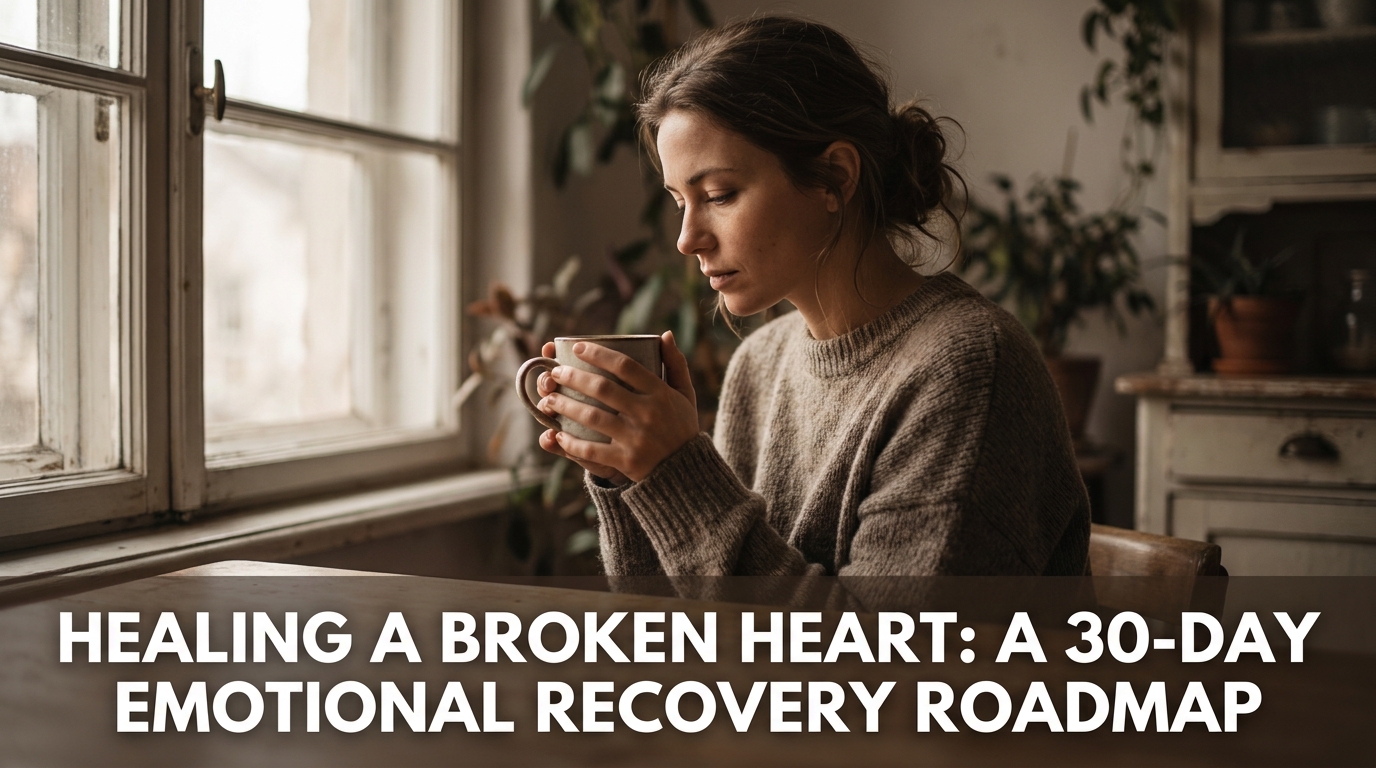
You didn’t just lose a person. You lost the future you had planned. The inside jokes, the Sunday mornings, the version of yourself that existed inside that relationship. And now you’re supposed to just… move on. If that feels impossible right now, you’re not weak — you’re human.
Research from neurologist Dr. Helen Fisher shows that heartbreak activates the same regions of the brain as physical pain and addiction withdrawal. Healing a broken heart is not a matter of willpower or simply “getting over it” — it is a genuine neurological and emotional process that takes time, intention, and the right roadmap. That’s exactly what this guide gives you.
This is your 30-day emotional recovery plan — broken into four science-backed weekly phases that meet you where you are and carry you forward, one day at a time.

Why Healing a Broken Heart Takes Longer Than You Think
Before the roadmap, it helps to understand what’s actually happening inside you — because heartbreak is far more than sadness.
When a relationship ends, the brain loses its primary source of dopamine and oxytocin — the chemicals associated with bonding, pleasure, and safety. The result is a neurochemical withdrawal that mirrors what happens when someone stops using an addictive substance. This is why you obsessively check their social media. Why you replay memories. Why you reach for your phone to text them at 2am even though you know you shouldn’t.
Grief after a breakup also follows its own version of the five stages — denial, anger, bargaining, depression, and acceptance — but rarely in a straight line. You may feel fine on Tuesday and devastated on Thursday. That’s not regression. That’s healing.
Understanding this biology doesn’t remove the pain. But it does remove the shame around it.
The 30-Day Emotional Recovery Roadmap
WEEK 1 (Days 1–7): Feel It Fully
The instinct after a breakup is to numb — to stay busy, scroll endlessly, or dive into distractions. Week one asks you to do the opposite. Not to wallow, but to feel with intention.
Day 1 — Allow the Grief Give yourself full permission to be a mess today. Cry if you need to. Sit with the loss. Don’t perform strength you don’t feel. The only way out is through, and through begins with acknowledgment.
Day 2 — Write It All Down Get a journal — physical, not digital. Write about what you’ve lost, what you’re feeling, and what you’re afraid of. Studies from the University of Texas show that expressive writing after emotional trauma significantly reduces psychological distress within weeks.
Day 3 — Create Your No-Contact Boundary If the relationship is truly over, remove or mute them on social media. Delete the text thread if you need to. This isn’t cruelty — it’s survival. Every time you check their profile, your brain restarts the withdrawal cycle from zero.
Day 4 — Tell One Trusted Person You don’t need to broadcast your pain. But isolating completely slows healing. Choose one person — a friend, a sibling, a therapist — and let them in. Being witnessed in pain is one of the most powerful healers there is.
Day 5 — Identify What You’re Actually Grieving Are you grieving them — or the future you imagined? The companionship — or the specific person? Getting honest about what the loss actually is helps you grieve the right thing, not a fantasy version of what was.
Day 6 — Rest Without Guilt Grief is physically exhausting. Sleep more than usual if your body asks for it. Eat gently. Cancel what you can. Your nervous system is in recovery mode and it needs resources.
Day 7 — Reflect on Week One Write a single page: what did you feel this week? What surprised you? What do you need more of going into next week? This reflection builds the self-awareness that makes healing stick.

WEEK 2 (Days 8–14): Reclaim Your Identity
The relationship shaped parts of how you saw yourself. Week two is about remembering — and rediscovering — who you are outside of it.
Day 8 — List What You Gave Up Were there hobbies, friendships, or parts of yourself you quietly set aside during the relationship? Write them down. These are not losses — they are invitations back to yourself.
Day 9 — Do One Thing Just for You Not to distract yourself. Not to post about it. Just because it makes you feel alive. A long walk. A meal you love. A movie you’ve been putting off. Pleasure is not a betrayal of grief — it’s part of healing.
Day 10 — Audit Your Environment Remove or store items that trigger spirals — photos, gifts, their belongings. You don’t have to throw anything away. You just need your daily environment to stop ambushing you with memories at random moments.
Day 11 — Reconnect With a Friend You’ve Drifted From Breakups often quietly shrink our social world. Reach out to someone you’ve missed. Not to vent — just to reconnect. Social bonds are one of the most powerful buffers against depression and isolation.
Day 12 — Write a Letter You Won’t Send Write everything you wish you could say to your ex — the anger, the love, the confusion, the things left unsaid. Then don’t send it. This exercise releases emotional charge that otherwise loops endlessly in your mind.
Day 13 — Identify Your Patterns Were there warning signs you ignored? Ways you abandoned yourself to keep the peace? Patterns you’ve seen in previous relationships? This isn’t self-blame — it’s self-knowledge. Awareness breaks cycles.
Day 14 — Celebrate Surviving Two Weeks This sounds small. It isn’t. Two weeks of intentional healing — of feeling instead of numbing — deserves acknowledgment. Do something kind for yourself today. You’re doing the work.

WEEK 3 (Days 15–21): Rebuild Your Foundation
The acute pain is beginning to soften. Week three is about building new structure — routines, habits, and practices that create stability from the inside out.
Day 15 — Start a Morning Routine Even a simple one. Wake up at the same time. Drink water before your phone. Spend ten minutes outside. Routine signals safety to a nervous system that’s been in chaos. It doesn’t need to be elaborate — it needs to be consistent.
Day 16 — Move Your Body Exercise is one of the most well-documented natural antidepressants available. A 30-minute walk, a yoga class, a swim — whatever feels accessible. Movement processes stored emotional energy that words and thoughts cannot reach.
Day 17 — Limit Heartbreak Content Sad playlists, breakup movies, and love songs have their place in early grief. By week three, they can start keeping you in a loop. Begin curating what you consume — music, social media, podcasts — toward content that energizes rather than marinates.
Day 18 — Set One Small Goal Not a life overhaul. One small, achievable goal for the week ahead. A book to finish. A room to reorganize. A skill to explore. Forward motion — even tiny — reactivates your sense of agency and future.
Day 19 — Practice Gratitude Without Forcing It This isn’t toxic positivity. It’s neurological retraining. Each evening, write three things that were genuinely okay today. Not amazing — just okay. Over time, this shifts the brain’s default scanning from threat to possibility.
Day 20 — Revisit Your Values What matters most to you? What kind of relationship do you actually want next time? What are you unwilling to compromise on? Clarity about your values now protects you from making fear-based decisions later.
Day 21 — Reflect on Week Three Write about who you’re becoming through this process. Not who you were in the relationship, not who you were before it — but who you are right now, in the middle of healing. That person deserves to be seen.

WEEK 4 (Days 22–30): Step Into What’s Next
You are not the same person you were on Day 1. Week four honors that transformation and begins to orient you toward the future — not by rushing into anything new, but by stepping forward with intention.
Day 22 — Write Your Healing Story Not the breakup story — the healing story. What have you learned about yourself this month? What did you discover you were stronger than you thought? Narrative reframing is one of the most powerful tools in psychological recovery.
Day 23 — Do Something That Scared You Before A solo restaurant. A new class. A conversation you’ve been avoiding. Small acts of courage rebuild the self-trust that loss can quietly erode.
Day 24 — Forgiveness — For Yourself First Forgiveness is not about excusing what happened or reconciling with your ex. It’s about releasing yourself from the weight of resentment, guilt, or self-blame. Write down one thing you forgive yourself for. Start there.
Day 25 — Update Your Vision for Your Life Not your relationship vision — your life vision. Where do you want to be in a year? What do you want to feel? Who do you want to become? Heartbreak, as brutal as it is, creates a rare opening to rebuild intentionally.
Day 26 — Thank Someone Who Showed Up for You A text, a call, a handwritten note. Gratitude expressed outward strengthens the relationships that carried you through. It also shifts your focus from what you lost to what you still have.
Day 27 — Revisit Day 2’s Journal Entry Read what you wrote in the raw early days. Notice how far you’ve traveled. This is important — because healing happens so gradually that we often don’t recognize it until we look back.
Day 28 — Define What Healthy Love Looks Like to You Based on everything you’ve learned — about yourself, about the relationship, about what you need — write your clearest definition yet of what a healthy, loving relationship looks and feels like for you specifically.
Day 29 — Do Something Beautiful Visit somewhere that moves you. Create something. Cook a meal with care. Watch a sunset. Beauty is not frivolous during healing — it is medicine. It reminds the nervous system that the world is still worth being in.
Day 30 — Write Yourself a Letter from the Future Imagine yourself one year from now — healed, grounded, genuinely okay. Write a letter from that version of you to who you are today. What does she want you to know? What is she grateful you chose to do this month?

The Bottom Line
Healing a broken heart is not a straight line. There will be days in week three that feel like week one. There will be moments of unexpected grief at week four. That is not failure — that is the honest, nonlinear shape of human healing.
What this roadmap gives you is not a guarantee of pain-free recovery. It gives you direction when everything feels directionless. Structure when you feel like you’re dissolving. And proof — day by day — that you are moving, even when it doesn’t feel like it.
You are not healing back to who you were before. You are healing forward into someone who knows themselves more deeply, loves more wisely, and carries their own heart with far more care.
💾 SAVE this article — pin it somewhere you’ll find it on the hard days. Come back to it whenever you need direction. 📤 SHARE this with someone going through a breakup right now. The right words at the right time change everything. 👉 FOLLOW TruthsInside.com for more honest, psychology-backed content on love, healing, and emotional growth.
❓ Frequently Asked Questions
Q1: How long does it really take to heal from a broken heart? Research suggests the average person begins to feel significantly better between 8 and 11 weeks after a breakup — but this varies enormously depending on the length of the relationship, the circumstances of the ending, attachment style, and the support available. This 30-day roadmap doesn’t promise complete healing in a month — it promises meaningful, measurable progress.
Q2: Is it normal to feel fine one day and devastated the next? Completely normal — and backed by psychology. Grief is not linear. The brain oscillates between processing pain and seeking relief, which creates the up-and-down pattern most people experience. The important thing is the overall trajectory over weeks, not how you feel on any single day.
Q3: Should I reach out to my ex during this process? In most cases, no — at least not in the first 30 days. Contact reactivates the neurochemical attachment cycle and makes it significantly harder to reach emotional equilibrium. If there are practical matters that require communication, keep it brief, factual, and emotion-free.
Q4: What if I’m still in love with them by Day 30? That’s okay. Thirty days is the beginning of healing, not the end of it. Love doesn’t disappear on a schedule. What changes over 30 days of intentional recovery is your relationship with the pain — it becomes something you carry rather than something that carries you.
Q5: When is it okay to start dating again? When you are genuinely curious about someone new — not when you are trying to fill a void, make your ex jealous, or prove something to yourself. The clearest sign you are ready is when the idea of dating feels like possibility rather than escape.
🎵 Music
Maren Lull is a singer-songwriter who writes from the places most people don’t talk about out loud.
Not the dramatic grief. Not the obvious heartbreak. The quiet kind — the ordinary Tuesday emptiness, the habit of reaching for someone who isn’t there anymore, the particular exhaustion of being strong for so long that the strength itself wears thin.
Her music lives at the intersection of emotional honesty and soft beauty — breathy vocals over gentle piano, slow tempos, lyrics that feel less like songs and more like something you wrote in a private notebook at two in the morning and never showed anyone.
Maren Lull writes for the people who feel everything deeply and say very little about it. For the ones who listen to sad music not because they want to feel worse — but because being understood, even by a song, makes the feeling easier to carry.
📱 Follow Maren Lull:
→ Spotify
→ Apple Music
→ Youtube
→ Audiomack