
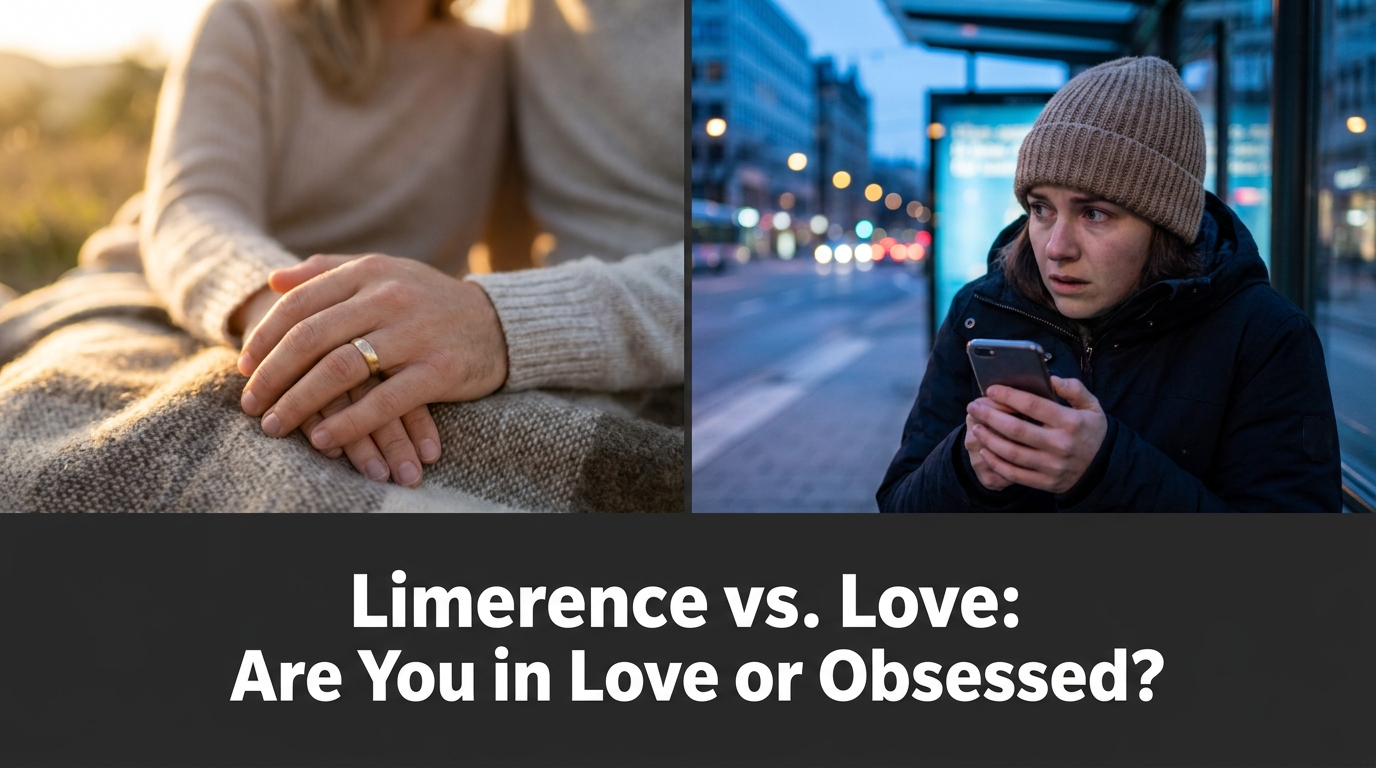
You think about them the moment you wake up. You replay every conversation, every glance, every word they said. When they text you, your whole body lights up. When they don’t, the silence feels unbearable. You call it love. But what if it isn’t?
Psychologist Dorothy Tennov first coined the term “limerence” in 1979 to describe an involuntary state of intense romantic obsession — one that mimics love so closely that most people never question which one they’re actually experiencing. Research suggests that limerence vs. love is one of the most misunderstood distinctions in all of relationship psychology, and confusing the two can lead to years of emotional pain, poor decisions, and relationships built on fantasy rather than reality.
This article breaks down exactly what limerence is, how it differs from genuine love, the signs you may be experiencing it, and what to do if you are.
What Is Limerence? The Psychology Behind Obsessive Love
Limerence is not simply a crush or infatuation. It is an involuntary, obsessive emotional state characterized by intrusive thinking about another person, an intense need for reciprocation, and extreme emotional highs and lows depending on that person’s behavior toward you.
Dr. Tennov identified several core features that define limerence:
- Intrusive thinking: The limerent object — the person you’re fixated on — occupies your thoughts for hours every day, often against your will.
- Crystallization: You idealize them completely, filtering out flaws and magnifying every positive quality until they become almost mythological in your mind.
- Fear of rejection: The possibility of not being loved back creates a level of anxiety that feels physically unbearable.
- Emotional dependency: Your entire emotional state rises and falls based on their smallest actions — a text, a look, a one-word reply.
- Fantasizing: You spend significant mental energy imagining a future with them, replaying interactions, and constructing elaborate scenarios.
Limerence can last anywhere from a few months to several years. It is not a choice. And it feels, from the inside, exactly like love.
Limerence vs. Love: The Key Differences
This is where the real clarity begins. Understanding the distinction between limerence and love is not about invalidating your feelings — it’s about understanding them accurately so you can make better decisions.
It’s About Them vs. It’s About You Both
Real love is fundamentally about the other person — their wellbeing, their growth, their happiness. You want good things for them even when those good things don’t directly involve you. Limerence, by contrast, is ultimately about how they make you feel. Their value to you is almost entirely tied to what their attention and affection does to your emotional state.
Stable vs. Volatile
Genuine love creates a baseline of emotional stability. There are disagreements, hard days, and difficult seasons — but underneath it all is a sense of groundedness and security. Limerence is a rollercoaster. Their one cold text can ruin your entire day. A single warm smile can carry you for a week. The volatility isn’t passion — it’s dependency.
Seeing Clearly vs. Seeing a Fantasy
Love includes full knowledge of a person — their flaws, their inconsistencies, their difficult qualities — and chooses them anyway. Limerence constructs a version of the person that doesn’t fully exist. You’re not in love with them — you’re in love with who you’ve decided they are. When reality doesn’t match the fantasy, limerence often collapses suddenly and completely.
Reciprocity vs. Obsession
Love can exist and thrive even in the mundane — the grocery runs, the boring evenings, the ordinary Tuesday. Limerence requires fuel: new signals of interest, reassurance, attention. Without regular reciprocation, the limerent state becomes agony. With it, it becomes euphoria. Neither state is sustainable.
Grows vs. Fades
Real love tends to deepen over time — through shared experience, conflict navigated, and vulnerability exchanged. Limerence tends to fade when the fantasy meets sustained reality. The moment you truly know someone — all of them — limerence often quietly dissolves.

Signs You May Be Experiencing Limerence
It can be difficult to self-diagnose limerence because it feels so much like love from the inside. But these signs are worth examining honestly:
- You think about this person for several hours every day — not warmly, but obsessively and often against your will.
- Your mood is almost entirely controlled by how they behave toward you on any given day.
- You interpret neutral or even negative behavior as secretly positive — reading into everything they do for hidden signals of affection.
- The idea of them being with someone else produces a level of pain that feels completely disproportionate to the actual relationship you have.
- You have idealized them to the point where you struggle to identify genuine flaws — or you acknowledge flaws but feel they somehow make this person even more appealing.
- You find it nearly impossible to redirect your attention to other people romantically, even when you try.
- The relationship — or situationship — creates far more anxiety than peace.
- You have a persistent fantasy of a moment of “mutual recognition” — the scene where they finally see what you mean to each other and everything clicks into place.
If several of these resonate, you may be experiencing limerence rather than love. That recognition is not something to be ashamed of — it is the beginning of genuine clarity.

Why Limerence Happens: The Neuroscience
Limerence is not a character flaw or a sign of weakness. It has a measurable neurological basis.
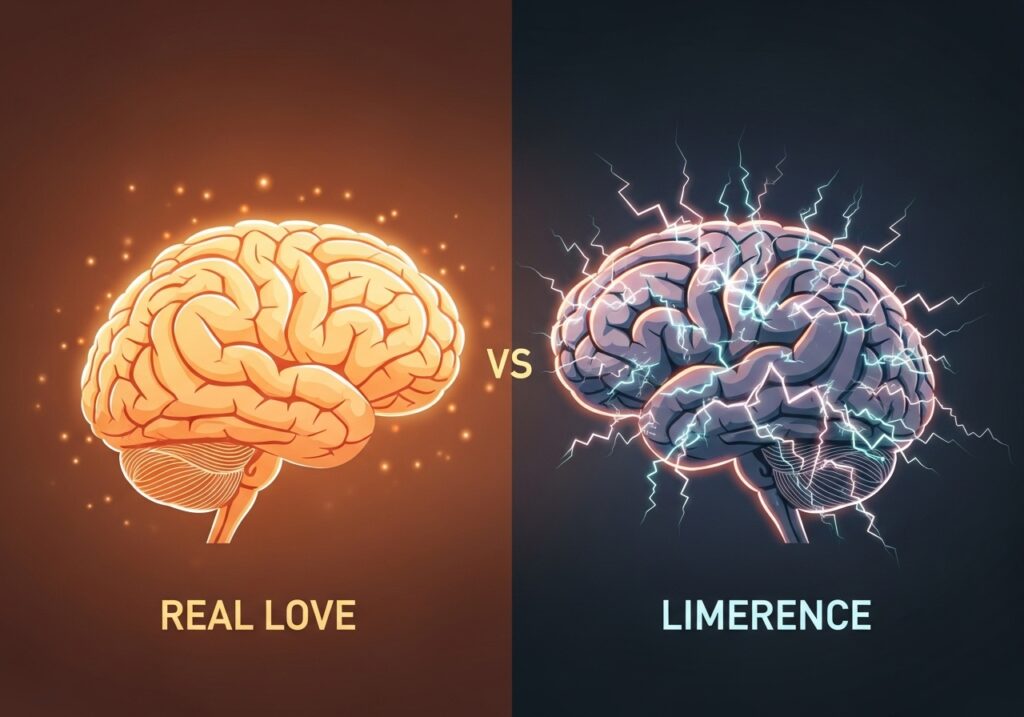
When you’re in a limerent state, your brain shows elevated activity in the dopamine and norepinephrine systems — the same systems activated by addictive substances. The uncertainty of whether your feelings will be reciprocated actually intensifies this response. Variable reinforcement — sometimes they respond warmly, sometimes they’re cold — creates the same neurological loop as a slot machine. Your brain becomes addicted to the possibility of the reward.
Additionally, research has found links between limerence and anxious attachment style — the pattern developed in early childhood when caregivers were inconsistent or unpredictable. If love as a child felt like something you had to earn or chase, limerence may feel familiar in a way that real, stable love does not. The stability of genuine love can even feel boring or “not right” to someone wired for the limerent chase.
This doesn’t mean you are broken. It means your nervous system learned a pattern — and patterns can be unlearned.
Can Limerence Turn Into Real Love?
Sometimes — but less often than people hope. For limerence to evolve into genuine love, several things need to happen:
The limerent object needs to be a genuinely compatible person — not just someone who triggered your attachment system. The relationship needs to move into sustained, unguarded reality — where both people are fully known, not idealized. And the limerent person needs to develop enough self-awareness to recognize the difference between loving someone and needing them.
When these conditions are met, limerence can soften into something real. But in many cases, sustained closeness simply dissolves limerence — because the fantasy cannot survive full reality. That dissolution, painful as it is, is often a gift.

What to Do If You’re Experiencing Limerence
Recognizing limerence is the first step. Here’s what actually helps:
- Name it. Calling it limerence rather than love immediately creates psychological distance from the obsessive loop. Language shapes experience.
- Reduce contact where possible. Every interaction with the limerent object resets the neurochemical cycle. Space is not cruelty — it’s recovery.
- Stop feeding the fantasy. Replaying memories, checking their social media, and imagining future scenarios all intensify limerence. Interrupt the loop deliberately.
- Redirect the energy. Limerence generates enormous emotional energy. Channel it into creative work, physical movement, meaningful projects, or genuine friendships.
- Seek therapy. Especially if limerence is a recurring pattern, a therapist can help identify the attachment wounds driving it and build more secure relational patterns.
- Be patient with yourself. Limerence is involuntary. You cannot think your way out of it immediately. But with time, reduced contact, and intentional redirection, it does fade.
The Bottom Line
Limerence vs. love is not a question of intensity — limerence can feel more intense than anything you’ve ever experienced. It is a question of foundation. Love is built on reality, reciprocity, and genuine knowledge of another person. Limerence is built on fantasy, uncertainty, and need.
Neither makes you broken. Neither makes you foolish. But only one of them can build something real.
The most loving thing you can do for yourself is learn to tell the difference — not to protect yourself from feeling deeply, but to make sure that when you do, you’re feeling something true.
💾 SAVE this article — come back to it whenever a feeling starts to consume more than it should. 📤 SHARE this with someone who might be confusing obsession with love right now. It could change everything for them. 👉 FOLLOW TruthsInside.com for more honest, psychology-backed content on love, emotions, and real relationships.
❓ Frequently Asked Questions
Q1: Is limerence the same as a crush? Not exactly. A crush is usually light, enjoyable, and doesn’t significantly disrupt daily functioning. Limerence is involuntary, intrusive, and often emotionally destabilizing. The key difference is degree — limerence consumes mental and emotional bandwidth in a way a simple crush does not.
Q2: Can you be in limerence with your partner? Yes — and it’s more common than people realize. Limerence can exist within a relationship, particularly in the early stages. If the limerence fades and genuine love hasn’t developed to replace it, couples sometimes mistake that shift for “falling out of love” when it’s actually just the natural end of an unsustainable neurochemical state.
Q3: How long does limerence last? Dr. Tennov’s research suggested limerence typically lasts between 18 months and 3 years when unrequited, but can extend significantly longer in some cases. Reciprocation, sustained contact, or continued uncertainty can all affect its duration.
Q4: Is limerence a mental health condition? Limerence is not currently classified as a clinical disorder, but it shares features with OCD, anxiety, and attachment disorders. For people who experience it repeatedly and severely, working with a therapist — particularly one specializing in attachment — can be genuinely transformative.
Q5: How do I know if what I feel is real love? Ask yourself this: do you love who they actually are — including their flaws, their bad days, and their ordinariness — or do you love who you’ve imagined them to be? Real love survives full knowledge. Limerence often doesn’t.
🎵 Music
Maren Lull is a singer-songwriter who writes from the places most people don’t talk about out loud.
Not the dramatic grief. Not the obvious heartbreak. The quiet kind — the ordinary Tuesday emptiness, the habit of reaching for someone who isn’t there anymore, the particular exhaustion of being strong for so long that the strength itself wears thin.
Her music lives at the intersection of emotional honesty and soft beauty — breathy vocals over gentle piano, slow tempos, lyrics that feel less like songs and more like something you wrote in a private notebook at two in the morning and never showed anyone.
Maren Lull writes for the people who feel everything deeply and say very little about it. For the ones who listen to sad music not because they want to feel worse — but because being understood, even by a song, makes the feeling easier to carry.
📱 Follow Maren Lull:
→ Spotify
→ Apple Music
→ Youtube
→ Audiomack