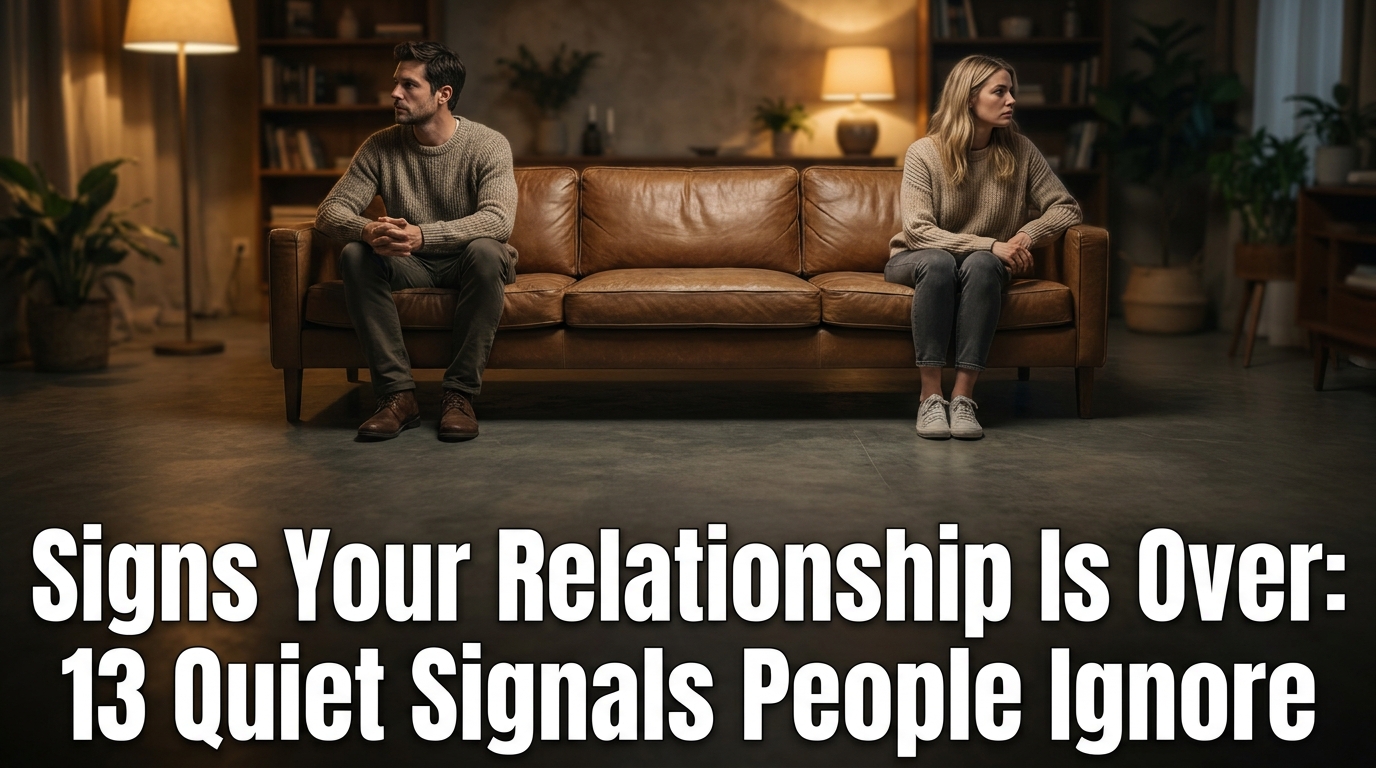
Nobody wakes up one morning and decides their relationship is over. It happens quietly — in the silences that stretch too long, the arguments that never quite resolve, the moments of tenderness that slowly stop coming. By the time most people admit it out loud, the signs have been there for months.
A 2022 study from the Journal of Family Psychology found that the average couple waits nearly two years after recognizing serious relationship problems before taking action — whether that’s seeking help or ending things. Two years of quietly ignoring signs your relationship is over because facing the truth feels more painful than staying. This article is for anyone who suspects something has shifted but isn’t quite sure what they’re seeing. These 13 quiet signals are the ones people miss — or choose not to look at — until it’s too late.

Why We Ignore the Signs a Relationship Is Ending
Before the signals themselves, it’s worth understanding why intelligent, self-aware people miss them — or look away when they don’t.
Sunk cost psychology plays a powerful role. The longer we’ve invested in a relationship — time, emotion, shared life — the harder it becomes to acknowledge that it may not be working. Our brains are wired to protect that investment, even when protecting it means staying somewhere that’s quietly making us smaller.
Fear of the alternative is equally powerful. The end of a relationship doesn’t just mean losing a partner — it means losing a shared home, a social circle, a vision of the future, and a daily rhythm that has become identity. Staying in a dying relationship can feel safer than stepping into that unknown.
And then there’s hope. The genuine, loving belief that things will get better — that the person you fell in love with is still in there, that the connection you once had can be rebuilt. Sometimes that hope is wisdom. Sometimes it’s the thing that keeps us in place the longest.
Understanding why we ignore the signs doesn’t mean judging ourselves for it. It means giving ourselves the clarity to finally look.
The 13 Quiet Signs Your Relationship Is Over
1. You’ve Stopped Fighting
This one surprises people — because fighting feels like the problem, not the absence of it. But relationship researchers, including Dr. John Gottman, have found that the most dangerous sign of a dying relationship isn’t conflict — it’s indifference. When you stop arguing, it often means you’ve stopped caring enough to try. The silence isn’t peace. It’s resignation.
2. Small Things Irritate You Disproportionately
The way they chew. The sound of their laugh. The specific way they load the dishwasher. When love is present, these quirks are endearing or simply neutral. When a relationship is ending, they become unbearable. This hypersensitivity to minor irritants is the emotional mind’s way of signaling that something deeper has shifted — and it’s worth paying attention to.
3. You Feel Lonelier With Them Than Without Them
Loneliness inside a relationship is one of the quietest and most painful signs a relationship is ending. If you feel more at ease, more yourself, and more connected to life when you’re alone than when you’re together, the relationship is no longer functioning as a source of companionship. That gap between physical togetherness and emotional isolation is one of the clearest signals something has fundamentally changed.

4. You’ve Stopped Sharing Good News With Them First
Think about the last time something genuinely good happened to you. Who was the first person you wanted to tell? If the answer is consistently not your partner — if your instinct is to call a friend, a parent, or a sibling before telling them — that shift in emotional intimacy is significant. We naturally turn toward our primary attachment figure in moments of joy. When we stop, it signals a quiet but serious disconnection.
5. Physical Intimacy Has Quietly Disappeared
This isn’t just about sex — it’s about all physical connection. The casual hand-hold. The kiss hello. The way you used to reach for each other without thinking. When physical affection fades without either person addressing it, it is often a symptom of emotional distance that has grown too large to naturally bridge. Bodies tend to reflect what hearts haven’t yet said out loud.
6. You’re Editing Yourself Constantly
You used to say whatever came to mind. Now you think twice, three times, before speaking — not because you’re being thoughtful, but because you’re managing his reaction, avoiding conflict, or protecting yourself from being misunderstood. Persistent self-editing in a relationship signals that emotional safety has eroded. And a relationship without emotional safety is one where both people are slowly disappearing.
7. The Future Feels Blank When You Picture It Together
Close your eyes and try to picture your life five years from now. Is your partner in that image? Is it a warm picture — or is it vague, flat, or quietly anxious? When we are genuinely invested in a relationship, we naturally project our partner into our future. When that future starts going blank, or when imagining it brings dread rather than excitement, it’s one of the most honest signals your inner self can give you.

8. Contempt Has Entered Your Interactions
Dr. John Gottman’s decades of research identified contempt — eye-rolling, dismissiveness, mockery, and condescension — as the single greatest predictor of relationship failure. Contempt is different from anger. Anger still believes the other person matters. Contempt communicates that you’ve begun to see them as beneath you — and once that dynamic takes root, it is extraordinarily difficult to reverse.
9. You Keep Having the Same Argument
Every couple has recurring conflicts — topics that keep resurfacing. But there’s a difference between ongoing negotiation and an unresolvable loop. If you’ve had the same argument — about respect, emotional availability, priorities, or trust — dozens of times with no movement in either direction, you’re not fighting about the topic anymore. You’re fighting about a fundamental incompatibility that the relationship has never been able to bridge.
10. You’ve Started Living Parallel Lives
You have your routines. They have theirs. Meals happen separately. Evenings are spent in different rooms. Social lives no longer overlap. This gradual drift into parallel living often happens so slowly that neither person notices it becoming the norm. But two people sharing a home while living essentially separate lives are not in a relationship anymore — they’re in an arrangement.
11. You Find Yourself Fantasizing About Being Single
Not in a flirtatious, casual way — but in a quiet, serious way that feels more like relief than rebellion. You imagine your own apartment. Your own schedule. Decisions made without negotiation. When the fantasy of being alone consistently feels more appealing than the reality of being together, it’s worth asking honestly what that contrast is telling you.

12. Trust Has Been Broken and Never Rebuilt
Trust is not just about fidelity. It’s about consistency, reliability, emotional safety, and follow-through on what matters. When trust breaks — through betrayal, repeated disappointment, or chronic dishonesty — and neither person does the work to genuinely rebuild it, it leaves a foundation that cannot hold the weight of a lasting relationship. Staying without rebuilding trust is not commitment. It’s endurance.
13. You Stay for the Wrong Reasons
This is the quietest signal of all — and the most important. Ask yourself honestly: why are you still here? If the answer is love, genuine connection, shared growth, and a belief that this relationship makes both of you better — those are right reasons. If the answer is fear of being alone, financial dependence, what other people will think, the years already invested, or not wanting to hurt them — those are reasons that keep you stuck, not reasons that keep you together. Staying for the wrong reasons doesn’t save a relationship. It just delays its ending.
What to Do When You Recognize These Signs
Recognizing these signals doesn’t automatically mean the relationship must end. But it does mean something needs to change — and soon.
- Have the honest conversation. Not an accusation, not an ultimatum — a genuine, vulnerable conversation about what you’re both experiencing. Many relationships improve dramatically once both people stop pretending everything is fine.
- Consider couples therapy. A skilled therapist can identify patterns that are invisible from inside the relationship and give both people tools to either repair or consciously close with clarity and respect.
- Give it a defined window. If you decide to try — set a timeframe. Three months of genuine effort, therapy, and honest communication. Then reassess. Open-ended trying with no accountability often becomes indefinite staying.
- Trust what your body already knows. Anxiety, dread, and persistent exhaustion in a relationship are not personality flaws. They are information. Your nervous system often knows the truth before your mind is willing to say it.
- Know that ending is not failing. Some relationships run their course. Choosing to end one with honesty and care — rather than staying until it becomes toxic — is one of the most loving things two people can do for each other.

The Bottom Line
Signs your relationship is over rarely arrive loudly. They come in the spaces — the quiet dinners, the separate routines, the dreams that stopped including each other. By the time most people name what they’ve been seeing, they’ve known for a long time.
This isn’t about giving up. It’s about being honest enough to see clearly — and brave enough to act on what you see, whether that means fighting for something worth saving or releasing something that has already let go.
The most painful thing is not ending a relationship that isn’t working. It’s spending years inside one — slowly becoming someone smaller — because the truth felt too hard to say out loud.
📌 Save, Share & Follow
💾 SAVE this article — return to it when something feels off but you can’t quite name what it is. 📤 SHARE this with someone who you sense might need permission to finally see what’s in front of them. 👉 FOLLOW TruthsInside.com for more honest, psychology-backed relationship content that tells the truth — even when it’s hard.
❓ Frequently Asked Questions
Q1: Can a relationship show these signs and still be saved? Yes — especially if both people are willing to honestly acknowledge what’s happening and take meaningful action. The presence of these signs is not a death sentence; it’s a warning signal. Couples therapy, open communication, and genuine behavioral change have saved relationships showing every sign on this list. The question is whether both people are willing to do that work.
Q2: How many of these signs does it take to know it’s really over? There’s no magic number. One sign in isolation — particularly a temporary one during a stressful period — may not be significant. A cluster of several signs that have been present consistently for months is worth taking seriously. Pay attention to patterns and duration, not single moments.
Q3: What if I recognize these signs but my partner doesn’t? This is one of the most painful positions to be in. If your partner genuinely cannot see what you’re experiencing, a couples therapist can provide a neutral space for both perspectives to be heard. If your partner refuses any form of engagement, that refusal is itself important information about whether change is possible.
Q4: Is it normal to grieve a relationship that wasn’t even good? Completely normal — and deeply human. We grieve the relationship we wished it had been, the future that won’t happen, and the person we were inside it. The quality of the relationship doesn’t determine the size of the grief. Give yourself permission to mourn it honestly.
Q5: How do I leave a long-term relationship when I still love them? Loving someone and recognizing that a relationship isn’t working are not mutually exclusive. You can love someone deeply and still understand that staying is harming you both. The most honest path is a direct, compassionate conversation — ideally with the support of a therapist — that honors the love while being truthful about the reality.
🎵 Music
Maren Lull is a singer-songwriter who writes from the places most people don’t talk about out loud.
Not the dramatic grief. Not the obvious heartbreak. The quiet kind — the ordinary Tuesday emptiness, the habit of reaching for someone who isn’t there anymore, the particular exhaustion of being strong for so long that the strength itself wears thin.
Her music lives at the intersection of emotional honesty and soft beauty — breathy vocals over gentle piano, slow tempos, lyrics that feel less like songs and more like something you wrote in a private notebook at two in the morning and never showed anyone.
Maren Lull writes for the people who feel everything deeply and say very little about it. For the ones who listen to sad music not because they want to feel worse — but because being understood, even by a song, makes the feeling easier to carry.
📱 Follow Maren Lull:
→ Spotify
→ Apple Music
→ Youtube
→ Audiomack