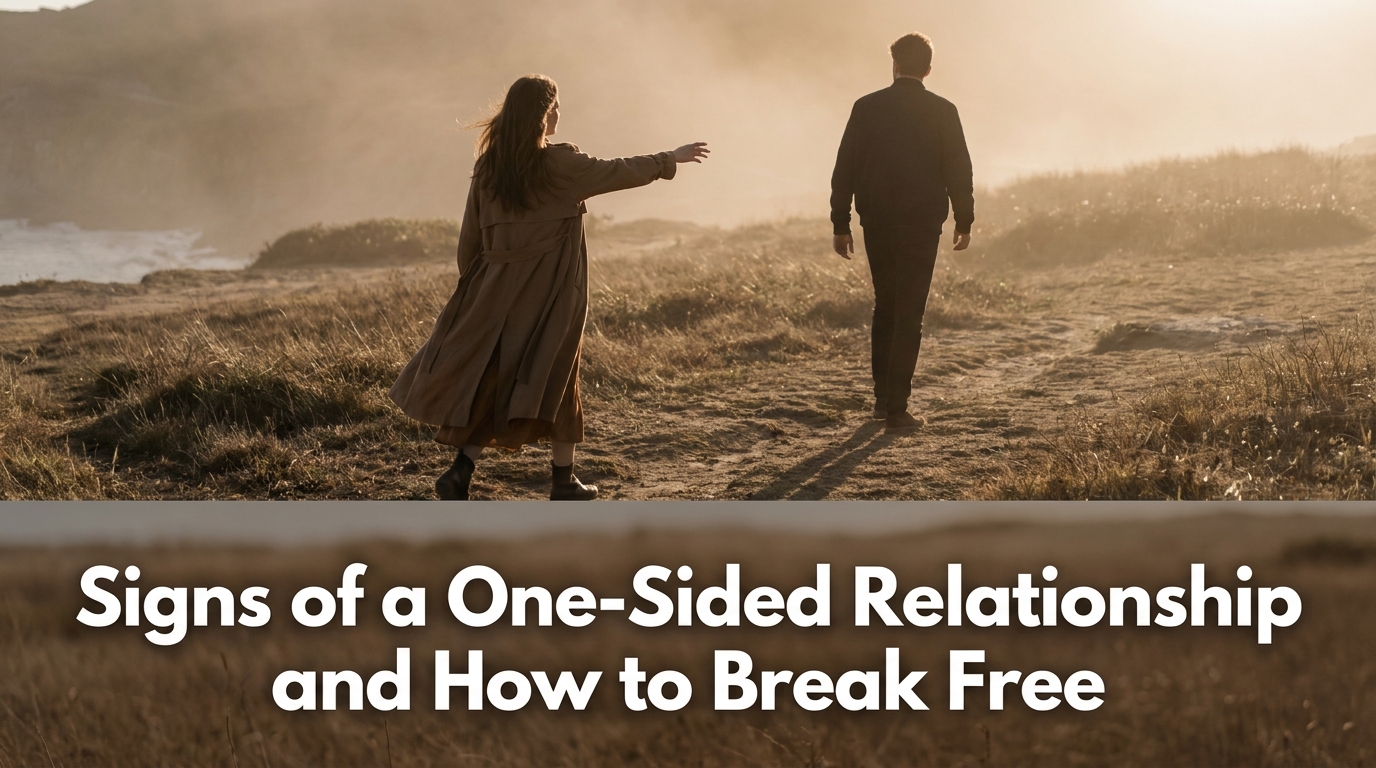
You plan the dates. You send the first text. You apologize first, try harder, love louder — and somehow it never feels like enough. You tell yourself they’re just busy, just stressed, just going through something. But deep down, in the quiet moments when you’re honest with yourself, you already know: you are carrying this relationship alone.
According to a study published in the Journal of Personality and Social Psychology, perceived inequity in relationships — where one partner consistently gives significantly more than the other — is one of the strongest predictors of relationship dissatisfaction, resentment, and eventual breakdown. Yet most people in one-sided relationships stay far longer than they should, because love makes it easy to rationalize imbalance as patience. This article lays out the clearest signs of a one-sided relationship, explains why they happen, and gives you a real path to breaking free — with your dignity intact.

Why One-Sided Relationships Happen
Before the signs, it helps to understand how two people arrive here — because one-sided relationships rarely start that way.
Most begin with genuine mutual interest. Over time, however, imbalance creeps in through subtle shifts — one person becomes more emotionally available while the other retreats, one person’s needs go consistently unmet while they continue meeting the other’s, one person does the emotional labor of keeping the relationship alive while the other simply inhabits it.
Several patterns drive this dynamic:
- Anxious-avoidant attachment pairing: One person with an anxious attachment style — who gives more to feel secure — paired with someone avoidant — who pulls back when intimacy deepens — is one of the most common setups for a one-sided relationship.
- People-pleasing conditioning: People who learned early that love is earned through giving often continue that pattern in adult relationships, giving far beyond what is reciprocated because stopping feels like abandonment.
- Gradual normalization: Imbalance that builds slowly is harder to identify than imbalance that arrives suddenly. By the time it’s obvious, it already feels like the relationship’s baseline.
- Hope and potential: Loving someone for who they could be — rather than who they consistently are — keeps many people pouring into a dynamic that never pours back.
Understanding the dynamic doesn’t excuse it. But it does make it easier to see clearly — and seeing clearly is where breaking free begins.
13 Signs of a One-Sided Relationship
1. You Are Almost Always the One Who Initiates
Texts. Calls. Plans. Difficult conversations. If you removed your initiations from the relationship entirely, ask yourself honestly: how much contact would remain? A relationship where one person carries all the reaching out is not a partnership — it is a pursuit. And no matter how much you love someone, you cannot sustain a relationship by yourself.
2. Your Efforts Go Unacknowledged
You remembered the thing that mattered to them. You showed up when it was inconvenient. You planned something thoughtful. And it passed without comment — not because they’re ungrateful, but because your effort has become invisible. When one person’s contributions are consistently taken for granted, it signals that the relationship has lost the reciprocity that healthy love requires.
3. You Make Excuses for Their Behavior — Constantly
They didn’t show up. They forgot something important. They said something dismissive. And before anyone else can react, you’re already explaining it away — they’re stressed, they’re going through something, that’s just how they are. A certain amount of grace is healthy in any relationship. But when you find yourself perpetually defending someone’s behavior to yourself and others, you may be working harder to protect the relationship than they are.

4. Your Needs Feel Like an Inconvenience to Them
You hesitate before asking for what you need — because you already anticipate the sigh, the eye-roll, the way they make you feel like you’re asking for too much. In a balanced relationship, needs are negotiated with care. In a one-sided one, your needs become something to manage around rather than something to genuinely meet. That shift — from partner to burden — is one of the clearest signs something is deeply wrong.
5. You Feel Anxious About Their Mood — Not Your Own
You’ve become an expert in reading their emotional weather. You know when to approach and when to stay quiet. You adjust your behavior based on how they seem to be feeling — not how you’re feeling. This hypervigilance, which often develops gradually, is your nervous system’s response to an environment of emotional inconsistency. It is exhausting. And it is not what love is supposed to feel like.
6. The Relationship Revolves Around Their Life
Their schedule determines when you meet. Their preferences determine where you go. Their emotional state determines the tone of the relationship on any given day. Your life — your goals, your feelings, your needs, your timeline — fits around theirs rather than alongside them. A relationship where one person’s world is the center and the other’s is the orbit is not a partnership. It is a supporting role you never auditioned for.
7. Conflict Always Ends With You Apologizing
Arguments happen in every relationship. But when you notice that you are almost always the one who apologizes — regardless of what actually happened — it’s worth examining why. Sometimes it’s because you genuinely were wrong. But in one-sided relationships, the pattern often reveals something else: you apologize to restore peace, because the alternative — their anger or withdrawal — feels more unbearable than the injustice of taking blame you don’t owe.

8. You’ve Shrunk Yourself to Keep Them Comfortable
You stopped mentioning certain dreams because they seemed uninterested. You dialed back your personality in social situations because of how they reacted. You’ve become a quieter, smaller version of yourself — not through any single dramatic moment, but through a long series of small adjustments made in the name of keeping things smooth. When a relationship consistently requires you to become less, it is taking something from you it has no right to take.
9. They Are Unavailable When It Matters Most
Not physically — emotionally. When you are struggling, grieving, scared, or overwhelmed, they are distracted, dismissive, or simply absent in the ways that count. Emotional availability during difficulty is one of the most fundamental requirements of a healthy relationship. A partner who is present only during the easy, convenient moments is not a partner in any meaningful sense of the word.
10. You Feel More Drained Than Fulfilled
Step back and ask yourself honestly: how do you feel after spending time with them? Energized and seen? Or depleted, second-guessing yourself, and quietly unsatisfied? Relationships are not supposed to be effortless — but they are supposed to leave you, on balance, more full than empty. Consistent emotional depletion after time with a partner is one of your clearest internal signals that the giving and receiving are profoundly out of balance.
11. You’ve Brought It Up — And Nothing Has Changed
You’ve had the conversation. You’ve explained what you need. You’ve been vulnerable enough to say “I feel like I’m giving more than I’m getting.” And for a brief window, things improved — and then quietly returned to exactly what they were before. One conversation without sustained change is information. A repeated pattern of acknowledgment without action is a decision. Their decision about how much you matter.

12. Your Happiness Is Conditional on Their Approval
Your good day becomes a bad one the moment they seem distant. Your confidence rises and falls entirely based on how they respond to you. Your sense of self-worth has quietly outsourced itself to their reaction. This kind of emotional dependency — where your entire internal landscape is regulated by someone else’s behavior — is both a sign of a one-sided relationship and one of its most damaging effects.
13. You Love Who They Could Be, Not Who They Are
You have a clear vision of who this person is capable of being — the partner they almost are on their best days. And that version is who you’re really in a relationship with. But relationships are built on who someone consistently is, not on who they occasionally glimpse of becoming. Loving potential is generous. Waiting indefinitely for it to arrive is a way of slowly giving your present to a future that may never come.
How to Break Free From a One-Sided Relationship
Recognizing the signs is the hardest part — but breaking free requires its own kind of courage. Here is a clear, honest path forward:
Start with one direct conversation. Before ending anything, give the relationship one clear, honest conversation — not a hint, not an argument, but a calm statement of what you need and what you’ve observed. Sometimes people are genuinely unaware of the imbalance. Their response to this conversation — not just their words, but their actions in the weeks that follow — will tell you everything.
Set a real deadline for change. If you’ve had this conversation before, set a private, firm internal deadline. Not an ultimatum delivered in anger — but a quiet commitment to yourself that if nothing meaningfully changes in 60 or 90 days, you will act on what you know. Deadlines create accountability where open-ended hope creates stagnation.
Stop over-functioning. Gradually reduce the behaviors that have been holding the relationship together single-handedly. Stop initiating every contact. Stop planning everything. Stop apologizing first every time. This is not manipulation — it is an honest test of what the relationship looks like when you stop carrying it alone. The results will be clarifying.
Rebuild your sense of self outside the relationship. One-sided relationships tend to gradually erode your identity. Reconnect with friendships that have drifted. Return to interests that were set aside. Rebuild the parts of yourself that exist completely independently of this person. This is not preparation to leave — it is preparation to be whole, regardless of what you decide.
When you are ready — leave clearly and kindly. Not with a long explanation designed to make them understand or change their mind. Not in anger. A clear, honest statement of why you are leaving, delivered with respect for the time you shared, and a commitment not to negotiate your way back into the same dynamic. You do not owe anyone a relationship. You do owe yourself one that is reciprocal.
Get support. Leaving a relationship — even one that has been taking more than it gives — is genuinely hard. A therapist, a trusted friend, or a support community can make the difference between following through and finding yourself back where you started.

The Bottom Line
Signs of a one-sided relationship are easy to rationalize when you love someone. Every imbalance has an explanation. Every disappointment has a reason. And love — real love — does require patience, grace, and the willingness to give even when it’s hard.
But there is a difference between giving through a difficult season and giving into a permanent pattern. Between patience and self-abandonment. Between loving generously and losing yourself entirely.
You were never meant to beg for basic reciprocity. You were never meant to shrink yourself to fit someone else’s comfort. A relationship that asks you to give everything while offering very little in return is not love — it is a lesson. And the lesson is always the same: you deserve more than you have been willing to ask for.
📌 Save, Share & Follow
💾 SAVE this article — return to it on the days when you’re tempted to make excuses for someone who keeps letting you down. 📤 SHARE this with someone you love who you sense is carrying a relationship entirely on their own right now. 👉 FOLLOW TruthsInside.com for more honest, psychology-backed relationship content that puts your wellbeing first.
❓ Frequently Asked Questions
Q1: Can a one-sided relationship become balanced? Yes — but only if the less-invested partner genuinely recognizes the imbalance and takes consistent, sustained action to correct it. A single conversation or brief improvement followed by a return to old patterns is not change — it is management. True rebalancing requires both people to be honest about the dynamic and committed to something different over time.
Q2: How do I bring up a one-sided relationship without starting a fight? Frame it around your experience rather than their behavior. “I’ve been feeling like I’m carrying more of the emotional weight lately and I’d like to talk about it” lands very differently from “you never initiate anything.” The goal of the conversation is understanding and change — not winning. Come to it calm, specific, and genuinely open to their perspective.
Q3: Is it possible to be in a one-sided relationship without realizing it? Absolutely — and it’s more common than people think. When imbalance develops gradually, it normalizes. You may not recognize how much you’ve been giving until you step back and examine the actual patterns — who initiates, who compromises, who apologizes, whose needs consistently take priority. Journaling or talking to a trusted friend can provide perspective that’s hard to find from inside the relationship.
Q4: What if I’m the one who has been less invested — can I change? Yes. Awareness is the beginning. If you recognize yourself on the other side of this article — as someone who has been taking more than giving — the most important next step is honest acknowledgment, both to yourself and your partner. Follow it with consistent behavioral change, not just intentions. And consider therapy to understand what has made full emotional investment feel difficult or threatening.
Q5: How do I stop loving someone even after I’ve left a one-sided relationship? You may not stop loving them quickly — and that’s okay. Leaving a relationship doesn’t switch off feelings. What changes is the decision about what you will accept. Allow yourself to grieve the relationship honestly, reduce contact as much as possible, and redirect your energy toward rebuilding your life. The feelings will shift with time, distance, and intentional healing.
🎵 Music
Maren Lull is a singer-songwriter who writes from the places most people don’t talk about out loud.
Not the dramatic grief. Not the obvious heartbreak. The quiet kind — the ordinary Tuesday emptiness, the habit of reaching for someone who isn’t there anymore, the particular exhaustion of being strong for so long that the strength itself wears thin.
Her music lives at the intersection of emotional honesty and soft beauty — breathy vocals over gentle piano, slow tempos, lyrics that feel less like songs and more like something you wrote in a private notebook at two in the morning and never showed anyone.
Maren Lull writes for the people who feel everything deeply and say very little about it. For the ones who listen to sad music not because they want to feel worse — but because being understood, even by a song, makes the feeling easier to carry.
📱 Follow Maren Lull:
→ Spotify
→ Apple Music
→ Youtube
→ Audiomack