How to Have a Happy Marriage: Lessons From Couples Married 20+ Years
When a marriage crosses the twenty-year mark, something shifts. The frantic passion of the early years gives way to something steadier, and for many couples, more meaningful. Researchers who study long-term relationships have found that couples who describe their marriage as happy after two decades share strikingly similar habits, and the Gottman Institute has reported that couples who repair conflict quickly and stay emotionally responsive are far more likely to remain stable over time. If you’ve ever wondered what separates a happy marriage from one that quietly falls apart, the answer isn’t about luck. It comes down to small, repeated choices.
We reached out to marriage counselors, relationship psychologists, and couples who have spent 20, 30, even 50 years together to understand what actually sustains a happy marriage decade after decade. What we found wasn’t a secret phrase or a formula for winning arguments. The couples who described their marriages as genuinely happy pointed to a consistent set of behaviors: how they talked to each other, how they repaired conflict, and how they kept choosing one another even when life got hard. Their stories offer something more useful than romantic advice. They offer a roadmap.
This article breaks down the real lessons behind a lasting, happy marriage, drawn from research and from the lived experience of couples who have weathered decades together. Whether you’re newly married, years into your relationship, or supporting a partner through a rough patch, these insights are meant to be practical, not idealized. A happy marriage isn’t about avoiding hard moments. It’s about how two people move through them together, again and again, until it becomes a shared way of life.
What Research Says About a Happy Marriage That Lasts
Dr. John Gottman’s decades of research on marital stability identified what he calls the “magic ratio”: stable couples maintain roughly five positive interactions for every negative one during conflict. This ratio, more than any single romantic gesture, predicts whether a marriage will thrive. Couples married 20 years or more who describe themselves as happy tend to have internalized this balance without ever hearing the term. They compliment each other, they laugh together, they check in throughout ordinary days. None of it is dramatic. It’s cumulative, and that accumulation is what protects a happy marriage from the slow erosion that ends so many relationships.
Longitudinal studies on long-married couples have also found something physical happening beneath the surface. Partners who rated their marriages as happy after 20-plus years showed measurably calmer physiological responses during disagreements, meaning their bodies were literally less reactive during conflict. This isn’t a coincidence. It’s the physical signature of emotional safety, built through thousands of small interactions over the years. A happy marriage, in other words, isn’t just a feeling. It leaves a mark on the nervous system itself.
📃 Related article: Maintain Your Identity: 7 Powerful Tips for Love
Communication Habits That Build a Happy Marriage
Nearly every couple we spoke to who had been married 20 or more years mentioned communication first, but not in the way most people expect. It wasn’t about talking constantly. It was about talking honestly, even when it was uncomfortable. One woman married 34 years described it as learning to stop performing contentment and start naming what she actually needed. That shift, from performance to honesty, shows up again and again in couples who sustain a happy marriage over the long haul.
“We stopped performing happiness for each other and started being honest about what we actually needed. That’s when things got real — and better.”
Couples in long, happy marriages also described a habit psychologists call “turning toward” — responding to a partner’s small bids for attention instead of ignoring them. A partner mentions a stressful email, and instead of a distracted “mm-hmm,” the other puts down their phone and asks a follow-up question. It sounds minor. Over 20 years, thousands of these tiny moments either build connection or quietly starve it. The couples with a genuinely happy marriage were the ones who kept turning toward each other, even on ordinary, unremarkable days.

How Happy Marriage Couples Handle Conflict
Every long-married couple fights. What separates a happy marriage from a strained one isn’t the absence of conflict, it’s how the conflict ends. Couples who described their marriages as happy consistently mentioned “repair attempts,” small gestures during or after an argument that de-escalate tension: a hand on the shoulder, a joke, an apology offered before the fight is fully resolved. Repair doesn’t mean the disagreement disappears. It means both people signal that the relationship matters more than winning.
One husband married 22 years explained that he and his wife made a rule early on: no one goes to bed while the other is still visibly hurt, even if the issue itself isn’t solved that night. That single habit, repeated hundreds of times over two decades, became one of the clearest markers of their happy marriage. Conflict resolution research consistently shows that how couples repair after disagreement matters more than how often they disagree in the first place. A happy marriage isn’t conflict-free. It’s conflict-repaired.
Rebuilding Trust and Intimacy Over Decades
Trust in a long marriage isn’t static. It’s rebuilt continuously, often without either partner noticing. Couples in a happy marriage described trust less as a single decision made at the altar and more as thousands of smaller decisions: showing up when you said you would, being truthful about money, staying emotionally present during hard seasons like grief, job loss, or illness. Trust erodes quietly when these small promises are broken, and it strengthens quietly when they’re kept.
Physical and emotional intimacy also change shape over 20-plus years, and the couples who maintained a happy marriage tended to accept that shift rather than fight it. Passion in year two looks different from closeness in year twenty, and expecting the early intensity to remain unchanged often creates disappointment. Instead, happy couples described intimacy evolving into shared rituals: a weekly walk, cooking together, inside jokes only the two of them understand. These rituals became the new language of closeness, replacing urgency with familiarity that still felt deeply intimate.
The Role of Shared Meaning in a Happy Marriage
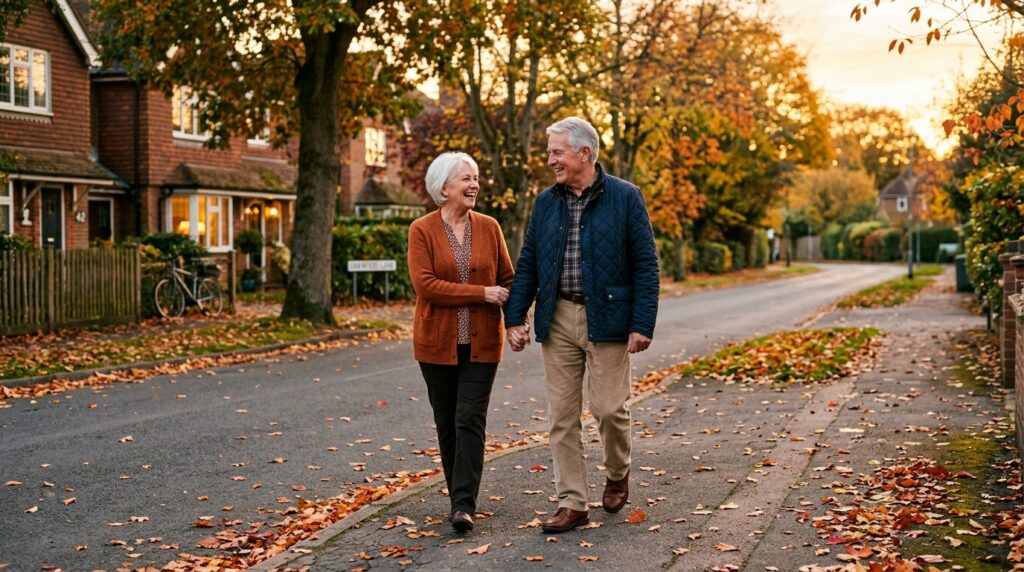
One of the more surprising findings from couples married decades was how often they mentioned purpose rather than romance. A happy marriage, many said, needed to be about something bigger than the two of them: raising children with shared values, building a home together, supporting each other’s careers, or working toward retirement goals side by side. Psychologists call this “shared meaning,” and it functions almost like glue during the harder, less romantic stretches of a long marriage.
Couples without this shared sense of purpose reported feeling more like roommates than partners once the early romance faded. Those who actively built shared meaning, through traditions, goals, or causes they both cared about, described their marriage as happy even during objectively stressful years. This suggests that a happy marriage isn’t sustained by constant romantic feeling alone. It’s sustained by a shared story both people are actively writing together, year after year.
“We weren’t always in love in the movie sense. But we were always building something together, and that mattered more.”
Signs Your Marriage Is Heading in the Right Direction
If you’re wondering whether your own relationship is on track for a happy marriage decades from now, researchers point to a few consistent signals. You and your partner still turn toward each other during small, ordinary moments. You repair after conflict instead of stonewalling or holding grudges for days. You can be honest about needs without fear of punishment. You’ve built rituals, inside jokes, or shared goals that feel like “yours” as a couple. None of these require grand gestures. They require consistency.
It’s also worth noting what a happy marriage does not require: constant excitement, zero disagreements, or a relationship that looks like anyone else’s. The couples married 20-plus years who described themselves as genuinely happy had wildly different personalities, love languages, and daily routines. What they shared wasn’t a formula. It was a willingness to keep choosing each other, imperfectly, again and again, long after the initial spark had settled into something steadier and, in its own way, more secure.
Frequently Asked Questions
What is the number one predictor of a happy marriage?
Research consistently points to how couples repair after conflict, not whether they avoid conflict altogether. Couples who apologize, de-escalate, and reconnect quickly after disagreements report significantly higher marital satisfaction over decades.
Can a marriage become happy again after years of distance?
Yes. Many couples described periods of emotional distance lasting months or years before actively rebuilding closeness through small, consistent habits like check-ins, shared rituals, and honest communication. A happy marriage often isn’t linear.
Do happy marriages still have arguments?
Almost always. The difference isn’t the presence of disagreement but how quickly and respectfully it’s resolved. Couples in long, happy marriages described conflict as normal, not as a warning sign.
How important is shared purpose to a happy marriage?
Very. Couples who built shared goals, traditions, or causes together reported higher satisfaction than those relying on romantic feeling alone, especially during stressful decades like child-rearing or career changes.
What’s one small habit that improves a marriage quickly?
Responding to a partner’s small bids for attention, a comment, a sigh, a shared observation, instead of ignoring them. This single habit, researchers say, is one of the strongest predictors of long-term connection.
Final Thoughts
A happy marriage isn’t built in dramatic moments. It’s built in the ordinary ones, repeated for years until they become a way of life. If this article gave you something to reflect on, save it for later, share it with someone who needs it, and follow Truthsinside.com for more research-backed relationship insight.
🎵 Music
Maren Lull is a singer-songwriter who writes from the places most people don’t talk about out loud.
Not the dramatic grief. Not the obvious heartbreak. The quiet kind — the ordinary Tuesday emptiness, the habit of reaching for someone who isn’t there anymore, the particular exhaustion of being strong for so long that the strength itself wears thin.
Her music lives at the intersection of emotional honesty and soft beauty — breathy vocals over gentle piano, slow tempos, lyrics that feel less like songs and more like something you wrote in a private notebook at two in the morning and never showed anyone.
Maren Lull writes for the people who feel everything deeply and say very little about it. For the ones who listen to sad music not because they want to feel worse — but because being understood, even by a song, makes the feeling easier to carry.
📱 Follow Maren Lull:
→ Spotify
→ Apple Music
→ Youtube
→ Audiomack